Pick up any Federal Reserve Note from the mid-twentieth century and hold it under a strong loupe. Look closely at Lincoln’s face on a 1963 five-dollar bill, or Hamilton’s collar on a 1934 ten. What you are seeing is not a photograph, not a lithograph, and not a digital reproduction. It is the result of a highly trained human hand pushing a steel burin across a polished die for months, sometimes years, translating a flat black-and-white photograph into a three-dimensional web of microscopic lines that will outlast the engraver, the Treasury Secretary whose signature appears beside it, and most of the collectors who ever handle it. The Bureau of Engraving and Printing portrait engravers were among the most specialized artists in American history, and their work defines the visual identity of United States currency from the Civil War era through today.
From Photograph to Portrait: The Engraving Workflow
The process began not in the engraving room but in a photographer’s studio. When Treasury officials selected a subject for a new note design, the BEP’s reference department assembled the best available photographic likenesses, often commissioning new copy prints from historical daguerreotypes or oil paintings. For the 1928 redesign that standardized the small-size currency format still in use today, BEP researchers sourced photographs from the Library of Congress, the Smithsonian Institution, and private collections to ensure every portrait would be authoritative.
A portrait engraver would begin by studying these source materials for weeks before touching steel. The engraver projected or traced a scaled outline of the subject’s face onto the die surface, but the actual cutting was done entirely by hand, without any mechanical pantograph assistance on the portrait itself. The background cross-hatching, lathe work, and geometric patterns surrounding the portrait were typically executed by separate vignette engravers and geometric lathe operators, but the face, that central oval that gave each note its human anchor, belonged entirely to the portrait specialist.
The burin, a small steel rod set into a wooden handle and ground to various point shapes, was the primary tool. Portrait engravers used pointed, flat, and lozenge-shaped burins depending on whether they were cutting fine hair lines, broad shadow areas, or subtle transitional tones. The steel die was kept soft during cutting and then case-hardened once the master approved the work. Transfer rolls then rocked across the hardened die under enormous pressure, picking up a mirror image of the design in relief, which was in turn used to produce the printing plates used on the presses.
When examining portrait quality on older large-size notes versus small-size notes, look for the density of line work in shadow areas under the chin and around the collar. Large-size notes from before 1928 often show more elaborate cross-hatching in these areas because engravers had significantly more die space to work with. A 1901 Bison Note ten-dollar Legal Tender (Fr. 122) displays portrait and vignette engraving that most experts consider the high-water mark of BEP craftsmanship.
The Master Engravers: Names Every Collector Should Know
The BEP employed a relatively small number of portrait engravers at any given time, and their individual styles are recognizable to trained eyes. George Frederick Cram Smillie joined the BEP in 1894 and produced portraits that appeared on currency for nearly three decades. His rendering of George Washington, used on the small-size 1928 series one-dollar Silver Certificate and later the Federal Reserve Note, was based on the Houdon bust and the Gilbert Stuart Athenaeum portrait. Smillie’s Washington remained the standard die for the dollar note through every series issued until the present day, meaning that every Washington portrait on every one-dollar bill printed since 1963 traces its lineage to Smillie’s steel cutting from the early twentieth century.
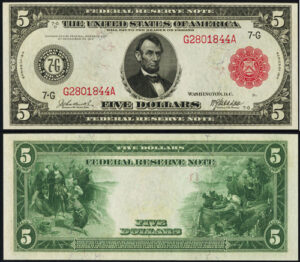
Marcus W. Baldwin engraved the Lincoln portrait used on the five-dollar note beginning with the 1928 series. Baldwin worked from the Mathew Brady photograph taken in 1864, a three-quarter view that showed Lincoln’s characteristic deep-set eyes and the lines around his mouth. Baldwin’s portrait was so successful that it survived, with only minor retouching, through every five-dollar Federal Reserve Note issued until the 1990s redesigns. Collectors comparing a 1928B five-dollar Legal Tender Red Seal (Fr. 1528) against a 1969C five-dollar Federal Reserve Note can see essentially the same portrait die, decades apart.
Alfred Sealey handled the Hamilton portrait for the ten-dollar note, working from the John Trumbull painting held at Yale University. The Hamilton portrait underwent more revision than most between the large-size and small-size eras, and careful comparison between a 1914 Federal Reserve Note ten (Fr. 915 through Fr. 942, depending on district) and a 1928 small-size ten reveals subtle differences in how the collar and coat lapel were rendered.
For the hundred-dollar note, Joachim C. Benzing engraved the Franklin portrait adopted for the 1928 series, drawing on the Joseph Duplessis painting of 1778. Franklin’s fur collar presented particular challenges because it required the engraver to suggest texture through varied line weights without allowing those lines to dominate the face above. Benzing’s solution, a series of short curved lines of diminishing depth as they approach the jawline, is visible under magnification on every pre-1996 hundred-dollar bill.
To identify different portrait die states on small-size notes, compare the depth and definition of the subject’s pupils across series dates. On Lincoln fives, the 1928 through 1950 series notes show a slightly more deeply cut pupil than later printings where the plate had seen more impressions. High-grade examples graded PMG 64 or better will show this distinction most clearly under a 10x loupe.
The Transition Era: Large-Size to Small-Size (1923 to 1928)
The shift from large-size to small-size currency beginning with the 1928 series forced BEP engravers to compress their portrait work into a significantly smaller oval. The new notes measured 6.14 by 2.61 inches compared to the old 7.42 by 3.13 inches, meaning portrait engravers had to re-cut or substantially rework every existing die to fit the new format. In some cases this produced subtle but collectible differences between the final large-size issues and the first small-size notes.
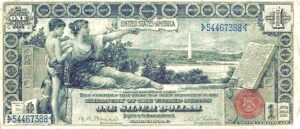
The 1923 large-size one-dollar Silver Certificate (Fr. 237 and Fr. 238) features a Washington portrait with noticeably more open background around the face than the cramped small-size 1928 version. Similarly, the final large-size five-dollar United States Note series 1923 (Fr. 91) carries a Lincoln portrait with more elaborate shoulder and lapel detail than the compressed 1928 version. These transitional notes are valuable not just as rarities but as documentary evidence of the engraving compromises forced by the format change.
Retouch, Re-engrave, and Variety: Why This Matters for Collectors
Portrait dies did not last forever. Heavy use on printing plates caused gradual wear, and BEP engravers periodically retouched dies to restore sharpness. These retouch cycles occasionally introduced minor differences that sharp-eyed collectors have catalogued as varieties. On the 1935 one-dollar Silver Certificate series, for example, researchers have identified at least two distinct states of the Washington portrait die based on differences in the hair lines above the right ear. While these varieties are not separately listed in standard Friedberg catalog numbers, they are noted in specialized literature such as the Whitfield-Yakes reference on Silver Certificates.
The most dramatic portrait-related variety on twentieth-century US currency involves the 1969 series Federal Reserve Notes, when the BEP introduced a modified portrait of Washington with slightly altered background line spacing. Notes from the 1963A series and the 1969 series can appear superficially identical, but the portrait die retouching is detectable under magnification. High-grade uncirculated examples of both are worth preserving for side-by-side comparison.
Build a reference set of the same denomination across consecutive series specifically to study portrait die changes. A set of one-dollar Silver Certificates from Series 1928 through 1957B, kept in archival sleeves and examined under consistent lighting, will train your eye to detect the kind of subtle retouching that separates common notes from genuinely distinct varieties. PCGS Currency and PMG both allow notes to be labeled with variety designations if you can document them with published references.
The Modern Era and Digital Transition
The 1990s redesign program, beginning with the 1996-series hundred-dollar note, brought significant changes to how portraits were produced. The enlarged off-center portrait of Franklin on the 1996 redesign was still hand-engraved, but BEP engravers began using digital imaging tools to assist with layout and scaling. The engraver Thomas R. Hipschen worked on elements of the redesigned notes, and the resulting portrait shows a finer, more photographic quality of line work than previous issues, partly because digital enlargements gave the engraver far more precise reference detail to work from.
The 2004 and 2006 series color-shifting note redesigns for the twenty, fifty, and hundred retained hand-engraved portrait elements within broader designs that incorporated security printing techniques impossible to execute with traditional intaglio alone. Today, BEP portrait engravers still train for years and still cut steel by hand for at least portions of every note design, though the full isolation of a single craftsman with a burin and a polished die, responsible for every line of the President’s face from hairline to collar, belongs largely to the era before 1990.
| Series / Fr. Number | Denomination and Type | Engraving Note | Rarity |
|---|---|---|---|
| 1901, Fr. 122 | $10 Legal Tender (Bison Note) | Elliott-Smillie portraits, considered peak BEP craftsmanship | Scarce |
| 1923, Fr. 237 | $1 Silver Certificate (large-size) | Final large-format Washington portrait die before 1928 compression | Scarce |
| 1928, Fr. 1500 | $5 United States Note (Red Seal) | First Baldwin Lincoln portrait in small-size format | Scarce |
| 1928, Fr. 2050-G | $100 FRN, Chicago district | First small-size Benzing Franklin portrait, low survival in high grade | Rare |
| 1934, Fr. 2200-C | $500 FRN, Philadelphia | McKinley portrait by Charles Burt lineage engravers, extremely low print run | Key Date |
| 1928B, Fr. 1528 | $5 Legal Tender (Red Seal) | Late-series Baldwin Lincoln, strong die impression, limited production | Rare |
| 1935, Fr. 1613 | $1 Silver Certificate, Hawaii overprint | Emergency wartime issue; standard Washington die on restricted stock | Scarce |
| 1996, no Fr. standard | $100 FRN (first enlarged Franklin) | Hipschen-era portrait, transitional hand-and-digital engraving technique | Common |
What to Look for as a Collector
Knowing the engraving history of US currency opens up several productive collecting paths. Type collectors building sets by design type should prioritize high-grade examples specifically for portrait quality: a PMG 65 EPQ example of a 1928 small-size note will show sharper portrait detail than a PMG 40 example of the same issue, and the difference in the engraving is part of what you are grading. Strike quality, which refers to the depth and evenness of the intaglio impression, varies even within the same print run and is a factor that experienced collectors specifically seek in top-grade notes.
Error collectors should pay particular attention to mismatched or weak portrait impressions, which occasionally occur when a plate is improperly inked or when a note goes through the press at a slight angle. These are distinct from the intentional portrait varieties discussed above and are generally rarer. A note showing a dramatically weak portrait impression on an otherwise normal 1950-series Federal Reserve Note, for example, would be a printable error worth significantly more than face value if the rest of the note is otherwise well-printed and the weakness is clearly mechanical rather than circulation wear.
For those interested in the artistic rather than the investment dimension of this hobby, the BEP itself maintains a display collection and has periodically published reference booklets on engraving techniques. The American Numismatic Association library holds several period manuals on intaglio printing from the late nineteenth and early twentieth centuries, available to members, that describe the engraving process in terms nearly identical to what BEP craftsmen would have used themselves.
Consider adding a few certified proof or specimen notes to your collection if budget allows. The BEP produced face proofs, which are single-color intaglio impressions of portrait dies on thick card stock, primarily for archival and approval purposes. When these occasionally appear at auction through houses like Stack’s Bowers or Heritage, they offer an unparalleled view of the engraver’s work stripped of all background color and printing. A face proof of the Franklin hundred portrait can sell for several hundred to several thousand dollars depending on the series and provenance, but the educational value for a serious collector is exceptional.
Conclusion: Steel, Time, and Human Skill
Every Federal Reserve Note in circulation today carries a portrait that descends, through transfer rolls and reworked dies, from a specific human hand cutting steel in a government building in Washington, DC. The names Smillie, Baldwin, Benzing, and Sealey are not widely known outside numismatic circles, but their work passes through more hands in a single day than most celebrated artists see in a lifetime. For collectors, understanding the engraving lineage of a note transforms it from a piece of paper into a document of craft history. The next time you hold a 1934 ten-dollar Gold Certificate or a 1957 Silver Certificate dollar, take a moment with a loupe. Count the lines. Follow them into the shadow under Hamilton’s chin or along the curve of Washington’s jaw. Somewhere in that web of cuts, a man sat alone with a burin and a polished die, and made something that has lasted a hundred years and will last a hundred more.