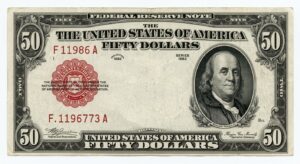
You’ve just acquired what appears to be a stunning original-finish Large Size note, the paper crisp, the color vibrant, margins wide and even. You’re already imagining the PMG 64 or better holder. Then the grader holds it up to oblique light and your heart sinks: a cluster of tiny pinholes in the upper left corner, invisible under normal lighting, punched there more than a century ago by a counting house clerk who probably never imagined collectors would care. Welcome to one of the most frustrating and commonly misunderstood defects in paper money collecting.
What Are Counting House Pinholes?
Before modern banking technology, bundles of currency at commercial banks, counting houses, and the Treasury itself were physically pinned together with long straight pins, much as a seamstress pins fabric. Clerks would stack notes in groups of 100, drive a pin through the corner to keep the bundle secure during counting, reconciliation, or transport, then remove it and move on. The result is a small, clean circular hole, typically 0.5 to 1.5 millimeters in diameter, driven perpendicularly through the paper. In many cases, multiple pins were used and clusters of two, three, or even five holes appear in the same corner region.
The practice was ubiquitous from the Civil War era through at least the early 1930s, which means virtually any original-circulation Large Size note and many early Small Size notes could potentially carry these marks. The holes themselves caused no structural damage to the note in circulation, they were simply a bookkeeping tool, but to modern graders they represent a physical alteration to the original paper that must be disclosed and penalized.
Why Detection Is Surprisingly Difficult
Under standard overhead or ambient lighting, a small pinhole in aged, slightly toned currency paper can be almost completely invisible. The surrounding paper may have darkened to the same tawny brown as the hole’s edge, and without backlighting, the eye simply doesn’t register the break in the surface. This is the single most common reason collectors are blindsided by pinhole penalties after submission.
Professional graders at PMG (Paper Money Guaranty) and PCGS Currency use several light sources during examination. Transmitted light, meaning a strong, diffuse light source held directly behind the note, is the primary tool. A pinhole of even 0.5mm becomes immediately obvious as a bright point of light against the note’s face. Oblique or raking light, directed across the note’s surface at a sharp angle, reveals surface disturbances including the slightly raised or compressed paper fibers around a pinhole’s edge. Many experienced graders use both methods sequentially before finalizing their assessment.
Before submitting any Large Size note for grading, perform your own transmitted light check at home. Hold the note up to a bright LED flashlight or a light table in a darkened room. Scan every corner and the central area slowly. You are looking for bright pinpoints of light that indicate holes, and for slightly translucent areas that may indicate thinning from prior repairs. This two-minute step can save you a costly grading surprise.
How PMG and PCGS Currency Grade and Note Pinholes
Both of the major third-party grading services handle pinholes similarly but with some nuance. PMG uses a Net grading system for notes with significant problems. A note that would otherwise grade 65 EPQ (Exceptional Paper Quality) might be assigned a net grade of 63, with the holder label reading something like “63 Net, pinholes.” The deduction is not arbitrary: graders weigh the number of holes, their size, their location relative to the design, and whether they penetrate notable design elements such as portrait vignettes, signatures, or serial numbers.
PCGS Currency similarly applies an Apparent grade designation for notes with pinholes, distinguishing them from problem-free examples at the same numeric level. A PCGS Apparent 64 will always carry a market discount compared to a straight 64, sometimes substantial.
The penalty scale is roughly as follows in common grading practice: a single small pinhole in a blank corner margin typically costs one grade point. Two or three pinholes in the same area cost one to two grade points. A cluster of four or more holes, holes in high-visibility areas, or holes that pass through signatures or portrait vignettes can cost two to three grade points and may push a note into the Net or Apparent category regardless of its otherwise exceptional state of preservation.
Which Series Are Most Vulnerable
Any collector focused on United States Notes (Legal Tender Notes), Silver Certificates, National Bank Notes, or Gold Certificates from the large-size era of 1861 through 1923 should assume pinholes are a real possibility on any circulated example. The 1875 and 1878 series of Legal Tender Notes in denominations of $1 and $2 are particularly common pinhole candidates because these low-denomination notes circulated heavily through commercial counting houses. Series 1882 and 1902 National Bank Notes are similarly affected, as every National Bank that issued currency was also processing and reconciling bundles constantly.
Among Small Size notes, the 1928 through 1934 series of Federal Reserve Notes and Silver Certificates, particularly in the $1 and $5 denominations, sometimes show bundle pinholes because early small-size production coincided with the tail end of physical bundling practices at some regional Federal Reserve Banks. Notes from the Federal Reserve Bank of San Francisco and Chicago appear somewhat more frequently with this defect in small-size series, though the phenomenon is not exclusive to any district.
When buying raw (ungraded) Large Size notes at shows or from dealers, always ask to inspect under a light table or hold the note yourself in front of a strong backlight before agreeing to a price. A reputable dealer will not only permit this but may assist with the process. If a seller is unwilling to allow transmitted-light inspection, treat that reluctance as a significant red flag.
The Market Value Impact: Real Numbers
The financial penalty for pinholes on desirable notes can be dramatic. Consider a Series 1899 $5 Silver Certificate (Friedberg catalog number Fr. 270-281 range, the “Running Antelope” design). In PMG 64 with EPQ, a Choice example of a common signature combination such as Lyons-Roberts might realize $1,800 to $2,400 at auction. The same note graded PMG 63 Net due to pinholes might bring $900 to $1,200, a discount of 40 to 50 percent even though the note looks nearly identical in hand.
On rarer notes the penalty is even more painful in absolute dollar terms. A Series 1901 $10 Legal Tender Note (Fr. 122, the famous “Bison” note) in PMG 65 EPQ has realized over $15,000 at major auctions. A PMG 63 Net with pinholes on the same note may bring $5,000 to $7,000. The discount percentage is similar but the dollar gap is staggering.
Even on more modestly valued notes, the pinhole penalty matters. A Series 1923 $1 Silver Certificate (Fr. 237) in PMG 64 EPQ might bring $350 to $500 in today’s market. The same note netted for pinholes at 62 might bring $150 to $200. For a note that retails for a few hundred dollars, that difference often exceeds the cost of grading itself.
If you are assembling a type set of Large Size notes on a budget, PMG or PCGS Net-graded notes with minor pinholes can represent genuine value. A PMG 62 Net pinhole on a visually attractive “Bison” note or 1896 Educational Certificate will display beautifully in an album or frame and costs a fraction of a problem-free example. Just buy them with full knowledge of the defect and price them accordingly when it comes time to sell.
Distinguishing Pinholes from Other Defects
New collectors sometimes confuse pinholes with insect damage (which tends to be irregular in shape and often accompanied by surface fraying), paper loss (which removes paper rather than piercing it cleanly), or counting machine perforations. Treasury cancellation perforations, used on specimen and proof notes as well as on notes pulled from circulation for destruction, are a distinct category entirely. These are typically arranged in a deliberate pattern spelling “CANCELLED” or forming geometric shapes, and they significantly and predictably reduce value on their own terms. A random cluster of two or three round holes near a corner is almost always a counting house origin, not a cancellation.
Counting machine pinholes from later mechanical counting equipment (1940s onward) also exist and are slightly different in character: they tend to be smaller (under 0.5mm), more precisely spaced, and located along one edge of the note rather than in a corner. Graders treat these similarly to counting house pinholes but their presence on Small Size modern notes is less common than on large-size material.
| Series / Issue | Denomination | Pinhole Frequency | Market Impact |
|---|---|---|---|
| 1875-1880 Legal Tender | $1, $2 | Very High | Frequent |
| 1882 National Bank Notes | $5, $10, $20 | High | Frequent |
| 1886-1891 Silver Certificates | $1, $2, $5 | Moderate to High | Occasional |
| 1896 Educational Silver Certs. | $1, $2, $5 | Moderate | Occasional |
| 1899 Silver Certificate | $5 (Running Antelope) | Moderate | Occasional |
| 1901 Legal Tender (Bison) | $10 | Low to Moderate | Rare |
| 1902 National Bank Notes | $5, $10, $20 | High | Frequent |
| 1923 Silver Certificate | $1 | Low | Rare |
| 1928-1934 Federal Reserve Notes | $1, $5 | Very Low | Notable When Found |
| 1934 Silver Certificates | $1 | Extremely Low | Notable When Found |
Practical Advice for Submitters
If you have already detected pinholes on a note you are considering submitting, the decision of whether to submit at all depends on several factors. For common-series notes where the pinhole penalty will bring the value below the cost of grading and holder fees, it may not be worth submitting at all. A raw note with disclosed pinholes, sold transparently, can still find a buyer at an appropriate price.
For genuinely scarce or rare notes where even a netted grade provides market credibility and authentication, submission still makes sense. A PMG-authenticated note with a disclosed pinhole defect will always be more liquid than the equivalent raw note because buyers know exactly what they are getting. On important pieces, the authentication value alone justifies the submission cost.
Never attempt to repair pinholes before submission. Common amateur attempts include filling holes with paper pulp, adhesive, or even clear nail polish. These repairs are detectable under ultraviolet light and close examination, and they convert a pinhole penalty into a far more serious “repaired” or “altered” designation that is considerably more damaging to value and collector confidence. The original unrepaired defect, disclosed and graded net, is always preferable to a hidden repair.
Building a Checklist for Pre-Submission Inspection
Experienced submitters develop a consistent pre-submission routine. Start with ambient light examination of both faces. Then hold the note at a 45-degree angle to a strong directional light source, raking light across the surface from each of the four directions. Finally, use transmitted light. Document any pinholes you find with a macro photograph before submission so you have a record of their location and can compare them to the grader’s findings. If you disagree with a penalty, both PMG and PCGS offer review processes, but having photographic documentation of your pre-submission assessment strengthens any appeal.
Understanding counting house pinholes doesn’t just protect your submission results; it changes how you buy. Once you can spot them reliably under a pocket flashlight at a coin show table, you gain a significant edge over less-experienced buyers who may be pricing a note as though it were problem-free. That’s the real value of mastering detection: not just avoiding bad surprises, but occasionally finding great notes at discounted prices from sellers who haven’t looked closely enough themselves.