📷 Image source: Wikimedia Commons. Images are selected by AI to represent the article topic and may not depict the exact note(s) described.
There is something quietly poignant about holding a Series 1923 $1 Legal Tender Note. Turn it over in your hands and you are touching the very last chapter of an era that defined American paper money for more than half a century. When the Bureau of Engraving and Printing delivered its final sheets of these large-size red seal singles, it closed a book on the grand tradition of oversize currency that had begun with the Demand Notes of 1861. The small-size notes that replaced them in 1928 were practical, economical, and modern. But they were never quite as handsome.
Historical Context: Legal Tender Notes and Their Long Run
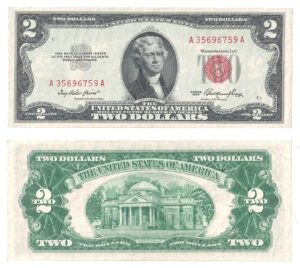
Legal Tender Notes, sometimes called United States Notes, were first authorized by the Legal Tender Act of February 25, 1862. Issued directly by the Treasury rather than through the Federal Reserve or national banks, they were backed by the full faith and credit of the federal government and bore the obligation “This Note is Legal Tender for All Debts, Public and Private.” Their most recognizable visual hallmark was the vivid red Treasury seal and red serial numbers, a feature that distinguished them immediately from the green-sealed Federal Reserve Notes and the brown-sealed National Bank Notes of the same period.
The one-dollar denomination in the Legal Tender series had a long and dignified history. Large-size $1 Legal Tender Notes were issued in series dating back to 1862, featuring a parade of iconic designs including the famous “Lazy One” (Series 1917, Fr. 36-39) with its ornate, nearly horizontal numeral “1” flanking the portrait of President Abraham Lincoln. By the time the Series 1923 notes were authorized, the design had been refined into a clean, authoritative face that numismatists today consider among the most attractive of all large-size issues.
The Design: A Fitting Finale
The obverse of the Series 1923 $1 Legal Tender Note presents a portrait of President Abraham Lincoln centered on the face of the note, framed by elaborate lathe-work engraving and ornate scrollwork borders typical of the large-size format. The large, scalloped red Treasury seal appears to the right of Lincoln’s portrait, while the red serial numbers are printed twice on the face. The obligation text and issuing authority read clearly across the top and bottom margins.
The reverse design features an intricate green-ink geometric pattern with the large numeral “1” prominently displayed at center, surrounded by complex guilloche engraving. The words “ONE DOLLAR” and the United States designation appear in formal serif lettering. The overall effect is one of restrained elegance, a note that looks like money in the truest sense, weighty and permanent.
When examining a Series 1923 $1 Legal Tender Note, pay close attention to the brightness of the red seal and serial numbers. Heavy handling causes these red inks to fade toward orange-brown. A note with bold, deeply saturated red color commands a significant premium in any grade, and original paper quality with full margins dramatically increases both eye appeal and value.
Signature Combinations: The Key to Identifying Varieties
The Series 1923 $1 Legal Tender Notes were issued under two Treasurer-Secretary signature combinations, and understanding these varieties is essential for serious collectors. The two Friedberg-catalogued varieties are:
Fr. 40: Speelman-White
The Fr. 40 variety carries the signatures of Treasurer Frank White and Secretary Andrew Mellon. Wait, let us be precise: Fr. 40 bears the signatures of Treasurer H.V. Speelman and Secretary A.W. Mellon. This is the more common of the two signature varieties, and it represents the bulk of the Series 1923 production. Speelman served as Treasurer from 1921 to 1927, while Mellon served as Secretary of the Treasury from 1921 to 1932, giving this combination a relatively long window of issue.
Fr. 40a: Woods-Mellon
The Fr. 40a variety carries the signatures of Treasurer Walter O. Woods and Secretary Andrew Mellon. Woods replaced Speelman as Treasurer in 1927, and notes bearing his signature represent the final production run of this series. The Fr. 40a is considerably scarcer than Fr. 40 in all grades, and in high grades (PMG 65 EPQ or PCGS 66 PPQ and above) it becomes genuinely elusive. Secretary Mellon’s signature appears on both varieties, making him the common thread across the entire Series 1923 issue.
Do not confuse the Series 1923 $1 Legal Tender Note with the similarly designed Series 1917 “Lazy One” notes. The Series 1923 notes use the Lincoln portrait design and lack the distinctive elongated “1” numerals that flank the portrait on the 1917 issues. Check the series date printed on the face of the note, typically found below the left serial number block.
Serial Number Ranges and Production Details
The Bureau of Engraving and Printing printed Series 1923 $1 Legal Tender Notes in large quantities by the standards of scarce currency, but the survival rate in problem-free circulated and uncirculated condition is far lower than raw population numbers suggest. These notes were spent freely during the 1920s and into the Depression years. The serial numbers for Series 1923 Legal Tender $1 notes run alphabetically through multiple letter prefix blocks, with the Fr. 40 (Speelman-Mellon) notes occupying the earlier serial ranges and Fr. 40a (Woods-Mellon) notes appearing in later blocks. Star notes, indicated by a star prefix replacing the letter prefix, were issued as replacements for defective notes and are among the most prized varieties in this series.
Star note examples for Series 1923 are particularly desirable. Given the era’s production methods and accounting practices, star notes from this series were printed in relatively small quantities, and surviving examples in grades above Very Fine are legitimately scarce. A PCGS or PMG-graded star note for this series in Extremely Fine or better condition is a trophy piece for any Legal Tender collection.
Grading Considerations for Series 1923
Series 1923 $1 Legal Tender Notes present several grading challenges that collectors must understand before purchasing. The large format means that folds are highly visible and dramatically reduce grade. A single center fold drops a note from Uncirculated to no better than Extremely Fine (EF-40 in numerical grading). The red ink on the seal and serials is prone to oxidation and surface wear that can appear as toning or fading under third-party grading scrutiny.
Paper quality is paramount. The Bureau of Engraving and Printing used high-quality linen-cotton blend paper for these notes, and examples with full, unrestored original paper brightness are described as having “Original Paper” quality, denoted as EPQ (Exceptional Paper Quality) by PMG or PPQ (Premium Paper Quality) by PCGS Currency. A PMG 64 EPQ example is categorically more desirable than a PMG 65 without the EPQ designation, as the latter may have been lightly pressed, cleaned, or otherwise conserved.
Always purchase Series 1923 $1 Legal Tender Notes in PMG or PCGS Currency holders when spending significant money. Cleaned, pressed, and repaired examples are common in this series. Under ultraviolet light, washed notes will often fluoresce differently than unaltered examples, and professional graders are trained to detect even subtle conservation. Raw notes at shows and estate sales can be bargains, but due diligence is essential.
The Transition to Small-Size Currency
The Series 1923 $1 Legal Tender Notes continued to be printed and released into circulation through the late 1920s. When the Treasury Department announced the transition to small-size currency in 1928, these large-size notes were withdrawn from circulation and replaced by the new small-size $1 Legal Tender Notes (Series 1928, also with red seals). The changeover was completed efficiently, and the public adapted quickly to the new smaller format. Many large-size notes were returned to the Treasury and destroyed, which is a significant reason why high-grade survivors are proportionally rarer than total print run figures alone would suggest.
The 1928 small-size $1 Legal Tender Notes carried on the red seal tradition for several more decades, with $1 United States Notes continuing in production (with interruptions) through Series 1966A. But the graceful, oversized elegance of the Series 1923 issue was never replicated. It stood as the definitive end point of an era.
| Friedberg No. | Signatures | Type | Rarity |
|---|---|---|---|
| Fr. 40 | Speelman-Mellon | Regular Issue, circulated grades | Common |
| Fr. 40 | Speelman-Mellon | Regular Issue, CU (PMG 63-64) | Scarce |
| Fr. 40 | Speelman-Mellon | Regular Issue, Gem CU (PMG 65 EPQ+) | Rare |
| Fr. 40a | Woods-Mellon | Regular Issue, circulated grades | Scarce |
| Fr. 40a | Woods-Mellon | Regular Issue, CU (PMG 63-64) | Rare |
| Fr. 40a | Woods-Mellon | Regular Issue, Gem CU (PMG 65 EPQ+) | Key Date |
| Fr. 40 Star | Speelman-Mellon | Star (Replacement) Note, any grade | Rare |
| Fr. 40a Star | Woods-Mellon | Star (Replacement) Note, any grade | Key Date |
Market Values and Collecting Strategy
In today’s market, circulated examples of Fr. 40 (Speelman-Mellon) in grades of Very Fine 20 to Extremely Fine 40 typically trade in the range of $30 to $100, making this an accessible entry point for newer collectors. A PMG 64 or 65 EPQ example commands prices in the $400 to $800 range at major auction houses such as Heritage Auctions or Stack’s Bowers. The Fr. 40a (Woods-Mellon) in comparable grades runs roughly two to three times the Fr. 40 price in most conditions.
Star notes for either variety are infrequently offered, and when Gem examples appear at auction they can exceed $2,000 to $5,000 depending on grade and eye appeal. The 2023 Heritage Long Beach sale featured a PMG 66 EPQ example of a Fr. 40 star note that realized well above pre-sale estimates, reflecting strong collector demand for premium quality survivors from this historic series.
A practical collecting strategy for the Series 1923 is to acquire a solid circulated example of Fr. 40 first, then target a problem-free VF or better Fr. 40a, and finally pursue a star note in whatever grade your budget allows. This three-note set tells the complete story of the series and fits naturally into a broader Legal Tender Note collection organized by signature variety.
If you are building a type set of large-size $1 notes, the Series 1923 Legal Tender Note pairs beautifully with the Series 1923 $1 Silver Certificate (Fr. 237, the blue seal “Porthole” note featuring an oval portrait of George Washington). Both were produced concurrently, share the same physical dimensions, and together represent the final large-size one-dollar notes of their respective types. Displaying them side by side is a conversation piece that captures the end of an era in a single frame.
Conclusion: Why the Series 1923 Deserves a Place in Every Collection
The Series 1923 $1 Legal Tender Note is not the rarest note in American numismatics, nor the most expensive. But it occupies a uniquely significant position at the close of the large-size era, one that makes it intellectually and historically compelling in a way that transcends raw scarcity. It is a note that collectors of modest means can acquire in respectable grades, study with genuine engagement, and hold with the knowledge that they own a tangible artifact from the final chapter of America’s grand large-size currency tradition.
Whether you pursue the common Speelman-Mellon variety in circulated condition or hunt for a Gem Woods-Mellon star note across years of patient searching, the Series 1923 $1 Legal Tender Note rewards the collector who takes the time to understand its history, its varieties, and its place in the broader sweep of United States paper money. It was the last of its kind. That alone makes it worth knowing.