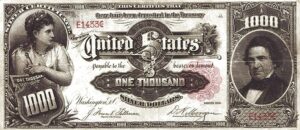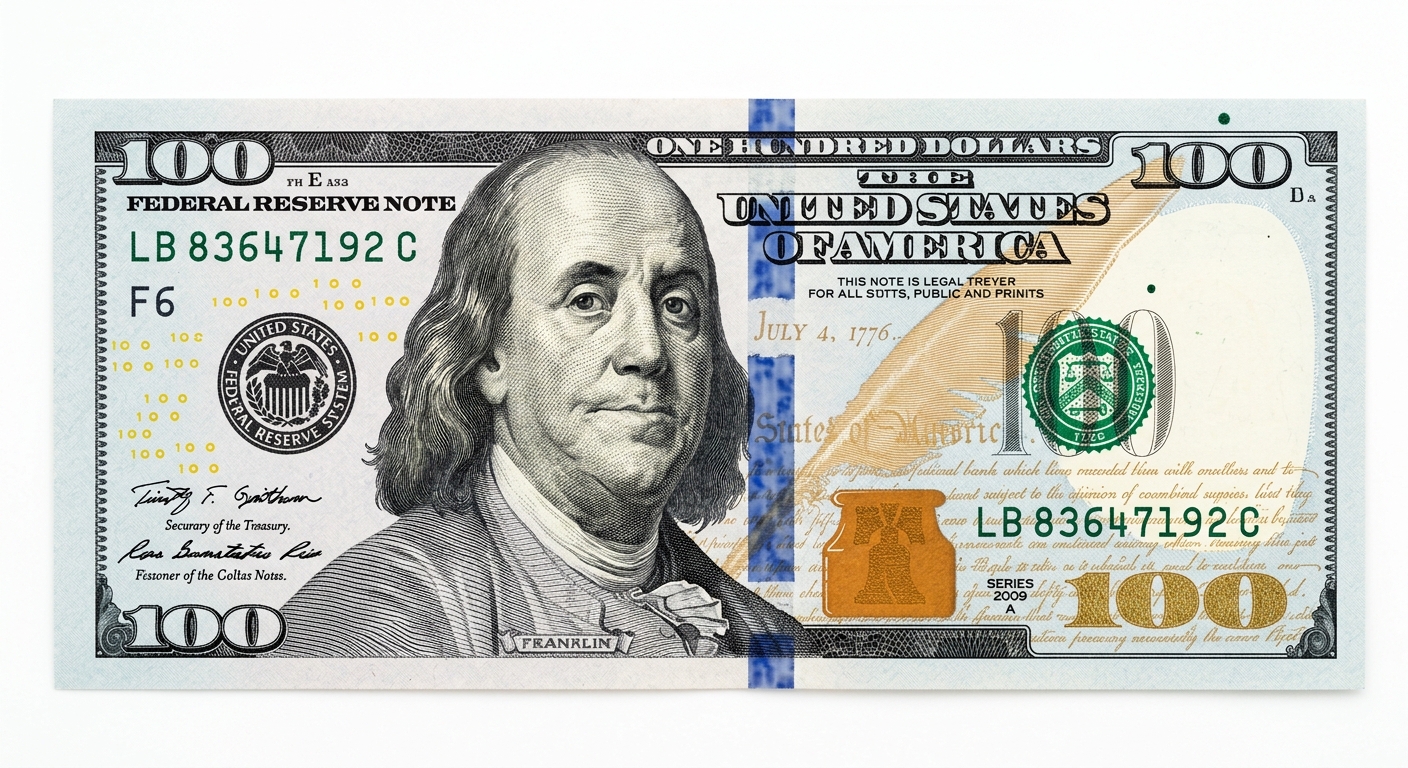
📷 Image source: Wikimedia Commons. Images are selected by AI to represent the article topic and may not depict the exact note(s) described.
Pull a stack of high-grade Federal Reserve Notes from any major auction lot and examine each one under a loupe. Chances are, somewhere in that stack, you will find a note carrying a tiny pinpoint of ink that was never supposed to be there. Maybe it sits in the margin above the Treasury seal. Maybe it hides in the open field near the serial number block. New collectors sometimes recoil from these notes, assuming they are damaged or impaired. Seasoned numismatists, however, know better. Stray ink dots are manufacturing artifacts, born in the Bureau of Engraving and Printing’s high-speed intaglio and letterpress presses, and the major grading services treat them very differently from post-issuance defects. Learning to read the distinction is one of the more rewarding skills you can develop as a paper money collector.
What Exactly Is a Stray Ink Dot?
Modern Federal Reserve Notes are produced in a multi-stage printing process. The back of each sheet is printed first using intaglio, where ink is forced from engraved recessed lines under enormous pressure, typically around 20 tons per square inch. The face follows with another intaglio pass. A third stage applies the green Treasury seal, black Federal Reserve seal, and serial numbers using a letterpress overprint process. Each stage involves thick, viscous inks and mechanical precision that, even in a world-class facility like the BEP’s Washington, D.C., and Fort Worth, Texas, plants, occasionally produces minute ink splashes, roller deposits, or wiped residue that lands outside the intended print area.
The result is a tiny dot, sometimes no larger than a period on this page, of genuine BEP ink sitting on the face or back of an otherwise pristine note. Because the ink is the same composition used in the official printing, it bonds to the cotton-linen substrate in exactly the same way. Under magnification, a stray ink dot has sharp, defined edges and sits slightly raised above the paper surface, just like any engraved detail. This raised tactile quality is actually one of the key tests graders use to confirm a dot originated at the BEP rather than being applied later.
When examining a note for stray ink dots, use a 10x loupe and rake the note at a low angle under a strong light source. Genuine BEP ink dots will show a slight relief above the paper surface, matching the texture of the surrounding intaglio printing. Post-issuance ink marks tend to sit flat or even soak into the paper fibers differently, making them easier to distinguish with practice.
How the Bureau of Engraving and Printing’s Press Technology Creates These Artifacts
The BEP prints Federal Reserve Notes on Giori-type and later Simultan presses, and since the 1990s has employed high-speed web-fed presses for certain denominations. The Simultan press, used extensively for Series 1990 through Series 2006 notes, prints both sides of a 32-subject sheet simultaneously. Ink is applied to engraved steel plates through a wiping mechanism that removes excess ink from the flat surface while leaving ink in the recessed design lines. Despite the precision of the wipe cycle, micro-droplets of ink can be mechanically displaced and deposit on the sheet margin or an adjacent note subject. When the sheet is later cut into individual notes, a stray deposit from the margin occasionally ends up on a finished piece.
The letterpress overprint stage introduces a separate opportunity for stray marks. The green ink used for Treasury seals is particularly fluid and can spray at high press speeds. Series 1995 and later notes, which introduced microprinting and redesigned security features, ran through upgraded presses that initially required recalibration periods. Notes from early production runs of the Series 1996 redesigned $100, printed between 1996 and 1997 at both the Washington and Fort Worth facilities, have been observed with higher frequencies of minor ink splatter in the note margins, a well-documented phenomenon among collectors of that series.
Graders’ Perspectives: PMG and PCGS Currency Policies
Both Paper Money Guaranty (PMG) and PCGS Currency, the two dominant third-party grading services for U.S. paper money, approach stray ink dots as manufacturing artifacts rather than as defects in the traditional sense. A defect, in grading parlance, typically implies post-issuance damage or abnormality, something that happened to the note after it left the BEP. A manufacturing artifact is a characteristic created during production. The philosophical distinction matters enormously because it determines whether the artifact triggers a grade reduction or simply a notation.
PMG’s published grading standards acknowledge that printing artifacts including misaligned overprints, partial offsets, and ink smears of BEP origin are evaluated on a case-by-case basis. For uncirculated notes graded 60 through 67, a single small stray ink dot that does not obscure a design element and does not appear in a location that dominates the visual impression of the note is typically noted in the grading remarks rather than used to lower the numerical grade. PMG’s holder population reports frequently show notes carrying comments such as “ink smear” or “stray ink” alongside grades of 65 EPQ and 66 EPQ, confirming that the Exceptional Paper Quality designation can coexist with these artifacts.
PCGS Currency takes a similarly nuanced approach. Their graders are trained to assess the note holistically, and a BEP-origin ink dot that is minor in size and placement will generally not affect an otherwise gem grade. However, both services reserve the right to lower a grade or apply a net grade when a stray ink mark is prominent, covers a significant portion of the design, or appears in the central field in a way that materially detracts from the note’s eye appeal.
When reviewing a PMG or PCGS Currency holder, always read the full grading notation on the label, not just the numerical grade. A note labeled “65 EPQ” with a remarks notation of “stray ink, face” is still a legitimately graded gem note. Some dealers discount these notes slightly, which can represent genuine value for the budget-conscious collector building a type set.
Common Locations for Stray Ink Dots on Federal Reserve Notes
Through examination of hundreds of certified notes across multiple series, certain locations emerge as the most frequent sites for stray ink deposits. On the face of notes, the lower margin below the Treasury seal and the white space between the left Federal Reserve seal and the portrait oval are common locations. On the back, the open sky above the architecture on $1 through $10 notes, and the wide margins on the $50 and $100, appear frequently. These areas correspond to zones adjacent to heavy ink coverage where overspray is more likely during the printing wipe cycle.
On the Series 2004A $20 Federal Reserve Notes, which introduced a new colorshift ink feature and required adjusted press settings, collectors have documented a noticeable incidence of small green ink specks in the right margin of the back, near the “TWENTY DOLLARS” text. Because this is a known production characteristic, graders at both major services are familiar with it and do not treat it as an irregularity warranting grade reduction on otherwise superior examples.
The Series 2006 and 2006A $5 notes, which feature Lincoln’s redesigned portrait and added background colors, also show occasional stray deposits of the purple background ink in the serial number area of the face. Notes from the early production weeks of this series, bearing low serial numbers from the Boston (A), New York (B), and Atlanta (F) districts, have come to auction in grades of 67 EPQ and 66 EPQ with such notations. They command prices consistent with their grade rather than any meaningful discount.
If you are submitting notes for grading and you spot what appears to be a stray ink dot, photograph it clearly and include a note to the grading service identifying it as a suspected manufacturing artifact. While graders will make their own determination, flagging it demonstrates awareness and ensures the artifact is examined in context rather than categorized by default.
When a Stray Ink Mark Does Reduce a Grade
Not every ink anomaly escapes grade impact. The size, location, and visual prominence of the mark all contribute to the grading decision. A stray ink dot the size of a grain of sand sitting in the white margin of a $1 note will almost never affect the grade. A smear of green seal ink that bisects the Federal Reserve Bank district letter, or a splatter that obscures part of the engraved portrait on a $100, crosses the threshold from minor artifact to genuine distraction. In such cases, PMG may assign a net grade or an “apparent” grade, while PCGS Currency may apply a qualifier that lowers the effective grade by one to two points.
Understanding this spectrum helps collectors make intelligent decisions. A note with a minor stray dot graded 66 EPQ might sell for 10 to 20 percent less than a clean 66 EPQ example of the same series and district. For scarce varieties, that discount can represent significant savings with minimal real-world impact on the note’s long-term collectibility. For common issues, the discount may be less pronounced because the supply of clean examples is deep enough that buyers simply move on to the next available note.
Distinguishing BEP Artifacts from Post-Issuance Ink
This is the critical skill and one that takes genuine handling experience to develop confidently. Post-issuance ink marks, pen marks, rubber stamp impressions, and business stamp deposits all have characteristics that differ from BEP printing inks. Federal Reserve Note inks, whether the black intaglio ink used for the main design, the green seal ink, or the color-shifting inks introduced in Series 1996 and later, are formulated to specific viscosity and adhesion properties designed for steel-plate printing on cotton-linen stock at high speed. They penetrate the paper fibers differently than oil-based ballpoint ink or water-based rubber stamp ink.
Under a 10x or higher loupe, BEP ink in a stray dot shows that characteristic slight surface relief and a density of color consistent with the surrounding intaglio printing. Post-issuance marks often show feathering at the edges where ink has wicked into the paper fibers, or conversely, a dried, cracked surface texture if the ink was thick and foreign. Graders at PMG and PCGS Currency are trained specifically to make this distinction, and their determination is generally reliable, though collectors who handle raw material regularly will develop their own eye for the difference.
Never attempt to remove a suspected stray ink dot from a raw note before submitting it for grading. Attempts to clean or mechanically lift ink invariably cause paper damage that will trigger an “apparent” grade or an “impaired” holder. Let the graders assess it in its natural state. A genuine BEP artifact will be recognized as such, and the note will grade accordingly.
| Series / Denomination | Variety or District | Known Artifact Type | Grade Impact |
|---|---|---|---|
| Series 1996 $100 | Early Washington and Fort Worth runs | Margin ink splatter, overprint smear | Noted Only |
| Series 1999 $5 | Multiple districts, mid-run production | Green seal overspray in lower margin | Noted Only |
| Series 2001 $10 | Fort Worth (star notes) | Stray black ink dot, face margin | Noted Only |
| Series 2004A $20 | All districts, early production | Green ink speck near back right margin | Noted Only |
| Series 2006 $5 | Boston (A), New York (B), Atlanta (F) | Purple background ink in serial area | Noted Only |
| Series 2009 $100 (pre-release) | Washington production, early sheets | Color-shift ink micro-splatter | Possible Net Grade |
| Series 2013 $1 | Multiple districts, high-speed web press | Stray ink dot, back open field | Noted Only |
| Any Series, Prominent Smear | Covering design element | Large intaglio ink displacement | Grade Reduction Likely |
Building a Collection Strategy Around Artifact Notes
For collectors who appreciate the manufacturing history of U.S. currency, notes with documented BEP artifacts occupy an interesting niche. They are genuine pieces of evidence that the printing process, for all its precision, involves real machinery and real chemistry operating at industrial scale. A stray ink dot on a Series 1996 $100 is, in a small way, a fingerprint of the Fort Worth or Washington press that produced it.
Practically speaking, buying certified uncirculated notes with minor ink artifact notations from reputable dealers or auction houses can stretch a collector’s budget. A PMG 65 EPQ example of a Series 1995 $100 Federal Reserve Note from the Boston district with a noted stray ink dot in the margin might trade for 15 to 25 percent below a comparable clean example. Over the course of assembling a complete Federal Reserve district set or a denomination type set, those savings accumulate meaningfully without any real compromise to the collection’s integrity.
The key is to handle the notes yourself, examine the artifact under magnification, and make your own judgment about eye appeal before committing. What reads as a minor notation on a grading label occasionally turns out to be more visually prominent in hand than expected. Conversely, many noted artifacts are essentially invisible at arm’s length and only detectable under a loupe. The collector who takes the time to look carefully is always better positioned than the one who makes decisions based on the label alone.
Conclusion
Stray ink dots and minor ink smears on uncirculated Federal Reserve Notes represent one of those nuanced areas of paper money collecting where informed collectors hold a real advantage. These BEP manufacturing artifacts, generated by the same presses and inks that produced the intended design, are treated by both PMG and PCGS Currency as notations rather than automatic grade penalties in the vast majority of cases. Understanding the distinction between a genuine BEP artifact and post-issuance damage, knowing which series and districts are more commonly associated with these features, and recognizing when an artifact crosses the threshold into grade-impacting territory are skills built through study and hands-on experience. The collector who develops this understanding will find genuine value hiding in plain sight across auction lots and dealer inventory that others pass over without a second glance.