9 min read
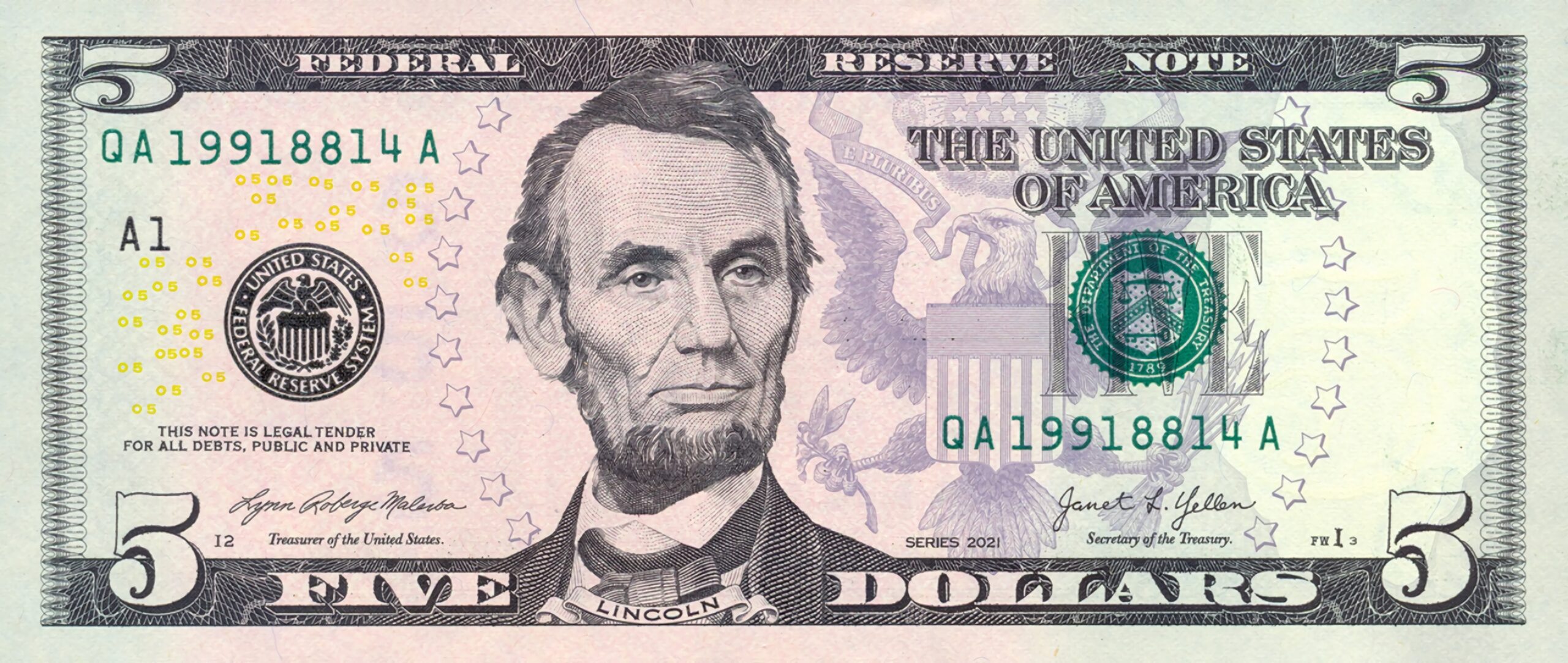
📷 Image source: Wikimedia Commons. Images are selected by AI to represent the article topic and may not depict the exact note(s) described.
Pick up any well-worn Federal Reserve Note and run your thumb across the portrait. Even on a circulated example, you will feel the characteristic raised texture of intaglio printing, that satisfying tactile ridge left by ink forced under enormous pressure into engraved recesses on a steel plate. That texture is not incidental. It is the fingerprint of a printing process the Bureau of Engraving and Printing has used for over 150 years, a process celebrated precisely because it is so difficult to counterfeit and so unforgiving of mechanical failure. When the inking system fails, the results range from subtly ghosted portraits to completely blank vignettes, and every point on that spectrum carries distinct implications for graders and collectors alike.
Printing Method
Intaglio (Engraved Steel Plate)
Typical Press Pressure
Approx. 20 tons per square inch
Error Classification
Insufficient Inking / Weak Impression
Rarest Variety
Fully uninked face or back plate
Primary Grading Impact
Verified as error, does not lower numerical grade
Key Grading Services
PMG, PCGS Currency
The Intaglio Process and Why Inking Failures Happen
Modern Federal Reserve Notes are produced in two distinct intaglio passes: one for the face (the portrait side) and one for the back. In each pass, a steel plate engraved with the design is flooded with thick, viscous ink, then wiped so that ink remains only in the recessed lines and cavities. The paper, dampened to precise humidity, is pressed against the plate with tremendous force. Ink is literally pulled from the engraving and deposited on the paper in three-dimensional relief.
The inking unit on a BEP intaglio press is a complex assembly of rollers, doctor blades, and ink reservoirs. When any component in this chain underperforms, including a partially clogged ink reservoir, a worn or misaligned doctor blade that over-wipes the plate, a roller that skips, or a temporary interruption in ink flow during a long press run, the result is a note that reaches the plate with insufficient ink available to fill the engraved lines. Fine portrait details, which depend on shallow, closely spaced engraved lines, are the first casualties. Coarser elements like the large numeral denominators may survive while Lincoln’s face on a $5 note or Hamilton’s on a $10 note dissolves into a pale, washed-out ghost.
Collector Tip
When examining a suspected insufficient-inking error under magnification, look specifically at the portrait’s hair detail and the fine crosshatching in the background lathe work. These shallow engravings disappear first in a weak inking event. If the denomination numerals are fully bold but the portrait is ghosted, that asymmetry is a strong indicator of genuine insufficient inking rather than chemical bleaching or washing, which tends to affect all ink uniformly.
A Spectrum of Severity: From Light to Catastrophic
Insufficient inking errors do not arrive in a single flavor. The numismatic community broadly recognizes a spectrum that runs from minor weakness to complete absence of ink, and where a note falls on that spectrum directly determines its market value.
Mild Weakness
At the subtle end, collectors encounter notes where portrait detail is noticeably softer than a normal impression, but all design elements are present. The portrait may look slightly flat, fine hair lines may merge, and the background geometric lathe work may lose crispness. These pieces are often discovered by collectors who accumulate large quantities of fresh, uncirculated notes from banks and compare them side by side. A mild weakness note from a common series like the 1988A or 1993 Federal Reserve Notes might retail for two to three times face value, primarily as a conversation piece.
Moderate Insufficiency
More dramatic examples show a noticeably pale portrait against a well-inked green back. On Series 1985 $1 Federal Reserve Notes, for instance, Washington’s portrait may appear translucent, the surrounding oval frame and ornamental border still legible but the facial modeling almost entirely absent. These notes generate real collector interest, particularly when the back printing is crisp and normal, creating a striking visual contrast. Certified examples in CU-63 to CU-65 grades regularly appear at auction in the $200 to $800 range depending on denomination and district.
Dramatic and Catastrophic Insufficiency
The genuinely spectacular examples in this error category are notes where the entire face plate impression is so faint as to be nearly invisible, or where the portrait vignette specifically printed as a discrete inking unit is completely absent. A $100 Federal Reserve Note from the Series 1990 or 1993 issues showing Benjamin Franklin’s portrait utterly missing while the surrounding border work and serial numbers survive is exactly the kind of showpiece that commands $2,000 to $5,000 or more in high grade. Complete back-side insufficient inking, where the iconic reverse design is reduced to a ghost, is comparably rare and valued.
Collector Tip
Do not confuse an insufficient-inking error with a fake “cleaned” or chemically washed note. Authentic insufficient-inking errors retain full paper integrity and normal paper feel. A washed note often shows disturbed surface fibers, a slightly stiff or brittle texture, and sometimes residual chemical odor. Both PMG and PCGS Currency will body-bag a washed note with a “Questionable” or “Altered” designation rather than grading it as an error, so third-party certification is essential before paying error premiums.
Portrait-Specific Weakness vs. Full-Plate Weakness
One nuance that separates advanced collectors from casual buyers is understanding the difference between portrait-specific weakness and full-plate weakness. The portrait vignette on a Federal Reserve Note is one of the most ink-intensive areas of the design because it uses deeply engraved, densely packed lines to model three-dimensional facial structure. In a mild inking failure, the portrait may suffer catastrophic loss while broader, less dense design areas remain fully inked.
Full-plate weakness is more uniform, affecting the serial numbers, Treasury seal, fine border work, and portrait simultaneously. This pattern tends to occur when a press run begins with a cold or under-inked plate, or when the ink reservoir runs critically low late in a sheet run. Portrait-specific weakness, by contrast, sometimes reflects a localized clogging of the plate or a wiper blade anomaly directly over the portrait area. Both are legitimate error categories, but portrait-specific weakness on high-denomination notes strikes collectors as more visually dramatic and commands higher premiums.
Grading Implications: How PMG and PCGS Currency Handle These Notes
Here is where many new error collectors make expensive assumptions. It is tempting to think that a note with a missing portrait must receive a lower numerical grade because it looks “wrong.” That is not how the grading standards work.
Both PMG (Paper Money Guaranty) and PCGS Currency evaluate error notes on the same criteria applied to normal notes: paper quality, fold pattern, soiling, edge integrity, and centering. An insufficient-inking error on a perfectly preserved, unfolded, corner-sharp note will still grade Gem CU-65 or even Superb Gem CU-67, provided the paper itself shows no wear, folds, or handling damage. The error is documented in the holder’s description line, typically as “Insufficient Inking” or “Weak Impression,” and the numerical grade reflects only the physical condition of the paper.
This is critically important for valuation. A raw (uncertified) insufficient-inking error, no matter how dramatic, is nearly impossible to sell at full error premiums without a slab. Buyers need the confidence that the piece has been authenticated as a genuine production error and not chemically manipulated. A PMG Gem CU-65 holder designating “Insufficient Inking” on a $50 1993 Federal Reserve Note is a fundamentally different market proposition than a raw example of the same note.
Collector Tip
When submitting insufficient-inking errors for grading, use the “Error” submission tier at both PMG and PCGS Currency. This routes your note to specialists who have seen the full range of intaglio failures and can properly distinguish genuine production errors from post-issue alterations. Standard submission tiers may result in delays or mislabeling if the grader on duty is less familiar with inking anomalies.
Series and Denominations Worth Hunting
Insufficient inking errors can appear across any series and denomination produced by intaglio, but certain series have produced documented examples that appear at auction with enough regularity to establish market benchmarks.
The Series 1985, 1988A, and 1993 small-size Federal Reserve Notes are among the most frequently documented for face-plate inking errors, likely reflecting higher print volumes during those years and the transition between press generations at the BEP. The Series 1950 and 1950A $20 Federal Reserve Notes, while older, occasionally surface with back-plate weakness, and in Fine to Very Fine condition these mid-century errors carry strong collector interest because of the combination of age, denomination, and error status.
Higher denominations are proportionally more exciting in this error category. A $100 note with an insufficient-inking error represents a more dramatic visual impact because Franklin’s portrait is larger and more detailed than Washington’s on a $1 note. The BEP’s move to redesigned high-security notes beginning with the 1996 Series $100 introduced color-shifting ink and additional printing passes, but the core intaglio portrait impression remained subject to the same inking failures, and errors from the 1996, 1999, and 2003 series do exist in certified form.
| Series / Date |
Denomination / Variety |
Estimated Certified Pop. |
Rarity |
| Series 1985 |
$1, Mild Face Weakness |
40-80 examples |
Scarce |
| Series 1988A |
$1, Dramatic Portrait Ghost |
15-25 examples |
Rare |
| Series 1993 |
$5, Moderate Face Weakness |
20-40 examples |
Scarce |
| Series 1993 |
$50, Near-Missing Portrait |
Under 10 examples |
Key Date |
| Series 1950A |
$20, Back Plate Weakness |
10-20 examples |
Rare |
| Series 1990 |
$100, Portrait Near-Absent |
Under 12 examples |
Key Date |
| Series 1996 |
$100, Redesign, Weak Portrait |
15-30 examples |
Rare |
| Series 2003 |
$20, Full Back Insufficiency |
Under 8 examples |
Key Date |
| Series 1988A |
$1, Minor Softness Only |
100+ examples |
Common |
Building a Focused Collection
For collectors who want to specialize in this error type, a few strategies pay dividends. First, focus on certified examples from established auction houses including Heritage Auctions, Stack’s Bowers, and Lyn Knight Currency Auctions. These venues maintain detailed lot archives, and searching their sold-lot databases for “insufficient inking” or “weak impression” terms will yield a realistic picture of current market pricing by denomination and severity.
Second, consider building a type set that illustrates the full spectrum of severity across a single denomination. A matched set of Series 1988A $1 notes ranging from minor softness through dramatic portrait absence, all graded and slabbed, makes a compelling educational display and is far more accessible financially than chasing rare high-denomination examples.
Third, pay attention to the back-printing condition on face-error notes. The visual drama of an insufficient-inking error is maximized when the back printing is fully normal and boldly inked, creating the jarring contrast that makes these notes so immediately striking. A note where both face and back show weakness is less visually compelling and will generally price lower than an example where the error is confined to one side.
Conclusion: Errors That Illuminate the Craft
Insufficient inking errors are not simply printing mistakes. They are accidental X-rays of the intaglio process, revealing just how many things have to go exactly right for a Federal Reserve Note portrait to achieve its characteristic depth and authority. Every example in a collection, whether a mildly soft Washington on a $1 note or a catastrophically absent Franklin on a $100 note, tells a story about the precision manufacturing behind American paper money and the rare moments when that precision breaks down. For collectors, these notes represent one of the most intellectually honest intersections of error numismatics and printing history, and understanding their grading implications is the first step toward collecting them with confidence.