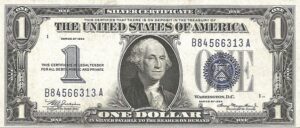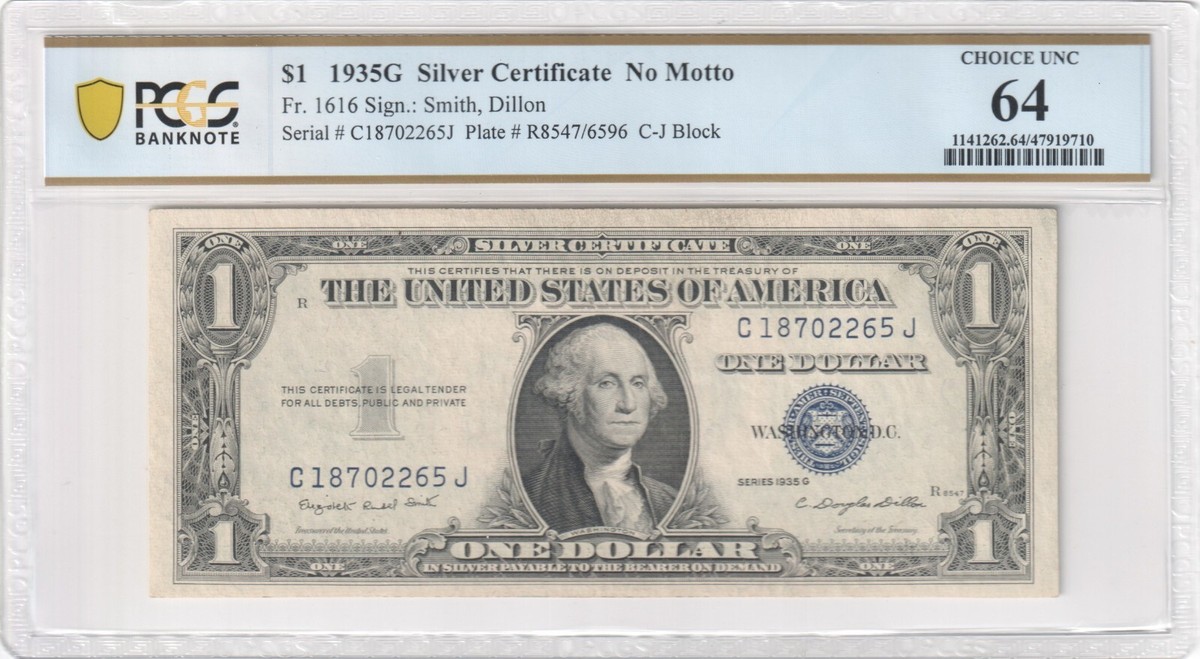
📷 Image source: U.S. Currency Education Program (uscurrency.gov). Images are selected by AI to represent the article topic and may not depict the exact note(s) described.
Pick up a Series 1935G $1 Silver Certificate and you are holding a note that captures one of the most consequential moments in American currency design history. Midway through the printing of this series, the Bureau of Engraving and Printing added the national motto “In God We Trust” to the reverse of the note, splitting a single series designation into two distinct collectible varieties. One note carries the motto; the other does not. The difference is immediately visible, historically significant, and surprisingly important to collectors who specialize in small-size currency.
Background: The Long Run of the Small-Size Silver Certificate
The $1 Silver Certificate had been issued in the small-size format since 1928, and by the mid-1950s the series had cycled through designations from 1928 all the way to 1935F. These notes all shared the same fundamental reverse design: the familiar back of the Great Seal of the United States set against a green-tinged “rainbow” background, printed in green ink. The obverse carried a blue Treasury seal and blue serial numbers, distinguishing Silver Certificates from the red-sealed Legal Tender notes and the green-sealed Federal Reserve Notes of the era.
The 1935 series itself had been remarkably long-lived, spawning suffix letters A through G as signature combinations changed at the Treasury Department. By the time the 1935G was being produced, Ivy Baker Priest served as Treasurer of the United States and Robert B. Anderson had taken over as Secretary of the Treasury. Their signatures appear on every 1935G note, regardless of variety, making the presence or absence of the motto the sole visual distinction between the two collectible types.
The Legislation Behind the Motto
The addition of “In God We Trust” to paper currency was no accident of design. Congress passed legislation in 1955 requiring the motto to appear on all United States currency, and President Dwight D. Eisenhower signed the bill into law. The Cold War context was unmistakable: American lawmakers wanted a clear symbolic distinction between the United States and the officially atheist Soviet Union. The motto had appeared on certain U.S. coins since the Civil War era, but its extension to paper money was a mid-twentieth-century development rooted firmly in the politics of that particular moment.
The Bureau of Engraving and Printing began implementing the change during active production runs, and the $1 Silver Certificate series bore the brunt of that transition. Rather than waiting for an entirely new series designation, the BEP continued printing notes with the existing 1935G designation but used new printing plates that incorporated the motto on the reverse. The result was two populations of notes sharing the same series date and the same signature combination but carrying different reverse designs.
When examining a 1935G Silver Certificate, always flip the note to the reverse first. Look at the lower left area of the reverse, below the “ONE” designation. The motto “In God We Trust” appears in that space on the With Motto variety. If that area is blank, you have the earlier, more collectible Without Motto type.
Identifying the Two Varieties
Distinguishing between the two varieties requires nothing more than a careful look at the reverse of the note. On the Without Motto variety, the reverse is clean below the primary design elements. On the With Motto variety, the words “IN GOD WE TRUST” appear in capital letters, centered, in the lower portion of the reverse. The inscription was added to a ribbon-like banner that integrates reasonably well with the existing design, though many observers note that it looks slightly like an afterthought, because in a sense it was.
The obverse of both varieties is identical. Serial numbers on both types run through standard alphabetical block designations. The blue seal and blue serial numbers appear on both. The Priest-Anderson signature combination is present on both. Without turning the note over, there is simply no way to tell which variety you are holding.
Print Runs and Relative Scarcity
The Without Motto variety was printed in substantially smaller quantities than the With Motto variety, which ran for a longer production window. Total production figures for the Without Motto 1935G are generally cited in the range of 31.3 million notes for regular issue, while the With Motto 1935G had a much larger production run exceeding 1.6 billion notes. That disparity in raw numbers makes the Without Motto variety more desirable to collectors, though neither variety is truly rare in circulated condition.
The real action, as with so many Silver Certificate varieties, is in the star note populations. Star notes, which the BEP used as replacement notes when a standard note was damaged during production, were printed in far smaller quantities for both varieties. A 1935G star note Without Motto is a genuinely scarce item, particularly in higher grades, and commands a substantial premium over its standard counterpart.
Star notes for the 1935G Without Motto are typically priced at three to five times the value of regular serial-numbered examples in the same grade. In gem uncirculated condition (MS-65 or better by PMG/PCGS standards), well-centered examples of the Without Motto star can fetch several hundred dollars at auction.
Condition and Grading Considerations
Because Silver Certificates circulated widely throughout the 1950s and into the 1960s, finding either 1935G variety in true uncirculated condition requires some searching. The notes were redeemable for silver on demand until 1968, which kept many in circulation longer than might otherwise be expected. Notes that were saved early tend to show the soft paper quality and occasional light folds that result from casual saving rather than deliberate preservation.
For grading purposes, third-party authentication services like PMG (Paper Money Guaranty) and PCGS Currency evaluate these notes on the standard 70-point scale. A note graded Fine-12 to Very Fine-25 will show multiple folds and some soiling but remain fully original and appealing. Extremely Fine-40 notes will show only light handling. Choice Uncirculated-63 through Gem Uncirculated-65 notes will command meaningful premiums, especially for the Without Motto variety and all star notes.
Centering is a particular concern with 1935-series Silver Certificates. The BEP’s sheet-fed printing process of that era was not perfectly consistent, and many notes show significant margin imbalances. A well-centered example commands a premium, while a note with dramatically uneven margins may be downgraded by third-party services regardless of its technical state of preservation.
When building a type set of small-size Silver Certificates, budget collectors often skip the Without Motto 1935G in favor of the more affordable With Motto variety. But a complete specialist collection of the 1935 series should include both varieties in both regular and star note format, totaling four notes for the 1935G alone.
The Transition to the Series 1957
The With Motto 1935G is historically fascinating precisely because it is transitional. It represents the BEP adapting an existing design mid-stream rather than waiting for a clean break. That clean break came with the Series 1957 $1 Silver Certificate, which incorporated the motto from the outset and also marked a shift to the new wide-margin, portrait-centered design that collectors recognize as distinctly different from the earlier 1935-series look. The 1957 and its successors (1957A and 1957B) all carry the motto and were printed in enormous quantities, making them common today.
Understanding the 1935G With and Without Motto varieties also helps collectors appreciate the broader trajectory of $1 Silver Certificate design. The series effectively ended with the 1957B, after which Silver Certificates were phased out entirely. Executive Order 11110 in 1963 and subsequent Treasury actions completed the transition to Federal Reserve Notes as the sole small-size paper currency for general circulation.
| Series / Variety | Type | Approx. Print Run | Rarity |
|---|---|---|---|
| 1935G Without Motto | Regular Issue | ~31.3 million | Scarce |
| 1935G Without Motto | Star Note | ~720,000 | Rare |
| 1935G With Motto | Regular Issue | ~1.6 billion | Common |
| 1935G With Motto | Star Note | ~5.76 million | Scarce |
| 1935F (Granahan-Dillon) | Regular Issue | ~1.17 billion | Common |
| 1935F | Star Note | ~5.4 million | Scarce |
| 1957 (first With Motto series) | Regular Issue | ~2.61 billion | Common |
| 1957A | Star Note | ~21.7 million | Common |
| 1935G Without Motto | Gem CU (65+) Regular | Survivors unknown | Key Date |
| 1935G Without Motto | Star Note Gem CU (65+) | Survivors very few | Key Date |
Building a Collection Around This Variety
For new collectors, the 1935G With Motto is an excellent entry point. In circulated grades, these notes routinely sell for $2 to $5 in Fine condition, occasionally even less in well-worn grades. They are abundant at coin shows, in dealer stocks, and on major auction platforms. A crisp uncirculated example with strong paper and good centering can be found for $15 to $30, making it one of the most accessible uncirculated Silver Certificate types available.
The Without Motto variety demands a premium at every grade level. Circulated examples in Fine to Very Fine condition typically sell in the $15 to $40 range depending on eye appeal. Uncirculated examples climb into the $50 to $150 range or beyond for premium gems. Star notes in any grade command additional premiums, and a certified gem star note Without Motto can easily exceed $300 to $500 at specialist auctions.
A natural collecting goal is a matched pair: one Without Motto and one With Motto, both in comparable grades, displayed together to illustrate the transition. Some collectors take this further by including the 1935F (the preceding series) and the 1957 (the succeeding series) to show the full context of how the motto was incorporated into American paper money design.
When purchasing a 1935G Without Motto at a coin show or online, ask the seller specifically whether the note has been examined for the motto. Some sellers inadvertently list Without Motto notes as generic 1935G examples without recognizing the variety. A quick flip to the reverse takes two seconds and can save you from overpaying, or help you recognize an underpriced bargain.
A Moment Frozen in Paper
The Series 1935G $1 Silver Certificate, in both its varieties, is ultimately a tangible artifact of American political and religious culture at a specific Cold War moment. The decision to add “In God We Trust” to the nation’s paper money was deliberate, legislative, and carried symbolic weight that resonated far beyond any numismatic consideration. That the Bureau of Engraving and Printing implemented the change mid-series, creating two permanently distinct varieties from a single series designation, was simply the practical consequence of keeping production running without interruption.
For collectors, that happenstance is a gift. Two varieties with the same signatures, the same blue seal, the same serial number format, but one fundamental difference visible on the reverse: a four-word motto that changed the face of American currency forever. Whether you collect one variety or both, the 1935G Silver Certificate belongs in any serious collection of small-size U.S. paper money, and understanding the distinction between With and Without Motto is one of the first marks of genuine expertise in this fascinating field.