📷 Image source: banknote.ws (World Banknote Gallery). Images are selected by AI to represent the article topic and may not depict the exact note(s) described.
There is a certain category of United States paper money that defies easy description. Not rare in the abstract, theoretical sense, but rare in the visceral, gut-punch way you feel when you realize you have been searching for a particular note for five years and have seen exactly two examples come to market. The Series 1891 $10 Silver Certificate belongs squarely in that category. With its somber portrait of Vice President Thomas Andrews Hendricks, its ornate Bureau of Engraving and Printing craftsmanship, and its devastatingly low survival rate, this note occupies a singular place in the landscape of large-size American currency.
Who Was Thomas A. Hendricks?
Before examining the note itself, it is worth understanding why Hendricks appears on it at all. Thomas Andrews Hendricks served as the 21st Vice President of the United States under President Grover Cleveland, taking office in March 1885. His tenure was tragically brief: he died in office on November 25, 1885, just eight months after his inauguration, at his home in Indianapolis, Indiana. He was 66 years old. Hendricks had been a prominent Democratic figure for decades, serving as Governor of Indiana and as a United States Senator, and he had narrowly missed the presidency on more than one occasion. His death while in office gave him a kind of melancholy national prominence that made his placement on currency a fitting, if bittersweet, tribute.
The Bureau of Engraving and Printing engraved his portrait from a photograph, resulting in a dignified, somewhat stern likeness that sits at the center-left of the note’s face. The engraving quality is exceptional, as one would expect from the BEP during this era, and the rendering of Hendricks captures both his authority and a certain frailty that feels historically appropriate given the circumstances of his death.
Design and Physical Characteristics
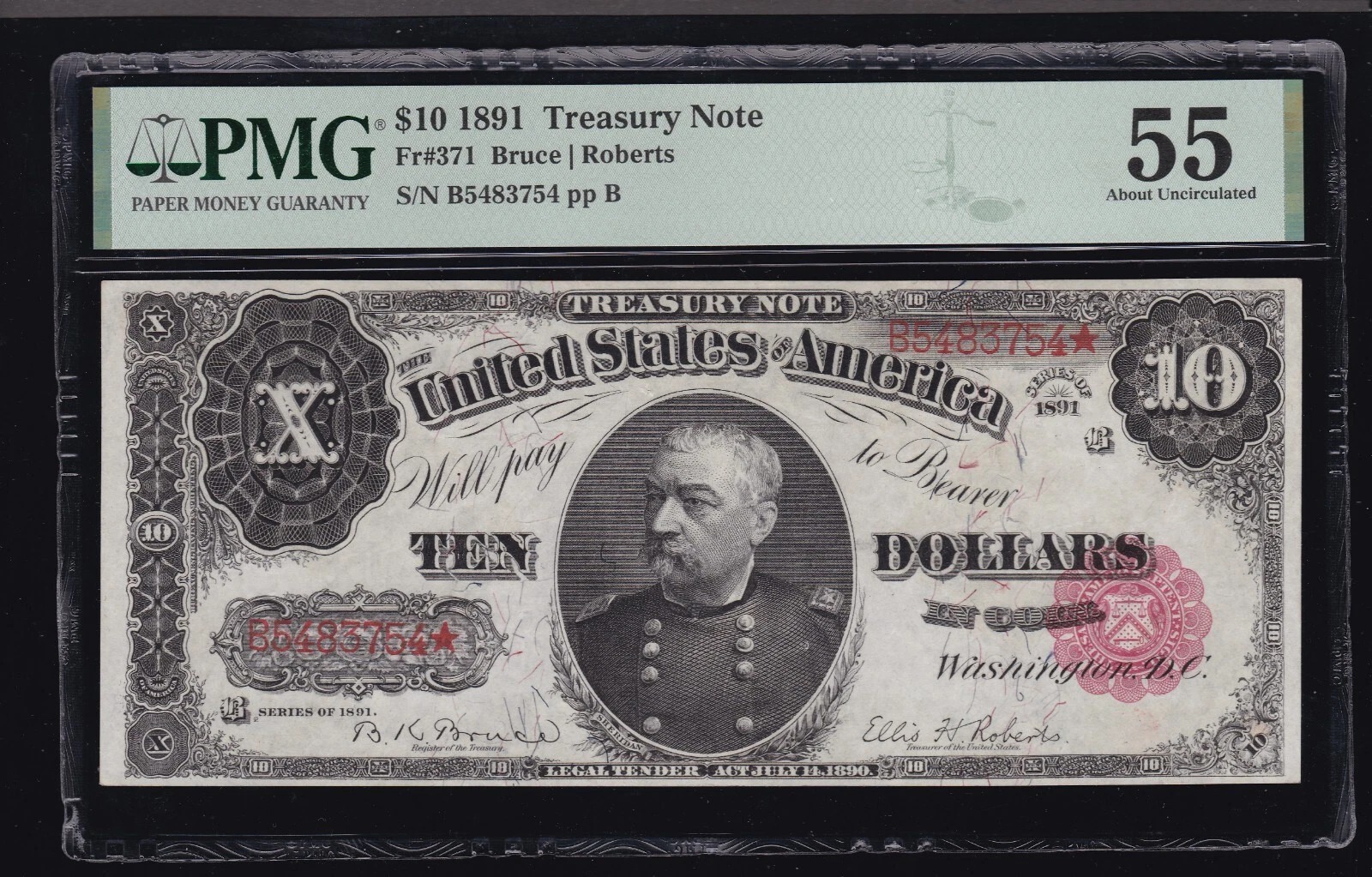
The Series 1891 $10 Silver Certificate is a large-size note, measuring approximately 7.375 by 3.125 inches, consistent with all large-size currency of the period. The face design places the Hendricks portrait prominently, surrounded by fine geometric lathe work and the bold obligation “THIS CERTIFIES THAT THERE HAVE BEEN DEPOSITED IN THE TREASURY OF THE UNITED STATES TEN SILVER DOLLARS.” The denomination numeral “10” appears in large form at the right side of the face.
The reverse of the Series 1891 $10 Silver Certificate is, frankly, one of the more understated designs of the era. The BEP had moved away from the elaborate allegorical back designs seen on some earlier Silver Certificate issues, opting for a cleaner, more typographic presentation. The word “SILVER” appears prominently in large block letters across the back, flanked by the denomination counters, printed in a deep, rich green ink that has aged beautifully on surviving examples.
The Treasury seal on the Series 1891 issues is red and of the smaller, scalloped variety introduced during this period, a notable departure from the large red seals of earlier series. Serial numbers are also printed in red ink, which adds to the visual cohesion of the face design.
When examining a Series 1891 $10 Silver Certificate, always check the serial number prefix and suffix letters carefully. The Rosecrans/Nebeker signature combination (Fr. 302) is significantly scarcer than the Tillman/Morgan pairing (Fr. 303), though both are formidable acquisitions. Authentication via a major third-party grading service is strongly recommended given the note’s value and the existence of altered or repaired examples in the market.
The Two Signature Combinations: Fr. 302 and Fr. 303
Like most large-size Silver Certificates of the 1891 series, the $10 denomination was produced under two different Register of the Treasury and Treasurer of the United States pairings. The first, Friedberg number 302, carries the signatures of William S. Rosecrans as Register and James W. Nebeker as Treasurer. Rosecrans served as Register from 1881 to 1893, while Nebeker held the Treasurer position from April 1891 to May 1893, which narrows the production window for Fr. 302 considerably. The second combination, Fr. 303, bears the signatures of Tillman as Register and Daniel N. Morgan as Treasurer, covering the period from 1893 onward.
Of the two, the Rosecrans/Nebeker pairing is the more elusive. Population data from the major third-party grading services suggests that fewer than a dozen examples of Fr. 302 have been certified in total across all grades, with the overwhelming majority of those in circulated condition ranging from Very Good to Fine. Uncirculated examples of Fr. 302 are essentially nonexistent in the current market. The Tillman/Morgan Fr. 303 is marginally more available but still commands extraordinary respect and corresponding prices.
Why Did So Few Survive?
Understanding the survival rate of any large-size note requires thinking about the economics and habits of the era. Silver Certificates in the $10 denomination were working currency. They circulated actively in commerce, passed through banks, merchant establishments, and private hands continuously. Unlike the $1 and $2 Silver Certificates, which might be tucked away as novelties, a $10 note represented a meaningful sum in the 1890s and early 1900s, roughly equivalent to several days of wages for an average laborer. Notes of this denomination were used, worn, and eventually returned to the Treasury for destruction.
The Series 1891 $10 also had a relatively short production window. The series was superseded by subsequent designs, and once a note type fell out of active production, the attrition rate on remaining circulators accelerated. Couple this with the limited collector awareness of the era (systematic paper money collecting was still in its infancy), and you have all the ingredients for catastrophic survival rates. Unlike coins, which are durable metal objects that survive burial, loss in couch cushions, and decades of neglect, paper currency is fragile. Moisture, fire, insects, and simple paper degradation have claimed the vast majority of 19th-century note production.
Condition census tracking for Series 1891 $10 Silver Certificates is informal but invaluable. Joining the Society of Paper Money Collectors (SPMC) and monitoring Heritage Auctions and Stack’s Bowers sale archives will give you the most complete picture of what grades have appeared and at what prices. Building a personal auction history file for this specific Friedberg number will serve you far better than relying on published price guides, which are updated infrequently and may not reflect current market realities for such a thinly traded note.
Market Performance and Recent Auction Results
The Series 1891 $10 Silver Certificate appears at major auction infrequently enough that each appearance is a genuine market event. Heritage Auctions has handled several examples over the past two decades, with results that illustrate both the note’s desirability and its condition sensitivity. A Fine 15 example of the Fr. 303 (Tillman/Morgan) sold for just over $14,000 in a Heritage sale in the mid-2010s, while a PCGS Very Fine 25 example of the same variety brought approximately $28,750 in a subsequent sale. The jump in value between circulated grades is steep because the pool of buyers for this note includes serious advanced collectors who are acutely aware of how rarely upgrade opportunities arise.
For Fr. 302 (Rosecrans/Nebeker), auction appearances are so rare that establishing a reliable price trend is genuinely difficult. Estimates from major dealers in the large-size market suggest that a Problem-Free Very Good example would likely open bidding at $20,000 or more, with Fine or better examples potentially reaching multiples of that figure if two serious collectors are competing. This is a note where private treaty sales between advanced collectors and dealers are as common as public auction appearances, which further obscures the true market.
Grading Considerations for the Series 1891 $10
Grading large-size Silver Certificates from this era requires attention to several specific factors. Paper quality is paramount: the note’s paper should retain its original crispness as much as possible, and collectors should be wary of examples that have been pressed, cleaned, or have had pinholes filled. The red serial numbers and Treasury seal on the 1891 $10 are susceptible to fading, and examples with bright, saturated color command significant premiums over those with washed-out ink.
Margins are another critical grading factor. The BEP’s sheet cutting practices of the 1890s were not as precise as modern standards, and many otherwise high-grade notes are downgraded due to close or uneven margins. A Series 1891 $10 Silver Certificate with four full, even margins is a genuinely exceptional find. Collectors should also examine the portrait area closely under proper lighting: the fine engraving lines of Hendricks’s face are often the first area to show wear, and a note graded Fine may show significant flatness in the portrait even if the paper itself remains relatively clean.
Do not overlook lightly circulated examples of the Series 1891 $10 Silver Certificate in your collecting strategy. Given the extreme rarity of high-grade survivors, a PCGS or PMG graded Very Fine 20 or Very Fine 25 example represents a legitimate condition rarity and a sound long-term acquisition. Chasing only gem uncirculated examples of notes this scarce can mean waiting indefinitely. A mid-grade certified example with original paper and good color is a far better holding than waiting years for an upgrade that may never appear.
The Hendricks Portrait in Context: Comparing Currency Likenesses
Thomas Hendricks holds the distinction of being one of only a small number of Vice Presidents ever depicted on United States paper money. The portrait used on the Series 1891 $10 is based on photographic references taken during the final years of his life, giving the engraving a particular gravity. Collectors who study large-size portraiture often note that the Hendricks engraving by the BEP is among the more successful likenesses of the era, capturing fine details of his features without the somewhat stiff formality that afflicts some contemporary portraits on currency.
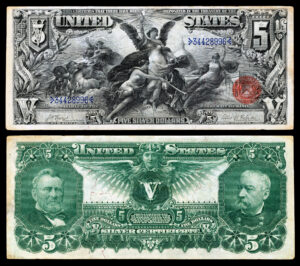
For comparison, the Series 1886 $5 Silver Certificate featured Ulysses S. Grant, and the Series 1896 Educational notes pushed portraiture entirely to the reverse, opting for allegorical figures on the face. The Hendricks $10 of 1891 sits in an interesting transitional moment in BEP design philosophy, between the heavily ornate Civil War-era designs and the cleaner, more modernist aesthetic that would fully emerge by the early 20th century.
| Friedberg Number | Signature Combination | Est. Known Population | Rarity |
|---|---|---|---|
| Fr. 302 | Rosecrans / Nebeker | 8 to 12 known | Key Date |
| Fr. 303 | Tillman / Morgan | 25 to 40 known | Rare |
| Fr. 302 (VF or better) | Rosecrans / Nebeker | 2 to 3 known | Key Date |
| Fr. 303 (VF or better) | Tillman / Morgan | 6 to 10 known | Rare |
| Fr. 302 (Uncirculated) | Rosecrans / Nebeker | None confirmed | Key Date |
| Fr. 303 (Uncirculated) | Tillman / Morgan | 1 possibly 2 known | Key Date |
| Fr. 303 (Problem-Free Fine) | Tillman / Morgan | Approximately 12 known | Rare |
| Fr. 302 (Problem-Free Fine) | Rosecrans / Nebeker | Approximately 4 known | Key Date |
Should the Series 1891 $10 Silver Certificate Be on Your Want List?
The honest answer depends on where you are in your collecting journey and what resources you can commit. For the advanced large-size collector building a type set of Silver Certificates, the Series 1891 $10 is an essentially mandatory acquisition, albeit one that may require years of patience and a significant budget. For the newer collector, it serves as an aspirational benchmark, a north star that illustrates just how challenging the upper reaches of American paper money collecting can be.
What is beyond dispute is the note’s historical significance. Thomas Hendricks served his country in multiple capacities across four decades, and his abbreviated Vice Presidency during one of the more consequential political eras of the 19th century makes his currency portrait a genuinely meaningful artifact. The Series 1891 $10 Silver Certificate is not merely a scarce note in a price guide. It is a tangible connection to a specific moment in American political history, rendered with extraordinary craftsmanship by BEP engravers who could not have known how few examples would survive into the following century.
When one of these notes does surface at auction or through a dealer, seasoned collectors take notice immediately. The appearance of a Series 1891 $10 Silver Certificate in any grade is not a routine transaction. It is an event. And for the collector fortunate enough to add one to their holdings, it represents the kind of acquisition that defines a collection for years to come.