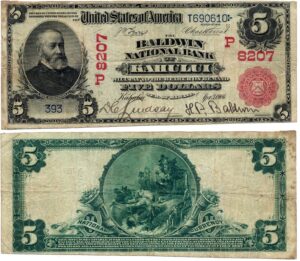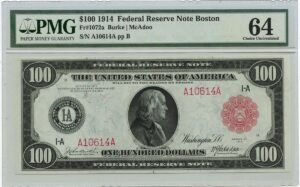
📷 Image source: eBay. Images are selected by AI to represent the article topic and may not depict the exact note(s) described.
On the morning of February 25, 1862, Abraham Lincoln signed the Legal Tender Act into law, and with that single stroke of his pen, the United States government did something it had never done before at the federal level: it issued paper currency that Americans were legally required to accept as payment for debts. No gold. No silver. Just the promise of a nation at war with itself. The notes that followed, soon nicknamed “greenbacks” for the distinctive green ink printed on their reverses, would finance the bloodiest conflict in American history and fundamentally reshape the relationship between the federal government and its money supply. For collectors today, these Civil War-era legal tender notes represent far more than old paper. They are artifacts of a constitutional crisis, an economic revolution, and a desperate gamble that somehow paid off.
The Financial Crisis That Forced Lincoln’s Hand
To understand why the greenback was born, you have to understand how utterly the traditional financing system had collapsed by the autumn of 1861. The Union was spending roughly $1.5 million per day on the war effort, a figure that would have seemed fantastical just a year earlier. Secretary of the Treasury Salmon P. Chase had initially attempted to finance the war through bond sales and loans from major banks in New York, Philadelphia, and Boston. For a brief period, this worked. Then came the disaster at Bull Run in July 1861, which shattered confidence and caused banks to suspend specie payments, meaning they stopped redeeming notes and deposits in gold and silver coin, on December 30, 1861.
With specie payments suspended and the treasury nearly empty, Chase and Congress faced a stark choice: find a new source of money or watch the Union war machine grind to a halt. The solution they reached for was one that hard-money advocates had resisted for decades: fiat paper currency issued directly by the federal government.
Demand Notes: The Forgotten Predecessors
Before the Legal Tender Act, Congress had actually authorized a smaller preliminary issue known as Demand Notes, approved under the Act of July 17, 1861. Issued in denominations of $5, $10, and $20, these notes promised payment “on demand” in coin at certain Treasury offices. They circulated briefly and were received for all government dues, but they were not technically legal tender for private debts. Approximately $60 million worth were authorized, though considerably less actually entered circulation.
Demand Notes are distinguished from later issues by their inscriptions: they bear the phrase “On Demand” and name specific Treasury payment locations, including New York, Boston, Philadelphia, Cincinnati, and St. Louis. The signatures on these notes were not printed but were actually hand-signed by Treasury clerks signing “for” the Register and Treasurer of the United States. A subset of the earliest notes bears fully hand-signed signatures before printed facsimile signatures replaced them, making those examples particularly prized by specialists.
When examining Civil War Demand Notes, look closely at the signatures. The earliest production examples from 1861 bear genuine hand-signed signatures from Treasury clerks, not printed facsimiles. These “hand-signed” Demand Notes command a substantial premium over the later printed-signature versions, even in lower grades. The distinction is visible to the naked eye: genuine ink signatures have a tactile, slightly raised quality that printed facsimiles lack.
The Legal Tender Act and the Birth of the Greenback
The Legal Tender Act of February 25, 1862, authorized the first $150 million in United States Notes, a name that would persist on American currency for over a century. A second tranche of $150 million followed under the Act of July 11, 1862, and a third of $150 million under the Act of March 3, 1863, bringing the total Civil War-era authorization to $450 million. Congress also established a statutory ceiling of $300 million in outstanding Legal Tender Notes at any one time, a limit that would be debated, breached, and litigated for decades afterward.
The notes themselves were produced by the American Bank Note Company and the National Bank Note Company in New York before the Bureau of Engraving and Printing gradually assumed more of the work. The Series 1862 notes were the first out, bearing the obligation “This Note is a Legal Tender for all debts public and private except duties on imports and interest on the public debt.” That exemption for import duties was a concession to hard-money interests, ensuring that customs revenue would still flow in gold, which the government then used to pay interest on its bonds.
The reverse designs were printed in green ink, a practical choice because green was difficult to photograph with the orthochromatic film of the era, helping deter counterfeiting. The public quickly seized on the color and the nickname greenback stuck permanently.
Portraits, Designs, and the Political Messaging of Civil War Currency
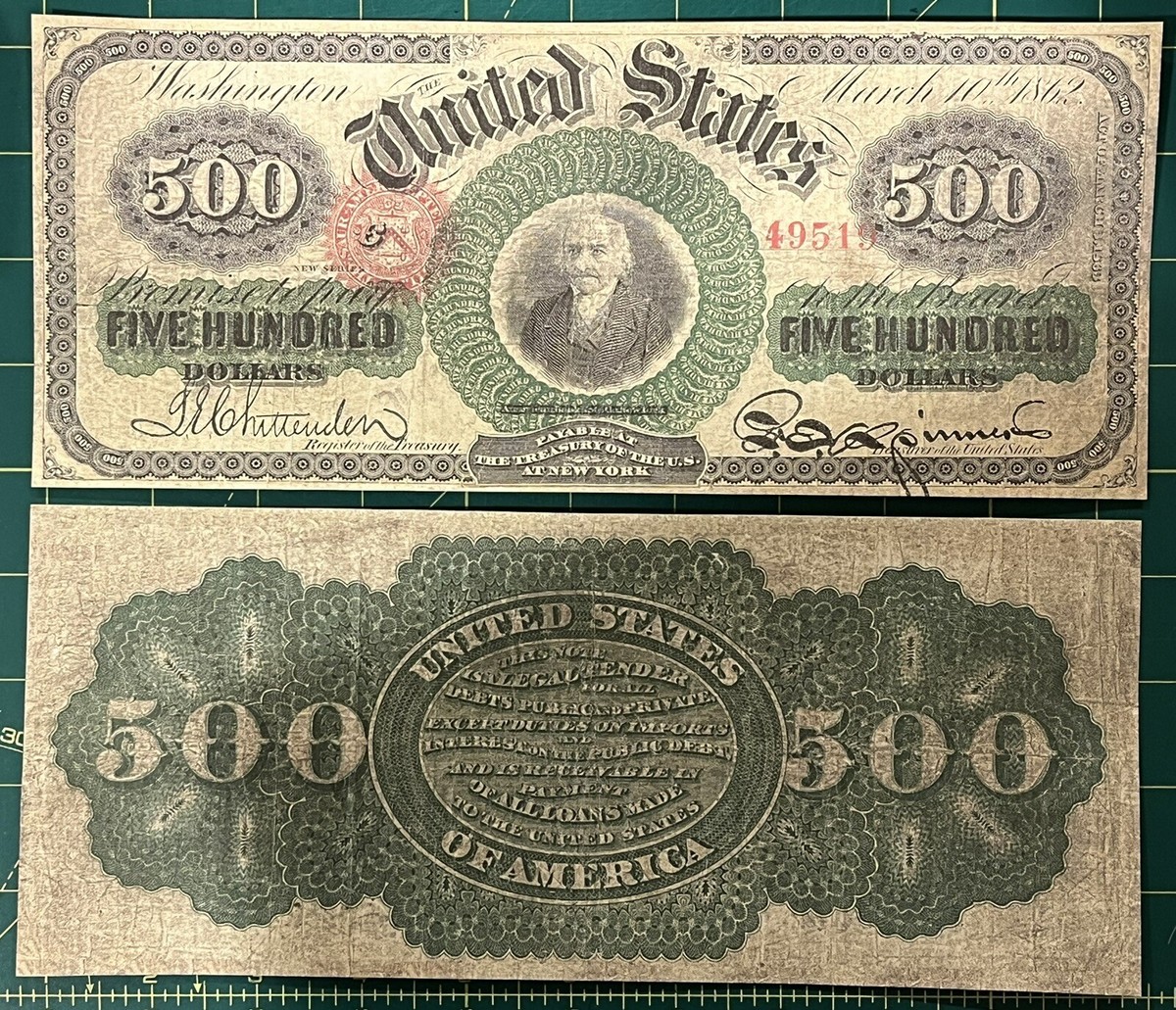
The portrait choices on Legal Tender Notes were anything but random. Chase, as Treasury Secretary, exercised considerable influence over the designs and was not shy about placing his own image on the $1 note of 1862, an act of self-promotion that later prompted Congress to pass legislation barring living persons from appearing on currency. Lincoln appeared on the $10 note. Alexander Hamilton graced the $5. The $100 note featured a large eagle vignette. The $500 bore a portrait of Albert Gallatin, and the $1,000 featured Robert Morris, the Revolutionary War financier, in an interesting nod to the nation’s earlier experiments with paper money.
The Series 1862 notes came in two varieties distinguished by their obligation text: the first obligation, which stated the legal tender clause and noted the exemptions, and the second obligation, which was modified slightly in wording. Collectors track these varieties carefully because they affect both rarity and value significantly.
Series 1862 Legal Tender Notes exist with two distinct obligation texts on their reverses. The “first obligation” notes preceded the “second obligation” notes in production and are generally scarcer. On the $1 and $2 denominations especially, this variety distinction can double or triple the value of an otherwise identical note. The PCGS and PMG population reports are your best resource for understanding how few examples of each obligation type have been certified in higher grades.
The Constitutional Fight: Were Greenbacks Legal?
The Legal Tender Act faced immediate and fierce constitutional challenge. Critics argued that the Constitution nowhere granted Congress the power to make paper money legal tender for private debts, and that forcing creditors to accept depreciated paper in settlement of gold-denominated obligations amounted to a taking of property. The greenback’s value did indeed fluctuate wildly: at the nadir of Union military fortunes in July 1864, one greenback dollar was worth only 35 cents in gold.
The constitutional question reached the Supreme Court in Hepburn v. Griswold (1870), which initially struck down the legal tender provisions as applied to debts contracted before the act’s passage. The Grant administration responded by packing the Court with two new justices, and in the Legal Tender Cases (Knox v. Lee and Parker v. Davis) of 1871, the Court reversed course and upheld the constitutionality of the Legal Tender Acts. It was a deeply political moment in American judicial history, and it settled the legal status of paper money in the United States for good.
Series 1863: The Second Major Issue
The Series 1863 Legal Tender Notes closely resembled the 1862 series but incorporated several changes. The obligation text was further revised on some denominations, and the serial number formats evolved. The series also saw the introduction of the distinctive red Treasury seal that would become standard on Legal Tender Notes for many years. Signature combinations for the 1862 and 1863 series included Chittenden-Spinner, Colby-Spinner, and Jeffries-Spinner, representing the successive Register-Treasurer pairings of the war and immediate post-war years. The Chittenden-Spinner pairing (Lucius E. Chittenden as Register, Francis E. Spinner as Treasurer) is the classic Civil War signature combination and appears on the earliest production of Legal Tender Notes.
Francis Spinner, who served as U.S. Treasurer from 1861 to 1875, had one of the most famously illegible signatures in Treasury history. His flourishing, nearly indecipherable script appears on enormous quantities of Civil War-era currency. Authenticated examples of currency bearing his actual hand-signed signature (as opposed to printed facsimiles) are significant finds. On Demand Notes, Treasury clerks signed “for” Spinner, and the variation in their penmanship creates interesting sub-varieties that advanced collectors track closely.
High Denominations: The $500 and $1,000 Greenbacks
The high-denomination Legal Tender Notes of 1862 and 1863 occupy a special place in American numismatics. The $500 Legal Tender Note of 1862, featuring Albert Gallatin, and the $1,000 note with Robert Morris were issued in comparatively small quantities and used primarily for large commercial transactions and interbank settlements. Very few survived in collectible condition. A Fine-grade example of the $500 1862 Legal Tender Note is a genuinely rare find, and Uncirculated examples are essentially museum pieces. The $1,000 notes are rarer still, with known survivors countable in the dozens.
| Series / Issue | Denomination and Variety | Est. Survivors | Rarity |
|---|---|---|---|
| 1861 Demand Note | $5, $10, $20 (Hand-signed) | Several hundred across all denoms | Rare |
| 1861 Demand Note | $5, $10, $20 (Printed signatures) | Approx. 1,000-2,000 total | Scarce |
| 1862 Legal Tender | $1 First Obligation (Chittenden-Spinner) | Approx. 500-800 in all grades | Scarce |
| 1862 Legal Tender | $1 Second Obligation | Several thousand | Common |
| 1862 Legal Tender | $2 First Obligation | Under 400 known | Rare |
| 1862 Legal Tender | $100 (Eagle reverse) | Fewer than 200 in Fine or better | Rare |
| 1862 Legal Tender | $500 (Gallatin portrait) | Fewer than 75 known total | Key Date |
| 1862 Legal Tender | $1,000 (Morris portrait) | Approximately 30-40 known | Key Date |
| 1863 Legal Tender | $5 (Hamilton portrait) | Several thousand | Common |
| 1863 Legal Tender | $50 (Hamilton vignette) | Under 300 in collectible grades | Rare |
Collecting Civil War Legal Tender Notes Today
For collectors approaching this series for the first time, a few practical considerations are worth noting. Third-party certification by PMG (Paper Money Guaranty) or PCGS Currency is essentially mandatory for any note purchased at significant cost. Civil War-era notes have been cleaned, pressed, and otherwise enhanced since the day they left circulation, and an expert eye backed by scientific examination is the only reliable protection.
The grading standards for Civil War currency are strict because the paper of the era is quite susceptible to fold lines, foxing, and ink oxidation. A PMG Very Fine 25 example of a Series 1862 $1 Legal Tender Note is genuinely attractive and historically evocative. An Extremely Fine 40 is a pleasing goal for most collectors. Choice Uncirculated notes from this era are extraordinary and priced accordingly.
New collectors are well advised to start with the more common second-obligation varieties of the smaller denominations. A Series 1862 $1 or $2 Legal Tender Note in VF condition can often be acquired for a few hundred dollars, providing a genuine piece of Lincoln-era Civil War history at an accessible price. From there, the series rewards deeper study: the varieties, signature combinations, and paper quality distinctions can occupy a specialist for a lifetime.
The Greenback’s Lasting Legacy
The $300 million ceiling on Legal Tender Notes in circulation was maintained, debated, and eventually legislated into permanence by the Specie Payment Resumption Act of 1875, which set January 1, 1879, as the date when greenbacks would be redeemable in gold at par. When that day arrived, most Americans chose simply not to redeem them, a profound vote of confidence in the currency that Lincoln’s government had created out of desperation fifteen years earlier. The United States Notes that descended from those original Civil War greenbacks remained in circulation in small quantities all the way through 1971, connecting the paper money of the Space Age to the darkest financial crisis of the Civil War.
When you hold a Series 1862 Legal Tender Note, even a well-worn example with honest folds from a century and a half of handling, you are holding paper that someone used to buy food, pay a debt, or perhaps fund a trip to enlist in the Union Army. The green ink on the back is the same formula that frustrated Confederate counterfeiters. The red Treasury seal is the same crimson that stared up at shopkeepers who had never before seen a federal paper bill. The greenback was born of crisis, survived a constitutional challenge, and outlived everyone who created it. As a collectible, it has no equal in American numismatic history.