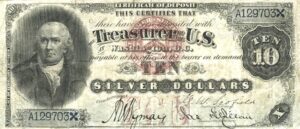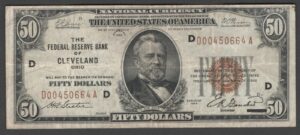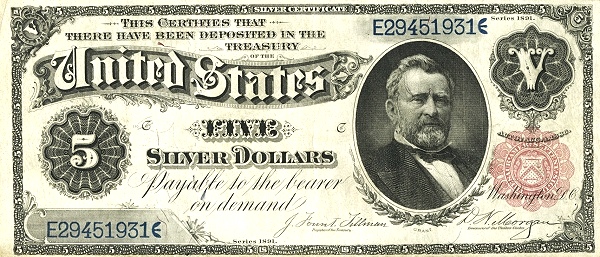
📷 Image source: banknote.ws (World Banknote Gallery). Images are selected by AI to represent the article topic and may not depict the exact note(s) described.
A Note That History Nearly Forgot
Ask almost any collector of large-size Silver Certificates to name the most desirable $5 issue, and the answer comes back quickly: the Series 1896 Educational note, or perhaps the dramatic Series 1899 Chief note. Mention the Series 1891 $5 Silver Certificate with the Grant portrait, and you are likely to be met with a pause. That pause is the entire point of this article. The 1891 $5 Silver Certificate is one of the most historically significant transitional notes in the entire Silver Certificate series, yet it consistently sells at a fraction of the price commanded by its neighbors on the timeline. For the patient collector willing to do the research, that gap represents genuine opportunity.
Where Does the 1891 Fit in the Silver Certificate Story?
The Silver Certificate program was authorized by the Bland-Allison Act of 1878 and expanded by subsequent legislation. By the early 1890s, the Bureau of Engraving and Printing was producing Silver Certificates in a dizzying variety of designs across multiple denominations. The $5 denomination had already seen the Series 1886 issue, which featured Ulysses Grant on a note with a distinctive reverse carrying five large silver dollar coins, earning it the nickname the “Silver Dollar Back.” The 1891 series updated that design, keeping the Grant portrait but moving to a new, more conventionally engraved reverse that would itself be replaced within just a few years by the stunning Series 1896 Educational design.
This puts the 1891 in an unusual narrative position. It is neither the romantic first appearance of Grant on a Silver Certificate, nor the visually spectacular Educational note that followed. It occupies what collectors sometimes call a “bridge issue,” a note that is essential to the complete run but rarely sought on its own terms. Understanding why that perception exists, and why it is at least partially undeserved, requires a closer look at the note itself.
Design and Engraving: More Than a Transitional Placeholder
The face of the Series 1891 $5 Silver Certificate is a product of some of the finest engraving talent the Bureau of Engraving and Printing ever employed. Ulysses S. Grant’s portrait, engraved by Charles Burt, dominates the left center of the note. Burt was one of the foremost portrait engravers of the nineteenth century, and his rendition of Grant here is considered among his finest achievements on currency. The image captures Grant in the dignified, slightly melancholy aspect that characterized his post-presidential years, the same period when he was quietly writing his famous memoirs while suffering from terminal throat cancer.
The red Treasury seal on the 1891 issue is a bold, scalloped design that replaced the older spiked seal format used on some earlier notes. The serial numbers appear in red as well, giving the face of the note a visually cohesive warmth that photographs beautifully in high grades. The reverse, often dismissed as plain, actually features meticulous lathe-work geometric patterns surrounding the large denomination numeral “5” and the obligation text. It is not the Silver Dollar Back of 1886, and it is not the allegorical grandeur of 1896, but it is precisely engraved and professionally balanced.
When examining a Series 1891 $5 Silver Certificate, pay close attention to the crispness of the engraved lines in Grant’s collar and lapel area. These fine details are the first to show wear and can help you quickly gauge circulated grade before consulting a population report.
The Three Signature Combinations and Their Scarcity
The Series 1891 $5 Silver Certificate was issued under three Register and Treasurer signature combinations, catalogued in the Friedberg reference as Fr. 267, Fr. 268, and Fr. 269. Each combination reflects a different administrative moment in Treasury history.
Fr. 267 carries the signatures of Rosecrans (Register) and Nebeker (Treasurer), representing the earliest production run of this series. This is the most available of the three in circulated grades, though truly choice examples in PMG or PCGS Very Fine 30 or better are not common. The Rosecrans-Nebeker pairing on the 1891 issue is the only one shared across several denominations of Silver Certificates from this period, making it a natural target for collectors building complete signature-set runs.
Fr. 268 is signed by Tillman (Register) and Morgan (Treasurer). This combination represents moderate scarcity, with a noticeably smaller survivor population than Fr. 267 in grades above Fine 15. The Tillman-Morgan pairing is sometimes referred to as one of the more underrated scarce combinations in large-size Silver Certificates generally.
Fr. 269, signed by Tillman (Register) and Roberts (Treasurer), is definitively the key to the set. Population data from grading services consistently shows that certified examples of Fr. 269 in any grade are uncommon, and the note is considered rare in grades above Very Fine. Auction appearances above Fine condition are noteworthy events, and a Choice Uncirculated example would represent a major find for any specialized collection.
The Tillman-Roberts signature combination (Fr. 269) appears on several 1891 Silver Certificate denominations, but the $5 is among the rarest. If you find an Fr. 269 at a general currency show among unsorted stock, the seller may not have identified the signature variety, giving you a potential pricing advantage. Always read the signatures on every large-size Silver Certificate you handle.
Why the Tombstone Overshadows Everything
The Series 1896 $5 Educational Silver Certificate, nicknamed the “Tombstone” by collectors because the large vertical cartouche on its reverse resembles a grave marker, is one of the most recognized pieces of American paper money ever printed. Its allegorical obverse depicts America offering electricity to the world, with a figure of Grant visible in a vignette at the lower right in a different engraved treatment. The Educational series was controversial in its time, with some critics considering it overly ornate and impractical for everyday commerce, but collectors have adored it for more than a century.
The Tombstone’s fame creates a shadow effect. Collectors building a type set of large-size $5 Silver Certificates will almost always prioritize the 1896 Educational, the 1886 Silver Dollar Back, and the 1899 Chief before circling back to the 1891 Grant portrait note. This ordering is understandable from an aesthetic standpoint, but it has the practical effect of suppressing demand for the 1891 and keeping its prices artificially accessible relative to its actual scarcity, particularly for the Fr. 268 and Fr. 269 signature varieties.
The Grant Connection: Historical Significance on Paper
Ulysses S. Grant’s appearance on American currency has a nuanced history. His face appeared on the $5 Silver Certificates of 1886 and 1891, and later on the $50 Federal Reserve Notes of the modern era, a placement that persists to the present day. The 1891 $5 is one of only two large-size notes to carry Grant’s portrait, and it predates by decades the general public familiarity with Grant as a “fifty-dollar bill president.” Collecting both the 1886 and 1891 issues together as a Grant portrait sub-collection within large-size currency is an approach that remains underexplored and can be assembled at relatively modest cost compared to building a complete type set.
Grant died in July 1885, just four days after completing his memoirs. His death was a moment of national mourning, and his image on the Silver Certificates of 1886 and 1891 carried genuine emotional resonance for Americans who remembered him as a Civil War hero. By the time the 1891 series entered circulation, the notes were passing through the hands of veterans who had served under Grant’s command. That historical context adds a dimension to these notes that purely aesthetic evaluation misses entirely.
A complete Grant portrait currency set across large-size issues, including the 1886 $5 Silver Certificate (Fr. 259-265), the 1891 $5 Silver Certificate (Fr. 267-269), is an achievable thematic collection that tells a coherent biographical story. Display notes in archival Mylar holders with printed historical context cards to enhance both preservation and presentation value.
Grading Considerations and Common Problems
Large-size Silver Certificates from the 1891 series present several specific grading challenges that collectors should understand before purchasing. The red inks used for the Treasury seal and serial numbers on these notes are susceptible to fading under prolonged UV exposure, a problem that can reduce an otherwise Fine note to a visually unpleasant example. Always examine the seal color carefully: a rich, saturated red is correct and desirable; a washed-out pink or orange-red indicates fading and will affect grade.
Paper quality on 1891 notes can vary considerably. Notes that spent time in humid regions of the South or along the Gulf Coast sometimes show paper softness or even light mold spotting that is difficult to detect without careful examination under a loupe. Conversely, notes from Western bank collections often survived in drier conditions and can present with surprisingly original paper quality even in circulated grades.
Pinholes are common on 1891 Silver Certificates, as cashiers routinely used pins to bundle notes. A single pinhole in an otherwise Very Fine example is generally noted by grading services but does not disqualify the note from an otherwise strong grade. Multiple pinholes or rust staining from pins, however, can significantly depress value. Check the upper left corner area near the serial number block, a favorite pinning location, with a light source held behind the note.
| Friedberg No. | Signature Combination | Relative Availability | Rarity |
|---|---|---|---|
| Fr. 267 | Rosecrans / Nebeker | Most available variety, moderate in VF+ | Scarce |
| Fr. 267 (Choice CU) | Rosecrans / Nebeker | Gem examples rare in any population | Rare |
| Fr. 268 | Tillman / Morgan | Fewer survivors than Fr. 267 above Fine | Scarce |
| Fr. 268 (VF or better) | Tillman / Morgan | Infrequent at major auction | Rare |
| Fr. 269 | Tillman / Roberts | Rare in all grades, key to the set | Key Date |
| Fr. 269 (VF or better) | Tillman / Roberts | Major rarity, exceptional auction event | Key Date |
| Fr. 267 (any grade, problem-free) | Rosecrans / Nebeker | Clean examples without fading or pinholes | Scarce |
| Fr. 268 / Fr. 269 (any grade) | Tillman signatures | Both varieties combined at auction, rare pairing | Rare |
Market Values and Collecting Strategy
In the current market, a circulated Fr. 267 in Fine 15 condition typically realizes between $150 and $350 at general currency auctions, representing genuine value for a 130-year-old large-size Silver Certificate. The same note in Very Fine 25 to 30 might bring $400 to $700 depending on eye appeal. Fr. 268 in comparable grades generally commands a 30 to 50 percent premium over Fr. 267 among knowledgeable bidders, though at general estate sales the two are sometimes offered at similar prices by sellers who have not identified the signatures.
Fr. 269 in any gradable condition is a four-figure note at specialist auction, and a PMG Very Fine 30 example would be expected to realize $2,000 or more. Uncirculated examples of Fr. 269 have not appeared with sufficient regularity to establish a reliable market benchmark, which itself signals the extreme rarity of the issue at the top of the grade scale.
For collectors building a comprehensive Silver Certificate type set on a measured budget, the 1891 $5 Grant portrait note offers an ideal entry point. A problem-free Fine example of Fr. 267 can be acquired for less than $300, provides a historically significant piece of the Silver Certificate narrative, and holds the potential for appreciation as collector interest in pre-1900 large-size notes continues to grow among younger numismatists rediscovering the series.
Conclusion: Reassessing the Overlooked
The Series 1891 $5 Silver Certificate with the Grant portrait is not overlooked because it lacks merit. It is overlooked because it sits between two of the most visually dramatic notes in American currency history and has never had a compelling nickname to anchor it in the popular imagination the way the Tombstone and the Educational note have. What it does have is a masterful engraved portrait, genuine historical resonance, documented scarcity in key signature varieties, and a price point that still allows thoughtful collectors to acquire problem-free examples without breaking their budgets. For those willing to look past the shadow of the Tombstone, the 1891 $5 Grant Silver Certificate offers exactly the combination of history, artistry, and accessible rarity that makes large-size currency collecting endlessly rewarding.