Pick up any Federal Reserve Note from your wallet and flip it over. The odds are good that a building stares back at you. The Lincoln Memorial, Independence Hall, the White House, Monticello — these structures are so familiar that most Americans never pause to consider how they got there, who chose them, or what the alternatives were. For currency collectors, however, the architectural imagery on United States paper money is a rich field of study, one that connects numismatics to art history, political symbolism, and the evolving story of American identity. The buildings on our banknotes were not chosen casually. Each one carries deliberate meaning, and tracing their appearances across different series and denominations reveals a fascinating record of how the nation has chosen to represent itself.
The Early Republic: Buildings as Symbols of Stability
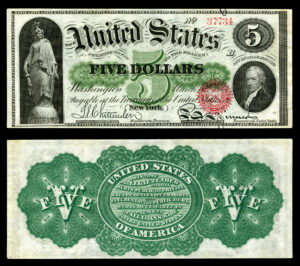
When the federal government began issuing paper currency in earnest during the Civil War, it faced a profound challenge of public confidence. The Demand Notes of 1861 and the Legal Tender Notes (United States Notes) of 1862 needed to project permanence, authority, and trustworthiness at a moment when the nation itself was fracturing. Architectural imagery provided exactly that symbolic weight. A building, unlike a political figure, could not die, defect, or fall from favor.
The 1862 series $1 Legal Tender Note featured a vignette of Salmon P. Chase, then Secretary of the Treasury, on the face, but architectural imagery anchored the reverse designs throughout the early Legal Tender series. The Treasury Building in Washington, D.C., still under construction in the early 1860s, appeared prominently on several denominations, a calculated choice that announced the permanence of federal financial authority even as cannon fire echoed in northern Virginia.
The $10 Legal Tender Note of 1862 and 1863 featured an image of the Treasury Building on its reverse, rendered in fine geometric lathe-work by the American Bank Note Company and later by the National Bank Note Company. These early engravings were remarkable for their detail, capturing the Greek Revival colonnades of the Treasury’s east facade. Collectors hunting these notes should look specifically for the Series of 1862 with the American Bank Note Company obligation, which differs subtly from the National Bank Note Company printings in the sharpness of the architectural lines and the depth of the green tint.
On 1862 and 1863 Legal Tender Notes featuring the Treasury Building, examine the obligation text on the reverse under magnification. Notes printed by the American Bank Note Company show crisper column capitals in the vignette than those produced by the National Bank Note Company. This distinction does not affect grade but can help you attribute unlabeled raw notes for your registry set.
National Bank Notes and the Era of Architectural Variety
No era in American currency history offered more architectural diversity on paper money than the National Bank Note period, which ran from 1863 through 1935. Because notes were issued by thousands of individual national banks across the country, the Bureau of Engraving and Printing and its predecessor contractors produced an enormous variety of vignettes, many of which depicted federal and civic buildings.
The First Charter Period (1863 to 1882) featured some of the most elaborate architectural engravings ever to appear on American currency. The $5 First Charter note carried a magnificent vignette of the Pioneer family on its face, but reverses in this series depicted the Landing of the Pilgrims and the Baptism of Pocahontas, both set within elaborate architectural frames. The Second Charter Period (1882 to 1902) introduced the iconic “brown back” and “date back” varieties, with reverses featuring the value repeated in ornate panels framed by architectural motifs derived from classical Roman and Greek design.
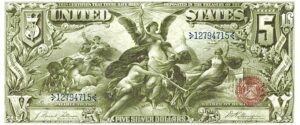
The 1896 Educational Series Silver Certificates deserve particular attention in any discussion of architecture on US currency. These three notes, the $1, $2, and $5, are widely considered the most artistically ambitious designs ever to appear on American paper money. The $1 note, designed by Will H. Low and engraved by Charles Schlecht, depicts History instructing Youth against a panoramic background that includes the Washington Monument and a distinctly classical domed building. The $2 shows the Sciences, and the $5 carries a portrait of Ulysses Grant and Philip Sheridan flanked by allegorical female figures, set before a backdrop of classical columns and architectural pediments. These notes were issued beginning in 1896 but proved too complex for the public to authenticate easily and were replaced by 1899.
The 1896 Educational Series $1 Silver Certificate (Fr. 224 through Fr. 226, covering the Tillman-Morgan, Bruce-Roberts, and Lyons-Roberts signature combinations) is one of the most condition-sensitive collectibles in US currency. The intricate intaglio engraving on these notes shows handling wear extremely readily. Even notes graded PMG or PCGS Currency 30 Very Fine can display extraordinary visual appeal, making mid-grade examples a practical entry point for collectors on a budget.
The Federal Reserve Era: Standardization and Iconic Architecture
The introduction of Federal Reserve Notes in 1914 began a long process of design standardization that would eventually give American currency the consistent architectural imagery we know today. The Series of 1914 Federal Reserve Notes featured portraits on the face and allegorical and architectural vignettes on the reverse. The $5 note showed Columbus’s landing and the Pilgrims; the $10 carried images of agriculture and industry; and the $20 depicted a transportation theme. Buildings as such were secondary in these designs, though architectural elements framed every vignette.
The decisive architectural moment came with the redesigns of the late 1920s and the small-size note era that began in 1928. For the first time, the United States issued standardized small-format currency in which each denomination received a fixed portrait on the face and a fixed building on the reverse. These pairings, established in 1928 and refined over subsequent decades, became defining features of American monetary identity.
The assignments were as follows: the $1 note received the Great Seal reverse rather than a building (the one-dollar bill’s reverse has always borne the dual-sided Great Seal design); the $2 note was eventually paired with the signing of the Declaration of Independence, depicting the room within Independence Hall; the $5 note was given the Lincoln Memorial; the $10 note featured the Treasury Building; the $20 note showed the White House; the $50 note displayed the United States Capitol; and the $100 note carried Independence Hall itself on its reverse.
These pairings were not universally fixed from 1928. The $2 note underwent the most dramatic architectural evolution. The Series of 1928 through 1963 $2 United States Notes all featured Monticello on their reverses, a design that emphasized Thomas Jefferson’s private architectural achievement. The Bicentennial redesign of the Series 1976 $2 Federal Reserve Note replaced Monticello with a reproduction of John Trumbull’s painting depicting the presentation of the Declaration of Independence, set within the chamber of Independence Hall. Interestingly, Monticello survived on the $2 note in a secondary capacity until the early 1960s designs were discontinued.
Lincoln Memorial on the Five Dollar Note
The Lincoln Memorial vignette on the $5 note is arguably the most studied architectural image in American numismatics, in part because it offers a unique visual puzzle. Look closely at the reverse of any Series 1928 through current $5 Federal Reserve Note: you can make out the interior of the Memorial within its colonnade, and sharp-eyed observers have long noted that the 26 columns visible represent the 26 states in the Union at Lincoln’s birth. More importantly for collectors, the engraving style of the Memorial changed across series. Notes from Series 1928 through 1950 show the Memorial in a style with stronger horizontal engraving lines, giving the structure a more textured, three-dimensional quality. The 1963 and later series shifted to a slightly cleaner, more graphic rendering.
The Series 1928 $5 Legal Tender Note (Red Seal) with the Lincoln Memorial reverse is particularly collectible, with the 1928 signature combination of Tate-Mellon representing the first small-size $5 Legal Tender Note. In Fine condition, these notes trade in the $15 to $25 range, but examples in PMG 65 Gem Uncirculated can command over $600, demonstrating the premium collectors place on pristine architectural detail.
When grading $5 notes for eye appeal on the Lincoln Memorial reverse, check the sky above the Memorial’s roofline first. This area, rendered in fine parallel engraving lines, shows ink wear and roller pressure flaws before virtually any other part of the design. A $5 note with clean, fully separated sky lines above the Memorial is almost certainly Uncirculated; cloudy or merged lines in that zone almost always indicate at least light circulation.
Independence Hall and the $100 Note
Independence Hall in Philadelphia has graced the reverse of the $100 Federal Reserve Note continuously since the small-size era began in 1928. The building depicted is the rear (south) facade of Independence Hall, a detail that surprises many collectors accustomed to seeing the more famous north entrance in photographs. The choice of the south facade was reportedly made because it offered a more symmetrical and visually balanced composition for the note’s rectangular format.
The Series 2013 $100 note, which entered circulation on October 8, 2013, retained Independence Hall on the reverse despite comprehensive security upgrades including the 3-D Security Ribbon, the Bell in the Inkwell, and new color-shifting ink. The Hall itself is rendered in copper ink on the new design, a subtle nod to the Liberty Bell’s material, and the clock on Independence Hall’s tower was updated. On older series notes through approximately Series 1990, the clock face shows roughly 4:10; collectors have long debated whether this reflects the approximate time of the Declaration’s adoption. The post-1990 high-security series notes show the same clock position. On the Series 2013 note, the clock reads approximately the same time, preserving a design continuity spanning nearly a century.
The Treasury Building on the Ten Dollar Note
The Treasury Building has the longest continuous presence of any structure on United States paper money, appearing in some form from the 1862 Legal Tender Notes through today’s $10 Federal Reserve Note. The current engraving shows the building’s south portico and Pennsylvania Avenue facade, rendered with extraordinary precision by Bureau of Engraving and Printing master engravers. The 1990 and later Series $10 notes introduced microprinting and security threads, but the Treasury Building vignette itself remained stylistically consistent with the 1928 design until the Series 1999 note introduced subtle color additions.
Collectors who specialize in the $10 denomination will find rich variety across signatures. The Series 1928 $10 Federal Reserve Note carries the Woods-Mellon signature combination for all twelve Federal Reserve districts. The 1928A through 1928C series represent progressively shorter print runs in certain districts, making district-specific collection a rewarding long-term pursuit. The Dallas (K) district notes in Series 1928B, for example, were printed in significantly smaller quantities than their New York (B) counterparts, a disparity reflected clearly in today’s market premiums.
| Series / Issue | Denomination and Building | Est. Print Run or Notes Known | Rarity |
|---|---|---|---|
| 1862 Legal Tender | $10, Treasury Building reverse | Est. under 500,000 issued | Rare |
| 1896 Educational Series | $1 Silver Certificate, classical architecture reverse | Est. 15 million printed; survivors scarce | Scarce |
| 1896 Educational Series | $5 Silver Certificate, classical architecture reverse | Est. 3.5 million printed | Rare |
| 1928 Small-Size | $5 Legal Tender, Lincoln Memorial (Red Seal, Tate-Mellon) | Est. 267,000,000 total series | Common |
| 1928B $10 FRN | $10, Treasury Building, Dallas District (K) | Est. 1,680,000 (Dallas) | Scarce |
| 1934A $100 FRN | $100, Independence Hall, San Francisco (L) Mule | Under 50 confirmed in collections | Key Date |
| 1976 $2 FRN | $2, Independence Hall Interior (First Day Issue, stamped) | Millions issued; stamped examples limited | Scarce |
| 1950E $50 FRN | $50, U.S. Capitol, New York (B) District | Est. 1,440,000 (New York) | Scarce |
| 2013 $100 FRN | $100, Independence Hall (current series) | Billions in circulation | Common |
The White House, the Capitol, and the Question of Political Neutrality
The White House on the $20 note and the Capitol on the $50 note raise an interesting question that numismatists sometimes overlook: why these buildings, and why these denominations? The pairings established in 1928 were largely practical, driven by the need to create reverse designs that were sufficiently complex to deter counterfeiting while remaining legible at small scale. The White House and Capitol were chosen partly because their silhouettes were so universally recognized that any deviation in a counterfeit would be immediately apparent to trained tellers.
Both structures have undergone design refinements across their long histories on US currency. The $20 note’s White House vignette was updated for the Series 1996 note, which introduced color-shifting ink and a security thread, and again for the Series 2004 redesign, which added background color and an updated engraving with greater architectural detail in the south portico’s colonnades. The $50 note’s Capitol dome rendering was similarly updated in the Series 1997 redesign, which added a security thread and watermark, and the Series 2004 note introduced a color-shifting numeral and refined the architectural engraving.
It is worth noting that the proposed redesign of the $20 note, which would have replaced Andrew Jackson’s portrait with Harriet Tubman’s image, generated considerable discussion about whether architectural imagery on the reverse might also be updated. As of 2024, the Harriet Tubman $20 design, originally announced by the Treasury Department in 2016 and expected by 2020, had not entered production, leaving the White House reverse unchanged. This ongoing saga illustrates how deeply the architectural imagery of American currency is entangled with questions of national identity.
Building a type set of $50 Federal Reserve Notes from Series 1928 through current issue, organized by the evolution of the Capitol dome engraving, is an underappreciated collecting specialty. The visual differences between the sharp, high-contrast engraving of a Series 1928 $50 and the more refined, security-enhanced rendering of a Series 2004 $50 tell the entire story of American currency printing technology in two notes side by side. A complete $50 type set is achievable for under $2,000 in Very Fine or better condition.
Conclusion: Architecture as the Hidden Language of Currency
The buildings on United States paper money are not decorative afterthoughts. They are carefully chosen symbols, precisely engraved, deliberately maintained across series, and freighted with meaning about American governance, history, and self-conception. From the Greek Revival columns of the Treasury Building that first anchored federal credibility in 1862, to the intaglio precision of Independence Hall on today’s $100 note, architecture has served as the visual foundation of public trust in American currency.
For collectors, this history offers a framework for approaching US currency that goes beyond serial numbers and signatures. Every building on every note is an engraver’s achievement, a political statement, and a historical artifact. The next time you handle a well-preserved 1896 Educational Series Silver Certificate or a crisp Series 1928 small-size note, take a moment to consider the architectural vignette on its reverse. The columns, domes, and facades rendered there in microscopic intaglio lines represent not just buildings, but the ideals those buildings were meant to embody. That is a story worth collecting.