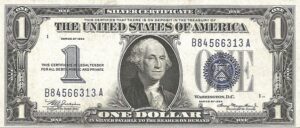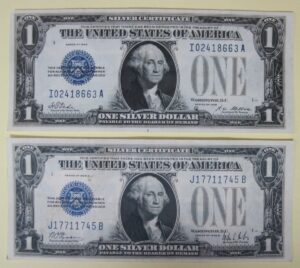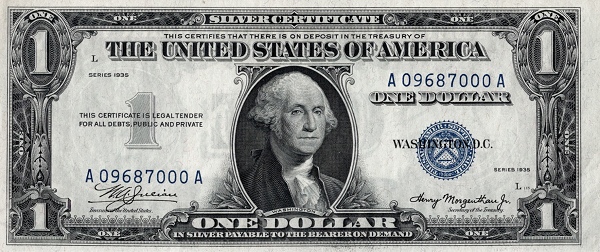
📷 Image source: banknote.ws (World Banknote Gallery). Images are selected by AI to represent the article topic and may not depict the exact note(s) described.
Pick up a Series 1934 $1 Silver Certificate at almost any coin show and you will likely see it described simply as “1934” in the dealer’s inventory. That single label, however, conceals a fascinating web of bureaucratic history, printing schedules, and genuine rarity differences. The Series 1934 $1 Silver Certificate was produced under six different pairs of Treasury signatures, issued across more than a decade from the mid-1930s through the late 1940s. Each signature combination corresponds to a specific window of time, a specific range of serial numbers, and a specific level of collector demand. Learning to distinguish them is one of the most rewarding skills a paper money collector can develop, because the notes look nearly identical at a glance yet can vary dramatically in value and scarcity.
A Brief History of the Series 1934 Design
The $1 Silver Certificate of 1934 was a direct outgrowth of the monetary upheaval of the early New Deal era. The Silver Purchase Act of 1934 compelled the Treasury to monetize vast quantities of silver, and the $1 denomination Silver Certificate became the workhorse of that policy. The design introduced in 1935 carried a series date of 1934 and featured a portrait of George Washington on the face and a large blue numeral “1” on the reverse, a design that would persist with only minor modifications well into the 1950s.
What makes the 1934 series particularly interesting is that the Bureau of Engraving and Printing did not re-designate a note’s series date every time a new Secretary of the Treasury or Treasurer of the United States took office. Instead, it simply changed the engraved signatures on the printing plates and continued production. The series date remained 1934 throughout, even as the notes rolled off the presses a decade later. The result is that the six signature combinations function almost like sub-series, each telling a chapter of the story of who was managing the nation’s finances at a particular moment.
Understanding the Signature System
On all United States paper money of this era, two signatures appear on the face of the note. The signature on the right belongs to the Secretary of the Treasury, a Cabinet-level political appointee. The signature on the left belongs to the Treasurer of the United States, an official who was often, though not always, a political reward appointment. When either officeholder changed, new printing plates were engraved with the new signature pair, creating a new collectible variety. Collectors identify these combinations by listing the Treasurer first and the Secretary second, following the convention established in standard references such as the Friedberg catalog.
Always use a loupe or magnifier when attributing Series 1934 $1 Silver Certificates. The engraved signatures are fine and precise, and distinguishing “Julian” from “Clark” or “Vinson” from “Snyder” by eye in poor lighting is an easy way to misattribute a note. Good lighting and at least 5x magnification will save you from costly mistakes at a show or auction.
The Six Signature Combinations in Detail
1. Julian / Morgenthau
The first and by far the most common combination pairs Treasurer William A. Julian with Secretary Henry Morgenthau Jr. Julian served as Treasurer from 1933 to 1949, one of the longest tenures in the office’s history, while Morgenthau held the Secretary’s post from 1934 to 1945. The Julian-Morgenthau combination represents the bulk of all Series 1934 $1 Silver Certificate production. Serial numbers for this combination begin at A00000001A and run through multiple letter blocks. These notes are plentiful in all grades and represent an affordable entry point for new collectors. Circulated examples are worth only a modest premium over face, while Gem Uncirculated specimens in grades of MS-65 or better from PMG or PCGS Currency carry premiums for exceptional paper quality and original sheen.
2. Julian / Vinson
Fred M. Vinson replaced Morgenthau as Secretary of the Treasury in July 1945, serving until June 1946 before being appointed Chief Justice of the Supreme Court by President Truman. The Julian-Vinson pairing thus covers a very short production window of less than a year. This brevity translates directly into scarcity. The Julian-Vinson combination is genuinely scarce compared to the Julian-Morgenthau notes, and collectors seeking a complete type set of all six varieties will find this one of the two most challenging to locate in high grades. Circulated examples appear regularly enough, but problem-free, well-centered Uncirculated specimens command strong premiums.
3. Julian / Snyder
John W. Snyder took over from Vinson as Treasury Secretary in June 1946 and would serve until January 1953. The Julian-Snyder combination covers the period from mid-1946 through Julian’s retirement in May 1949. Print runs were substantial, making this combination moderately available in circulated grades, though Uncirculated examples are noticeably scarcer than Julian-Morgenthau notes of similar quality. Collectors often overlook this combination, which can make patient searching rewarding.
When assembling a set of all six Series 1934 $1 Silver Certificate signature combinations, consider focusing on a consistent grade rather than the highest possible grade for each. A matched set of six notes all grading PMG Very Fine 30 or Choice Very Fine 35 makes a far more visually coherent display than a mixed set where some notes are Uncirculated and others are heavily circulated, and it is far more affordable to complete.
4. Clark / Snyder
Georgia Neese Clark replaced Julian as Treasurer in June 1949, and she continued to serve alongside Secretary Snyder until the end of the Truman administration in January 1953. The Clark-Snyder combination is the second-most-produced variety after Julian-Morgenthau, and circulated examples are common. However, the combination is notable because Clark was one of the few women to serve as Treasurer during this period, giving the notes a historical dimension that appeals to a broader audience beyond traditional currency collectors. Star note replacements from this combination are moderately scarce.
5. Priest / Humphrey
With the transition to the Eisenhower administration in January 1953, both the Treasurer and the Secretary changed. Ivy Baker Priest became Treasurer and George M. Humphrey became Secretary. Their combination appears on Series 1934 notes, though by the time this pairing was in effect, the Bureau of Engraving and Printing was already preparing the transition to the Series 1935 design variants. Production of 1934-series notes with the Priest-Humphrey combination was therefore more limited than the earlier Truman-era pairings. This is a genuinely scarce combination, and Uncirculated examples are difficult to find. Circulated notes in Fine to Very Fine grades represent a reasonable way to fill this slot in a type set.
6. Priest / Anderson
The final signature combination of the Series 1934 $1 Silver Certificate pairs Treasurer Ivy Baker Priest with Secretary Robert B. Anderson, who replaced Humphrey in July 1957. By this date, the 1935-series notes had long since taken over the vast majority of $1 Silver Certificate production, and the handful of 1934-series notes printed with the Priest-Anderson signatures represent the rarest variety of the entire run. The Priest-Anderson $1 Silver Certificate in any condition above Fine is a genuinely exciting find, and Gem Uncirculated examples are considered key date material by advanced collectors. Precise production figures for this combination have been a subject of debate in the numismatic literature, but all major references agree it was printed in comparatively tiny quantities.
Star notes, indicated by a star symbol replacing the first letter of the serial number, command premiums for every signature combination in this series. The Priest-Anderson star notes in particular are extremely rare and should be authenticated by a major grading service such as PMG or PCGS Currency before any significant purchase. Altered serial numbers on common varieties have been documented in the hobby.
How to Physically Attribute the Notes
Attributing a Series 1934 $1 Silver Certificate requires nothing more than reading the engraved signatures printed on the face of the note below and flanking the portrait of Washington. On the lower left is the Treasurer’s signature, and on the lower right is the Secretary of the Treasury’s signature. Both are accompanied by a small printed title line identifying the office. The key points of confusion for new collectors are distinguishing the Vinson and Snyder signatures as Secretaries, and distinguishing the Julian and Clark signatures as Treasurers. Henry Morgenthau’s distinctive signature is unlikely to be confused with any other. William Julian’s signature is a flowing cursive with prominent capital letters. Georgia Neese Clark’s signature is slightly more compressed. Ivy Baker Priest’s signature is bold and upright. Vinson’s Secretary signature is a compact cursive, while Snyder’s is slightly more angular. Anderson’s signature as Secretary is the most modern-looking of the group, with a more open letterform.
Once you have identified the signature pair, cross-reference against the Friedberg catalog numbers. The Julian-Morgenthau combination is Friedberg 1606, Julian-Vinson is F-1607, Julian-Snyder is F-1608, Clark-Snyder is F-1609, Priest-Humphrey is F-1610, and Priest-Anderson is F-1611. These Friedberg numbers are universally recognized by dealers, auction houses, and grading services, and using them in any transaction eliminates ambiguity.
Serial Number Ranges as a Secondary Check
While signatures are the definitive attribution method, serial number letter blocks can serve as a useful secondary check. The Julian-Morgenthau notes span the earliest serial number blocks and include the A-A through many mid-alphabet block letters. The later combinations appear in progressively higher blocks. If you encounter a note with a very late alphabet block, such as Y or Z prefix letters, it is almost certainly one of the later signature combinations. This is not a substitute for reading the signatures, but it can flag notes that deserve closer examination before purchase.
| Friedberg No. | Signature Combination | Est. Notes Printed | Rarity |
|---|---|---|---|
| F-1606 | Julian / Morgenthau | 1.6 billion+ | Common |
| F-1607 | Julian / Vinson | Approx. 80 million | Scarce |
| F-1608 | Julian / Snyder | Approx. 400 million | Common |
| F-1609 | Clark / Snyder | Approx. 900 million | Common |
| F-1610 | Priest / Humphrey | Approx. 50 million | Scarce |
| F-1611 | Priest / Anderson | Approx. 18 million | Key Date |
| F-1607 (Star) | Julian / Vinson, Star Note | Under 2 million est. | Rare |
| F-1610 (Star) | Priest / Humphrey, Star Note | Under 1 million est. | Rare |
| F-1611 (Star) | Priest / Anderson, Star Note | Fewer than 200,000 est. | Key Date |
Grading Considerations Specific to This Series
The Series 1934 $1 Silver Certificates were printed on paper with a distinctive feel that ages somewhat predictably. Circulated examples frequently show folds, edge wear, and light soiling. The most common grade for notes that survived in everyday commerce is Very Good to Fine, corresponding to PMG grades of 10 to 15. Notes that were saved from circulation early and stored reasonably well often grade in the Extremely Fine 40 to About Uncirculated 55 range. True Gem Uncirculated notes, graded PMG 65 EPQ or PCGS Currency 65 PPQ, are far more desirable and command significant premiums, particularly for the scarcer signature combinations.
Paper quality designations matter enormously for this series. The EPQ (Exceptional Paper Quality) designation from PMG and the PPQ (Premium Paper Quality) designation from PCGS Currency indicate that a note has original paper quality without restoration, chemical treatment, or pressing. For the common Julian-Morgenthau combination, the difference between a graded 65 without a quality designation and a graded 65 EPQ can be meaningful at auction. For the Priest-Anderson combination, it can be the difference between a note that a serious specialist will pursue aggressively and one they will pass over entirely.
The Series 1934 $1 Silver Certificate set of six signature combinations is one of the most achievable complete type sets in United States paper money collecting. Budget collectors can complete the set in circulated grades for well under $500 with patience, while high-grade specialists chasing Gem Uncirculated EPQ examples for all six types will find it a satisfying multi-year project. Either approach gives you a historically rich set that spans more than a decade of American monetary policy.
Conclusion: A Deceptively Rich Collecting Area
The Series 1934 $1 Silver Certificate is a masterclass in the principle that great numismatic complexity can hide inside an apparently simple, ubiquitous note. From the abundant Julian-Morgenthau issues that any dealer can produce by the handful, to the elusive Priest-Anderson Gem Uncirculated star note that might appear at a major auction once in several years, the full spectrum of this single series encompasses everything a collector could want: accessible entry points, genuine research challenges, clear attribution criteria, and the satisfying historical narrative of a decade of American Treasury leadership. Take the time to learn the six signature combinations, acquire a magnifier, and pick up a copy of the Friedberg catalog. You will never look at a plain-seeming Series 1934 $1 Silver Certificate the same way again.