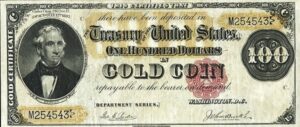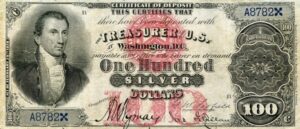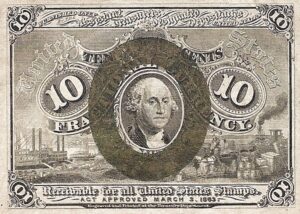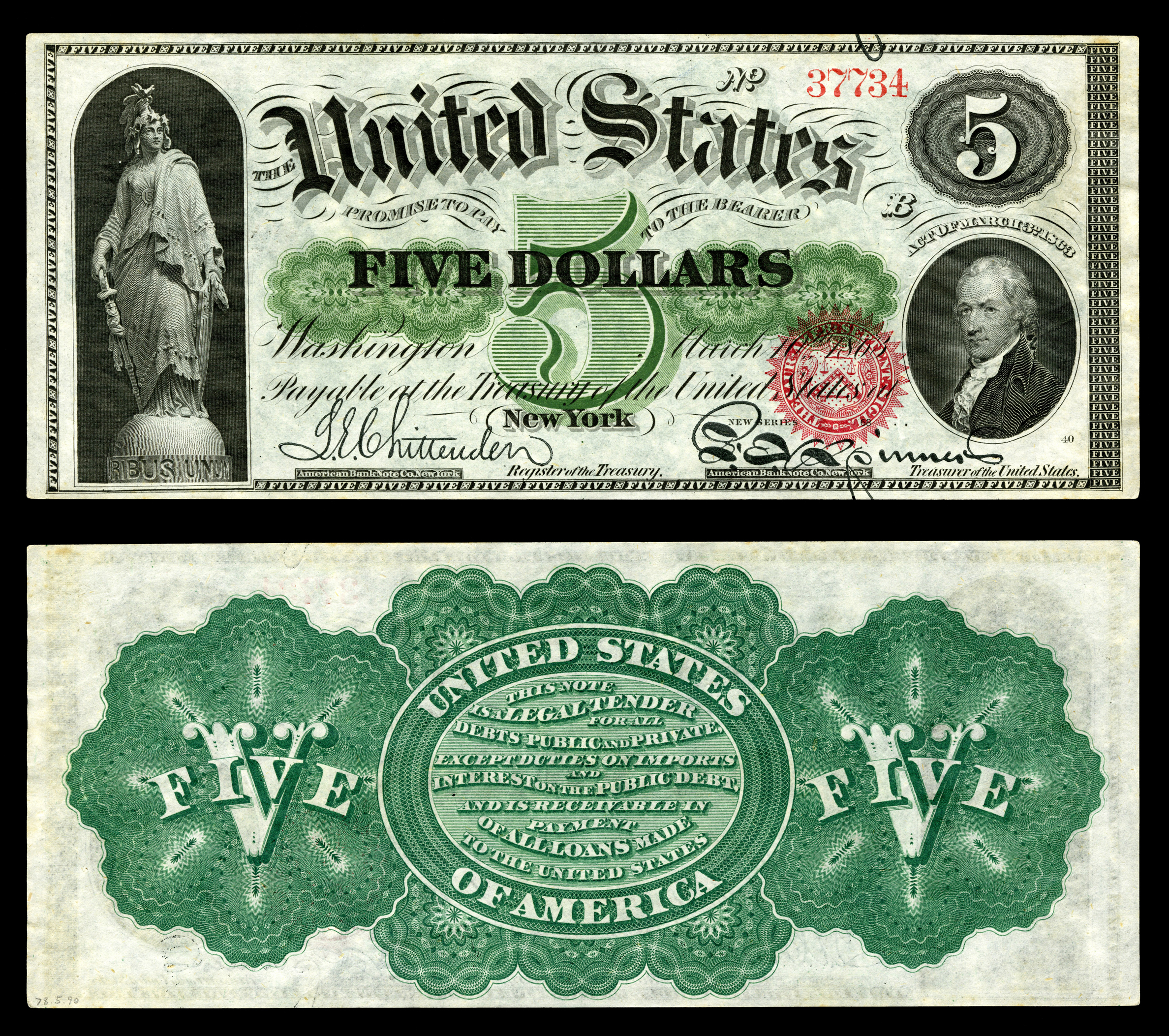
📷 Image source: Wikimedia Commons. Images are selected by AI to represent the article topic and may not depict the exact note(s) described.
Pick up a well-preserved 1863 United States Note and hold it at arm’s length. Before you read a denomination, before you study a portrait, your eye is drawn to something else entirely: a dense, almost hypnotic web of interlocking curves, spirals, and rosette patterns framing every edge of the bill. This is geometric lathe work, and in 1863 it was the most powerful weapon the U.S. Treasury had in its war against counterfeiters. To understand these notes fully — their design philosophy, their production history, and why certain varieties command serious premiums today — you need to understand the machines that made them possible.
The Counterfeiting Crisis That Demanded a Solution
By the time Congress passed the Legal Tender Act on February 25, 1862, authorizing the first federally issued paper currency since the Continental currency of the Revolutionary era, counterfeiting was already a national epidemic. Contemporary estimates suggested that as much as one-third of all circulating bank notes in the United States before the Civil War were fraudulent. The technology gap between the Treasury and the counterfeiters was dangerously narrow. A skilled engraver working with a copper plate and a pantograph could reproduce most mid-19th century banknote designs well enough to deceive merchants and bank tellers.
Photography made things worse. The daguerreotype had been public knowledge since 1839, and by the 1850s, photographic reproduction techniques were advancing rapidly. Treasury officials and private bank note companies alike understood that any design element that could be photographed could, in theory, be reproduced. What was needed were designs that existed at the very limit of mechanical precision — patterns so mathematically complex, so perfectly repetitive, that even a gifted counterfeiter working from a photograph would reveal their imperfections under a loupe.
The answer was already sitting in the workshops of the American Bank Note Company and the National Bank Note Company: the geometric lathe engine, sometimes called the rose engine or the ruling machine.
How the Rose Engine Worked
The geometric lathe, in its bank note printing form, was a specialized mechanical device that held a hardened steel engraving point against a rotating soft steel or wax surface while simultaneously oscillating that surface along multiple axes according to cam-driven programs. By combining a primary rotation with secondary and tertiary oscillations of varying frequencies and amplitudes, the machine could inscribe curves of extraordinary complexity — guilloche patterns, rosettes, interlocking wave borders, and the basket-weave spirals that became the hallmark of Civil War-era U.S. currency.
The critical feature was mathematical precision. Every loop of a rose-engine pattern is the product of a fixed gear ratio. Two adjacent loops in a border are not merely similar — they are identical to tolerances measured in thousandths of an inch. A counterfeiter working by hand, no matter how skilled, introduced microscopic variations in spacing, depth, and curvature. Under a jeweler’s loupe, those variations were a death sentence for the forgery. And photography, which was the other potential reproduction method, could capture the overall pattern but lost the depth and the fine line width variations that the intaglio printing process transferred from the engraved plate to the paper.
When examining an 1863 United States Note under 5x to 10x magnification, look at the scrollwork border near a corner. On a genuine note, the lathe-work lines will be perfectly uniform in spacing and the ink will show the characteristic ridge of intaglio printing — you can feel it with a fingertip. On contemporary counterfeits or later photo-reproductions, lines will waver slightly and ink will sit flat on the paper surface rather than raised above it.
Reading the 1863 Note Designs: A Field Guide to the Borders
The 1863 Legal Tender Notes are cataloged in the standard Friedberg reference (“Paper Money of the United States” by Arthur Friedberg and Ira Friedberg, currently in its 22nd edition) under multiple Friedberg numbers depending on denomination, obligation text, and signature combination. The Second Obligation notes of 1862-1863 are visually the most dramatic, featuring the so-called “monochrome lathe work” borders in which the geometric engine work was printed in the same color as the face design.
On the $1 Legal Tender Notes of 1862-1863 (Fr. 16-17, featuring the Chittenden-Spinner and Chittenden-Spinner signature combinations), the border consists of a primary running wave pattern enclosing a secondary rosette band. The corner medallions are themselves miniature lathe-work compositions, with concentric ellipses generated by the rose engine and then hand-engraved with patriotic motifs at their centers. The $2 notes (Fr. 41-42) feature a particularly dense guilloche border, sometimes described by collectors as the “lace border” type because of its resemblance to Brussels needle lace when examined under magnification.
The higher denominations show even more ambitious geometric work. The 1863 $100 Legal Tender Note (Fr. 95 in the rarest varieties) frames an eagle vignette with borders that incorporate at least four distinct lathe-work programs running simultaneously: an outer running-vine pattern, an inner basketweave, corner rosettes of the type called “engine-turned medallions,” and a fine-line background screen behind the central vignette itself. The background screen alone required a separate lathe-work pass on a specialized ruling machine that moved the plate in a rectilinear rather than rotational pattern.
The Printers Behind the Work: NBNC and ABNC
The 1862 and 1863 Legal Tender Notes were not printed by the government directly. The Bureau of Engraving and Printing, as a fully operational entity, did not assume full control of federal currency production until 1877. For the Civil War-era notes, the Treasury contracted with two New York-based private bank note printing companies: the National Bank Note Company (NBNC) and the American Bank Note Company (ABNC).
Both companies maintained extensive shops of geometric lathe machines. The ABNC, which had been formed in 1858 from a merger of seven earlier bank note firms, possessed some of the most sophisticated rose-engine equipment in the world and employed specialist machinists whose sole job was designing and cutting the cam programs that governed the lathe’s oscillations. These cam sets were proprietary trade secrets, guarded as carefully as any engraving die.
The split production between NBNC and ABNC created minor but detectable differences in border execution between printings. Advanced collectors who specialize in this series look for these printer-specific differences as a secondary variety-identification tool, though the Friedberg catalog does not formally distinguish them in most cases.
The signature combinations on 1862-1863 Legal Tender Notes are your fastest dating tool. Chittenden-Spinner signatures date to 1862-1864, Colby-Spinner to 1869-1874 (appearing on notes bearing the 1869 series date), and Allison-Spinner to 1869-1874. A note’s Friedberg number depends on both the obligation text on the back and the signature combination on the face, so always examine both sides carefully before assigning a catalog number.
The Second Obligation Reverse: A Masterpiece of Lathe Work
If the faces of the 1863 notes represent impressive geometric engine work, the reverses of the Second Obligation notes are where the technology truly shows off. The Second Obligation text, which appeared on notes beginning in late 1862, reads in part: “This Note is a Legal Tender for all debts public and private except duties on imports and interest on the public debt, and is exchangeable for U.S. six per cent twenty year bonds, redeemable at the pleasure of the United States after five years.” This text was set within an elaborate cartouche of lathe-work borders printed in green, the origin of the “greenback” nickname that Civil War soldiers and citizens assigned to these notes.
The green lathe-work printing on the reverse was an additional anti-counterfeiting layer. The specific green ink formulation used by the Treasury’s contractors was chemically resistant to the photography of the era: early orthochromatic photographic plates were insensitive to green wavelengths, meaning that photographing a genuine note produced a reverse image in which the green lathe work was essentially invisible. Any counterfeit produced from such a photograph would lack the back design entirely, an immediately obvious tell.
Condition Realities: Grading These Fragile Notes
Civil War-era Legal Tender Notes survived in circulation far longer than they should have. Paper quality in 1862-1863 was inconsistent — the wartime demand for paper consumed existing stocks and forced printers to accept lower-grade sheets. Many surviving examples show edge splits, pinholes from being tacked to ledgers, and the characteristic brown toning that comes from acidic paper aging without archival storage.
Third-party grading services (PCGS Currency and PMG are the two dominant services for U.S. paper money) apply a 70-point scale to these notes. For the 1862-1863 Legal Tender series, a PMG or PCGS grade of Very Fine 25 to Extremely Fine 40 represents a genuinely attractive collectible example with visible lathe work detail and original paper color. Choice Uncirculated 64 and above examples exist but are legitimately rare, particularly for the higher denominations. A PMG 64 example of the 1863 $100 Legal Tender (Fr. 95) sold at Heritage Auctions in 2019 for approximately $47,000, illustrating the premium the market assigns to high-grade survivors.
For beginning collectors, Very Good to Fine grade examples of the $1 and $2 denominations (Fr. 16-42 range) can be acquired for $200 to $600 depending on the specific Friedberg number and signature combination, providing an accessible entry point into one of American numismatic history’s most visually dramatic series.
When evaluating 1863 Legal Tender Notes for purchase, prioritize eye appeal of the lathe work over technical grade alone. A note graded Fine 15 with crisp, well-struck border detail and original color can be more satisfying to display than an Extremely Fine 40 example with weak border impression or faded green back printing. The geometric engine work is the artistic heart of these notes, and it should look like it.
Why Photography Could Not Replicate These Designs
The specific vulnerability of mid-19th century counterfeiting to geometric lathe work comes down to three factors working in combination. First, intaglio depth: the engraved lines in a genuine lathe-work plate are cut to varying depths that produce varying ink film thicknesses on the finished note. A photograph captures only reflected light from the surface and cannot record this depth variation. Second, line resolution: fine-screen guilloche patterns on these notes can reach 200 or more lines per inch, exceeding the resolving power of period photographic lenses and emulsions. Third, the color registration problem: producing an accurate counterfeit required correct alignment of multiple color passes, each with its own lathe-work pattern, to tolerances that early photolithography could not achieve.
The effectiveness of these measures is demonstrated by historical record. The Secret Service, established on July 5, 1865 (the day President Andrew Johnson signed its authorizing legislation), found that genuine geometric-lathe counterfeits of the 1862-1863 Legal Tender series were essentially nonexistent. Crude hand-engraved copies existed, but they were detectable by any moderately attentive merchant. The design had done its job.
| Friedberg Number | Denomination and Variety | Estimated Survivors | Rarity |
|---|---|---|---|
| Fr. 16 | $1, First Obligation, Chittenden-Spinner | 300-500 | Scarce |
| Fr. 17a | $1, Second Obligation, American Bank Note Co. monogram | 150-250 | Rare |
| Fr. 41 | $2, First Obligation, Chittenden-Spinner | 200-350 | Scarce |
| Fr. 62b | $5, Second Obligation, National Bank Note Co. monogram | 100-180 | Rare |
| Fr. 73 | $10, First Obligation, Chittenden-Spinner | 60-120 | Rare |
| Fr. 87 | $50, Second Obligation, Chittenden-Spinner | 30-55 | Key Date |
| Fr. 95 | $100, Second Obligation, Chittenden-Spinner | 20-40 | Key Date |
| Fr. 18a | $1, Spinner autograph countersign variety | Under 10 known | Key Date |
| Fr. 42a | $2, with ABNC plate letter variety | 40-70 | Rare |
| Fr. 63 | $5, First Obligation, common type | 600-900 | Common |
Legacy: How 1863 Lathe Work Influenced Modern Currency
The geometric lathe work pioneered in such elaborate form on the 1862-1863 Legal Tender Notes did not disappear from American currency. Elements of rose-engine design persisted on U.S. paper money well into the 20th century, and modern Federal Reserve Notes still incorporate guilloche-derived patterns in their security printing, now generated by computer-controlled engraving machines rather than mechanical rose engines, but mathematically descended from the same anti-counterfeiting philosophy.
The specific challenge has changed. Modern counterfeiters use digital scanners and inkjet printers rather than hand engravers and photographic plates. The response, color-shifting ink, microprinting, security threads, and watermarks, addresses those specific vulnerabilities. But the underlying logic is identical to what the National Bank Note Company’s machinists understood in 1862: make something so precisely complex that reproduction reveals its own imperfection. In that sense, every Federal Reserve Note in your wallet carries a direct conceptual inheritance from the ornate scrollwork borders of the 1863 greenback.
For collectors, the 1862-1863 Legal Tender series represents a uniquely accessible intersection of art history, technological history, and numismatic history. These notes are not merely old currency. They are primary documents of a moment when American ingenuity, under the specific pressure of wartime financial crisis, produced some of the most visually sophisticated engraving work ever applied to circulating paper money. Holding one is holding that ingenuity in your hands.
Building a type set of the 1862-1863 Legal Tender Notes by denomination is an achievable and rewarding collecting goal. Acquiring one circulated example each of the $1, $2, $5, and $10 denominations in the VG to Fine range can be accomplished for under $2,000 total, giving you a representative cross-section of the lathe work styles used across the series. Add a $20 (Fr. 126-127 range) as a stretch goal: it features one of the most elaborate engine-turned border compositions in the entire series.