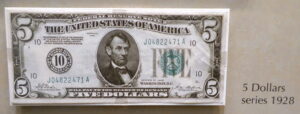
Walk into any major currency show and you will hear the same refrain from newer collectors hovering over dealer cases: “Is that the best grade available?” The assumption baked into that question is that lower grades are lesser notes, period. But spend a few years focused specifically on large-size United States currency, those magnificent oversized notes issued from the Civil War era through 1928, and your perspective shifts dramatically. A Fine-15 1882 Gold Certificate or a Very Fine-20 1880 Legal Tender can stop you cold in your tracks with its visual presence, historical gravity, and even a surprising amount of remaining detail. Understanding what circulated grades actually mean for large-size notes is one of the most practical skills any serious collector can develop.
The Grading Scale in Plain Language
Before diving into why Fine-15 deserves more respect, it helps to lay out the full circulated spectrum as it applies to large-size notes. The standard numerical scale used by Paper Money Guaranty (PMG) and PCGS Currency follows the Sheldon-derived 70-point system, and the circulated grades relevant to most large-size collectors break down like this:
- About Uncirculated (AU-50 to AU-58): Only the lightest handling or a single vertical fold separates these notes from true Uncirculated. Strong originality and paper quality throughout.
- Extremely Fine (EF/XF-40 to EF-45): Light folds visible but edges remain sharp. Excellent color retention. These are the workhorses of high-end large-size collecting.
- Very Fine (VF-20 to VF-35): Multiple folds evident, possibly some light soiling, but all design elements remain crisp and fully legible. Center folds are typical at this grade.
- Fine (F-12 to F-15): Clearly circulated with several folds and some body softness, but no major damage. Paper is still intact, portraits retain good detail, and color is typically still pleasing.
- Very Good (VG-8 to VG-10): Well worn with rounded corners and possible minor staining. Design still fully clear but softened significantly.
- Good (G-4 to G-6): Heavy wear, possible small edge nicks, design clear but flat. Usually the baseline for very rare notes where condition is secondary to existence.
Notice that Fine-15 sits at the upper boundary of the Fine range. It is not a heavily worn note. It has experienced genuine circulation, yes, but the defining characteristic of a Fine-15 is that the damage stops well short of anything destructive. Folds are present, body softness is noticeable, but tears, missing pieces, heavy staining, and repairs are absent. On a note measuring nearly seven and a half inches wide, that means you still have a lot of real estate to admire.
When evaluating large-size notes in circulated grades, always examine eye appeal separately from technical grade. A Fine-15 with original paper color, no pinholes, and strong ink saturation can photograph more beautifully than a technical VF-25 that has been pressed or cleaned. Ask dealers specifically whether a note has been processed before purchasing.
Why Large-Size Notes Are Different from Small-Size Currency
The rules that govern small-size note collecting, those issued from 1929 onward in the familiar 6.14 x 2.61 inch format, do not translate directly to the large-size world. Several factors make circulated grades far more acceptable and even desirable in the pre-1929 arena.
Survival rates are dramatically lower. A 1902 Date Back National Bank Note from a small Montana town may have had a total issue of only a few hundred notes. Even if every printed note survived, you would be dealing with a universe of perhaps a dozen or two known examples today. When rarity is this extreme, grade becomes subordinate to the simple question of whether the note exists at all. A Fine-15 example of Friedberg 598 (the 1902 Plain Back $10 National) from a defunct Kansas territorial bank is not a compromised collectible; it is a numismatic miracle.
The engraving quality is simply extraordinary. Large-size notes were produced during an era when the Bureau of Engraving and Printing employed master die sinkers whose work has never been surpassed. The portrait of George Washington on a Series 1880 Legal Tender $1 note (Fr. 29-38) features cross-hatching and stippling of such density that even a Fine-15 example retains visible dimensional modeling in the face. The vignette work on the 1896 “Educational Series” notes, including the famous allegorical figures by engraver Charles Schlecht from designs by Will H. Low, remains breathtaking in grades as low as Very Good. In Fine-15, these notes are magnificent.
The paper stock itself tells a story. Pre-Federal Reserve large-size notes were printed on high-quality linen-cotton blend paper that ages very differently from modern currency stock. Original uncleaned paper from 1875 or 1890 develops a warm ivory or honey tone that is part of the note’s character. A Fine-15 note with original surfaces and that aged paper color is infinitely preferable to a technically higher-graded note that has been cleaned, pressed, or chemically brightened.
Specific Examples: Fine-15 Notes Worth Celebrating
Let us get concrete about where Fine-15 grades represent genuine collecting value rather than compromise.
1882 Gold Certificates (Fr. 1200-1213)
The Series 1882 $100 Gold Certificate (Fr. 1205) features a striking yellow-orange Treasury seal and the portrait of Thomas H. Benton in an elaborate frame. In Uncirculated, this note commands $15,000 to $25,000 at major auction. A Fine-15 example, with its characteristic four-fold pattern and gently softened paper, can be acquired for $1,800 to $3,000, and the visual impact is still tremendous. The bright gold ink on the reverse loses almost nothing to moderate circulation.
1896 Silver Certificates (Fr. 224-225, 269, 270)
The Educational Series is arguably the most artistically ambitious currency the United States ever produced. The $1 note (Fr. 224-225) depicting “History Instructing Youth” by designer Edwin Blashfield, the $2 “Science Presenting Steam and Electricity” (Fr. 247-249), and the $5 “America” (Fr. 270) are all stars of the large-size world. In Fine-15, the central vignettes retain extraordinary detail. A Fine-15 Fr. 270 $5 Educational has traded at auction for $1,200 to $2,200 in recent years, compared to $9,000 or more in Uncirculated. For a note of this beauty, Fine-15 is a genuine bargain entry point.
1880 Legal Tender Notes (Fr. 29-183a)
The large red or brown Treasury seals on 1880 Legal Tender notes are among the most visually commanding design elements in American currency. In Fine-15, the seal color retention is often excellent because the ink formulation used by the BEP in this era was remarkably stable. A Fine-15 example of Fr. 144, the 1880 $50 Legal Tender with the large brown seal, might present with deep, warm color and virtually no fading despite its 140-plus years of age.
For 1880 and 1890 series Legal Tender and Silver Certificate notes, pay close attention to seal color when evaluating Fine-grade examples. Original seal color, whether large red, large brown, or small red, is a key value driver independent of the technical grade. A Fine-15 with vibrant original seal color can outperform a VF-20 with faded or oxidized seal color in both desirability and market value.
Signature Combinations and How They Affect Fine-Grade Collecting Strategy
Large-size currency carries Register of the Treasury and Treasurer of the United States signature combinations that vary by year of issue and significantly affect rarity. Among Legal Tender notes, for example, the Allison-Spinner combination (1869-1875) on Series 1869 “Rainbow” notes is considerably scarcer than the later Rosecrans-Nebeker pairing on 1880 series notes. This means that a Fine-15 Fr. 64 (the 1869 $10 “Rainbow” Legal Tender) occupies a very different market position than a Fine-15 Fr. 114 from 1880 of similar denomination.
Before purchasing any large-size note in circulated grades, identify the exact Friedberg number, which encodes the specific signature combination and variety. Two notes that look nearly identical to the untrained eye can differ by a factor of five or ten in catalog value based solely on whose signatures appear and whether the seal is the correct color for that Friedberg number. The 2022 edition of Robert Friedberg’s “Paper Money of the United States” (now in its 22nd edition) is the indispensable reference, and serious collectors should own a physical copy.
Grading Pitfalls for Large-Size Notes in Circulated Grades
Several problems disproportionately affect large-size notes and can cause a note to grade lower than expected or to be misrepresented by sellers.
Corner folds versus body folds: A corner fold, where only the corner tip has been turned over, carries far less grading penalty than a full diagonal body fold. Experienced buyers examine fold patterns carefully. A note with two moderate body folds but intact corners may grade Fine-15 or VF-20, while a note with extensive corner folding but a cleaner body might grade the same technically but present quite differently.
Pinholes: Pre-Federal Reserve era banking practice involved pinning notes to ledger sheets or bundling them with straight pins. Pinholes are common on large-size notes and, depending on their number and placement, are often noted as qualifiers by grading services (e.g., PMG Fine 15 Net or Fine 15 with comment “pinholes”). A single small pinhole away from the portrait area has minimal impact on value; multiple pinholes through the central design can drop market value significantly even at equivalent technical grades.
Cleaning and pressing: This is the most serious concern in the large-size market. Artificially brightened notes, those treated with solvents or pressed under heat to simulate higher grade, are not rare. PMG and PCGS Currency both note cleaning when detected, issuing grades with qualifiers such as “Apparent” or “Net.” Always favor third-party graded notes in slabs for any purchase above $200, and be especially cautious with raw notes offered at shows or online as “original” and “bright.”
Use ultraviolet light to detect cleaned or chemically treated large-size notes. Original paper fluoresces differently from paper that has been washed or treated with brightening agents. Many experienced dealers carry a UV penlight for exactly this purpose, and you should too. A small UV flashlight costs under $15 and can save you hundreds or thousands of dollars when evaluating raw circulated large-size notes.
Building a Circulated Large-Size Collection Strategically
For collectors who accept that Fine through Very Fine grades are not only legitimate but often the only practical path to certain notes, several collection strategies open up.
One popular approach is the “type set” strategy: acquire one example of each major large-size currency type in the best affordable grade. This would include Demand Notes (1861), Legal Tender Notes, National Bank Notes, Silver Certificates, Treasury or Coin Notes, Federal Reserve Notes (1914 and 1918 series), Federal Reserve Bank Notes, Gold Certificates, and the short-lived Refunding Certificates. A complete type set in Fine to Very Fine condition is achievable for a collector with patience and a budget of $10,000 to $30,000 over several years. The same set in Uncirculated would cost hundreds of thousands of dollars and several decades.
Another approach focuses on a single series pursued at depth across all denominations and signature varieties. The Series 1882 Brown Back National Bank Notes (Fr. 466-478), for example, are available in grades from Good through AU, and a dedicated collector building a state collection or a denomination collection within this series will find that Fine-15 and VF-20 examples provide a satisfying, complete set at manageable cost.
When building a circulated type set of large-size notes, prioritize eye appeal and originality over strict technical grade. A PMG Fine 15 note with strong color, no distracting problems, and original surfaces will outperform a VF-25 “NET” (problem note) in both enjoyment and resale. Budget collectors who focus on originality over grade rarely regret their purchases.
| Friedberg Number | Series and Type | Est. Fine-Grade Examples Known | Rarity |
|---|---|---|---|
| Fr. 1 (Demand Note) | 1861 $5 Demand Note, New York | Fewer than 40 in all grades | Key Date |
| Fr. 270 | 1896 $5 Educational Silver Certificate | Approx. 150-200 in circulated grades | Rare |
| Fr. 1205 | 1882 $100 Gold Certificate | Approx. 80-120 surviving examples | Rare |
| Fr. 144 | 1880 $50 Legal Tender, Large Brown Seal | Approx. 200-300 in circulated grades | Scarce |
| Fr. 379e | 1902 Plain Back $10 National, Rare State Banks | Varies by charter; some under 5 known | Key Date |
| Fr. 224 | 1896 $1 Educational Silver Certificate | Approx. 600-900 in circulated grades | Scarce |
| Fr. 114 | 1880 $10 Legal Tender, Rosecrans-Nebeker | Approx. 1,000-plus surviving | Common |
| Fr. 1223 | 1922 $100 Gold Certificate | Several thousand in circulated grades | Common |
| Fr. 64 | 1869 $10 “Rainbow” Legal Tender | Approx. 100-180 in circulated grades | Rare |
| Fr. 466-478 (Brown Back Nationals) | 1882 $5-$100 Brown Back Nationals, Common States | Thousands surviving across charter varieties | Common |
Market Realities: What Fine-15 Actually Costs
The price gap between circulated and uncirculated large-size notes is one of the most dramatic in all of paper money collecting, and it works heavily in favor of the circulated buyer. Consider the 1896 $2 Educational Silver Certificate (Fr. 247). In PMG VF-20, recent Heritage Auctions results show prices in the $900 to $1,500 range. The same note in PMG Uncirculated 63 has realized $7,000 to $12,000. For a collector who prioritizes the artistic and historical experience of owning this masterwork of American engraving, the VF-20 provides roughly 90 percent of the visual satisfaction at 15 to 20 percent of the cost.
The calculus becomes even more compelling when rarity intersects with grade. Consider the 1880 $500 Legal Tender Note (Fr. 185b), one of the great rarities in American paper money. Only a handful of examples are known in any grade. A collector who encounters a Fine-15 or Very Good-10 example and passes on it waiting for a higher grade may wait a lifetime. In these extreme cases, the philosophy of grade-first collecting is not merely expensive; it is self-defeating.
Conclusion: Grade Is Context, Not Character
The grade of a large-size United States note tells you about its journey through American economic life: how many hands held it, how many cash drawers it rested in, how many transactions it facilitated across the decades. A Fine-15 note has lived a full life. It has been used as money in the truest sense, which is, after all, what it was made for.
For collectors at every level, the message is consistent: evaluate large-size notes holistically. Look at originality, eye appeal, color vibrancy, portrait detail, and historical significance alongside the technical grade. A Fine-15 1882 Gold Certificate with original paper, vivid orange seal, and no problems is not a lesser note. It is, in many ways, exactly what paper money collecting is supposed to feel like: the tangible intersection of art, history, and commerce held in your hands across more than a century of American life.