📷 Image source: banknote.ws (World Banknote Gallery). Images are selected by AI to represent the article topic and may not depict the exact note(s) described.
Walk into any major currency auction and watch what happens when a large-size Gold Certificate in Choice Uncirculated or better crosses the block. Bidders who spent weeks researching print runs and Friedberg numbers suddenly find themselves chasing condition, not rarity. A Series 1922 $10 Gold Certificate (Fr. 1173) with a print run in the millions can hammer for ten times its catalog value if graded PMG 65 EPQ, while a legitimately scarce Series 1882 $100 (Fr. 1210) in Fine-12 sits politely at a fraction of its theoretical worth. That paradox is not an accident. It is the defining characteristic of the large-size Gold Certificate market, and understanding it will change how you approach every purchase, every trade, and every submission you make.
A Brief History of Large-Size Gold Certificates
The United States issued Gold Certificates continuously from 1865 through the large-size era, which ended with the transition to small-size notes in 1928. The first series authorized under the Act of March 3, 1863 circulated almost exclusively among banks and clearing houses. Public circulation did not become widespread until the Series 1882 issues, which introduced the bold orange-gold seal and the portrait designs that collectors recognize today. The Series 1905 and 1906 issues brought one of the most visually striking designs in American currency history, the $20 Technicolor note (Fr. 1180), featuring a rose-colored back. By the Series 1922 issues, Gold Certificates had become the most widely circulated gold-backed currency in everyday American commerce, remaining so until President Roosevelt’s Executive Order 6102 in April 1933 required their surrender.
That surrender order is the single most important fact for condition collectors to internalize. Unlike Federal Reserve Notes or Silver Certificates, Gold Certificates were called in and destroyed by the millions. Citizens who held them had strong legal and financial incentive to exchange them, meaning notes that survived did so largely by accident: forgotten in estate drawers, saved as novelties, or tucked away by dealers and collectors who quietly ignored the order. The survivors were not, as a rule, carefully preserved high-grade examples. They were the strays, and most of them show it.
Why Paper Quality Is the Starting Point for Every Grade
Before a grader looks at fold lines, soiling, or margins, they assess paper quality, and on Gold Certificates this is uniquely challenging. The Bureau of Engraving and Printing used a high-rag-content paper stock for large-size notes, but Gold Certificates were printed with heavy ink coverage on both sides. The gold seal, the ornate backs, and the dense portrait work all deposited substantial ink onto the sheet. Over decades, that ink load makes paper more brittle and prone to splitting along fold lines. A Gold Certificate that was folded in a wallet for even a brief period often shows a crease that has actually cracked the paper fibers, resulting in a visible white line that a comparable Silver Certificate fold would not produce.
When examining a Gold Certificate in hand, hold it at a 45-degree angle to a strong raking light source before you evaluate any fold lines. Paper fiber separations, sometimes called “breaks,” appear as bright white lines distinct from simple compression creases. A break automatically limits a note’s grade ceiling, typically to Fine-15 or below under PMG standards, regardless of overall eye appeal.
The EPQ designation, which stands for Exceptional Paper Quality under PMG’s system (PCGS Currency uses PPQ, Premium Paper Quality), is not merely a marketing badge. On Gold Certificates it represents a genuinely rare survival characteristic. Population reports from PMG as of recent years show that for the Series 1906 $20 (Fr. 1181), there are hundreds of graded examples in the VF-20 through EF-40 range, but only a small fraction carry the EPQ qualifier. The note simply circulated too hard and too long for most survivors to retain original paper integrity.
Series-by-Series Grading Considerations
Series 1882 Issues (Fr. 1178 through Fr. 1218)
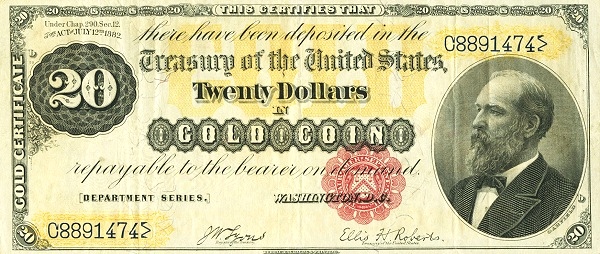
The 1882 series spans denominations from $20 through $10,000, with the higher denominations representing some of the most condition-sensitive notes in all of American currency. The $50 (Fr. 1196 through Fr. 1198, varying by signature combination) is a perfect case study. Lyons-Roberts and Lyons-Treat signatures are the most common pairings, and even so, locating an example above Very Fine-30 with original paper requires patience. The $100 denomination (Fr. 1203 through Fr. 1218) in grades of AU-50 or better is legitimately rare, with PMG populations in those grades often numbering in single digits per signature variety. The $500 and $1,000 denominations in the 1882 series are so seldom seen in any grade above Fine that the grading discussion becomes almost theoretical for most collectors.
Series 1905 and 1906 $20 Gold Certificates
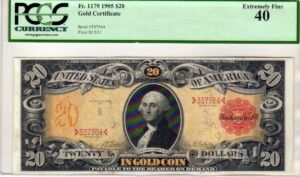
The so-called “Technicolor” $20 (Fr. 1180, Series 1905) deserves special discussion. With a printed face featuring a portrait of George Washington set against red and gold, and a back printed in vivid rose-red, this note fades with exposure to light and develops toning patterns unlike any other issue. Collectors prize fully original color examples with bright rose backs as a specific subset of condition collecting. A PMG 63 EPQ example of Fr. 1180 with vibrant original colors will substantially outperform a PMG 64 example that has experienced color fade or light toning. The Series 1906 follow-up (Fr. 1181 through Fr. 1187, spanning multiple signature combinations from Lyons-Roberts through Vernon-Treat) dropped the rose back for a more conventional gold design, but remains highly condition-sensitive due to the same heavy ink characteristics.
For the Series 1905 $20 “Technicolor” note (Fr. 1180), always request high-resolution scans of the back before purchasing. Faded rose backs are common and can be difficult to detect in standard catalog photography. Original color on this note is a condition premium in its own right, sometimes adding 50% or more to realized prices compared to a faded example of the same assigned grade.
Series 1907 $10 Gold Certificates (Fr. 1167 through Fr. 1172a)
The $10 denomination of 1907 is one of the most accessible entry points in large-size Gold Certificates, with the Teehee-Burke signature combination (Fr. 1172) representing the highest print volumes of the group. Even so, Choice Uncirculated examples are genuinely scarce, and PMG 65 EPQ examples are legitimately rare for any signature variety in this series. Collectors new to the series often underestimate how difficult it is to find an example without a center fold, since the $10 note was the most frequently circulated denomination of the entire large-size Gold Certificate family.
Series 1922 Issues (Fr. 1173, Fr. 1174, Fr. 1178a, etc.)
The Series 1922 issues represent the final and most heavily printed large-size Gold Certificates, with the $10 (Fr. 1173, Speelman-White signatures) and $20 (Fr. 1187) accounting for enormous print runs well into the tens of millions. In circulated grades, these notes are genuinely common. But condition rarity asserts itself sharply above EF-40. The 1933 recall eliminated most high-grade survivors, and the notes that escaped tended to be lower-denomination examples that had already seen significant pocket wear. Finding a Series 1922 $10 in PMG 66 EPQ or better is a meaningful numismatic achievement, and auction records reflect it.
Grading Specific Defects: What Affects Gold Certificates Most
Beyond fold lines and paper breaks, several defects are disproportionately common on Gold Certificates relative to other large-size types. Ink smears and plate skips occur more frequently because of the heavy ink coverage required for the gold seal and ornate backs. Rubber band impressions appear on survivors that were bundled in estate holdings for decades. Staple holes and pin holes are especially damaging to Gold Certificate values because they suggest the note was treated as a document rather than as currency, a sign of prolonged casual storage. Edge nicks and splits, while penalized on any large-size note, carry additional weight here because the heavy paper stock tends to split rather than tear cleanly, creating jagged margins that are difficult to ignore even at arm’s length.
Rubber band impressions are among the most underappreciated condition problems on Gold Certificates, particularly on the 1882 and 1905 series where the paper has had over a century to absorb the impression. What looks like a faint discoloration in a scan can be a deep physical groove in hand. Before submitting a raw note for grading, examine both the face and back in raking light to identify any linear impressions running parallel to the short axis, which is the classic rubber band orientation.
Population Data and What It Tells Us About Condition Rarity
PMG’s online population report is one of the most powerful research tools available to Gold Certificate collectors, and it rewards careful analysis. Consider the Series 1882 $50 Gold Certificate (Fr. 1196, Lyons-Roberts): across all grades, total graded examples may number fewer than 75 to 100 notes. Of those, perhaps five to eight grade at EF-40 or above. That is classical issue rarity combined with condition rarity, and the market prices it accordingly, with EF examples selling for multiples of a Fine-12 specimen. Now compare that to the Series 1922 $20 (Fr. 1187): thousands of graded examples exist, making it easy to find a circulated note at reasonable cost. But PMG 64 EPQ and above populations are tiny. In 2022 and 2023 auction results, PMG 65 EPQ examples of Fr. 1187 achieved realized prices of $4,500 to $7,500, while average circulated VF examples of the same note trade for $150 to $300. The print run tells you almost nothing about those prices. Condition tells you everything.
The EPQ and PPQ Premium: Quantifying the Condition Premium
Collectors who have tracked Heritage Auctions, Stack’s Bowers, and Lyn Knight results over the past decade have documented EPQ premiums on Gold Certificates that routinely exceed those seen on other large-size types. For an 1882 $20 (Fr. 1178) in EF-40, a non-EPQ example might bring $800 to $1,200. The same note with EPQ can reach $2,500 to $3,500, a premium of 100% to 200%. For the Series 1906 $20 in Choice CU-63 range, the EPQ gap is even more pronounced because so few examples exist with fully original paper at that grade level. The practical implication for collectors is straightforward: when budgeting for a Gold Certificate purchase, weight condition over rarity in your allocation of funds. A common-issue note in superb condition is typically a sounder long-term hold than a rare-issue note in mediocre condition.
| Friedberg / Series | Denomination and Notes | Est. Pop. EF-40+ | Condition Rarity |
|---|---|---|---|
| Fr. 1180 (1905) | $20, “Technicolor,” Lyons-Roberts | Approx. 30 to 50 known | Key Date |
| Fr. 1196 (1882) | $50, Lyons-Roberts signatures | Approx. 6 to 10 known | Key Date |
| Fr. 1210 (1882) | $100, Lyons-Roberts signatures | Approx. 4 to 8 known | Key Date |
| Fr. 1167 (1907) | $10, Vernon-McClung signatures | Approx. 20 to 35 known | Rare |
| Fr. 1172 (1907) | $10, Teehee-Burke, highest print run | Approx. 60 to 90 known | Scarce |
| Fr. 1181 (1906) | $20, Lyons-Roberts, common issue | Approx. 40 to 65 known | Scarce |
| Fr. 1173 (1922) | $10, Speelman-White, large print run | Approx. 150 to 200 known all grades | Scarce |
| Fr. 1187 (1922) | $20, Speelman-White, highest mintage | Approx. 80 to 120 known EF+ | Scarce |
| Fr. 1178 (1882) | $20, Lyons-Roberts, circulated survivors | Common below VF, scarce above | Common (Circ.) |
| Fr. 1178a (1922) | $50, Speelman-White signatures | Approx. 15 to 25 known EF+ | Rare |
Practical Grading Checklist for Gold Certificate Buyers
Whether you are evaluating a raw note at a show or scrutinizing scans before bidding online, work through the following assessment in order. First, evaluate paper integrity: look for breaks, splits, and rubber band impressions before anything else. Second, assess the seal color: the gold seal should show bright, even coloration without fading or ink transfer. Third, examine the margins: large-size Gold Certificates should have four clear borders with no design elements touching or cutting into the printed area. Fourth, look at the back: the ornate back designs are excellent condition indicators because they show wear, soiling, and handling marks with unusual clarity on Gold Certificates. Fifth, verify that any folds are simple compressions rather than hard creases with fiber separation. Sixth, check for any evidence of cleaning, pressing, or restoration, which can artificially improve appearance while masking underlying damage.
When comparing two graded Gold Certificates of the same Friedberg number and grade, always check the holder generation and grading date if available. PMG and PCGS Currency have both tightened their EPQ and PPQ standards over the years. A note graded PMG 63 EPQ in 2008 may not have qualified for EPQ under 2018 or later standards. Older holder generations for the same grade designation can sometimes represent slightly more lenient assessments, which matters when you are comparing two holders for a potential purchase or trade.
Building a Condition-Focused Gold Certificate Collection
A practical strategy for new collectors entering this market is to start with Series 1922 issues in the EF-40 to AU-55 range with EPQ, where the cost of entry is manageable and the condition upgrade path is clear. As your budget grows and your eye develops, move toward the 1906 and 1907 series in the same grade band. Reserve the 1882 series for targeted, patient purchases where you can afford to wait for the right example rather than settling for a problem note. Experienced collectors building type sets often choose one or two condition highlights across the series rather than attempting comprehensive coverage, because the cost of assembling the 1882 high-denomination issues in presentable grades is prohibitive for most budgets.
The large-size Gold Certificate series rewards patience, education, and a willingness to let issue rarity take a backseat to what the market genuinely values above all else: a note that survived over a century in America’s most turbulent monetary era with its paper, its color, and its dignity intact. Those are not common notes regardless of what the print run ledgers say. And when you find one, the grade is not just a number. It is the whole story.