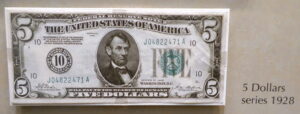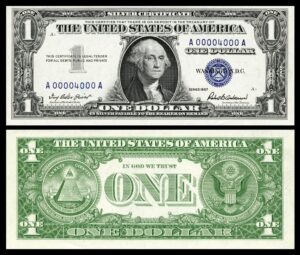
📷 Image source: banknote.ws (World Banknote Gallery). Images are selected by AI to represent the article topic and may not depict the exact note(s) described.
The Blue Seal Problem Every Silver Certificate Collector Eventually Faces
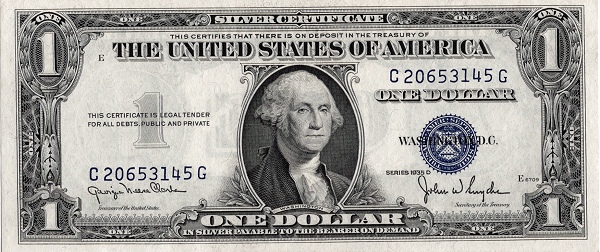
You pull a 1935A Silver Certificate from an old album and hold it to the light. The note has crisp paper, sharp corners, and original embossing. But the blue Treasury seal looks a little washed out, somewhere between cornflower and sky blue instead of the deep cobalt you expect. Is this a problem? Will a grading service penalize it? Is it worth submitting at all?
This is one of the most common and genuinely tricky questions in U.S. paper money grading. Silver Certificates, issued from 1878 through the 1963 series, carry a blue Treasury seal and blue serial numbers that are chemically distinct from the green ink used on Federal Reserve Notes. That blue ink is more photosensitive and more reactive to atmospheric conditions than many collectors realize, and the difference between a naturally toned example and a chemically washed or improperly stored note is not always obvious at first glance.
A Brief History of the Blue Seal on Silver Certificates
Silver Certificates were authorized by the Act of August 4, 1886, and the large-size issues through the 1923 series carried the blue seal that would become synonymous with the denomination. When the Bureau of Engraving and Printing transitioned to small-size notes following the Currency Act of 1929, the blue seal carried over as the defining visual element of the Silver Certificate class.
The small-size series runs from the 1928 series (Fr. 1600 through Fr. 1607 for $1 notes) all the way through the 1963 series $1 note (Fr. 1621). The $5 Silver Certificates run from Fr. 1650 through Fr. 1657, and the $10 issues carry Friedberg numbers Fr. 1700 through Fr. 1708. Each of these notes used a blue ink formulated from a combination of Prussian blue pigments and binding agents that were susceptible to light, humidity, and certain household chemicals, including many of the adhesives used in mid-20th-century plastic currency albums.
The 1957 series $1 Silver Certificate (Fr. 1619 and Fr. 1619 star notes) represents the last widely circulated issue and also the series most commonly encountered with seal color problems, simply because billions were printed and many spent decades stored under less-than-ideal conditions. The 1957 series had a combined print run exceeding 2.6 billion notes for the standard issue alone, and a significant portion of surviving examples show some degree of seal color variation.
Understanding What Causes Each Type of Color Change
Natural Toning: What It Looks Like and Why It Happens
Natural toning on Silver Certificate blue seals typically appears as a subtle shift toward a slightly greenish-blue or slate-blue hue. The color change is uniform across the seal face, and the serial numbers tend to show the same tonal shift. Critically, the underlying ink retains its saturation and depth. You are looking at a color that has shifted slightly, not at ink that has lost body or coverage.
This type of toning results primarily from slow oxidation of the iron compounds in the ink, combined with minor absorption of sulfur compounds from the paper itself. Notes that were stored in paper envelopes, cotton albums, or archival folders often develop this character over decades. A 1935D Silver Certificate (Fr. 1613 or Fr. 1614 with the motto addition) stored in a cedar chest for 60 years might show exactly this kind of toning, and professional grading services at both PMG and PCGS Currency generally treat it as a neutral to mildly positive attribute on high-grade examples, not a reason to reduce the numeric grade or assign a qualifier.
When examining a Silver Certificate for natural toning, compare the seal color against the serial numbers on the same note. If both have shifted in the same direction and to roughly the same degree, the color change is almost certainly environmental and natural. Mismatched toning between the seal and serials is a red flag for cleaning or chemical exposure.
Problematic Fading: The Signs That Hurt a Grade
Fading that affects grade is a different matter entirely. True fading involves actual pigment loss, not just oxidation shift. Under magnification, faded ink shows a speckled or granular appearance where pigment particles have been removed or bleached. The color looks thin, with areas of near-white paper visible through what should be solid ink coverage. On the seal face, the fine line details of the eagle or lathe-work design may be less distinct than on a comparable un-faded example.
The most common causes of grading-relevant fading are UV exposure (sunlight through window glass is especially damaging), contact with PVC-based album pages, exposure to household cleaning chemicals in the storage environment, and deliberate washing by a previous owner attempting to improve the note’s apparent cleanliness. That last cause is the most serious: washed notes are considered “processed” or “altered” by grading services and will receive a details designation regardless of how attractive they look to the naked eye.
A 1934A $10 Silver Certificate (Fr. 1703) with a washed or UV-faded seal might grade anywhere from VF Details to EF Details depending on the paper quality, while an untouched example in the same physical condition might grade PMG 35 or PMG 40 Choice Very Fine outright. The price difference between a straight grade and a details note in that range can be $150 to $400 depending on the signature combination.
PVC Migration: The Silent Killer of Blue Seals
One of the least discussed but most pervasive causes of seal color damage is PVC migration from older plastic currency holders. Albums and sleeves manufactured before the widespread adoption of Mylar and archival polyethylene in the 1990s frequently used polyvinyl chloride as the base plastic. Over time, plasticizers in PVC migrate outward as an oily residue that coats the note’s surface. On green ink, this residue is often invisible. On blue ink, it can cause a characteristic gray-green discoloration or a patchy, mottled fading pattern.
Silver Certificates stored in pre-1990s Whitman or H.E. Harris albums are particularly at risk, and many 1935 and 1957 series notes that appear in dealers’ stocks and online auctions today bear exactly this kind of damage. The fading is irreversible, and if it has penetrated the paper fibers, no conservation treatment can fully restore the original color.
If you acquire Silver Certificates from older collections stored in vintage plastic albums, remove them immediately and place them in archival-quality Mylar D or polyethylene holders. Even brief additional time in a PVC environment can deepen existing damage. Examine the reverse of each note for any oily sheen, which is an early indicator of active PVC migration before visible discoloration appears.
How PMG and PCGS Currency Grade Seal Fading
Both major third-party grading services address seal color under their broad criteria for paper quality and originality. PMG’s published standards state that any evidence of chemical treatment or cleaning results in a “Details” designation, regardless of the numeric grade that would otherwise apply. PCGS Currency uses similar language in their grading standards, with the term “Apparent” applied to notes showing signs of alteration.
For natural toning, both services generally follow the same principle: if the toning is even, consistent with the note’s age and storage history, and does not obscure design elements, it is noted as a neutral factor. On very high-grade notes (PMG 65 EPQ or above), even natural toning can prevent the coveted EPQ (Exceptional Paper Quality) or PPQ (Premium Paper Quality) designation, because EPQ and PPQ require the paper and inks to be fully original and undisturbed. A 1957 $1 Silver Certificate with beautiful, even toning might grade PMG 65 but not PMG 65 EPQ, which in the current market represents a meaningful value difference. A PMG 65 EPQ 1957 $1 (Fr. 1619) commonly sells for $35 to $60, while the same note in PMG 65 without EPQ might bring $18 to $28.
The 1934 series $1 Silver Certificates present a particular challenge. These notes, covering Friedberg numbers Fr. 1606 and Fr. 1607, were printed on paper that is now 85 to 90 years old, and natural toning on high-grade survivors is extremely common. Graders understand this and do not penalize appropriate age toning. What they do penalize is fading that suggests intervention, storage damage, or selective bleaching.
The Ultraviolet Test: Your Most Valuable Diagnostic Tool
A shortwave or longwave ultraviolet lamp is the single most useful tool for evaluating Silver Certificate seal color. Under UV light, original blue ink fluoresces in a characteristic way, typically appearing as a slightly brightened or contrasting tone against the paper. Washed or chemically treated ink loses this fluorescence partially or completely, appearing flat or dark where it should glow.
PVC-damaged areas often show an uneven fluorescence pattern, with affected zones appearing markedly different from surrounding ink. Natural toning, by contrast, typically does not disrupt the UV fluorescence signature of the ink, because the underlying pigment is intact.
A good 365-nanometer longwave UV lamp costs between $15 and $40 and is one of the best investments a currency collector can make. When buying any Silver Certificate valued above $50 raw, UV examination should be considered mandatory before purchase.
When using a UV lamp to evaluate seal color, always examine both the seal and the serial numbers together. Original notes will show consistent fluorescence across all blue ink elements. If the seal fluoresces normally but the serials appear dull or dead, the serial numbers may have been touched up, which is a form of alteration that grading services treat very seriously. The reverse scenario, a dull seal with normal serials, usually points to localized UV exposure or targeted cleaning.
Large-Size Silver Certificates: A Different Challenge
Large-size Silver Certificates, particularly the popular 1886, 1891, 1896 Educational series, and 1899 issues, present related but distinct grading considerations. The 1896 $1 “History Instructing Youth” (Fr. 224 through Fr. 226) and $2 “Science Presenting Steam and Electricity” (Fr. 247 through Fr. 249) are among the most visually dramatic notes in American currency history, and their blue seals are subject to the same fading and toning dynamics as small-size issues.
On large-size notes, the older printing inks are generally more stable than small-size era formulations, but they are also much harder to replace or restore without detection, so altered large-size examples tend to be more obvious to experienced graders. A problem-free Fr. 224 in VF condition currently trades in the $2,500 to $3,500 range. A details-graded example of the same note, even with attractive eye appeal, typically sells at a 40 to 60 percent discount.
| Series / Fr. Number | Denomination and Notes | Approximate Print Run | Rarity |
|---|---|---|---|
| 1957 / Fr. 1619 | $1, standard issue, highest volume | 2,609,600,000 | Common |
| 1957B / Fr. 1621 | $1, final SC series, Granahan-Dillon | 458,880,000 | Common |
| 1935A / Fr. 1608 | $1, WWII era, wide distribution | 6,111,832,000 (all suffix varieties) | Common |
| 1934 / Fr. 1606 | $1, Julian-Morgenthau signature | 682,176,000 | Scarce in high grade |
| 1934A / Fr. 1703 | $10, Julian-Morgenthau, common fading | Est. 105,000,000 | Scarce |
| 1934B / Fr. 1704 | $10, Julian-Vinson, low print run | Est. 4,982,400 | Rare |
| 1934C / Fr. 1651 | $5, Julian-Snyder signature pair | Est. 7,200,000 | Rare |
| 1896 / Fr. 224 | $1 Educational, any grade, toning common | Est. under 10,000,000 | Rare |
| 1891 / Fr. 223 | $1, large-size, Tillman-Morgan sigs | Est. under 5,000,000 | Key Date |
| 1928 / Fr. 1600 | $1, first small-size SC, Woods-Mellon | 638,296,908 | Scarce in Gem |
Practical Grading Scenarios: Real-World Examples
Consider a 1935D $1 Silver Certificate (Fr. 1613, no motto) submitted to PMG. The note has four sharp corners, strong paper, and no folds. The blue seal has an even, slightly greenish shift consistent with 70-plus years of age. PMG would almost certainly grade this note in the 63 to 65 range, and if the paper quality supports it, award the EPQ designation. The green tonal shift would be noted but would not trigger a qualifier.
Now consider the same physical condition note, but with a patchy, lighter area on the right side of the seal and a slightly bleached appearance to two of the serial number digits. This pattern is consistent with a localized chemical cleaning or a PVC contact point. PMG would grade this note EF Details or AU Details, depending on paper body, with a “Apparent: Cleaned” or “Apparent: Chemical Alteration” qualifier. The collector who paid $45 for the note in “About Uncirculated” condition just bought something worth $12 to $18 in the details market.
The financial stakes get considerably higher on star notes. A 1935A $1 star note (Fr. 1608 star) in PMG 65 EPQ with full, vibrant blue seal color sells for $125 to $200 in today’s market. The same note with a faded seal in PMG 65 Details would bring $25 to $40. On genuinely scarce varieties like the 1934B $10 (Fr. 1704), the gap between a clean straight-grade VF and a details VF can exceed $1,000.
Conclusion: Train Your Eye Before You Open Your Wallet
Evaluating blue seal color on Silver Certificates is a skill that develops with deliberate practice and exposure to a wide range of examples. The best way to train your eye is to handle as many certified examples as possible, comparing seal colors across grades and varieties. Major shows like the ANA World’s Fair of Money and the FUN Convention always have dealer tables with dozens of slabbed Silver Certificates available for comparison, even if you are not buying.
The core principle is straightforward: natural toning is a slow, even, chemically logical change that affects the whole note consistently, while problematic fading is localized, uneven, or inconsistent with the note’s apparent storage history. When in doubt, use your UV lamp, match seal tone against serial number tone, and trust your instincts. A well-preserved Silver Certificate with honest age toning is always preferable to a bright-looking note that has been chemically compromised. The market agrees, grading services agree, and after a little practice, your eye will agree too.