Written in Ink, Pressed in Steel: The Story Behind Every Signature on US Paper Money
Pick up any piece of United States paper money, old or new, and two names stare back at you from the face of the note. Most people glance past them without a second thought. But for currency collectors, those signatures, the facsimile autographs of the Treasurer of the United States and the Secretary of the Treasury, are among the most important identifying features on the entire note. They determine series dates, separate common pieces from rare treasures, and document nearly 160 years of American monetary history.
The journey from hand-penned autographs on individually signed Civil War demand notes to the laser-precise engraved facsimiles on today’s Federal Reserve Notes is a fascinating one. Along the way, collectors encounter forged signatures, transition-period oddities, printing blunders, and a cast of real human beings whose pen strokes now define some of the most coveted pieces in American numismatics.
The Beginning: Hand-Signed Demand Notes (1861)
The story begins under extraordinary circumstances. In August 1861, with the Civil War raging and the federal government desperately short of hard currency, Congress authorized the first general-circulation United States paper money: the Demand Notes. These notes, issued in denominations of $5, $10, and $20, bore a design feature that would never appear again on American currency, actual handwritten signatures applied in pen and ink by Treasury Department clerks.
The notes were supposed to carry the signatures of the Register of the Treasury and the Treasurer of the United States, but the sheer volume of notes needed outpaced what those two officials could physically sign. The Bureau of Engraving and Printing (then not yet formally established as such) employed dozens of clerks who signed “for the” respective official. This is why Demand Notes are collected in varieties based on which clerk signed them, with Friedberg catalog numbers distinguishing “for the” signatures from the rarer autographs of the officials themselves.
Spinney’s research has documented at least 18 distinct clerk signatures for the Register’s position alone on the 1861 $5 Demand Note. Original fine-condition examples catalog in the Friedberg guide from roughly $1,500 for common signature combinations to well over $8,000 for the scarcer pairings. A note bearing an actual autograph of Register Lucius Chittenden is considered exceptional.
When examining 1861 Demand Notes, use magnification to determine whether signatures were applied by pen or are early printed facsimiles. Genuine hand-signed examples show ink feathering and slight pressure variations under 10x magnification. The difference in catalog value between a signed and unsigned variety on the $10 Demand Note (Fr. 7 vs. Fr. 6) can exceed $3,000 in the same grade.
Legal Tender Notes and the Gradual Move to Printed Signatures (1862 to 1869)
When Congress authorized United States Notes (Legal Tender Notes) beginning in February 1862, the Treasury faced the same logistical problem at even greater scale. The first series of Legal Tender Notes still required handwritten signatures, and once again clerks were employed to sign on behalf of officials. The 1862 and 1863 series $1 and $2 notes are particularly well documented for signature varieties, with Friedberg numbers Fr. 16 through Fr. 23 encompassing multiple Register and Treasurer pairings on the $1 denomination alone.
The transition toward printed signatures happened gradually and was not uniform across all note types simultaneously. The Series of 1869 United States Notes, the famous “Rainbow Notes” with their vibrant polychrome printing, introduced fully engraved facsimile signatures for the Register and Treasurer positions. These engraved signatures were part of the intaglio printing plate itself, pressed into the paper with the same recessed-plate precision as the portraits and border work.
The pairing on the 1869 series was Register John Allison and Treasurer Francis Spinner, whose distinctive signature, often described as a series of wavy lines that he developed deliberately to prevent forgery, appears on notes across multiple series from 1861 to 1875. Spinner reportedly claimed his signature was impossible to forge; historians have noted it looks barely legible even as an original.
Understanding How Signature Combinations Define Series and Varieties
By the 1870s and into the large-size note era that lasted through 1928, the signature combination became the primary mechanism for distinguishing note series and varieties within series. The rule that a new Secretary of the Treasury signature triggers a new series letter (or series year) has governed United States currency ever since. A change in the Treasurer’s signature alone creates a new variety within the same series.
Consider the Series of 1902 National Bank Notes: the plain-back variety with the signatures of Napier and Thompson (Friedberg Fr. 689 to Fr. 709) is substantially more available than the Napier-Burke combination on the same design. Collectors tracking down complete signature-combination sets for a single denomination of National Bank Notes are engaged in one of the most challenging pursuits in American numismatics, because print run data for specific signature pairings at specific banks often simply does not exist.
The Friedberg catalog, now in its 22nd edition, is the essential reference for large-size United States currency, organizing notes primarily by signature combination. However, for National Bank Notes, the Hickman-Oakes catalog (“Standard Catalog of National Bank Notes”) provides bank-specific data that Friedberg does not. Serious collectors of National Currency own both references.
The Large-Size Era: A Golden Age for Signature Collectors (1874 to 1928)
The large-size note era produced the richest variety of signature combinations in American currency history. Between 1874 and 1928, United States currency was signed by 23 different Secretaries of the Treasury and 13 different Registers or Treasurers, creating dozens of distinct pairings across multiple note types. Some combinations appeared on only a single denomination or type, making them exceptionally rare today.
Among the most celebrated rarities defined by signature combinations is the Napier-McClung pairing on Series 1907 $20 Gold Certificates (Fr. 1185). James McClung served as Treasurer for only a brief period from 1906 to 1907, and the overlap of his tenure with the printing of $20 Gold Certificates was extremely limited. Fewer than a dozen examples are confirmed in collector hands. A PMG Very Fine 25 example sold at Heritage Auctions in 2019 for $74,750.
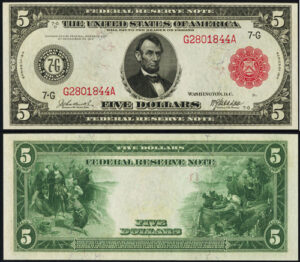
The Parker-Burke combination on large-size Federal Reserve Notes (Series 1914) is another signature-defined rarity. James Parker served as Treasurer from 1908 to 1912 and his overlap with William McAdoo’s tenure as Secretary created notes that, for certain Federal Reserve districts and denominations, are virtually unknown. The Dallas district $50 with Parker-Burke signatures (Fr. 1034) is listed in the Standard Catalog as an “extremely rare” note with only a handful of confirmed survivors.
Small-Size Currency and the Standardization of Engraved Signatures (1928 to Present)
The shift to small-size currency in 1928 brought a more formalized system. Engraved facsimile signatures were by this point completely standard, and the redesigned small-size format locked in a consistent two-signature system: Treasurer of the United States on the left, Secretary of the Treasury on the right. This arrangement has been maintained on all Federal Reserve Notes through the present series.
In the small-size era, series dates are tied specifically to Secretary of the Treasury changes, while a Treasurer change creates a series suffix letter. Thus, the Series 1934 $100 Federal Reserve Note with Julian-Morgenthau signatures (the most common) differs from the rarer Julian-Vinson (1945) and the Julian-Snyder (1946) pairings. The Julian-Vinson $100 in particular had a much shorter print window due to Vinson’s relatively brief tenure, and star note examples of this combination command significant premiums.
The 1963 series brought a curious and notable change: for the first time since the 19th century, the title “Register of the Treasury” disappeared from United States currency entirely. The position of Register, which had existed since 1778, was eliminated as a currency-signing authority. From 1963 forward, the two signatures appearing on Federal Reserve Notes have been those of the Treasurer of the United States and the Secretary of the Treasury, the pairing familiar to modern collectors.
For small-size Federal Reserve Notes, the signature combination also interacts with Federal Reserve district to create collecting possibilities that multiply quickly. The Series 1934A $1,000 Federal Reserve Note with Julian-Morgenthau signatures exists for all 12 districts, but the print runs varied enormously. The Minneapolis district example had a printing of roughly 1,200 notes compared to over 200,000 for the New York district, making district-complete signature-combination sets a genuine challenge for high-denomination collectors.
Notable and Historically Significant Signature Combinations
Several signature pairings carry historical significance beyond their numismatic rarity. Ivy Baker Priest, who served as Treasurer from 1953 to 1961 under President Eisenhower, became the first woman whose signature appeared on general-circulation US currency at massive scale. Her name, paired with Secretary George Humphrey and later Robert Anderson, appears on billions of small-size Federal Reserve Notes from the Series 1953 and 1957 issues. Despite the enormous print runs, the symbolism of her inclusion was noted at the time.
Katherine Sullivan, who served as Treasurer from 2020 to 2021, signed notes with Secretary Steven Mnuchin for a brief overlapping period, and those Sullivan-Mnuchin combinations on Series 2017A notes are already being tracked by collectors for their relatively limited production window. Similarly, the forthcoming Harriet Tubman $20 note, once issued, will introduce a new portrait design and an entirely new signature combination that will be closely watched from the first printings.
How to Authenticate and Grade Signatures on Older Notes
For pre-1869 notes with genuine hand-applied signatures, authentication involves several considerations. Genuine ink signatures on Demand Notes and early Legal Tender Notes will show period-appropriate iron gall ink, which often browns slightly with age and shows feathering where the pen nib splayed on the paper fibers. Ultraviolet examination can reveal later additions or ink substitutions.
Third-party grading services including PMG (Paper Money Guaranty) and PCGS Currency examine signatures as part of their grading process. A note with a faded, smeared, or partially missing hand-applied signature may be graded down one or two points from what the paper itself would otherwise support. Conversely, an unusually crisp and bold hand signature can be noted as a positive attribute in the grading comments.
| Series / Type | Signature Combination | Approx. Print Run or Known Examples | Rarity |
|---|---|---|---|
| 1861 Demand Note $5 (Fr. 1) | Hand-signed, clerk autographs | Est. 7.2 million issued; very few survive | Rare |
| 1869 $1 US Note (Fr. 18) | Allison-Spinner (engraved) | Moderate; first engraved combination | Scarce |
| 1907 $20 Gold Cert. (Fr. 1185) | Napier-McClung | Under 12 confirmed examples | Key Date |
| 1914 $50 FRN Dallas (Fr. 1034) | Parker-Burke | Fewer than 6 known | Key Date |
| 1928 $500 FRN (various districts) | Woods-Mellon | Approx. 140,000 total; survivors scarce | Rare |
| 1934 $100 FRN (Fr. 2152) | Julian-Morgenthau | Several million; widely available | Common |
| 1934A $1,000 FRN Minneapolis | Julian-Morgenthau | Approx. 1,200 notes | Key Date |
| 1935A $1 Silver Cert. (Fr. 1608) | Julian-Morgenthau (HAWAII overprint) | 35,052,000 with overprint; survivors moderate | Scarce |
| 1953 $5 Silver Cert. (Fr. 1655) | Priest-Humphrey | Multi-million; abundant in circulation grades | Common |
| 2017A $1 FRN (various districts) | Sullivan-Mnuchin | Limited window; totals still being tracked | Scarce |
Building a Signature-Focused Collection
One of the most accessible and intellectually rewarding ways to collect US currency is to focus on signature combinations as the organizing principle. A collector pursuing, for example, every Treasurer signature that appeared on $1 Federal Reserve Notes from 1963 to the present can assemble a meaningful set for modest cost. Signatures of Treasurers including Kathryn Granahan, Dorothy Andrews Elston, Romana Acosta Banuelos, Francine Irving Neff, Azie Taylor Morton, Angela Buchanan, Katherine Ortega, Catalina Vasquez Villalpando, Mary Ellen Withrow, Nancy Hernandez, Rosario Marin, Anna Escobedo Cabral, Rosa Gumataotao Rios, Jovita Carranza, Lynn Malerba, and others can all be found on $1 notes in circulated grades for under $5 each.
Stepping back to the large-size era, building a type set that includes one example of each major signature combination for a single denomination, say the $10 United States Note from 1862 through 1923, creates a genuine research challenge and a historically meaningful display collection. The Friedberg catalog lists 18 distinct major varieties for the $10 Legal Tender Note across that period, defined primarily by signature pairings and design changes that those pairings help date.
Conclusion: Two Names That Tell the Whole Story
The evolution of signatures on United States currency mirrors the evolution of the nation’s financial institutions themselves: urgent and handmade at the moment of crisis in 1861, increasingly systematized through the Gilded Age, and finally mechanically precise in the modern era. For collectors, every signature combination is a timestamp, a production record, and a link to specific human beings who served the Treasury at a particular moment in history.
Whether you are examining a Civil War Demand Note under magnification for evidence of a clerk’s pen, or pulling a freshly printed Series 2021 $20 from circulation to note the Malerba-Yellen pairing, the signatures on US currency reward careful attention. They are among the smallest details on the note and, for the informed collector, among the most telling.