Walk into any coin show in the country and you will overhear collectors debating ink varieties, paper stock, and plate positions, but rarely does anyone stop to ask the most fundamental question of all: why is American money green in the first place? The answer stretches back to the 1860s, winds through organic chemistry, wartime economics, and federal security policy, and lands squarely in the laps of collectors who care deeply about ink color as a grading and attribution factor. Whether you are attributing a Lazy Deuce from the 1870s or examining the subtle olive shift on a Series 1950 Federal Reserve Note, understanding green ink is essential numismatic knowledge.
The Civil War Origins: Green by Necessity
The story begins not with an aesthetic choice but with a logistical crisis. In 1861, the United States Treasury faced an urgent need to issue paper currency to fund the Civil War. The American Bank Note Company and the National Bank Note Company were already printing government securities, but the technology of the day presented a critical vulnerability: early photography could capture the fine black intaglio lines of a note with reasonable fidelity. Counterfeiters who gained access to a decent camera and a simple printing press could theoretically reproduce the face of a note.
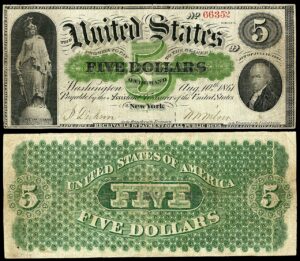
Treasury officials and their contracted printers recognized that adding a second color to the reverse would defeat photographic reproduction almost entirely, because the orthochromatic film available in the 1860s rendered all colors as shades of grey. Green was selected for the reverse of the Demand Notes of 1861 (Fr. 1-3 in the Friedberg catalog) for a combination of reasons. First, green ink made from chrome green, a compound synthesized from Prussian Blue and lead chromate (chrome yellow), was relatively stable, abundantly available, and extremely difficult for contemporary photography to distinguish from the black background in a photograph. Second, chrome green was resistant to both acid and alkali chemical alterations that forgers used to erase or alter note denominations. Third, and perhaps most practically, the ink was affordable at a scale of millions of impressions.
The public immediately noticed the green reverses and coined the term “greenback,” a nickname that has outlasted every design generation of U.S. currency since. The Legal Tender Notes (United States Notes) authorized by the Legal Tender Act of February 25, 1862 carried the tradition forward, and when the Bureau of Engraving and Printing formally opened on August 29, 1862, green ink formulation became part of its institutional DNA.
When examining Civil War-era Demand Notes (Fr. 1-3) or early Legal Tender Notes, look closely at the reverse green ink under 10x magnification. Notes with vivid, un-oxidized green ink on the reverse command significant premiums, sometimes 20-30% above catalog value for the same grade. Dull, brownish-olive ink indicates oxidation of the chrome yellow component and will cost you on a PCGS or PMG grading submission.
The Chemistry of Green: From Chrome Green to Modern Formulas
Chrome green, the original pigment, is a physical mixture rather than a true chemical compound. Prussian Blue (iron(III) hexacyanoferrate) provided the blue component, while lead chromate supplied the yellow. Mixed in the right proportions and suspended in a linseed oil or varnish vehicle, the resulting ink dried to a rich, stable green. However, chrome green had a significant weakness: the lead chromate component was susceptible to slow oxidation over decades, gradually shifting toward an olive or brownish-olive tone. This is precisely why many large-size notes from the 1870s through the 1910s show a distinctly olive-green or yellow-green reverse rather than the clean emerald green seen on uncirculated examples.
By the late nineteenth century, the BEP began experimenting with synthetic organic dyes to supplement or replace the inorganic chrome green base. Viridian (hydrated chromium oxide, Cr2O3·2H2O) was more lightfast and did not contain lead, making it safer for press operators. The transition was gradual and not well documented in public BEP records, but numismatists who specialize in ink varieties note a shift in the character of green ink on Federal Reserve Notes beginning around the Series 1914 large-size issues. Notes from the Boston and New York districts of the 1914 series (Fr. 832-891 range) show subtle ink color differences that some researchers attribute to regional ink batches and supplier changes during World War I, when German chemical imports were disrupted.
Modern BEP green ink is a closely guarded proprietary blend. What is publicly known, from BEP technical literature and patent disclosures, is that current currency ink contains iron oxide particles that give it magnetic properties detectable by automated cash-handling machines. The ink also fluoresces in specific ways under ultraviolet light and absorbs infrared radiation in a pattern that differs from commercially available inks. These properties are deliberately engineered into the ink chemistry, not added as afterthoughts.
A handheld UV lamp (365nm wavelength) is an inexpensive but powerful tool for any currency collector. Genuine Federal Reserve Notes printed after the 1990s redesigns will show specific fluorescence patterns in the ink and security fibers. Counterfeit notes often glow uniformly bright white under UV because they are printed on bleached commercial paper coated with optical brighteners. This is one of the fastest authentication checks you can perform at a show or estate sale.
Treasury Seal Colors and Their Relationship to Ink History
While the reverses of U.S. notes have been green since 1861, the Treasury seal and serial numbers on the face of notes have appeared in a remarkable variety of colors across different currency types, and understanding these colors is essential for collectors attributing notes correctly.
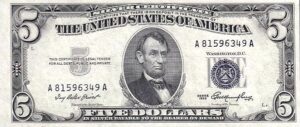
Red seals and serials appear on United States Notes (Legal Tender Notes) throughout their production history from 1862 through the final Series 1966-A $100 United States Notes. The red ink used was a separate iron-oxide-based pigment chosen to contrast clearly with the black intaglio portrait engraving. Blue seals and serials identify Silver Certificates, with the color coding system formalized during the National Currency era. Gold seals in orange-gold ink appear on Gold Certificates (Series 1882, 1888, 1900, 1905, 1906, 1907, and 1922 in large-size format; Series 1928 in small-size). Brown seals distinguished early National Bank Notes. Green seals on both the face and reverse became the standard for Federal Reserve Notes beginning with the Series 1914 large-size issues and have remained consistent through today’s small-size series, making Federal Reserve Notes the most uniformly green of all U.S. currency types.
The standardization of green across the Federal Reserve Note series after 1914 was a deliberate security and administrative decision. A unified ink color simplified the BEP’s production workflow and made it easier to detect alterations where someone had raised a denomination by replacing portions of a lower note with elements from a higher one.
Small-Size Era Ink Varieties and Collector Significance
When the United States transitioned to small-size currency on July 10, 1929, the BEP inherited a more industrialized ink supply chain. However, ink variation did not disappear. Collectors of small-size notes have documented several meaningful ink shifts across the series. The Series 1928 Federal Reserve Notes (Fr. 1500-1535 for the $1 denomination) were printed with a slightly bluer-green ink than the warmer, more yellow-green ink seen on Series 1934 notes. This is visible to the naked eye when comparing high-grade examples side by side.
The Series 1934 $100 Federal Reserve Note in particular offers a well-documented ink variety. The light green seal variety (Fr. 2152-F and related district numbers) commands a substantial premium over the standard dark green seal. The light green seal resulted from a diluted ink batch used during a specific production window and affects notes from multiple Federal Reserve districts. PMG-graded examples of the Chicago light green seal $100 in Very Fine 30 have realized over $1,200 at major auction houses, compared to $200-300 for standard dark seal examples in the same grade.
If you are building a type set of Series 1934 Federal Reserve Notes, always check the Treasury seal color on $100 notes before purchasing. The light green seal (Fr. 2152-F through 2152-L variants) is a distinct and collectible variety. Under natural daylight, the light green seal appears noticeably paler and more yellowish than the standard deep emerald green. This variety is frequently mis-attributed by generalist dealers who are not focused on currency.
The Security Science: Why Green Still Matters Today
Modern currency security is a layered system, and ink remains one of its most critical layers. The color-shifting ink (CSI) introduced on the Series 1996 redesigned $100 Federal Reserve Note shifts from green to black when tilted, a property achieved through thin-film optical interference technology embedded in the ink’s metallic flake particles. This is distinct from the standard green ink used for the remainder of the note and requires specialized manufacturing equipment costing millions of dollars, placing it entirely beyond the reach of casual counterfeiters.
The Federal Reserve Note redesigns introduced between 1996 and 2013 (covering the $100, $50, $20, $10, and $5 denominations) each incorporated generation-specific ink security features. The Series 2004 $20 note introduced background color printing in peach and blue tones, breaking the monochromatic green tradition on the reverse for the first time in over 140 years. This was a significant departure, driven by security rather than aesthetics, because multicolor printing using intaglio, offset, and letterpress techniques simultaneously makes reproduction exponentially more difficult.
The BEP’s Washington DC facility and its Fort Worth Texas plant (which has added a “FW” plate position letter to notes since 1991) both use the same ink specifications, ensuring consistency across production sites. Notes from the Fort Worth facility are identifiable by the small “FW” appearing to the right of the Federal Reserve district letter on the face of the note, a detail that matters to plate position and printing facility collectors.
| Series / Date | Denomination or Variety | Print Run or Notes | Rarity |
|---|---|---|---|
| 1861 Demand Notes (Fr. 1-3) | $5, $10, $20 First Greenbacks | Approx. 7.2 million total issued | Key Date |
| 1862 Legal Tender (Fr. 16-17) | $1 First Legal Tender, Green Reverse | Est. 150,000 surviving | Rare |
| 1914 FRN Large-Size (Fr. 915-950) | $20 Blue Seal, Ink Transition Era | Multiple district batches | Scarce |
| 1928 Small-Size FRN (Fr. 1500-1535) | $1 Bluer-Green Ink Variety | Approximately 638.5 million $1 notes printed | Common |
| 1934 FRN Light Green Seal (Fr. 2152-F) | $100 Chicago Light Green Seal | Small percentage of 1934 run | Scarce |
| 1934-A FRN (Fr. 2153-A through L) | $100 Dark vs. Light Seal Variants | District-specific batches | Scarce |
| 1996 Series $100 FRN | First Color-Shifting Ink (CSI) Note | Billions printed, first-run collectible | Common |
| 2004 Series $20 FRN | First Multicolor Reverse Since 1861 | Wide distribution | Common |
Grading Implications: How Ink Condition Affects Your Note’s Value
For collectors submitting notes to PMG (Paper Money Guaranty) or PCGS Currency, ink condition is a meaningful grading factor, particularly for large-size type notes. PMG’s grading standards explicitly consider ink brightness as part of the overall eye appeal assessment. A note that grades Very Fine 25 on paper quality but shows heavily oxidized, brownish-olive green ink may receive a net grade or a comment notation that will suppress its market value. Conversely, a note with original, vibrant green ink that has retained its color through careful storage can punch above its technical grade at auction.
Proper storage is the collector’s best defense against ink deterioration. Mylar or Melinex polyester sleeves (not PVC-based plastics, which off-gas chemicals that attack ink and paper) stored in acid-free boxes away from light and humidity swings will preserve ink color for generations. Temperature stability matters more than the exact temperature; fluctuations between warm and cool cause paper to expand and contract, stressing the ink film and accelerating oxidation.
Conclusion: Green as Identity, Science, and Collecting Opportunity
From the chrome green reverses of the 1861 Demand Notes to the optically variable inks of the 2009 Series $100, the color green has been simultaneously a practical security choice, a chemical engineering challenge, and a defining element of American monetary identity. For collectors, understanding ink chemistry unlocks a layer of attribution and valuation that goes beyond simple date and signature combination lookup. The Series 1934 light green seal $100 is worth multiples of its dark seal counterpart precisely because ink matters. The vivid original green of an uncirculated 1880 Legal Tender Note is worth preserving precisely because chemistry is working against it every decade.
Next time you pull a note from a 2×2 flip or examine a raw note at a show table, take an extra moment to assess the ink. Is the green clean and vibrant, or has time and oxidation shifted it toward olive? Is the Treasury seal a true emerald or a faded teal? These are not trivial questions. They are the questions that separate a well-informed currency collector from everyone else in the room.