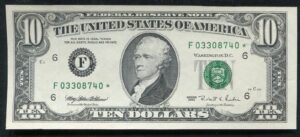
Pull a Federal Reserve Note from your wallet and look closely at the black serial numbers flanking the green Treasury seal. On a properly printed note, those elements align with geometric precision, sitting squarely within their designated fields and perfectly parallel to the note’s borders. Now imagine those same numbers sliding halfway off the face, printing onto the Federal Reserve seal, or tilting at a rakish angle across the portrait. That is the world of third printing errors, and for collectors willing to learn the mechanics behind them, it represents one of the most rewarding corners of modern error currency.
The Three-Stage Printing Process and Why Stage Three Is So Error-Prone
To understand third printing errors, you first need to appreciate the layered manufacturing process the Bureau of Engraving and Printing uses for Federal Reserve Notes. The BEP prints modern currency in three distinct passes, each adding specific elements to the sheet.
The first printing applies the green back design using offset lithography. The second printing lays down the complex intaglio face design, including the portrait, fine-line vignettes, denominational numerals, and the words “Federal Reserve Note.” Both of these stages use large 32-subject sheets and operate with highly controlled tension and registration systems.
The third printing is fundamentally different. This letterpress or typographic overprint stage adds the elements that make each note unique: the Federal Reserve district letter and number, the black serial numbers (applied twice, once on each side of the face), the green Treasury seal, and the Federal Reserve Bank seal. Because this stage uses a different press configuration and must precisely register over an already-printed intaglio sheet, it carries the highest mechanical risk of misalignment. The sheets at this stage can shift, skew, or feed improperly. A deviation of even two millimeters produces a visually obvious error, and deviations of five millimeters or more create dramatic, high-value collectibles.
Anatomy of a Third Printing Misalignment Error
Third printing misalignment errors come in several distinct varieties, each with its own collecting community and value profile.
Shifted Serial Numbers
The most common third printing error involves one or both serial numbers shifting from their intended position. A minor shift of 1 to 3mm is considered a “noticeable” error and commands modest premiums, typically $75 to $200 for common series in circulated grades. A major shift of 5mm or more, where numbers visibly intrude into the portrait field or overlap the Federal Reserve seal, can fetch $300 to $1,500 in Extremely Fine condition depending on the series.
Particularly dramatic are cases where one serial number prints entirely within the face design rather than in its border strip. A 1995 series $1 note with the left serial number shifted into the George Washington portrait field, for example, cataloged at around $650 in Very Fine 30 in a 2022 Heritage Auctions sale.
When evaluating a shifted serial number error, use a millimeter ruler to measure the offset from the note’s border. Document this measurement before submitting to PMG or PCGS Currency, as encapsulation labels sometimes note shift severity, which helps future buyers assess value instantly.
Misaligned Seals
Seal misalignments fall into two categories. The green Treasury seal and the black Federal Reserve Bank seal are both applied in the third printing, so they can shift independently of the serial numbers or in concert with them. A seal shifted upward into the numeral field, or downward so it partially prints off the note’s edge, creates a visually jarring error that is extremely popular with collectors.
One of the most celebrated seal errors in modern note collecting is the “inverted seal” misprint, though true 180-degree seal inversions are vanishingly rare on post-1980 notes. Far more common are vertical or horizontal shifts. A 1988A series $20 Federal Reserve Note from the Chicago district (G) with both the Treasury seal and right serial number shifted approximately 8mm to the right, pushing the seal into the Andrew Jackson portrait, sold at Stack’s Bowers in 2021 for $1,840 in PMG Very Fine 25.
Skewed Third Printing
Sometimes the sheet feeds into the third printing press at a slight angle. The result is a note where both serial numbers and the seals appear to run diagonally across the face. A skew error of more than three degrees is considered significant. These are rarer than simple horizontal or vertical shifts because the press feeding mechanism normally prevents angular misfeeds. A 2003A $10 note with a pronounced skew error of approximately four degrees sold for $2,200 at a 2023 Heritage auction in PMG Very Fine 30.
Double-Printed Third Elements
A note that passes through the third printing press twice receives doubled serial numbers and seals. Unlike intaglio doubling errors, which occur in the second printing, third printing doubling produces a characteristic “shadow” effect where a second, slightly offset impression of the numbers and seals appears in a lighter or heavier ink density. These are rarer still and can exceed $3,000 in gem uncirculated grades for scarcer series.
Do not confuse a genuine double third printing with simple ink smearing or a filled die. On a true double-printed third printing, you will see a complete second set of numbers and seal imagery, not merely blurred edges. Examine under 5x to 10x magnification before attributing the variety.
Which Series Produce the Most Notable Third Printing Errors
Third printing errors have been documented across virtually every post-1963 Federal Reserve Note series, but certain series stand out because of documented print run anomalies, equipment transitions at the BEP, or simply because more collectors were scrutinizing notes at the time of release.
The Series 1985 notes, particularly $1 and $5 denominations, saw a transitional period in press technology at the BEP’s Washington facility. Several collectors reported and documented significant third printing shifts from this era, and attributable examples now carry strong premiums. A 1985 $5 note with both serials shifted 6mm rightward and the Treasury seal partially overlapping the Lincoln Memorial vignette is documented in the IBNS Journal from 1988.
The Series 1993 and Series 1995 runs are another hotbed for documented errors, coinciding with increased public awareness of error notes following the growth of organized currency collecting in the early 1990s. The 1995 series alone produced several dozen documented major third printing errors that have been certified by PMG, with $1 notes from the Atlanta (F) and New York (B) districts appearing most frequently in auction records.
The Series 2003A notes attracted particular collector attention due to a widely reported batch of misaligned notes that entered circulation through Federal Reserve Bank of Richmond (E) distribution channels. Numismatic News covered the story in its February 2005 issue, and certified examples in this series are comparatively plentiful at the minor-to-moderate shift level, making them an accessible entry point for new collectors.
Series 2003A $20 and $50 notes from the Richmond (E) district are among the most affordable documented third printing errors available today. You can often find PMG-certified examples with 3 to 5mm shifts in the $150 to $400 range, making them ideal first acquisitions for collectors building an error note type set.
Ink Color Clues and Authentication Considerations
Authenticating a third printing misalignment error requires more than a visual inspection of note position. Experienced collectors and graders look at several specific characteristics to confirm the error is genuine rather than the product of post-printing alteration.
First, the ink chemistry must be consistent. Genuine third printing overprints use specific green ink for the Treasury seal and black ink for the serial numbers and Federal Reserve seal. These inks carry a distinctive sheen under ultraviolet light that differs from the second printing intaglio inks. If someone has added fake serial numbers to an otherwise blank or rare note, the UV response will differ noticeably.
Second, the paper fibers beneath the overprint should show no cutting, removal, or chemical alteration. Forgers occasionally attempt to reposition authentic third printing elements by soaking and re-drying notes, which damages surface fibers in detectable ways.
Third, the registration of the third printing relative to the second printing background provides internal consistency clues. On a genuine shift error, the relationship between the face intaglio design and the note’s border should appear normal. Only the third printing elements shift relative to everything else. If the portrait and the serial numbers are both off-center in the same direction, you likely have a second printing misalignment, not a third printing error, which is a different and often more valuable variety.
Grading Third Printing Errors: Special Considerations
Standard grading scales apply to error notes just as to regular issues, with grades running from Poor (P-1) through Gem Uncirculated (PMG 66 EPQ or higher). However, certain nuances are specific to misalignment errors.
PMG and PCGS Currency both note shift errors on their certification labels, typically describing the error as “Serial Number Shift” or “Overprint Shift” with a directional descriptor. PMG introduced standardized error notation descriptions around 2005, which significantly improved market transparency for these notes. Pre-2005 certified errors sometimes lack descriptive labels and may be undervalued as a result.
Collectors should be aware that uncirculated (CU 63 and above) examples of third printing errors are genuinely uncommon. Most major shift errors entered circulation before anyone noticed them, meaning Very Fine (VF 25 to 35) and Extremely Fine (EF 40 to 45) represent the typical grade range for these notes. A PMG 64 or higher example of a major shift error is a legitimate rarity and commands significant premiums over EF examples.
If you find what appears to be a third printing error in circulated condition, resist the urge to clean or press the note. Even light cleaning that improves apparent appearance will result in a PMG or PCGS “Details” designation, which dramatically reduces the note’s market value compared to a straight grade. Store it flat in a Mylar sleeve and submit it as found.
| Series / Date | Denomination and District | Shift Severity | Rarity |
|---|---|---|---|
| 1985 | $5, Chicago (G) | Major (6mm+ horizontal) | Rare |
| 1988A | $20, Chicago (G) | Major (8mm, seal into portrait) | Key Date |
| 1993 | $1, New York (B) | Moderate (4 to 5mm vertical) | Scarce |
| 1995 | $1, Atlanta (F) | Minor to moderate (2 to 4mm) | Common |
| 1995 | $5, Boston (A) | Major skew (3+ degrees) | Rare |
| 2001 | $10, San Francisco (L) | Double third printing | Key Date |
| 2003A | $20, Richmond (E) | Minor to moderate (3 to 5mm) | Common |
| 2003A | $50, Richmond (E) | Moderate (5mm horizontal) | Scarce |
| 2006 | $100, New York (B) | Major (7mm, both serials shifted) | Rare |
| 2009 | $1, Multiple districts | Minor (1 to 2mm) | Common |
Where to Find Third Printing Errors and What to Pay
The most reliable source for certified third printing error notes remains the major numismatic auction platforms. Heritage Auctions, Stack’s Bowers, and Lyn Knight Currency Auctions all hold dedicated paper money sales several times yearly. Heritage’s online archive at HA.com is an invaluable free resource: you can search specifically for “overprint shift” or “serial number shift” in the currency section and review decades of realized prices, which gives you an excellent calibration for current market values.
For raw, uncertified notes, currency shows such as the annual Memphis International Paper Money Show (held each June) and the ANA World’s Fair of Money are productive hunting grounds. Dealers who specialize in error notes, including those affiliated with the Society of Paper Money Collectors (SPMC), typically bring carefully curated inventories. Prices for raw errors at shows are often 20 to 40 percent below certified equivalents, reflecting the authentication risk premium that certification removes.
Online marketplaces including eBay carry large volumes of purported error notes, but buyer vigilance is essential. Stick to sellers with 100 percent positive feedback on currency transactions and look for photos clear enough to confirm the error characteristics described above. For any purchase above $100, insisting on PMG or PCGS certification is the safest policy.
Building a Type Collection Around Third Printing Errors
Many collectors approach third printing errors as a type collection, aiming to acquire one example of each major error category (horizontal shift, vertical shift, skew, double print, and seal-only shift) across different denominations. A comprehensive type set of five to six notes representing the full range of third printing error varieties can be assembled for $800 to $2,500 depending on grade and severity choices, and it makes a compelling display set that illustrates the entire production failure spectrum in a single framed presentation.
A more focused approach involves building a denomination-specific run. Collecting third printing errors exclusively on $1 Federal Reserve Notes, for instance, gives you the most economical path since $1 errors trade at lower absolute dollar values than $20 or $100 errors of equivalent rarity. The Series 1995 $1 notes offer enough documented variety in Atlanta (F) and New York (B) districts that a rich sub-collection is achievable with patience.
Conclusion: Errors That Tell the Story of How Money Is Made
Third printing misalignment errors are more than visual curiosities. Each one is a frozen record of a specific mechanical failure in one of the most sophisticated manufacturing environments in the federal government. The serial numbers that should have aligned with textbook precision instead bear witness to a skipped sheet, a worn press cam, or a feeding mechanism that failed for a fraction of a second before an inspector caught the run.
For collectors, that story adds a dimension of historical and mechanical interest that purely aesthetic collecting cannot replicate. Whether you are just discovering error notes for the first time or adding a dramatic 2001 double-print $10 to a mature collection, third printing errors reward careful study. Learn the mechanics, know the key series, verify authenticity rigorously, and you will find these mistakes to be among the most genuinely interesting pieces modern American currency has ever accidentally produced.