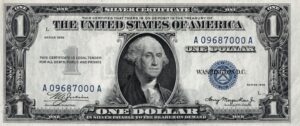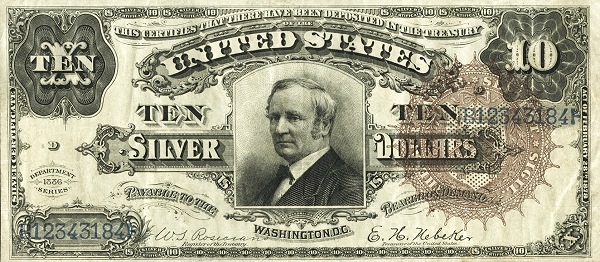
📷 Image source: banknote.ws (World Banknote Gallery). Images are selected by AI to represent the article topic and may not depict the exact note(s) described.
Walk into any major currency show and flip through the $5 silver certificate dealer stock. You will find plenty of Series 1953 and 1953A notes in varying grades, and if you look carefully, you might spot a 1953C tucked somewhere near the back. But the one that dealers often price highest, the one that sophisticated collectors quietly seek out, is the Series 1953B. With the lowest print run of any regular-issue small-size $5 silver certificate in the entire 1953 group, and star notes that command serious premiums even in circulated grades, the 1953B is a genuinely underappreciated key date that rewards patient, informed collectors.
Setting the Stage: The Final Generation of $5 Silver Certificates
To appreciate the 1953B, you need to understand its position in the broader timeline of American paper money. The small-size $5 silver certificate was introduced with the Series 1934, featuring a blue Treasury seal and blue serial numbers that immediately distinguished it from the green-sealed Federal Reserve Notes circulating alongside it. The reverse design, depicting the Lincoln Memorial, remained constant throughout the small-size era. What changed across series were the signature combinations of the Treasurer of the United States and the Secretary of the Treasury, which reflected the administration in power at the time of printing.
The 1953 group, which includes the 1953, 1953A, 1953B, and 1953C, represents the final chapter of this storied series. Congress effectively ended new silver certificate issuance with the Act of June 4, 1963, and the Treasury stopped redeeming them for silver on June 24, 1968. The 1953C was the last series printed, but the 1953B holds the distinction of being the scarcest of the four in terms of regular-issue production.
The Granahan-Dillon Signature Combination
Every series designation change in US currency corresponds to a new pairing of signatories. The 1953B carries the signatures of Kathryn O’Hay Granahan as Treasurer of the United States and C. Douglas Dillon as Secretary of the Treasury. Granahan, a former congresswoman from Pennsylvania, served as Treasurer from April 1962 to November 1966, making her signature appear on several series across multiple denominations. Dillon, who served as Secretary from January 1961 to April 1965 under both Presidents Kennedy and Johnson, brings a shorter window of overlap with Granahan’s tenure than their predecessors or successors, which directly contributed to the 1953B’s comparatively small production run.
When authenticating a 1953B, verify both the blue serial numbers and the blue Treasury seal on the right side of the face. The seal on 1953-series notes is the smaller, scalloped-edge style introduced on small-size currency. Any note showing a large, ornate seal is from an earlier era and warrants closer scrutiny for alterations.
Print Run Analysis: Why the Numbers Matter
The Bureau of Engraving and Printing (BEP) printed approximately 19,496,000 regular-issue Series 1953B $5 silver certificates. Compare that to the Series 1953, which saw approximately 90,648,000 notes produced, and the Series 1953A with roughly 73,000,000 notes. Even the Series 1953C, often assumed to be scarce because it was the last issued, had a regular-issue run of approximately 29,640,000 notes. The 1953B’s production figure is less than 22 percent of the 1953 run, making it by far the key date of the group for regular-issue examples.
For collectors working with the Friedberg catalog, the 1953B $5 silver certificate is listed as Friedberg number F-1657, while its star note counterpart carries the designation F-1657*. These catalog numbers are the standard reference points for dealer listings, auction descriptions, and grading service holders, and knowing them saves considerable time when searching inventory.
The Star Notes: A Story Within a Story
If the regular-issue 1953B is scarce, the star notes are genuinely rare. The BEP printed approximately 1,548,000 star note replacements for the 1953B series. This figure sounds substantial in isolation, but consider survival rates: silver certificates circulated heavily before and during their redemption window, and $5 notes took particularly hard use as an everyday working denomination. Finding a 1953B star note in Fine or better condition already requires some luck; locating one in Extremely Fine or above takes real effort and patience.
Star notes from the 1953B series can be identified by the star symbol that precedes the serial number on the face of the note. The serial numbers themselves are printed in blue ink, consistent with the silver certificate format. Star notes were used by the BEP to replace notes that were damaged or destroyed during the printing process, so their numbers represent a ceiling on production rather than a count of what actually entered circulation.
When evaluating a 1953B star note, pay particular attention to the corners and the central fold line. These are the first areas to show wear on heavily circulated $5 notes. A note grading VF-25 or better on a star is genuinely collectible, and anything grading EF-40 or above should be considered for immediate acquisition at fair market prices, as upgrades rarely surface.
Grading Considerations Specific to the 1953 Series
The paper stock used in the early-to-mid 1960s for these later 1953-series notes has a particular feel that experienced collectors recognize quickly. It is slightly crisper than the paper from the 1940s printings and tends to show folds with a sharp, precise crease rather than the softer breaks seen on older notes. When grading a 1953B for your collection or a potential purchase, consider the following benchmarks.
In Very Fine (VF-20 to VF-35), a regular-issue 1953B is a perfectly respectable addition to a type collection and can often be acquired for modest sums. The star note in the same grade commands a substantially higher premium. In Extremely Fine (EF-40 to EF-45), both regular and star notes become meaningfully more valuable, with the star note often trading at three to five times the regular-issue price in comparable grade. At the About Uncirculated (AU-50 to AU-58) level, regular-issue 1953B notes are noticeably scarcer than their 1953 or 1953A counterparts, reflecting the smaller print run. Gem Uncirculated (MS-65 EPQ or better) 1953B star notes are legitimately rare and appear infrequently even at major auction houses such as Heritage, Stack’s Bowers, or Lyn Knight.
What to Look for When Buying
The 1953B has attracted some attention from collectors who recognize its relative scarcity, which means pricing can vary considerably depending on the seller’s level of awareness. At general antique shows or estate sales, it is not impossible to find a 1953B priced as a common type note. At specialized currency dealers and major auctions, it will be priced more accurately. Key things to verify before purchasing include the series date printed on the face (located beneath the portrait of Abraham Lincoln), the signature combination confirming Granahan and Dillon, and the presence of blue serial numbers and blue Treasury seal.
Third-party grading from PCGS Currency or PMG adds meaningful protection when buying a 1953B star note, particularly in higher grades. Slabbed examples also trade more easily in the secondary market. If you are paying a significant premium for a high-grade star note, the grading fee is a worthwhile investment in peace of mind.
The Place of the 1953B in a Complete Silver Certificate Collection
Collectors assembling a complete run of small-size $5 silver certificates by series will encounter the 1953B as the primary obstacle to completion. A full type set of the 1953 group, one each of the 1953, 1953A, 1953B, and 1953C, is a satisfying and achievable goal, but the 1953B will be the last piece found in the desired grade. Those building more ambitious sets that include star notes for every series will find the 1953B star note to be the single most challenging acquisition in the entire small-size $5 silver certificate category.
The broader context matters too. The small-size $5 silver certificate series spans from 1934 through 1953C, and some of the earlier varieties including certain 1934 and 1934A issues have their own scarcity stories. But within the 1953 group, which is the entry point for most collectors building a complete set, the 1953B stands apart. Its combination of low print run, historical timing, and the demanding survival rate for high-grade examples gives it a legitimacy that makes it more than just a catalog number; it is a genuine key date in American paper money history.
| Series / Friedberg No. | Signatures | Print Run (Regular) | Rarity |
|---|---|---|---|
| 1953 / F-1654 | Priest / Humphrey | ~90,648,000 | Common |
| 1953 Star / F-1654* | Priest / Humphrey | ~3,456,000 | Scarce |
| 1953A / F-1655 | Priest / Anderson | ~73,000,000 | Common |
| 1953A Star / F-1655* | Priest / Anderson | ~2,160,000 | Scarce |
| 1953B / F-1657 | Granahan / Dillon | ~19,496,000 | Scarce |
| 1953B Star / F-1657* | Granahan / Dillon | ~1,548,000 | Key Date |
| 1953C / F-1658 | Granahan / Fowler | ~29,640,000 | Common |
| 1953C Star / F-1658* | Granahan / Fowler | ~1,800,000 | Rare |
Conclusion: A Quietly Significant Note Worth Pursuing
The Series 1953B $5 silver certificate does not have the flashy appeal of a large-size educational note or the iconic status of a $10,000 Federal Reserve Note. What it has is something arguably more useful to working collectors: a genuine rarity backed by verifiable production data, a clear place in a completable series, and a price point that, particularly for circulated examples, remains accessible to collectors who know what they are looking for. The star note, by contrast, deserves every bit of the premium it commands. With a print run of approximately 1,548,000 and decades of attrition from circulation and attrition from collectors who did not know they had something special, high-grade survivors are genuinely uncommon.
Whether you are building your first type set of silver certificates or filling the final gaps in a complete small-size $5 run by series, the 1953B warrants serious attention. Learn the Friedberg numbers, know the Granahan-Dillon signature combination on sight, and set aside a dedicated budget for the star note. When the right example surfaces, and it will, you will be ready.
Set up saved searches on major auction platforms using both “1953B $5 silver certificate” and the Friedberg numbers F-1657 and F-1657* to catch listings from sellers who may not have cross-referenced both naming conventions. Many strong buys appear under one description but not the other, and automated alerts cost nothing.