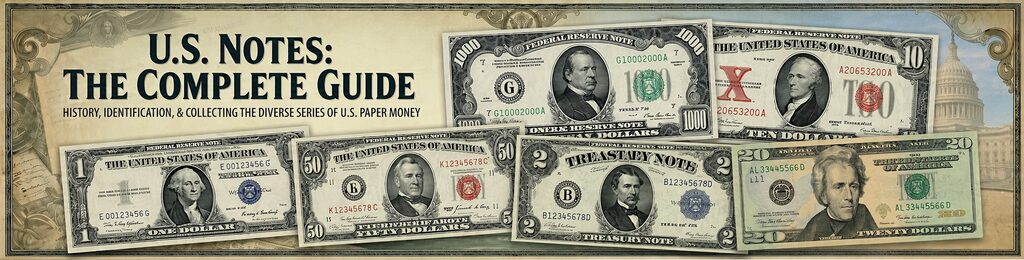
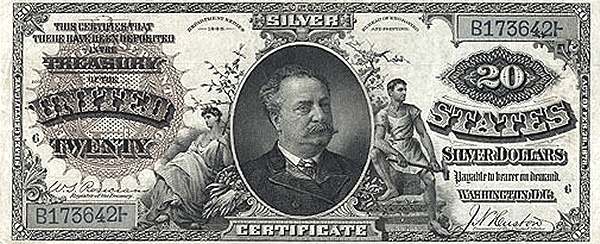
📷 Image source: banknote.ws (World Banknote Gallery). Images are selected by AI to represent the article topic and may not depict the exact note(s) described.
September 6, 1901: A Shot That Echoed Through the Treasury
At 4:07 in the afternoon on September 6, 1901, Leon Czolgosz fired two shots into President William McKinley as he greeted visitors at the Pan-American Exposition in Buffalo, New York. McKinley died eight days later, on September 14, elevating 42-year-old Theodore Roosevelt to the presidency. The political shockwave was immediate and profound. But for students of American paper money, the aftermath of that assassination carries a very specific numismatic significance: the men Roosevelt appointed to lead the Treasury Department, and the broader currency reforms that followed, produced some of the most visually distinctive and collectible banknotes ever printed by the United States government.
The Men Who Signed the Money: Understanding Treasury Signature Combinations
Every large-size US note from this era carries two signatures: the Register of the Treasury and the Treasurer of the United States. These are not merely bureaucratic formalities for collectors. A specific signature pairing can mean the difference between a $200 note and a $2,000 note in identical condition. Roosevelt’s appointments created several entirely new signature combinations that define some of the scarcest and most sought-after varieties in the large-size series.
When McKinley died, Lyman J. Gage was serving as Treasury Secretary, a holdover from the McKinley cabinet. Roosevelt retained Gage briefly before appointing Leslie M. Shaw of Iowa in January 1902. Shaw served until 1907, when George B. Cortelyou took over. Each cabinet change triggered downstream appointment changes at the Register and Treasurer level, and it is those sub-cabinet positions that directly affect the signatures on the notes themselves.
The critical signature combinations for collectors to know during the Roosevelt years are as follows. The pairing of Treasurer Ellis Roberts with Register Judson Lyons (both McKinley-era holdovers active into 1905) appears on a wide range of Series 1899 Silver Certificates and Series 1902 National Bank Notes. The subsequent pairing of Treasurer Charles Treat with Register William Vernon, active from approximately 1905 to 1909, spans some of the most widely circulated large-size issues of the Roosevelt administration. These two men signed more notes than virtually any other pairing of the era, making many of their issues common today. But low-denomination varieties signed by Vernon-Treat from specific small Federal Reserve cities can still be genuinely scarce.
Always check the specific signature combination before purchasing any large-size note from 1899 to 1923. Two notes of identical type, denomination, and grade can vary by a factor of ten or more in value based solely on who signed them. The Friedberg catalog assigns separate catalog numbers to each signature variety, and dealers who are not specialists sometimes miss these distinctions entirely.
The Series 1899 Silver Certificate: “The Black Eagle” and Its Roosevelt-Era Variants
Perhaps no note better illustrates the intersection of McKinley-era design and Roosevelt-era production than the Series 1899 $1 Silver Certificate, universally known among collectors as the “Black Eagle” note (Friedberg 226 through 236). The design, featuring a powerful American eagle perched above portraits of Abraham Lincoln and Ulysses Grant, was approved under McKinley but printed in enormous quantities well into the Roosevelt and even Taft administrations.
The Black Eagle was printed across eleven distinct signature combinations, each carrying its own Friedberg number and its own rarity profile. The earliest varieties signed by Lyons-Roberts (Fr. 226) are considerably scarcer than the later Vernon-Treat issues (Fr. 232 through 234) that were produced by the tens of millions. For a new collector, the Vernon-Treat Black Eagle in circulated grades such as Very Fine represents one of the most affordable entry points into genuine large-size currency, with examples commonly available for $60 to $120 depending on condition. By contrast, the Lyons-Treat variety (Fr. 228), produced during the brief transitional period of 1905, commands a significant premium, with Fine examples selling for $200 to $350 and Extremely Fine specimens pushing past $600 at auction.
The most valuable Black Eagle variety of all, however, is the Napier-McClung signature combination (Fr. 236), which dates to the Taft administration and represents the end of the series. In Extremely Fine condition, this variety has realized over $1,200 at major auction houses including Heritage and Stack’s Bowers.
Gold Certificates and the Roosevelt Treasury: Series 1905 and the “Technicolor Note”
Roosevelt harbored strong views about the aesthetic quality of American coinage and currency, famously enlisting sculptor Augustus Saint-Gaudens to redesign US gold coins in 1905 and 1907. His influence extended, more indirectly, to paper currency design. The Series 1905 $20 Gold Certificate (Friedberg 1180) stands as one of the most visually arresting notes ever produced by the Bureau of Engraving and Printing, featuring a vivid combination of gold and red inks on the reverse that earned it the collector nickname the “Technicolor Note” or the “Embossed Note.”
Printed during the height of the Roosevelt years, the Series 1905 $20 Gold Certificate carried the Lyons-Treat signature combination and was issued in relatively small quantities compared to the workhorse Silver Certificate issues. Today, in Very Fine condition, this note typically sells for $1,500 to $2,500, while Gem Uncirculated examples with strong color and embossing have reached $15,000 or more at major sales. The reverse gold ink is notoriously prone to oxidation and toning, so eye appeal is paramount when evaluating this issue.
When examining a Series 1905 $20 Gold Certificate, pay close attention to the embossed portrait of George Washington on the obverse and the condition of the gold ink on the reverse. Notes that have been cleaned or “brightened” to restore the gold color will show a flat, lifeless sheen under a loupe rather than the rich, slightly raised texture of a problem-free original. Third-party grading from PCGS Currency or PMG is strongly recommended for any example above Fine condition.
The $5 “Indian Chief” Silver Certificate: A McKinley Design Outlasting Its Era
The Series 1899 $5 Silver Certificate (Friedberg 271 through 282), known to collectors as the “Indian Chief” or “Running Antelope” note, is one of the most visually distinctive pieces of American paper money ever printed. The obverse features a portrait of Onepapa Sioux chief Ta-to-ka-in-yan-ka (Running Antelope), depicted wearing a Pawnee headdress in what historians have noted was a cartographic liberty by the Bureau of Engraving and Printing. This note, designed and approved under McKinley, was produced extensively through the Roosevelt years and beyond.
Like the Black Eagle, the Indian Chief exists across multiple Roosevelt-era signature combinations. The Vernon-Treat pairing (Fr. 280 through 281) represents the most commonly encountered variety, with circulated examples in Fine to Very Fine condition trading for $200 to $500. The scarcer Napier-Thompson variety (Fr. 282), however, is a genuinely important rarity. With a very limited printing and few survivors known in any grade, Fine examples have sold for over $2,500 and Uncirculated specimens are considered condition rarities of the first rank.
National Bank Notes and the Series 1902: Roosevelt’s Banking Legacy in Paper
The Series 1902 National Bank Notes represent the most direct numismatic legacy of the Roosevelt Treasury period. Authorized under the Gold Standard Act adjustments and issued by thousands of individual national banks across the country, these notes in denominations from $5 to $100 are the workhorses of Roosevelt-era currency collecting. The three major varieties, distinguished by the presence or absence of Treasury seal and date plate backs, are classified as the 1902 Red Seal, 1902 Blue Seal Date Back, and 1902 Blue Seal Plain Back.
The 1902 Red Seal issues, printed only briefly in 1902 and early 1903, carry the Lyons-Roberts or Lyons-Treat signatures and are the scarcest of the three major varieties. Notes from small-charter banks in western or southern states with very limited print runs are genuinely rare. The 1902 Blue Seal Date Back issues, printed from roughly 1908 to 1915, span multiple signature combinations and bank charters. For certain banks chartered in sparsely populated territories, even common signature varieties can be condition rarities.
National Bank Note collecting rewards geographic specialization. Focusing on notes from your home state or region allows you to develop real expertise in which banks are scarce, which denominations were under-printed, and which signature combinations are truly rare for your area. State-specific references such as Don Kelly’s “National Bank Notes: A Guide with Prices” are invaluable companions to the Friedberg catalog for this type of collecting.
William McKinley on Currency: The Irony of Posthumous Commemoration
Perhaps the most poignant numismatic footnote to the McKinley assassination is this: McKinley himself never appeared on any circulating US currency during his lifetime. Yet within a few years of his death, his portrait was selected for the Series 1903 $500 Gold Certificate (Friedberg 1218) and later the Series 1918 Federal Reserve Bank Note $500 (Friedberg 1132). In a very real sense, the man whose death triggered the Roosevelt-era currency changes eventually found a home on the very money his administration had helped shape.
The McKinley $500 Gold Certificate is, predictably, an extreme rarity today. Most survivors are held in institutional collections or have been graded by PMG or PCGS Currency in the single digits of population. When one does appear at a major auction, which happens perhaps once every several years, the realized price routinely exceeds $100,000 for a Fine or Very Fine example. For most collectors, this note exists only in the pages of the Friedberg catalog and in the dreams of what a truly complete type set might look like.
| Series / Friedberg No. | Type and Denomination | Signature Combination | Rarity |
|---|---|---|---|
| 1899, Fr. 226 | $1 Silver Cert. “Black Eagle” | Lyons-Roberts | Scarce |
| 1899, Fr. 232 | $1 Silver Cert. “Black Eagle” | Vernon-Treat | Common |
| 1899, Fr. 236 | $1 Silver Cert. “Black Eagle” | Napier-McClung | Scarce |
| 1899, Fr. 280 | $5 Silver Cert. “Indian Chief” | Vernon-Treat | Common |
| 1899, Fr. 282 | $5 Silver Cert. “Indian Chief” | Napier-Thompson | Key Date |
| 1905, Fr. 1180 | $20 Gold Cert. “Technicolor” | Lyons-Treat | Rare |
| 1902 Red Seal, various Fr. | National Bank Notes $5-$100 | Lyons-Roberts / Lyons-Treat | Scarce |
| 1902 Blue Seal Date Back | National Bank Notes $5-$100 | Vernon-Treat (small-charter banks) | Rare |
| 1903, Fr. 1218 | $500 Gold Cert. (McKinley portrait) | Lyons-Roberts | Key Date |
Building a Roosevelt-Era Currency Collection: Practical Strategy
For collectors looking to assemble a focused set around this historically rich period, a tiered approach makes the most sense. At the entry level, the Vernon-Treat Black Eagle in Very Fine and the Series 1902 Blue Seal Plain Back National Bank Notes from major cities offer genuine large-size notes with real historical context for under $200 per piece. In the intermediate range, assembling a complete signature set of the Series 1899 $1 Silver Certificate, all eleven Friedberg varieties, is a satisfying long-term project that will cost between $1,500 and $4,000 depending on condition targets. At the advanced level, the Series 1905 Technicolor $20 or a small-charter 1902 Red Seal note from a defunct western bank represent the kind of focused, historically grounded pursuit that distinguishes a serious collection from a random accumulation.
Conclusion: One Bullet, a Thousand Varieties
The assassination of William McKinley in September 1901 was, first and foremost, a human tragedy. But history, including numismatic history, is shaped by the specific people who hold power at specific moments. Theodore Roosevelt’s Treasury appointments, his aesthetic sensibilities, and the currency legislation passed during his administration combined to produce one of the richest and most varied chapters in the story of American paper money. The notes that bear the signatures of Lyons, Roberts, Treat, Vernon, and their colleagues are not merely financial artifacts. They are tangible links to a pivotal transition in American history, available to collectors at every budget level, and still capable of genuine surprise for those who know where and how to look.