📷 Image source: banknote.ws (World Banknote Gallery). Images are selected by AI to represent the article topic and may not depict the exact note(s) described.
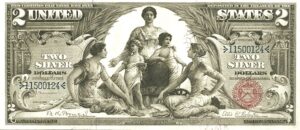
In the spring of 1896, the Bureau of Engraving and Printing released a series of silver certificates that stopped the country cold. Newspaper critics called them breathtaking. Collectors lined up at Treasury windows not to spend them, but to keep them. The $2 denomination of what would become known as the Educational Series featured a soaring allegorical scene unlike anything that had appeared on American currency before or since: a majestic winged female figure representing Electricity, rendered in the sweeping, organic lines of the emerging Art Nouveau movement, presiding over a panorama of American progress. More than 125 years later, the 1896 $2 Educational Silver Certificate (Friedberg catalog number Fr. 247, 248, and 249, corresponding to the three signature combinations) remains the crown jewel of large-size U.S. currency collecting.
The Design and Its Origins
The Educational Series was the brainchild of Bureau of Engraving and Printing Director Claude M. Johnson and Treasury Secretary John G. Carlisle, who wanted to elevate American currency to the artistic level of European banknotes. They commissioned three renowned American muralists to design the face vignettes: Will Hicok Low for the $1, Edwin Howland Blashfield for the $2, and Walter Shirlaw for the $5. Blashfield, whose monumental murals grace the Library of Congress’s Great Hall (completed just one year earlier in 1895), brought to the $2 note the same grand allegorical vocabulary he used in public architecture.
The central figure on the face of the note is a winged woman representing Electricity, sometimes also interpreted as Science or Steam and Electricity combined. She is depicted in flight or suspended in a dynamic pose, holding aloft a torch that crackles with electric light. Below her stretches a panoramic American landscape with a steam-powered locomotive thundering across a bridge, telegraph lines running into the distance, and a rising sun that bathes the entire scene in optimistic light. The composition reads unmistakably as a celebration of the Gilded Age’s faith in technological progress, rendered in a visual language that blends classical allegory with the sinuous, nature-inspired forms of Art Nouveau.
The reverse of the note is equally remarkable. It features twin portraits of inventors and statesmen associated with American progress: Robert Fulton (inventor of the steam-powered commercial boat) on the left and Samuel F. B. Morse (inventor of the telegraph) on the right. Both portraits were engraved from life images and are considered among the finest portrait engravings ever produced by the Bureau. Between them runs an elaborate geometric lathe-work border that took engravers months to complete on the geometric lathes that were the Bureau’s pride during this period.
When examining the face vignette, look carefully at the engraved detail in Electricity’s wings and drapery folds. On genuine notes in Fine condition or better, you should be able to see individual feather separations and the fine crosshatching of the drapery. Heavily circulated or cleaned notes will show worn, indistinct lines in these areas, significantly reducing value and desirability.
Signature Combinations and the Three Friedberg Varieties
The 1896 $2 Educational Silver Certificate was issued with three distinct Treasury signature combinations, each corresponding to a different Friedberg number and a different level of scarcity. Understanding these varieties is the first step toward building a meaningful collection of this series.
Fr. 247 (Tillman-Morgan): This is the first and most common signature combination, signed by Register of the Treasury Judson W. Tillman and Treasurer Daniel N. Morgan. Tillman served as Register from April 1893 to May 1897, and Morgan as Treasurer from May 1893 to June 1897, making this pairing the initial issue of the series. In Very Fine condition, Fr. 247 typically trades between $400 and $600 at auction, while Choice Uncirculated (MS-63 by PCGS or PMG standards) examples regularly bring $2,500 to $3,500. A PMG 65 EPQ example sold for $6,600 at Heritage Auctions in January 2022.
Fr. 248 (Tillman-Roberts): This variety pairs Tillman with Treasurer Ellis H. Roberts, who succeeded Morgan in June 1897. It is considerably scarcer than Fr. 247 and commands a meaningful premium in all grades. In Very Fine, expect to pay $600 to $900, while Uncirculated examples can exceed $5,000. The shorter overlap of the Tillman-Roberts tenure in relation to this series contributes directly to its relative scarcity.
Fr. 249 (Bruce-Roberts): This is the rarest of the three varieties by a significant margin, pairing Register Roswell Flower Bruce with Treasurer Roberts. Bruce was appointed Register in May 1898 and served only briefly before this signature combination was retired. Fr. 249 in Fine condition routinely sells for $1,200 to $1,800, and Uncirculated examples are genuinely rare. The most recent notable auction result for a PMG 64 EPQ example was $14,400 at Stack’s Bowers in August 2021, illustrating the premium collectors place on high-grade survivors.
Authentication matters enormously with Educational Series notes. The American Bank Note Company produced extremely high-quality facsimiles of Educational notes during the early twentieth century for advertising purposes. These are not counterfeits in the legal sense, but they do circulate in the collector market. Always purchase Fr. 247, 248, and 249 notes in PMG or PCGS Currency holders from reputable dealers or major auction houses. The genuine notes will show plate letter and serial number combinations that can be cross-referenced against documented auction appearances.
Paper Stock, Serial Numbers, and Physical Characteristics
Like all silver certificates of the era, the 1896 $2 note was printed on large-format currency paper measuring approximately 7.375 by 3.125 inches (large-size notes are noticeably bigger than today’s currency). The paper itself contains red and blue fiber inclusions visible under magnification, a security feature that was standard for the period. The Treasury seal printed on the face is a large, ornate red seal with a scalloped border, sometimes described as a “large red scalloped seal” to distinguish it from the smaller seals used on later series.
Serial numbers on Educational Series $2 notes run in red ink and typically appear in the upper left and lower right positions on the face of the note. The serial number format begins with a letter prefix, followed by a numeric sequence, and ends with a letter suffix. Notes with serial numbers below 1000, ending in repeating digits, or featuring solid serial numbers (all the same digit) carry additional collector premiums regardless of condition, sometimes adding 25 to 50 percent to the base value.
The plate position letter (A, B, C, or D) appears in small print near the serial number and near the Treasury seal. Position A and B notes are more commonly encountered; position D notes are somewhat scarcer and attract modest additional attention from specialists. The face plate number and back plate number, printed in small numerals at the margins, are also tracked by advanced collectors.
Grading Nuances Specific to Educational Notes
Grading the 1896 $2 Educational Silver Certificate requires paying close attention to several areas that are particularly vulnerable to wear and environmental damage. The fine line work in the face vignette, especially in Electricity’s wings and the locomotive scene below, begins to show wear very quickly in circulation. A note that grades Very Fine-25 by PMG standards will typically show significant softening of the wing detail and loss of crispness in the locomotive engraving, even though the overall paper quality and margins may remain attractive.
Centering is a critical grading factor for this series. Well-centered examples with even margins on all four sides are substantially rarer than off-center survivors and command meaningful premiums. PMG and PCGS Currency both award the EPQ (Exceptional Paper Quality) or PPQ (Premium Paper Quality) designations to notes with original paper surfaces free from washing, pressing, or chemical treatment. For Educational Series notes, the EPQ or PPQ designation can add 30 to 50 percent to realized prices at auction, reflecting how rarely original, untampered examples survive.
Pinholes are another common issue. Large-size notes from this period were often strung on strings or pinned through filing systems in banks and businesses, and even a single small pinhole can drop a note from a Gem grade into the Fine to Very Fine range in terms of market value, even if the paper is otherwise exceptional. Always examine Educational notes under a strong light source, both in transmitted and reflected light, to check for pinholes, splits along fold lines, and paper thinning.
The 1896 $2 Educational note is one of the most frequently altered or “improved” notes in the hobby. Cleaning, pressing, and chemical brightening are common. When examining a raw (ungraded) example, look for an unnatural uniformity of color across the note’s surface, which can indicate washing. Genuine uncirculated examples will show subtle toning at the margins and along fold lines if they have been stored in albums or envelopes for decades. A note that looks impossibly bright and white but has soft, rounded corners is almost certainly pressed or cleaned.
The Art Historical Context: Why Art Nouveau on a Banknote?
The 1896 Educational Series arrived at a fascinating cultural moment. Art Nouveau, which took its name from the Parisian gallery Maison de l’Art Nouveau (opened by Siegfried Bing in December 1895, just months before the Educational notes were issued), was simultaneously emerging in Europe and making its way into American decorative arts through magazines, posters, and the influential work of designers like Louis Comfort Tiffany. Blashfield’s figure of Electricity fits comfortably within this visual language: the flowing drapery, the organic curves of the wings, the sense of dynamic movement frozen in a single graceful gesture.
It is worth noting that American currency had never before and has never since integrated genuine fine art at this level of ambition. The Educational Series represented an explicit statement that the United States could produce currency that rivaled the engraved masterpieces of European national banks. The public response was enthusiastic: notes were withdrawn from circulation almost immediately for preservation, which is precisely why a relatively healthy population of high-grade survivors exists today compared to other large-size types of similar age.
Ironically, the series was also controversial. Some members of Congress objected to the allegorical figures on the $1 note (a partially draped female figure representing History instructing youth) as insufficiently modest. The protests contributed to the Educational Series being short-lived; by 1899, all three denominations were replaced with new designs that returned to more conventional portraiture. The $1 was replaced by the 1899 Black Eagle Silver Certificate, the $2 by the 1899 Washington Silver Certificate, and the $5 by the 1899 Chief Silver Certificate, all of which adopted a very different visual vocabulary.
Building an Educational Series Collection
For collectors approaching the 1896 $2 Educational Silver Certificate for the first time, the most achievable entry point is a Fr. 247 (Tillman-Morgan) example in the Fine-20 to Very Fine-30 range. In this grade range, the artistic qualities of the design remain clearly visible, the note is definitively original (heavy wear tends to eliminate the temptation to press or clean), and the price point is accessible at $350 to $550 depending on centering and eye appeal.
The natural next step for advancing collectors is to acquire all three signature varieties in comparable grades, creating a matched set that tells the complete story of the note’s production life. Some specialists go further, collecting by plate position, or seeking out examples with serial numbers below 100 (which document the very first notes printed and released), or hunting for the rare instances where Treasury officials’ personal signatures appear in ink on the face of the note, a practice that occurred on some presentation specimens.
The ultimate goal for many collectors is a Gem Uncirculated example with EPQ designation, particularly of the scarce Fr. 249 (Bruce-Roberts) variety. These notes represent the pinnacle of American currency art and engraving, and in today’s market they are legitimate four to five figure investments with a strong auction track record. The 2021 and 2022 auction seasons demonstrated continued robust demand from both currency specialists and crossover collectors from the fine art world who are drawn by the note’s obvious connections to American Gilded Age aesthetics.
| Friedberg No. | Signature Combination | Estimated Survivors (All Grades) | Rarity |
|---|---|---|---|
| Fr. 247 | Tillman-Morgan | 1,500-2,500 | Common |
| Fr. 247 (Low Serial) | Tillman-Morgan, #1-100 | Under 20 known | Rare |
| Fr. 248 | Tillman-Roberts | 600-1,000 | Scarce |
| Fr. 249 | Bruce-Roberts | 200-350 | Key Date |
| Fr. 247 (Gem, EPQ) | Tillman-Morgan, PMG 65+ | Under 50 known | Rare |
| Fr. 248 (Gem, EPQ) | Tillman-Roberts, PMG 65+ | Under 20 known | Rare |
| Fr. 249 (Gem, EPQ) | Bruce-Roberts, PMG 65+ | Under 5 known | Key Date |
| Fr. 247 (Mule Plate) | Tillman-Morgan, mixed plate | Extremely rare | Key Date |
Conclusion: A Note Worth Knowing
The 1896 $2 Educational Silver Certificate is not merely a collectible banknote. It is a primary document of American cultural history, an artifact of the Gilded Age’s ambitions, its faith in progress, its complicated relationship with classical and contemporary European aesthetics, and its brief, brilliant experiment in turning everyday currency into fine art. Edwin Blashfield’s allegorical Electricity still crackles with energy after more than a century, and the Bureau of Engraving and Printing’s master engravers rendered her with a precision and beauty that modern printing technology has never replicated.
Whether you are adding your first Fr. 247 in Fine condition or hunting for a Gem EPQ example of the elusive Fr. 249, this series rewards careful study and patient acquisition. Few collecting goals in American numismatics offer a richer combination of historical depth, artistic significance, and genuine scarcity. The note that made newspaper critics reach for superlatives in 1896 still earns them today.