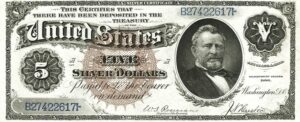
The National Bank Note Grading Dilemma
Walk through any major currency show and you will see them everywhere: raw National Bank Notes tucked into archival holders, priced by eye and sold on reputation. You will also see slabbed examples from the same approximate era selling for two, three, or even five times as much. The difference is not always the note itself. Sometimes it is simply the strategic decision of whether to submit for third-party grading in the first place.
National Bank Notes, issued between 1863 and 1935 through thousands of chartered banks across all 48 contiguous states and several territories, represent one of the most complex and regionally charged collecting areas in all of American numismatics. With more than 14,000 issuing banks recorded in the Hickman-Oakes census and successor databases, the range of rarity is staggering. A $10 Original Series note from the First National Bank of Deadwood, South Dakota (Charter 2391) inhabits a completely different universe of value and collector demand than a circulated $5 Series of 1882 Brown Back from a large Eastern city bank with thousands of survivors. Understanding that distinction is the foundation of any smart submission strategy.
Understanding the Two-Tier Market
The National Bank Note market effectively operates on two tracks simultaneously. The first track covers common charters, typically large-city banks in states like New York, Pennsylvania, Illinois, and Massachusetts that issued hundreds of thousands of notes across multiple series. These institutions often have dozens or even hundreds of surviving examples in collector hands. Think of the First National Bank of Chicago (Charter 2670) or the Mechanics National Bank of New York. Notes from these banks in circulated grades from VF-20 through AU-55 frequently trade in the $200 to $600 range depending on denomination and series, and a grading slab adds perhaps $25 to $50 in perceived value, rarely enough to offset a $35 to $65 submission fee, especially after the weeks of turnaround time.
The second track is where the real grading calculus changes. Rare territorial issues, single-known examples, small-town banks from sparsely populated states like Nevada, New Mexico, or Alaska Territory, and certain scarce denominations like $50 and $100 Original Series notes can command five-figure or six-figure prices. For these notes, third-party grading is not optional. It is the price of admission to the top tier of the market.
Before submitting any National Bank Note, consult the most recent Don Kelly population data or the Heritage Auctions archive to estimate how many examples of that specific charter and denomination are currently known. If more than 25 examples exist in any grade, the note likely falls into the “common” category where grading fees may not pencil out unless the note grades VF-30 or better.
Series, Signatures, and Seal Colors: What Graders Actually Evaluate
National Bank Notes span six distinct type series, and each carries its own grading considerations. The Original Series (1863 to 1875) and Series of 1875 notes feature the large-size format with red scalloped Treasury seals and were printed on paper that was particularly susceptible to moisture damage and edge wear. Graders at PMG and PCGS Currency pay close attention to paper quality, centering (which was notoriously inconsistent from the Continental Bank Note Company and American Bank Note Company printings), and the crispness of the charter number overprint.
The Series of 1882 notes introduced three distinct sub-types: the Brown Backs (1882 to 1908), the Date Backs (1908 to 1916), and the Value Backs (1916 to 1922). Signature combinations matter here. Notes bearing the Rosecrans-Huston signatures (1889 to 1891) on Brown Backs are among the most commonly encountered pairings. By contrast, Rosecrans-Nebeker signatures (1891 to 1893) on a $50 or $100 Brown Back from a small-state charter represent a genuinely scarce combination that warrants submission regardless of grade. Even a Fine-12 example of such a note from a reported population of three or four survivors belongs in a slab.
The Series of 1902 notes, divided into Red Seals (1902 to 1908), Date Backs (1908 to 1916), and Plain Backs (1916 to 1935), represent the largest surviving body of National Bank Notes and also the most nuanced grading landscape. Series of 1902 Red Seals are uniformly scarcer than their Date Back or Plain Back counterparts, and even common-charter Red Seals in grades of VF-35 or better are worth the submission cost. A 1902 Red Seal $10 note from a well-documented large-city bank might retail raw for $450 in VF but could bring $650 to $900 slabbed and graded VF-30 or VF-35 at a major auction, a meaningful premium that easily justifies a $45 submission fee.
The Small-Size National Bank Notes: An Often Overlooked Category
Many newer collectors focus exclusively on large-size Nationals without realizing that the small-size Series of 1929 National Bank Notes, issued in Type 1 (1929 to 1933) and Type 2 (1933 to 1935) varieties, have their own distinct rare-charter landscape. Type 1 notes carry the bank’s charter number printed twice on the face; Type 2 notes carry it six times. The distinction affects value, and certain charter-denomination combinations are genuinely rare in either type.
The Territory of Alaska issued small-size Nationals through only a handful of banks, including the First National Bank of Fairbanks (Charter 7718) and the First National Bank of Anchorage (Charter 12072). A $20 Type 1 from Charter 12072 in Very Fine condition is a five-figure note. Slabbed by PMG or PCGS Currency, it becomes more liquid and commands better auction results because buyers have confidence in both the grade and the authenticity, a particular concern in Territorial Nationals where alterations and outright counterfeits have appeared in the market.
For small-size 1929 Nationals, the Type 1 versus Type 2 distinction can be worth hundreds of dollars on certain rare charters. When submitting, specifically request that the grading service note the type designation on the label, since some earlier slabs from the mid-2000s omitted this detail. Both PMG and PCGS Currency now include this information as standard on National Bank Note labels.
When Grading Fees Eat Your Profit: The Common Note Problem
Here is the honest math that many dealers avoid discussing openly. Standard economy-tier submissions to PMG run approximately $30 to $38 per note as of 2024 pricing schedules. Turnaround at the economy level can stretch to 60 to 90 days. Express tiers run $65 to $85 per note with faster service. If you submit a Series of 1902 Plain Back $5 note from the First National Bank of Philadelphia (Charter 539) in Very Good-10 condition, you might realistically be holding a note worth $95 to $130 raw. The slab adds credibility but rarely bumps that value past $150 to $160. After fees and shipping, you have lost money on the transaction.
The break-even analysis for common National Bank Notes in circulated grades generally looks like this: if the raw market value of the note is below $300 in its current condition, economy-tier grading rarely pencils out unless you are submitting in a bulk lot that qualifies for volume discounts. Even then, the overhead of time and logistics may outweigh the marginal premium a slab provides on a common note.
The exception is condition rarities. A common-charter note that grades PMG 64 or 65 Gem Uncirculated represents the top of the condition census for that note even if the charter itself is mundane. Gem-grade Nationals of any charter are scarce because most circulated heavily and paper quality was inconsistent. A PMG 65 EPQ (Exceptional Paper Quality) designation on a Series of 1929 Type 1 $10 note from an otherwise ordinary Midwestern bank can push the value from a raw $200 estimate to $700 or $1,000 at auction because high-grade collectors compete for condition-census notes regardless of charter rarity.
Authenticating Altered Notes: Why Slabbing Protects Buyers
The National Bank Note market has a well-documented problem with altered notes, specifically notes where a charter number, bank name, or state designation has been chemically or mechanically altered to create the appearance of a rarer issue. The most notorious examples involve notes from common Eastern charters being altered to simulate territorial issues from Wyoming, Indian Territory, or Hawaii. Prices for genuine territorial Nationals can be ten to twenty times higher than their common counterparts in equivalent grades, making the financial motive for alteration substantial.
PMG and PCGS Currency both employ forensic examination techniques, including UV light analysis, paper fiber examination, and comparison with documented genuine examples. A slabbed territorial National Bank Note from either service carries an implicit authentication guarantee that raw notes cannot provide. This is precisely why serious buyers of rare charter issues routinely demand encapsulated examples and apply meaningful discounts, sometimes 30 to 50 percent, to raw notes of equivalent apparent grade and rarity.
If you acquire a raw territorial National Bank Note, particularly from Alaska, Hawaii, Indian Territory, Oklahoma Territory, New Mexico Territory, or Arizona Territory, submit it for grading before attempting to resell. Even if the note is genuine and grades modestly, the authentication component of the slab can be worth more than the grade itself in terms of buyer confidence and realized auction prices.
Building a Submission Strategy by Charter Category
Experienced collectors and dealers typically categorize their National Bank Note submissions into three buckets. The first bucket contains definite submissions: any territorial issue regardless of grade, any note with a reported survivor population below ten examples, any large-size Original Series or 1875 note in Fine or better condition, any Series of 1902 Red Seal in VF or better regardless of charter, and any note with a provenance trail connected to a major collection like the Grinnell Collection or the Donlon Collection. These go to the grading service automatically.
The second bucket contains conditional submissions: Series of 1882 notes from small-state banks (defined loosely as banks in states with fewer than 100 total surviving examples of any denomination), any note suspected to be at the top of its condition census, and any note where the buyer is a known institutional collector or auction house that requires encapsulated examples. Submit these after verifying current population data and ensuring the expected grade improvement in realized value exceeds fees by at least 40 percent to account for uncertainty in final grade.
The third bucket contains notes to sell raw: common-charter Series of 1929 Type 1 and Type 2 notes in circulated grades below Fine-15, Series of 1902 Plain Back notes from large-city charters in VG to Fine condition, and any note where the raw retail value falls below $250. These notes move efficiently in the raw market through direct sales, club auctions, and dealer networks without the overhead of professional grading.
| Series / Type | Charter / Region | Est. Known Survivors | Rarity |
|---|---|---|---|
| Original Series $5 (1863-1875) | Territory of Wyoming charters | 8 to 15 total | Key Date |
| Series of 1882 Brown Back $50 | Indian Territory banks | Fewer than 20 known | Key Date |
| Series of 1902 Red Seal $10 | Common large-city charters, VF+ | Hundreds known | Scarce |
| Series of 1902 Red Seal $10 | Small-state or territorial charters | Under 25 known per charter | Rare |
| Series of 1929 Type 1 $20 | First NB of Anchorage (Ch. 12072) | Approx. 12 to 20 known | Key Date |
| Series of 1929 Type 2 $5 | First NB of Fairbanks (Ch. 7718) | Under 30 known | Rare |
| Series of 1929 Type 1 $10 | Large Midwestern cities, VF-30 or below | Many hundreds | Common |
| Series of 1875 $1 | Any issuing bank, Fine or better | Relatively few in higher grades | Scarce |
| Series of 1882 Date Back $5 | Hawaii Territory banks | Under 50 known | Rare |
| Series of 1902 Plain Back $5 | Common Eastern city banks, circ. grades | Thousands | Common |
Timing Your Submissions for Maximum Return
Submission timing is a practical consideration that most guides ignore. Heritage Auctions, Stack’s Bowers, and Lyn Knight Currency Auctions all hold major currency sales in January, April, June, and August of each year, corresponding roughly to FUN, the Central States Numismatic Society show, the summer convention circuit, and the American Numismatic Association World’s Fair of Money. Submitting notes approximately 90 days before a major sale with express or regular grading tiers ensures your material arrives encapsulated in time for consignment deadlines, which typically fall 45 to 60 days before the auction date.
Conversely, submitting during post-show periods when grading services are processing high submission volumes can push economy-tier turnaround past 120 days. For rare charters where you intend to auction the note rather than hold it, this timing mismatch can mean missing an entire auction cycle and sitting on capital for six additional months.
Check the current PMG and PCGS Currency turnaround time estimates before submitting, as these fluctuate significantly throughout the year. Post-ANA and post-FUN submission volumes are historically the highest, and economy-tier turnaround can balloon during these periods. For rare notes heading to auction, always use at least the regular service tier to keep turnaround predictable.
The Bottom Line: Matching Submission Strategy to Note Value
The core principle is straightforward even if the application requires research: third-party grading amplifies value when the note itself already commands collector interest based on rarity, territorial origin, series significance, or high-grade condition. For a genuine key-date National Bank Note, slabbing does not simply add the cost of the fee to the value. It can multiply the realized price by a factor of 1.5 to 3 times compared to an equivalent raw example, because it resolves the two greatest sources of buyer hesitation in this market: uncertainty about grade and uncertainty about authenticity.
For common notes, that multiplication effect disappears. The slab becomes a cost center rather than a value creator, and the strategic collector recognizes the difference. Know your charter populations, understand your series-level rarity, and apply grading fees where they earn their keep. That discipline, more than any single note purchase, defines the difference between a collector who builds equity and one who simply builds a collection.