Stand on the south side of 14th Street in Washington, D.C., and look toward the massive neoclassical granite structure at 14th and C Streets SW. That building, completed in stages between 1914 and 1938, is the Bureau of Engraving and Printing’s main facility, and virtually every piece of federal paper currency printed since Woodrow Wilson’s first term has passed through its presses. But the story of how the BEP got there, and what that journey means for currency collectors, is rarely told in full. It touches on Civil War emergency measures, congressional turf battles, overcrowded basement vaults, and ultimately a production transformation that changed American banknote printing forever.
Origins in the Treasury Basement: 1862 to 1880
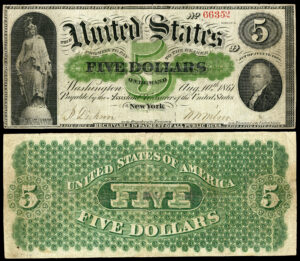
The Bureau of Engraving and Printing did not spring into existence as a grand federal institution. It was born out of wartime desperation. When Congress authorized Demand Notes in July 1861 and then United States Notes (Legal Tender Notes) under the Legal Tender Act of February 25, 1862, the Treasury Department initially contracted with private bank note companies, primarily the American Bank Note Company and the National Bank Note Company in New York. But Treasury Secretary Salmon P. Chase grew frustrated with the slow turnaround, the secrecy concerns, and the cost of private contracting.
In August 1862, Chase directed that a small operation be established within the Treasury Building itself, in the basement, where workers, many of them women hired specifically because they could be paid lower wages than men, would apply Treasury seals and signatures to notes already printed by the contractors. This modest operation, sometimes called the “First Division” of the Currency Bureau, occupied cramped, poorly ventilated rooms beneath the grand offices above. By 1863, the operation had expanded into actual plate printing for fractional currency, and the die was cast: the federal government was going to print its own money.
By the late 1870s, the Treasury basement operation was genuinely untenable. Thousands of sheets of currency were stored in conditions that horrified auditors. Humidity, poor lighting, and fire risk were constant concerns. Congress finally appropriated funds for a dedicated building, and in 1878 construction began on a facility on 14th Street SW, just south of the Mall. This first standalone BEP building opened in 1880 and represented a genuine leap forward in production capacity and security. The Series of 1880 Legal Tender Notes and Silver Certificates, with their large, beautifully engraved faces and distinctive colored Treasury seals, were among the first major series produced with the new facility’s expanded capabilities.
Notes from the 1880 series are among the most collectible of the “large size” era. The Series 1880 $1 Legal Tender Note (Fr. 29 through Fr. 39) features the famous “large brown seal” variety in early printings and a red seal in later issues. Fine examples of the brown seal varieties, particularly with the Scofield-Gilfillan signature combination, can fetch $800 to $2,500 depending on grade, making them genuinely attainable for intermediate collectors building a type set.
Why the 14th Street Building Was Already Obsolete by 1900
The 1880 facility solved the immediate crisis but created a longer-term problem: it was already at capacity before the turn of the century. The currency demands of Gilded Age America were staggering. National Bank Notes were being printed for hundreds of new chartered banks each year. Silver Certificates, Gold Certificates, and Treasury Notes of 1890 each required separate plate inventories and press configurations. The BEP’s workforce grew from roughly 400 employees in 1880 to more than 2,000 by 1900, and the physical plant simply could not keep pace.
Multiple congressional studies in the 1890s and early 1900s examined the problem. The BEP’s directors submitted repeated requests for a new, purpose-built facility. The argument was not only about capacity: it was about security, fire safety, and the integrity of the currency supply itself. A catastrophic fire in the 14th Street building would have been an economic disaster of the first order. Congress finally acted with an appropriation in 1905, and the architectural firm of James Knox Taylor, then serving as Supervising Architect of the Treasury, developed plans for a building on Independence Avenue SW, just west of 14th Street, designed specifically around the workflow of currency production from plate engraving through finished sheet delivery.
Construction and the 1914 Opening
Construction of the new BEP facility proceeded between 1911 and 1914. The building was designed in the Beaux-Arts style that dominated federal construction of the era, with a granite exterior, large windows for natural light in the engraving rooms, and a layout that placed the most sensitive operations, plate vaults and examining rooms, in the building’s interior away from exterior walls. The main production wing facing Independence Avenue was substantially complete and operational by the summer of 1914, though full transition from the old 14th Street building took several additional months.
The timing was historically remarkable. The Federal Reserve Act had been signed into law on December 23, 1913, and the new Federal Reserve Banks were being organized throughout 1914. The first Federal Reserve Notes, authorized under that act, were a Series of 1914, and they were printed in the new Independence Avenue facility. Collectors today recognize these as among the most historically important large-size notes ever issued: the first currency produced at what would become the permanent home of American paper money production.
The Series 1914 Federal Reserve Notes come in two major varieties distinguished by seal color: the earlier “Red Seal” issues (Fr. 832 through Fr. 891 for the $1 through $100 denominations) and the more common “Blue Seal” notes. Red Seal 1914 FRNs were printed in relatively small quantities before the Treasury switched to the blue seal design. A Red Seal 1914 $5 Federal Reserve Note in Very Fine condition typically trades between $350 and $900 depending on the issuing district, making the 12-district set a satisfying long-term collecting challenge.
What Changed on the Notes Themselves
The physical transition between facilities was not instantaneous, and this created interesting overlaps in the currency record. Plates that had been in use at the 14th Street building were transferred and continued to be used at the new facility. Serial number sequences were not reset during the move. However, the new building’s superior engraving rooms and press equipment did eventually enable finer detail work, and the BEP’s master engravers, including Marcus Baldwin who joined the staff in 1912, took advantage of the improved conditions.
For collectors, the most consequential period is roughly 1914 through 1923, when the large-size note era was winding down and the BEP was simultaneously ramping up production in its new home. The Series of 1923 $1 Silver Certificate (Fr. 237 and Fr. 238, the famous “Porthole” note featuring Lincoln on the reverse) was one of the last great large-size designs produced before the transition to small-size currency in 1929. It was printed entirely at the Independence Avenue facility and represents a kind of capstone for the era inaugurated by the 1914 move.
The Small-Size Currency Revolution and the 1938 Annex
The shift to small-size currency in 1929 was itself partly enabled by the Independence Avenue facility’s layout, which could accommodate the new high-speed presses required for the smaller format. Print runs expanded dramatically: where large-size notes might have been produced in press runs of a few hundred thousand sheets, small-size production quickly scaled into the tens of millions of sheets per year. The BEP’s workforce and physical plant requirements grew accordingly.
By the mid-1930s, the 1914 building was again being pushed to its limits. A major annex was constructed to the west of the original structure and completed in 1938, adding substantial press room space and allowing the BEP to meet the currency demands of the New Deal era and the approaching wartime economy. Notes printed from 1938 onward benefit from this additional capacity, though from a collector standpoint the 1914 to 1938 period represents the facility’s most historically interesting output.
When examining small-size notes from the late 1920s and 1930s, pay attention to the Series date and signature combination rather than just the year you think a note was printed. The Series of 1928 $1 Silver Certificate (Fr. 1600), for example, was printed from 1928 through 1934 at the Independence Avenue facility. High-grade examples (PMG 65 EPQ or better) of the scarcer signature varieties, particularly Woods-Woodin, can command significant premiums over common signature pairings of the same series.
Reading the Transition in Serial Numbers and Plate Records
Advanced collectors and researchers can actually trace the facility transition through BEP plate records and the serial number progression on surviving notes. The BEP maintained meticulous plate ledgers from the 1870s onward, and these records, portions of which have been reproduced in reference works including Gene Hessler’s comprehensive plate histories, show delivery dates for finished currency that correspond to specific press runs. Notes with serial numbers in certain ranges on Federal Reserve Bank Notes of 1915 and 1918, for instance, can be definitively associated with specific months of production in the new facility.
The National Archives holds extensive BEP production records, and serious researchers willing to spend time with Record Group 318 can reconstruct remarkable detail about when specific plates were in use and at which facility. For most collectors, the practical takeaway is simpler: any large-size note dated 1914 or later was produced at the Independence Avenue building, while earlier series may have been produced at either the 14th Street facility or during the actual transition period.
| Series / Friedberg No. | Type and Denomination | Est. Known Examples | Rarity |
|---|---|---|---|
| Fr. 29, Series 1880 | $1 Legal Tender, Brown Seal | 500-800 graded | Scarce |
| Fr. 347, Series 1890 | $1 Treasury Note (Coin Note) | 300-500 graded | Scarce |
| Fr. 832-843, Series 1914 | $1 FRN, Red Seal, All Districts | Varies by district | Rare |
| Fr. 848 (Boston), Series 1914 | $5 FRN, Red Seal | Under 200 graded | Key Date |
| Fr. 1000, Series 1915 | $5 Federal Reserve Bank Note | 400-600 graded | Scarce |
| Fr. 237, Series 1923 | $1 Silver Certificate (Porthole) | 3,000-5,000 graded | Scarce |
| Fr. 1600, Series 1928 | $1 Silver Certificate, Woods-Woodin | 800-1,200 graded | Rare |
| Fr. 2051-G, Series 1928 | $500 FRN, Chicago District | Under 100 graded | Key Date |
| Fr. 700, Series 1882 | $5 Gold Certificate, Brown Seal | 200-350 graded | Rare |
| Fr. 379, Series 1886 | $1 Silver Certificate, Martha Washington | 1,000-1,500 graded | Common |
Visiting the BEP Today: A Collector’s Pilgrimage
The Independence Avenue facility is still active and offers public tours that give collectors a remarkable perspective on the scale of modern currency production. Walking through the public gallery above the press room, watching sheets of Federal Reserve Notes moving through intaglio presses that apply the same basic printing principle used in 1914, is a genuinely moving experience for anyone who collects the product. The BEP gift shop sells uncut currency sheets, special packaging sets, and other collector items that, while not rare, make excellent introductory pieces for new collectors or gifts for those curious about the hobby.
A second BEP facility in Fort Worth, Texas, opened in 1991 and handles a significant portion of current production. Notes printed there can be distinguished by the small “FW” plate position letter that appears on the face of the note, a detail worth knowing when examining modern issues for variety collecting.
Conclusion: Why the Address Matters
The Bureau of Engraving and Printing’s journey from a cramped Treasury basement to an Independence Avenue landmark is not mere institutional biography. It is the physical framework within which American paper money was transformed from an emergency wartime measure into a permanent, sophisticated, nationally standardized currency system. Every note in your collection printed after 1914 came from that building, or its Fort Worth counterpart. Understanding the history of where your notes were made adds a layer of meaning to the objects themselves, connecting the ink and paper in your hands to the engravers, press operators, and Treasury officials who shaped what American money looks like. That connection is, ultimately, what makes currency collecting more than an investment strategy. It makes it history you can hold.