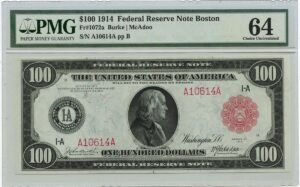
Pull out a $1 Federal Reserve Note with the letter “I” printed to the left of the portrait, and you are holding a piece of paper money tied directly to the wheat fields of Minnesota, the cattle ranches of Montana, and the dairy farms of Wisconsin. The Federal Reserve Bank of Minneapolis, designated as District 9, has been issuing currency since the Federal Reserve System opened its doors on November 16, 1914. For collectors, District 9 notes occupy a unique intersection of American agricultural history and paper money scarcity, with some series offering genuinely rare finds alongside the more common circulated examples that make this district accessible to beginners.
Why the Minneapolis Fed Was Built for Farm Country
When Congress passed the Federal Reserve Act in December 1913, one of the driving forces behind the legislation was the chronic instability of agricultural credit in rural America. Farmers across the northern Great Plains had long suffered from what economists called the “crop lien” system: a cycle of short-term, high-interest borrowing against future harvests that left families perpetually indebted. The Minneapolis Fed was chartered specifically to serve this region, and its early operations were shaped almost entirely by the agricultural calendar. Loan demand spiked every spring as farmers prepared fields, and the bank’s currency issuance reflected those seasonal pressures.
The district is geographically vast. Stretching from the Upper Peninsula of Michigan westward through Minnesota, North and South Dakota, and into all of Montana, District 9 covers more than 500,000 square miles. Yet its population has always been relatively sparse compared to districts like New York or Chicago. That demographic reality has a direct consequence for collectors: lower overall currency circulation meant that certain Minneapolis issues were printed in far smaller quantities than their counterparts from larger districts, creating scarcity that rewards patient hunters today.
The 1914 Federal Reserve Notes: District 9’s First Issues
The earliest Federal Reserve Notes, the Series 1914 Red Seals and Blue Seals, are the foundation of any serious District 9 collection. The 1914 Red Seal notes were issued briefly before the Treasury changed the seal color to blue, making red seals considerably scarcer across all districts. For Minneapolis, the 1914 Red Seal issues are cataloged in the Standard Catalog of United States Paper Money under numbers that place them among the top-tier collectibles for this district.
The 1914 Red Seal $5 Minneapolis note (Friedberg number Fr. 832) carries a catalog value in Fine condition of approximately $800 to $1,200, while Extremely Fine examples have realized $2,500 or more at major auction. The $10 and $20 Red Seal Minneapolis notes (Fr. 893 and Fr. 952 respectively) are even scarcer in high grade, with $20 Red Seals in VF-30 routinely bringing $3,000 or above. The signature combination on these earliest issues is Burke-McAdoo, representing Register of the Treasury James Burke and Secretary of the Treasury William McAdoo.
When examining 1914 Minneapolis Red Seal notes, pay close attention to the district letter “I” and numeral “9” printed within the Federal Reserve seal. Counterfeits of these early notes do exist, and a misaligned district identifier is one of the first signs of a problem note. Always cross-reference with an established Friedberg guide before purchasing raw examples above Fine condition.
Large-Size Notes and the Agricultural Panic of the Early 1920s
Between 1914 and 1928, the Minneapolis Fed issued large-size Federal Reserve Notes in denominations from $5 through $100, and also participated in Federal Reserve Bank Note issuance. The period from 1920 to 1922 was catastrophic for District 9 farmers. Wheat prices collapsed from a wartime high of $2.94 per bushel in 1919 to under $1.00 by 1921, devastating farms across the Dakotas and Minnesota. The Minneapolis Fed’s currency issuance during this period reflects the contraction: total notes outstanding from District 9 declined sharply as rural banks failed and currency returned to the Fed rather than circulating through the agricultural economy.
Large-size Minneapolis notes from the Series 1914 Blue Seal, carrying signature combinations such as Teehee-Burke, Elliott-Burke, Elliott-White, and Speelman-White, are all collectible and vary in value by signature pair and denomination. The Speelman-White combination (1921 to 1922) on $5 notes is among the more available, with circulated examples cataloging around $150 to $250 in VF. By contrast, the same denomination with the Elliott-Burke signatures in Fine condition brings $200 to $350 depending on centering and embossing sharpness.
Small-Size Federal Reserve Notes from Minneapolis: Series 1928 Onward
The transition to small-size currency in 1928 brought a new collecting chapter for District 9 enthusiasts. The Series 1928 through 1928G $1 Silver Certificates carry no district designation, but the small-size Federal Reserve Notes from 1928 forward all feature the Minneapolis “I” designation prominently. For beginning collectors, the most accessible entry point is the Series 1950 through 1977 era, where circulated Minneapolis $1 notes can be found for $3 to $10, and uncirculated examples are available for modest premiums over face value.
Where things get genuinely interesting for the serious collector is in the star note population for this district. Because Minneapolis has always had lower note demand than coastal districts, its star note print runs tend to be smaller. A classic example is the Series 1974 $1 Minneapolis star note: the Bureau of Engraving and Printing produced only approximately 1,280,000 of these replacements, compared to over 30,000,000 star notes for the New York district in the same series. In uncirculated grades of MS-63 or better, the Series 1974 Minneapolis $1 star is a $35 to $60 note, a genuine bargain for its relative scarcity.
Building a “district run” of Minneapolis $1 Federal Reserve Notes, one from each series from 1963 through the current series, is an achievable and educational project for collectors at any budget level. Focus on CU (crisp uncirculated) condition to make the set visually uniform. The total investment for a complete run in CU excluding the rarest star notes is typically under $300, making it an ideal first themed collection.
National Bank Notes from Minneapolis District Agricultural Towns
Beyond Federal Reserve Notes issued directly by the Minneapolis Fed, collectors of District 9 material must also consider the Type 1 and Type 2 National Bank Notes issued between 1929 and 1935 by state-chartered national banks throughout the district. These notes bear the name of individual towns and banks, and for agricultural community collectors they are among the most historically resonant pieces in American paper money.
Consider the First National Bank of Minot, North Dakota, which issued Series 1929 Type 1 $10 notes under charter number 3614. Minot served as a major grain marketing hub, and the bank’s notes circulated through farm communities across the Souris River valley. Surviving examples in VF condition catalog at $150 to $225. Even more evocative are the notes from smaller agricultural banks: the First National Bank of Harvey, North Dakota (charter 7159), or the Farmers National Bank of Northfield, Minnesota (charter 13779), where the bank name itself announces the agricultural mission of the institution. Notes from banks with fewer than 5,000 examples printed are considered rare and can command significant premiums regardless of grade.
The scarcest National Bank Notes from District 9 come from banks in Montana and the Upper Peninsula of Michigan, where population density was lowest and note issuance correspondingly thin. The First National Bank of Plentywood, Montana (charter 9660), issued fewer than 2,000 surviving notes across both Type 1 and Type 2, and a Fine example of their $5 can exceed $400 at specialized auction.
Farm Credit and Agricultural Paper: Beyond Standard Currency
A complete study of District 9 agricultural finance cannot stop at Federal Reserve Notes and National Bank Notes. The broader world of farm credit instruments issued in conjunction with or parallel to the Minneapolis Fed’s operations offers collectors a rich secondary market of agricultural paper. The Federal Land Banks, established under the Federal Farm Loan Act of 1916, issued bonds and certificates that circulated in rural communities as quasi-monetary instruments. The Federal Land Bank of St. Paul, which served much of District 9’s agricultural territory, issued interest-bearing bonds in denominations as small as $50 that were accepted as collateral and sometimes exchanged between farmers in lieu of currency during the lean years of the early 1930s.
While these instruments are not technically currency in the Federal Reserve Note sense, they are collected by many serious paper money enthusiasts who recognize their integral role in the monetary history of farm communities. The Federal Farm Mortgage Corporation certificates from 1934, backed by New Deal agricultural legislation, are particularly interesting: they bear Treasury of the United States guarantees and were specifically designed to stabilize land values across the wheat belt that forms the heart of District 9.
Agricultural states in District 9 produced a remarkable variety of Depression-era scrip notes when local banks closed during 1932 and 1933. Towns including Fargo, North Dakota, and Duluth, Minnesota issued emergency scrip backed by local tax obligations. These pieces are cataloged in Ralph Mitchell and Neil Shafer’s “Standard Catalog of Depression Scrip” and represent some of the most historically compelling and undervalued paper money from this region. Fine examples from small Minnesota towns often sell for $40 to $150 at regional shows.
High-Value Minneapolis Notes Collectors Should Know
Among post-1928 small-size issues, the $500 and $1,000 Federal Reserve Notes from Minneapolis carry a collector premium that reflects both their high face value and their relative district scarcity. The Series 1934 $500 Minneapolis note (Fr. 2201-I) is the key large denomination for District 9 collectors. With an estimated surviving population of fewer than 150 examples across all grades, these notes command prices of $4,000 to $8,000 in VF condition and considerably more in the rare event that an uncirculated example surfaces. The Series 1934A $1,000 Minneapolis note is even scarcer, with major auction records showing realized prices above $15,000 for Extremely Fine examples.
For collectors focused on more affordable modern issues, the Series 1995 $1 Minneapolis star note presents a genuinely compelling opportunity. The Bureau of Engraving and Printing produced only approximately 512,000 of these replacement notes for District 9, making them one of the scarcest small-denomination star notes of that era. In uncirculated grades, examples have sold for $45 to $85, a price that seems likely to increase as more collectors become aware of the population data.
| Series / Type | Denomination / Variety | Approx. Print Run or Survivors | Rarity |
|---|---|---|---|
| 1914 Red Seal (Fr. 832) | $5 Large-Size FRN | Est. fewer than 400 survivors | Key Date |
| 1914 Red Seal (Fr. 952) | $20 Large-Size FRN | Est. fewer than 250 survivors | Key Date |
| 1929 Type 1 NBN, Plentywood MT (Ch. 9660) | $5 National Bank Note | Fewer than 2,000 total issued | Rare |
| Series 1934 (Fr. 2201-I) | $500 Small-Size FRN | Est. fewer than 150 survivors | Key Date |
| Series 1974 $1 Star Note | $1 Replacement (I*) | Approx. 1,280,000 printed | Scarce |
| Series 1988A $1 Star Note | $1 Replacement (I*) | Approx. 640,000 printed | Rare |
| Series 1995 $1 Star Note | $1 Replacement (I*) | Approx. 512,000 printed | Rare |
| Series 1950 $1 FRN (Circulated) | $1 Regular Issue (I) | Standard print, widely available | Common |
| 1929 Type 2 NBN, Harvey ND (Ch. 7159) | $10 National Bank Note | Est. fewer than 3,500 issued | Scarce |
| Series 1963A $1 FRN Minneapolis | $1 Regular Issue (I) | Large run, common in CU | Common |
Grading Considerations Specific to District 9 Notes
Agricultural communities handled their currency hard. Notes that circulated through farm towns of the Dakotas and Montana in the 1920s and 1930s were used in conditions that accelerated wear: dusty grain elevators, wet spring fields, and the rough pockets of working farmers. As a result, high-grade examples of early Minneapolis notes are genuinely scarce, and collectors should be appropriately skeptical of notes offered as Extremely Fine or better without third-party certification from PCGS Currency or PMG. The grading standards for early Minneapolis large-size notes require particular attention to corner integrity, as the thick cotton-linen paper of 1914 to 1928 issues tends to develop corner splits before other wear becomes apparent.
For collectors buying uncertified District 9 large-size notes in the $500 to $2,000 range, consider that the cost of PCGS or PMG certification ($30 to $75 depending on service tier) is a worthwhile insurance policy. Certified examples of key District 9 notes consistently bring 20 to 40 percent premiums over comparable raw notes at major auctions including Heritage, Stack’s Bowers, and Lyn Knight.
Conclusion: Why District 9 Deserves Your Attention
The Federal Reserve Bank of Minneapolis has operated for over a century at the intersection of American agricultural economics and monetary policy. Its notes, from the scarce 1914 Red Seals through the underappreciated modern star notes of the 1990s, offer collectors at every level an opportunity to engage with that history in a tangible, paper-in-hand way. The relative obscurity of District 9 compared to New York or Chicago means that key pieces remain genuinely undervalued in the current market, a situation that patient and well-informed collectors can turn to their advantage. Whether you start with a $10 circulated Series 1950 $1 note bearing the Minneapolis “I” or set your sights on a certified 1914 Red Seal, the wheat fields of the northern plains are waiting to tell their story through your collection.