📷 Image source: banknote.ws (World Banknote Gallery). Images are selected by AI to represent the article topic and may not depict the exact note(s) described.
On July 9, 1896, William Jennings Bryan stepped to the podium at the Democratic National Convention in Chicago and delivered one of the most consequential speeches in American political history. “You shall not press down upon the brow of labor this crown of thorns,” he thundered, “you shall not crucify mankind upon a cross of gold.” The crowd erupted. Bryan won the presidential nomination that night. And the trajectory of American paper money, already in turbulent motion, lurched dramatically in a direction that collectors still feel today when they handle Silver Certificates from the 1890s.
To truly understand the Silver Certificates of this era, you cannot separate the notes from the politics. The denomination, design choices, print volumes, and the eventual legislative endpoints of these issues were all downstream consequences of a monetary war that gripped the country from roughly 1873 to 1900. This article traces that war, its key legislative battles, and what it all means for collectors building a collection around this fascinating period.
The Crime of 1873 and the Birth of the Silver Movement
To understand the 1890s, you must back up to the Coinage Act of 1873, which demonetized silver by removing the standard silver dollar from the list of authorized coins. Silver advocates, mostly Western miners and Southern and Midwestern farmers drowning in debt, called this the “Crime of 1873.” Their argument was straightforward: more money in circulation meant easier credit, higher crop prices, and debt relief. Gold alone, they believed, served the interests of Eastern bankers and British creditors at the expense of working Americans.
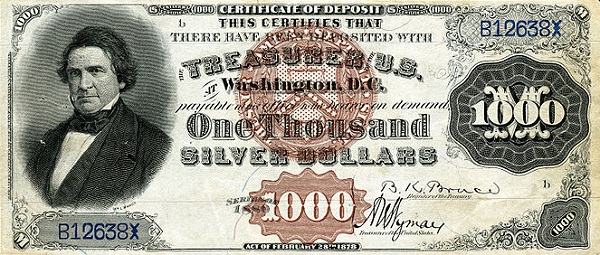
The first legislative response was the Bland-Allison Act of February 28, 1878, which required the Treasury to purchase between two and four million dollars worth of silver per month and coin it into silver dollars. The Act also authorized Silver Certificates, which were paper notes redeemable in silver coin. These became a cornerstone of everyday commerce and a politically loaded monetary instrument simultaneously.
The earliest Silver Certificates, Series 1878 and 1880 in large-size format, featured portraits of figures like Robert Morris (on the $1,000 denomination) and were issued in denominations ranging from $10 to $1,000. The Series 1880 $1 Silver Certificate, bearing the signatures of Scofield-Gilfillan and later Bruce-Gilfillan combinations, is among the more collectible early issues. An example in Fine-12 can trade for $400 to $600 today, while a Choice Uncirculated (MS-63) specimen commands $2,500 or more depending on the signature pair.
The Sherman Silver Purchase Act: Doubling Down Before the Crash
By 1890, silver advocates had enough political muscle to push through the Sherman Silver Purchase Act, signed July 14, 1890. This legislation required the Treasury to purchase 4.5 million ounces of silver per month, a dramatic increase over Bland-Allison levels. Payment was made with a new class of Treasury Notes of 1890, redeemable in either gold or silver at the Treasury’s discretion. These Treasury Notes are among the most visually spectacular U.S. currency ever produced.
The Treasury Notes of 1890 featured elaborate “watermelon” backs, so called by collectors because the large zeros in the denomination counters resembled watermelons when viewed at the right angle. The $100 Treasury Note of 1890, for example, bears the Rosecrans-Nebeker signature combination and carries a large brown Treasury seal. In circulated grades, these notes are genuinely rare. A Fine example of the $100 1890 Treasury Note (Friedberg catalog number Fr. 377) can fetch $4,000 to $7,000 at auction. The Series 1891 versions, with revised backs showing the denomination more plainly, are slightly more available.
When pursuing Treasury Notes of 1890, pay close attention to the signature combinations. The Rosecrans-Nebeker pairing is most common, while Rosecrans-Huston on certain denominations is considerably scarcer. Use the Friedberg “Paper Money of the United States” catalog as your primary reference, as these distinctions can represent hundreds or even thousands of dollars in value difference.
The Panic of 1893 and the Repeal of Sherman
The Sherman Act barely survived three years. The Panic of 1893, one of the worst economic crises in American history, triggered a catastrophic run on gold reserves. President Grover Cleveland, a “Gold Democrat” who viewed silver inflation as dangerous and irresponsible, called a special session of Congress and lobbied hard for repeal. On October 30, 1893, Congress repealed the Sherman Silver Purchase Act, ending the mandatory silver purchases.
The repeal was a political earthquake. It shattered the Democratic Party between its gold and silver factions, cleared the way for Bryan’s insurgent campaign three years later, and had immediate, traceable effects on Silver Certificate production volumes. The Treasury’s silver purchases dropped sharply, and though Silver Certificates remained in production, the political winds were clearly shifting toward gold.
For collectors, the 1891 and 1896 series Silver Certificates issued in this transitional window represent a uniquely charged moment in monetary history. The Series 1891 $1 Silver Certificate (Fr. 223-229), featuring Martha Washington’s portrait, was the first U.S. paper currency to depict a woman. The Tillman-Morgan signature combination on the Series 1891 $1 is common in circulated grades, available for under $100 in VG, but the Napier-McClung combination is notably scarce.
The 1896 Educational Series: Art Meets Ideology
Perhaps no currency series in American history carries more ideological freight than the Silver Certificates of 1896, universally known today as the “Educational Series.” Designed by noted artists including Will H. Low and Edwin H. Blashfield, these notes featured elaborate allegorical scenes intended to illustrate the civilizing power of American democracy and education.
The $1 Educational note (Fr. 224-225) depicts “History Instructing Youth” against a backdrop of the Washington Monument and Capitol, flanked by portraits of Martha and George Washington on the reverse. The $2 note (Fr. 247-248) shows “Science Presenting Steam and Electricity to Commerce and Manufacture.” The stunning $5 note (Fr. 268) features “America” as a central allegorical female figure with electric light and a dynamo at her feet.
These notes were politically symbolic in ways that were not entirely accidental. Issuing elaborate, beautiful Silver Certificates at the height of the silver debate was itself a statement: silver-backed currency could be as prestigious and sophisticated as any gold instrument. Treasury officials and silver advocates understood the propaganda value of premium design.
The Educational Series $5 note is dramatically rarer than the $1 or $2 denominations. While original print figures are not precisely documented for all varieties, auction results consistently show that gem uncirculated ($5 Fr. 268) examples have sold for $35,000 to $60,000. Even in Very Fine condition, budget $8,000 to $15,000. The $1 Educational in the same grade is far more accessible at $300 to $600, making it an excellent entry point for collectors drawn to the series.
Bryan’s Campaign and Its Effect on Silver Certificate Volumes
William Jennings Bryan’s 1896 presidential campaign on a free silver platform representing unlimited coinage of silver at a 16-to-1 ratio to gold was the high-water mark of the silver movement. His loss to William McKinley, who ran explicitly on the gold standard, was immediately interpreted by Treasury officials and Congress as a public mandate for gold orthodoxy.
The practical effect on Silver Certificate production was significant. New designs were ordered to replace the politically charged Educational Series as quickly as practical. The Series 1899 Silver Certificates, introduced beginning that year, replaced the allegorical grandeur of 1896 with more conventional portraiture. The $1 Series 1899 (the famous “Black Eagle” note, Fr. 226-239) features a large American eagle above portraits of Lincoln and Grant, a design that conveyed national unity rather than monetary ideology.
Production volumes on the Series 1899 $1 were enormous by the standards of the era. This is the most commonly encountered large-size Silver Certificate in the collector market today, with circulated examples readily available for $30 to $80. However, certain signature combinations within the 1899 series are genuinely scarce. The Speelman-White combination (Fr. 238) had a relatively limited print run, and gem examples carry substantial premiums.
Bryan ran again in 1900 and lost again, more decisively. The Gold Standard Act of March 14, 1900 formalized what the market had already decided: the United States was on a gold standard, and silver’s role in the monetary system would be permanently secondary. Silver Certificates would continue to be issued, but they were no longer the symbolic battleground they had been in the 1890s. They were simply a convenient paper form for silver dollar holdings.
Building a “political narrative” collection of 1890s currency can be enormously rewarding. Consider assembling one example each of: a Sherman Act-era Treasury Note of 1890, a Series 1891 Silver Certificate, a Series 1896 Educational note, and a Series 1899 “Black Eagle” note. Together they tell the complete story of the silver debate’s rise and fall. The total cost for circulated examples of each is achievable for under $1,500, with the Treasury Note being the most expensive component.
Signature Combinations as Collecting Keys
One dimension of 1890s currency that rewards careful study is the range of Treasury Register and Treasurer signature combinations. During this turbulent decade, political turnover in Treasury appointments was frequent, creating numerous signature pairings that appeared on notes for relatively short windows of time.
On Series 1891 Silver Certificates, for example, you encounter combinations including Rosecrans-Nebeker, Rosecrans-Morgan, Tillman-Morgan, Tillman-Roberts, Bruce-Roberts, and Lyons-Roberts, among others. Each reflects a specific moment in Treasury staffing history. The Fessenden-Treat combination, appearing on very late Series 1899 notes, represents one of the shorter-lived pairings and is eagerly sought by specialists.
Cross-referencing the Friedberg catalog numbers with population reports from PCGS or PMG gives serious collectors the most reliable guide to true scarcity. A note listed as “scarce” in older literature may have had additional examples certified since publication, so current population data always takes precedence.
| Series / Friedberg No. | Denomination and Type | Approx. Known or Print Context | Rarity |
|---|---|---|---|
| 1890 / Fr. 377 | $100 Treasury Note, Rosecrans-Nebeker | Fewer than 100 known in all grades | Key Date |
| 1891 / Fr. 353 | $50 Treasury Note, Rosecrans-Nebeker | Very few survivors, mostly low grade | Rare |
| 1896 / Fr. 268 | $5 Educational Silver Certificate | Low original print; under 200 known | Key Date |
| 1896 / Fr. 247 | $2 Educational Silver Certificate | Moderate survivors, mostly circulated | Scarce |
| 1896 / Fr. 224 | $1 Educational Silver Certificate | Most available of Educational series | Scarce |
| 1891 / Fr. 223 | $1 Silver Cert, Martha Washington | Common in circulated grades | Common |
| 1899 / Fr. 226 | $1 “Black Eagle,” Lyons-Roberts | Very large print run, widely available | Common |
| 1899 / Fr. 238 | $1 “Black Eagle,” Speelman-White | Limited print window, fewer survivors | Scarce |
| 1891 / Fr. 353 | $1 Silver Cert, Fessenden-Treat | Short appointment window, very few made | Rare |
| 1890 / Fr. 374 | $10 Treasury Note “Watermelon,” various sigs | Hundreds known, most heavily circulated | Scarce |
The Legacy for Collectors Today
The currency debates of the 1890s left a paper trail, quite literally, that modern collectors can hold in their hands. Every Treasury Note of 1890, every Educational Series certificate, every “Black Eagle” $1 note is a material artifact of one of the most intense political and economic arguments in American history. The choice of designs, the timing of series changes, and the volumes printed were not neutral bureaucratic decisions. They were made by human beings living through a genuine national crisis over what money was, who it served, and what kind of country America would become.
When McKinley’s victory in 1896 effectively closed the silver debate, it did not immediately end Silver Certificate production. These notes continued to circulate until the Federal Reserve Act of 1913 began reshaping the entire currency system, and Silver Certificates themselves persisted in modified form until 1964. But the passion that surrounded their earliest issues, the political energy of Bland-Allison and Sherman and the Educational Series, belongs specifically to this extraordinary decade.
For collectors at any level, the 1890s represent one of the most historically rich and visually rewarding periods in all of American numismatics. Whether your budget runs to a circulated $1 Black Eagle at $50 or a gem Educational $5 in the five-figure range, there is an entry point into this story. And knowing the story makes every example more meaningful.