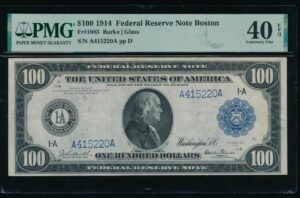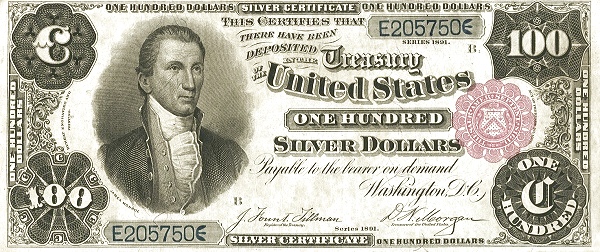
📷 Image source: banknote.ws (World Banknote Gallery). Images are selected by AI to represent the article topic and may not depict the exact note(s) described.
A Printing Bureau at War
When the USS Maine sank in Havana Harbor on February 15, 1898, it triggered a chain of events that would push the Bureau of Engraving and Printing (BEP) to its operational limits. The Spanish-American War, formally declared on April 25, 1898, and concluded by the Treaty of Paris on December 10, 1898, lasted only 114 days of active combat. But the fiscal and logistical demands placed on the BEP rippled through the entire production calendar, affecting everything from postage stamps to Silver Certificates to the War Revenue bonds that financed Commodore Dewey’s fleet at Manila Bay.
The BEP in 1898: Infrastructure and Capacity
By the late 1890s, the Bureau of Engraving and Printing had outgrown its post-Civil War origins and operated from its purpose-built facility on 14th Street SW in Washington, D.C., completed in 1880 and expanded in 1891. The Bureau was responsible for printing United States Notes, Silver Certificates, Gold Certificates, National Bank Notes (the plates, at minimum), postage stamps, internal revenue stamps, and government bonds. Each category required specialized intaglio presses, skilled plate printers, and a carefully managed workflow of steel engraved plates.
In fiscal year 1897, the BEP had printed approximately 186 million sheets of currency and well over 3 billion postage stamps. The facility ran on a relatively predictable annual schedule, with currency print runs calibrated to Federal Reserve and Treasury demand forecasts. The war shattered that predictability almost overnight.
The War Revenue Act and the Stamp Surge
Congress passed the War Revenue Act on June 13, 1898, imposing new excise taxes on a sweeping range of commercial transactions: proprietary medicines, matches, chewing gum, tobacco, bank checks, telegrams, railroad tickets, and more. Each of these new taxes required documentary stamps, and the BEP was the only institution legally authorized to produce them.
The scale of demand was extraordinary. The Act required the BEP to design, engrave, and produce dozens of new stamp denominations in a matter of weeks, not months. Engravers who would normally spend six to eight weeks perfecting a single portrait vignette for a currency note were instead reassigned to stamp production in rotating shifts. The BEP’s Annual Report for fiscal year 1898 noted that the War Revenue stamps required the creation of over 100 new plate varieties and that ordinary production schedules for postage and currency had to be renegotiated with the Treasury Department.
For collectors, the 1898 War Revenue stamps (Scott R161 through R190 and the documentary series) are directly linked to this printing crisis. Many early printings show plate wear and color inconsistency that philatelists attribute precisely to the rushed production environment at the BEP during the summer of 1898.
If you collect both paper money and stamps, acquiring a complete set of 1898 War Revenue documentary stamps alongside any Series 1896 Silver Certificate is a compelling way to document the BEP’s divided production burden during this conflict. The stamps and the notes were printed in the same building, often by the same craftsmen, during the same weeks of crisis.
Silver Certificates in Transition: Series 1896 to Series 1899
The most significant currency story of the 1898 period for note collectors is the transition from the celebrated Series 1896 Educational Notes to the Series 1899 Silver Certificates. This transition is often discussed in purely aesthetic terms, as the replacement of the breathtakingly complex Educational designs with more conventional portraiture. But the production strain of 1898 played a genuine, underappreciated role in accelerating that transition.
The Series 1896 Silver Certificates, issued in $1, $2, and $5 denominations, featured elaborate allegorical vignettes engraved by Charles Schlecht, G.F.C. Smillie, and others. The $1 note bore the “History Instructing Youth” design; the $2 featured “Science Presenting Steam and Electricity to Commerce and Manufacture”; the $5 depicted “Electricity as the Dominant Force in the World.” These notes required an exceptional amount of plate maintenance time. The fine cross-hatching and intricate line work wore printing plates down faster than simpler designs, demanding more frequent plate restorations, precisely the kind of labor-intensive work the BEP could not afford to prioritize when War Revenue stamp plates were queued on every available engraving bench.
Treasury officials, working with BEP Director Claude Johnson, began authorizing design simplifications in late 1898, laying the groundwork for the Series 1899 issues that would debut in 1899 and 1900. The $1 Black Eagle (Fr. 226 through Fr. 270), the $2 “Twin Dollars” (Fr. 247 through Fr. 270 range), and the $5 Running Antelope (Fr. 271 through Fr. 281) all used simpler background geometrics that required less plate restoration time per thousand sheets.
The signature combination of Lyons-Roberts, which appears on the earliest Series 1899 $1 Silver Certificates starting with Fr. 226, can be traced to Register of the Treasury Judson Lyons (appointed 1898) and Treasurer Ellis Roberts. Lyons was appointed in April 1898, the same month war was declared, making his early signature notes a direct artifact of the wartime transition period.
When evaluating Series 1896 Educational Notes, pay close attention to print sharpness. Notes printed in late 1897 and early 1898, before the War Revenue Act disrupted normal BEP maintenance schedules, tend to show crisper fine-line detail than those printed in mid-to-late 1898 when plate maintenance was deferred. A PCGS or PMG certified note’s print date cannot be determined precisely, but cross-referencing serial number ranges with known print runs can help narrow the window.
Financing the War: The 3 Percent Popular Loan Bonds of 1898
On June 14, 1898, just one day after the War Revenue Act, Secretary of the Treasury Lyman Gage authorized the issue of the “3 Percent Popular Loan” under authority of the Act of June 13, 1898. These bonds were issued in denominations of $20, $100, $500, and $1,000, with a total authorized amount of $200 million. They were called “popular” because they were deliberately designed to be sold directly to ordinary American citizens, not just institutional investors, at a time when patriotic fervor was at its peak.
The BEP produced these bonds under enormous time pressure. Secretary Gage wanted them available for subscription within weeks of authorization. The engraving work for bond faces and backs required some of the Bureau’s most skilled craftsmen, the same men whose labor was already split across War Revenue stamps and ongoing currency production. The bonds were subscribed fully within days of their public offering in late June 1898, reflecting extraordinary public enthusiasm. The Treasury ultimately raised approximately $190 million from the Popular Loan before supplementing it with additional borrowing.
These 1898 war bonds are genuinely scarce in collector markets today. Most were redeemed between 1901 and 1904 as the Treasury refinanced wartime debt. Surviving examples, particularly in the $20 and $100 denominations, occasionally appear at major auction houses. A well-preserved $1,000 denomination 1898 Popular Loan bond realized over $3,400 at a Stack’s Bowers sale in 2019, a reminder that fiscal instruments printed under wartime duress carry substantial historical and collector value.
National Bank Notes and the Wartime Economy
The Spanish-American War also produced secondary effects on National Bank Note production. The war’s financing required large quantities of U.S. government bonds to serve as backing for National Currency under the National Bank Act. Banks that wished to issue National Bank Notes had to deposit U.S. government bonds with the Treasury as collateral. The flood of new 1898 war bonds onto the market actually made it easier and cheaper for smaller national banks to acquire the bond collateral they needed, contributing to a modest uptick in new national bank charters and note issuances in 1898 and 1899.
For collectors of National Bank Notes from this period, look for notes from banks chartered in 1898 and 1899 in states with strong patriotic responses to the war: New York, Ohio, Pennsylvania, and Illinois all saw clusters of new bank charters during this window. Series 1882 Brown Back National Bank Notes (Fr. 479 through Fr. 492) issued by banks with 1898 charter dates carry the distinction of being wartime-era institutional currency.
When researching National Bank Notes from 1898 and 1899, cross-reference the issuing bank’s charter date with the Office of the Comptroller of the Currency’s historical charter records, available at the OCC website. Banks chartered between April and December 1898 were operating in a war-bond-flush environment that directly shaped their note-issuing capacity.
The BEP Workforce and Wartime Overtime
BEP Director Claude Johnson submitted unusually candid annual reports in 1898 and 1899 acknowledging the strain on his workforce. The Bureau employed approximately 2,800 workers by 1898, including roughly 500 skilled plate printers who operated the intaglio presses for currency. These workers were not soldiers, but they fought their own war of production. Overtime records from the BEP’s internal payroll ledgers (preserved at the National Archives, RG 318) indicate that many press operators worked six and sometimes seven-day weeks from June through October 1898.
Johnson also noted in his fiscal 1898 report that the Bureau had to temporarily suspend certain lower-priority currency reorder requests from regional Federal Reserve predecessors (specifically, the sub-treasuries) in order to fulfill War Revenue stamp orders on statutory deadlines. This meant that some currency denominations experienced brief supply gaps in mid-1898, though no public currency shortage was ever reported.
| Item / Series | Denomination or Variety | Estimated Surviving Examples | Rarity |
|---|---|---|---|
| Series 1896 Silver Certificate (Educational) | $1 Fr. 224 (Tillman-Morgan) | Several thousand known | Scarce |
| Series 1896 Silver Certificate (Educational) | $2 Fr. 247 (Tillman-Morgan) | Under 1,000 in circulated grades | Rare |
| Series 1896 Silver Certificate (Educational) | $5 Fr. 270 (Tillman-Morgan) | Fewer than 400 confirmed | Key Date |
| Series 1899 Silver Certificate (Black Eagle) | $1 Fr. 226 (Lyons-Roberts, first run) | Moderate survivors, low Mint State | Scarce |
| 1898 Popular Loan Bond | $20 denomination | Under 200 known | Rare |
| 1898 Popular Loan Bond | $1,000 denomination | Fewer than 50 known | Key Date |
| 1898 War Revenue Stamp (Scott R163) | 2-cent documentary, imperforate | Scarce used, very rare unused | Rare |
| Series 1882 Brown Back NBN | Any, bank chartered April-Dec 1898 | Varies by state and bank | Scarce |
| Series 1891 Silver Certificate | $1 Fr. 222 (Tillman-Morgan) | Common in lower grades | Common |
Legacy: How 1898 Changed BEP Design Philosophy
The war of 1898 did not cause a sudden revolution in BEP practices, but it accelerated trends that were already forming. The move toward simpler, more press-efficient currency designs in the Series 1899 issues reflects a lesson learned under fire: that beautifully complex intaglio engraving is a peacetime luxury the Bureau could not always afford. The 1898 crisis also reinforced arguments that the BEP needed additional press capacity and a larger trained workforce, arguments that eventually contributed to the Bureau’s 1914 expansion to its current main building on 14th and C Streets SW.
For the collector, the period from roughly 1896 to 1901 represents one of the most visually and historically rich eras in American paper money. The Educational Silver Certificates stand as the artistic pinnacle of nineteenth-century BEP craftsmanship. The Series 1899 notes that followed reflect pragmatic wartime compromise. Owning examples from both series, understanding what drove the transition between them, transforms a simple currency collection into a coherent historical narrative about a nation discovering its own imperial ambitions and paying for them in ink and steel.
A focused thematic collection around the 1898 production period could include: a Series 1896 $1 Educational Certificate (Fr. 224 or Fr. 225), a Series 1899 $1 Black Eagle (Fr. 226), a War Revenue documentary stamp from Scott R161-R190, and if budget allows, a 1898 Popular Loan bond fragment or cancelled specimen. PMG and PCGS both recognize the Educational Notes as among the most collectible of all large-size U.S. currency, and even VF examples carry strong market premiums, typically ranging from $500 to over $3,000 depending on denomination and signature combination.
Conclusion: Four Months That Left a 50-Year Paper Trail
The Spanish-American War lasted barely four months, but its fiscal demands echoed through BEP production logs, Treasury balance sheets, and currency design committees for years afterward. Collectors who approach this period with knowledge of the War Revenue Act, the Popular Loan bonds, and the Silver Certificate design transition hold a more complete picture of American monetary history than those who see only the aesthetics of the notes themselves. The BEP’s workers, bent over engraving benches in a Washington summer, printing stamps for chewing gum taxes and bonds for battleship coal, were as much a part of the war effort as any soldier at San Juan Hill. Their work survives in every surviving Educational note, every canceled war bond, and every overworked stamp sheet that found its way into a collector’s album more than a century later.