Walk through the National Museum of American History in Washington, D.C., and you will find, tucked within the Kenneth E. Behring Center, one of the most consequential accumulations of paper money on the planet. The Smithsonian Institution’s National Numismatic Collection (NNC) contains over 1.6 million objects, of which tens of thousands are paper currency items ranging from colonial-era bills of credit to experimental Depression-era Federal Reserve notes. But the story of how those notes arrived at the Smithsonian, and what their condition and completeness tell us about survivorship in early American currency, is something most collectors have never fully explored. It is a story that should fundamentally reshape how you think about rarity.
Origins: From Patent Office Curiosities to a National Collection
The Smithsonian’s numismatic holdings did not begin with any grand institutional vision. When Congress established the Smithsonian in 1846 under the terms of British scientist James Smithson’s bequest, it inherited a hodgepodge of objects already in federal custody, including a small number of foreign coins and medals previously held by the U.S. Patent Office. Currency collecting was not a formal priority. The institution’s earliest curators were primarily natural scientists, and paper money was considered more archival than collectible.
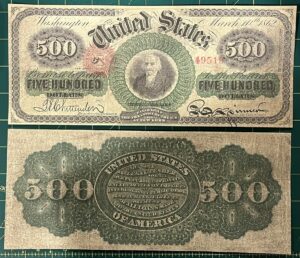
The first meaningful accumulation of American paper money at the Smithsonian came through transfers from the Treasury Department during the 1860s and 1870s. As the Civil War-era currency system was overhauled, the Treasury maintained printing specimens and proof impressions of every note issued. Some of these specimen notes, often printed on one side only or bearing the word SPECIMEN in large overprint, made their way to the Smithsonian as educational objects. Among the earliest recorded transfers were specimen examples of the Demand Notes of 1861, the nation’s first federally issued paper currency. The Smithsonian holds examples of all three issuing city designations: New York, Philadelphia, and Boston. That completeness is itself significant, because in the open market, the Boston $5 Demand Note (Friedberg catalog number Fr. 1) in collectible grades commands prices well above $15,000, and full sets of all denominations across all three cities rarely appear for auction.
The Chase National Bank Donation of 1908: A Turning Point
The single most important moment in the Smithsonian’s paper money history came in 1908, when the Chase National Bank of New York donated its extraordinary reference collection to the institution. John Jay Knox, former Comptroller of the Currency, had spent decades assembling a near-complete type set of National Bank Notes, Treasury notes, and Legal Tender issues on behalf of the bank. The donation included certified proof impressions of rare Series 1875 National Bank Notes, face proofs for the high-denomination Legal Tender series, and critically, examples of notes that had no other known surviving specimens outside of government archives.
The Chase donation was so comprehensive that it effectively defined what “rare” meant for several note categories. When collectors today consult the Standard Catalog of United States Paper Money or the Friedberg reference guide and see population data suggesting only two or three known examples of a particular variety, the Smithsonian specimen is almost always one of them. The institution’s holdings of Series 1878 Silver Certificates, for example, include the $10 denomination (Fr. 283) in proof condition, a note that has appeared at public auction fewer than five times in the past thirty years.
When researching a rare note variety, always check the Smithsonian’s online catalog at collections.si.edu before assuming a note is unique. The NNC holds many “off-market” specimens that suppress true population counts. A note listed as “3 known” in auction records may actually have 4 or 5 examples when Smithsonian holdings are included, which meaningfully affects value modeling.
What the Holdings Reveal: The Survivorship Paradox
Here is where the Smithsonian’s collection becomes genuinely instructive for active collectors. Survivorship bias in paper money is a well-known concept: we know more about notes that survived than about those that were destroyed, redeemed, or simply lost. But the Smithsonian’s holdings expose a more nuanced version of this problem.
Consider the Continental Currency notes issued between 1775 and 1779. The Smithsonian holds examples of nearly every emission, including the February 17, 1776 issue and the January 14, 1779 issue, which represent the widest spread of the Continental experiment. Their condition ranges from Fine to About Uncirculated, yet the institution acknowledges that most of its Continental holdings arrived as either printer’s waste or as notes held by individual families who simply never spent them. The notes that circulated most heavily, the $1 and $2 denominations from the 1777 and 1778 emissions, are paradoxically harder to find in collectible condition today than the nominally higher-denomination $30 and $35 bills, which were impractical for everyday commerce and thus saw less handling.
This survivorship pattern repeats itself across multiple eras. The Smithsonian’s holdings of Large Size Federal Reserve Notes from the 1914 series illustrate it perfectly. The institution has strong representation in the $5 and $10 denominations across most of the twelve Federal Reserve districts, but its $50 and $100 examples from the same series are significantly thinner. High-denomination notes were redeemed quickly by banks and businesses, meaning fewer entered private hands and fewer were saved as curiosities. The $50 Federal Reserve Note of 1914 (Fr. 1035 through Fr. 1046 for the blue seal variety) remains among the more challenging Large Size type coins to locate in grades above Very Fine precisely because of this commercial circulation pattern.
For Large Size Federal Reserve Notes from 1914 and 1918, high-denomination notes in the $50 to $100 range are genuinely more scarce in grades above VF20 than their print run figures suggest. When the Smithsonian’s own holdings skew toward lower grades on these pieces, it is a reliable signal that the note saw heavy commercial use. Price accordingly when evaluating dealer offerings.
National Bank Notes and the Geographic Survivorship Gap
Perhaps no category better illustrates survivorship bias in action than National Bank Notes, and the Smithsonian’s collection here is both impressive and revealing in its gaps. The NNC holds examples from hundreds of issuing banks across the country, including notes from states like Nevada, Wyoming, and New Mexico Territory that issued very small numbers of charters. But the collection is strikingly thin on notes from banks that operated for only one or two charter cycles in rural agricultural communities, particularly across the Great Plains states during the 1880s and 1890s.
These so-called “broken bank” charters, institutions that failed before the Federal Reserve era, issued notes that were redeemed at face value through the Treasury’s guaranty mechanism. Because redemption was accessible and the notes had real spending power, they were nearly all turned in. The Smithsonian has virtually no examples of notes from dozens of failed South Dakota and Nebraska territorial banks that operated between 1882 and 1892. This is not an acquisition oversight. These notes simply do not exist in collectible form in any meaningful numbers. When one surfaces at auction, it draws extraordinary premiums. A $5 National Bank Note from a single-issuance territorial Nebraska bank sold at a major auction house in 2019 for over $22,000 against a pre-sale estimate of $8,000, precisely because even the Smithsonian cannot fill that gap.
Fractional Currency and the Proof Imperative
The Smithsonian’s fractional currency holdings offer one of the clearest windows into 19th-century Treasury printing practices. The NNC holds complete proof sets of all five issues of Fractional Currency (1862 to 1876), including the elusive First Issue 50-cent note featuring a portrait of President Lincoln (Fr. 1312) in perforated proof format. The Treasury printed these proof impressions specifically for archival purposes, and the Smithsonian’s acquisition of the complete run from the Bureau of Engraving and Printing provides a baseline for what genuine proof Fractional Currency should look like.
Collectors should note that the distinctions between proof, specimen, and issued notes in Fractional Currency are critically important for valuation. A First Issue 50-cent proof (Fr. 1312 in proof) in Superb Gem condition can command $3,000 to $5,000, while the same design in issued circulated form (Fine grade) might bring $200. The Smithsonian’s proofs helped establish the grading benchmarks that PCGS Currency and PMG later codified for their certification standards. Studying the Smithsonian’s published images of these proofs, many available through the SI catalog online, is a legitimate and free educational resource for collectors aiming to authenticate their own holdings.
The Smithsonian’s digitized collection at collections.si.edu includes high-resolution scans of many proof and specimen notes. Before purchasing any high-value proof fractional currency or early Legal Tender proof, compare your note against the Smithsonian’s reference images. Look closely at the depth of the engraved lines, the sharpness of the portrait stippling, and the paper color. These characteristics are consistent across genuine Bureau of Engraving and Printing proofs and inconsistent with altered or fraudulent pieces.
The Large Size Gold Certificates: Survivorship at the Extremes
If any single category demonstrates how institutional preservation shaped the collector market, it is the Large Size Gold Certificates. The Gold Certificate Act of 1863 authorized the issue of currency backed by gold coin on deposit at the Treasury. The earliest Gold Certificates, the Act of 1863 and 1865 issues, were issued only for inter-bank settlement and were never intended for general circulation. The Smithsonian holds examples of the $20 denomination from the 1863 issue (Fr. 1166), the only known example outside of a small number of private collections. Most other denominations from this earliest issue exist in populations of one to three notes worldwide.
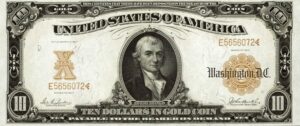
By contrast, the Series 1922 Gold Certificates in denominations of $10 and $20 survived in considerable numbers because they circulated widely right up to the Gold Recall of April 1933, when Executive Order 6102 required citizens to surrender gold-backed currency. Millions of $10 and $20 Gold Certificates were redeemed and destroyed, yet enough were held back by collectors, emigrants, and cautious citizens that they remain obtainable today. A 1922 $10 Gold Certificate (Fr. 1173) in Very Fine grades typically brings $150 to $300, a price accessible to nearly any collector. The $50 and $100 from the same series are substantially harder to locate because fewer people quietly tucked away a $100 bill in 1933.
| Note / Series | Friedberg Number | Approx. Known Population | Rarity |
|---|---|---|---|
| Demand Note 1861, $5 Boston | Fr. 1 | 8-12 known | Key Date |
| Continental Currency, $35 (Jan. 14, 1779) | CC-94 | 15-20 known, VF+ | Rare |
| Silver Certificate 1878, $10 | Fr. 283 | 4-5 known | Key Date |
| Gold Certificate 1863, $20 | Fr. 1166 | 1-2 known | Key Date |
| Federal Reserve Note 1914, $50 Blue Seal | Fr. 1035-1046 | 200-400 per district, VF+ | Scarce |
| National Bank Note, 1882 Nebraska Territory | Various | Under 10 per charter | Rare |
| Fractional Currency 1st Issue, 50c Proof | Fr. 1312 (proof) | 50-75 graded examples | Scarce |
| Gold Certificate 1922, $10 | Fr. 1173 | Thousands surviving | Common |
| Legal Tender 1869 “Rainbow”, $1000 | Fr. 186 | Under 20 known | Key Date |
| Federal Reserve Bank Note 1918, $2 (all districts) | Fr. 747-780 | 300-1,200 per district | Scarce |
How to Use the Smithsonian as a Research Tool
The practical collector takeaway from all of this is straightforward: the Smithsonian’s National Numismatic Collection is not just a museum exhibit. It is an active research resource. The NNC maintains a publicly searchable database at collections.si.edu where you can filter by object type, date, denomination, and issuing authority. While the digitization effort is ongoing and not every item has a high-resolution image, thousands of paper money objects are already documented online with catalog metadata including acquisition source, condition notes, and Friedberg or other reference numbers.
Researchers and serious collectors can also request in-person study appointments through the National Museum of American History’s curatorial division. These visits, which are free, allow examination of notes not currently on public display. The curators, including the current chair of the NNC division, have historically been generous with their expertise and have contributed to multiple published population studies in the Journal of the Civil War Era, the Essay-Proof Journal, and the Bank Note Reporter.
Conclusion: Institutional Holdings as a Market Signal
The Smithsonian’s paper money collection is, in a very real sense, the floor of the market for American currency rarity. Notes that exist only in the Smithsonian’s vaults are effectively priceless: they cannot be bought or sold, and their existence sets the outer boundary of what it means for a note to be rare. Notes that exist in the Smithsonian plus one or two private collections represent the upper tier of the collector market. And notes that are common enough to be omitted from the Smithsonian’s active acquisition priorities, the 1922 Gold Certificates, circulated Federal Reserve Notes from the 1950s onward, common Small Size type notes, form the accessible foundation that new collectors can pursue without institutional competition.
Understanding this hierarchy does not require a trip to Washington, though the trip is genuinely worthwhile. It requires only a willingness to consult the Smithsonian’s public records, cross-reference them with current population reports from PCGS Currency and PMG, and think critically about why certain notes survived and others did not. That analytical habit is, in the end, what separates a serious currency collector from someone who simply buys notes. The Smithsonian has been teaching that lesson for over 175 years. It is time more collectors enrolled.