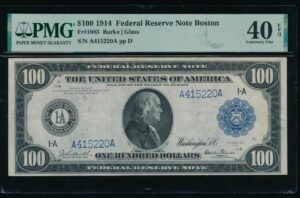
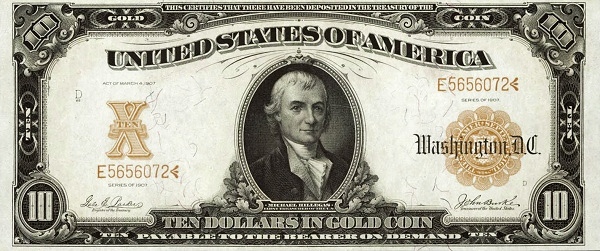
📷 Image source: banknote.ws (World Banknote Gallery). Images are selected by AI to represent the article topic and may not depict the exact note(s) described.
There is a moment in every serious currency collector’s journey when the conversation turns to the absolute pinnacle of American paper money, and the name that surfaces, again and again, is the Series 1900 $10,000 Gold Certificate. This is not merely the highest denomination Gold Certificate ever issued; it is, by virtually every measure, the highest denomination note ever officially placed into general circulation in United States history. To hold even a photograph of one is to brush against the rarefied world of Gilded Age banking, massive treasury transfers, and a monetary system anchored to gold in ways most modern Americans can barely imagine.
A Note Born from the Needs of High Finance
To understand why the United States government produced a $10,000 banknote in 1900, you have to appreciate the mechanics of the American banking system at the turn of the twentieth century. Large interbank transfers, settlement of accounts between major financial institutions, and Treasury operations routinely involved sums that made moving physical gold coin impractical and risky. Gold Certificates, backed dollar-for-dollar by gold coin or bullion deposited with the U.S. Treasury, provided an elegant solution. They were, in effect, warehouse receipts for gold, and they circulated primarily among banks rather than in the hands of everyday citizens.
The Series 1900 $10,000 Gold Certificate was authorized under the Gold Certificate Act and the broader legislative framework governing U.S. currency at the time. It was printed by the Bureau of Engraving and Printing and signed by Register of the Treasury Judson W. Lyons and Treasurer of the United States Ellis H. Roberts, the signature combination that makes every surviving example immediately identifiable. The obverse features a portrait of Andrew Jackson, a choice that carries its own ironic weight given Jackson’s legendary hostility toward paper money and central banking during his presidency. The reverse is dominated by a bold, ornate design in warm gold-orange tones, reinforcing the note’s identity as a direct claim on the government’s gold reserves.
When researching Gold Certificates, always verify the signature combination first. The Series 1900 $10,000 note is exclusively found with the Lyons/Roberts pairing. Any example claiming a different signature combination should be treated with extreme suspicion and submitted immediately to a third-party grading service such as PCGS or PMG for authentication.
Design Details and Physical Characteristics
The Series 1900 $10,000 Gold Certificate measures approximately 7.375 by 3.125 inches, consistent with the large-size format used for all U.S. currency before the 1929 redesign reduced notes to their familiar modern dimensions. The obverse carries the bold orange-gold seal associated with the Gold Certificate class, a defining visual feature that collectors immediately recognize. Serial numbers were printed in gold ink, adding another layer of visual distinction to these already imposing notes.
The back of the note is printed in a rich, golden-brown color scheme with elaborate lathe-work engraving, the painstaking hand of Bureau craftsmen who took tremendous pride in their work. The denomination is spelled out in full across the face and back with the unmistakable gravitas one would expect from a note worth the equivalent of several years’ wages for an average American worker in 1900. In today’s purchasing power, $10,000 in 1900 represents roughly $370,000 to $400,000, a figure that underscores just how removed from everyday commerce these notes truly were.
The Infamous Treasury Fire of 1935 and the Washington, D.C. Connection
Here is where the story of the Series 1900 $10,000 Gold Certificate takes a dramatic turn that transforms it from a remarkable numismatic rarity into something closer to legend. In 1935, as part of the broader dismantling of the Gold Certificate system following President Franklin D. Roosevelt’s Executive Order 6102 of 1933, which had effectively recalled gold and gold-backed currency from circulation, the Treasury Department began systematically destroying outstanding Gold Certificates. A fire, or more accurately a controlled destruction event, at the Treasury eliminated the vast majority of these notes.
What survived did so almost by accident. A small number of Series 1900 $10,000 Gold Certificates were reportedly discovered in a vault or storage area at the Treasury Building in Washington, D.C. These surviving notes were all officially cancelled with perforations or cancellation stamps, marking them as redeemed or invalidated instruments. The government, recognizing their historical significance even as it invalidated them monetarily, allowed a handful to be preserved. Some ended up in the Smithsonian Institution’s National Numismatic Collection; others entered private hands through channels that remain somewhat murky in the historical record.
All known surviving Series 1900 $10,000 Gold Certificates bear official cancellation marks, typically punch-hole perforations through the note. Do not be alarmed by these cancellations; they are expected and actually authenticate the note’s legitimacy. An uncancelled example, if one were ever to surface, would require extraordinary documentation and provenance to be considered genuine.
How Many Survive? The Question Collectors Ask Most
The precise number of surviving Series 1900 $10,000 Gold Certificates has been a subject of ongoing numismatic debate. The consensus among leading currency scholars and auction houses places the number at approximately four known examples, though some researchers suggest a fifth may exist in an institutional collection with limited public access. This compares starkly to the thousands of examples that must have originally been printed to serve interbank settlement functions across the country’s major financial centers.
The Smithsonian holds at least one example that is regularly cited in academic literature on American paper money. Other examples have appeared at major numismatic auctions over the decades, most notably through Heritage Auctions and Stack’s Bowers, though sales have been extraordinarily rare events given the tiny surviving population. Grading these notes presents its own challenges. The cancellation perforations technically represent damage in conventional grading frameworks, yet the notes are so contextually unique that standard grading scales almost feel inadequate. PMG and PCGS Currency both encapsulate known examples with special notation acknowledging their cancelled status and historical significance.
Comparison with Other Ultra-High Denomination Notes
Collectors sometimes conflate the Series 1900 $10,000 Gold Certificate with the $10,000 Federal Reserve Notes of Series 1928 and 1934, which featured Salmon P. Chase on the obverse and were used primarily for Federal Reserve Bank transfers. Those notes, while extraordinarily rare in their own right, represent a different currency type issued under a different monetary framework. The Gold Certificate predates the Federal Reserve System entirely; the Fed was not established until 1913, more than a decade after the Series 1900 notes were produced.
There is also the matter of the $100,000 Gold Certificate Series 1934, which bears Woodrow Wilson’s portrait and was never legally released for public circulation, existing solely as an intra-governmental transfer instrument between Federal Reserve Banks and the Treasury. By that strict definition, the Series 1900 $10,000 Gold Certificate holds its title as the highest denomination note ever officially released for use, however limited that use may have been to the banking and financial elite of its era.
If you encounter a dealer or auction listing claiming to offer a Series 1900 $10,000 Gold Certificate, demand complete provenance documentation going back as many decades as possible. Given that only approximately four examples are known, any note surfacing without a clear, documented chain of ownership should be sent directly to PMG or PCGS Currency for full authentication before any purchase discussion proceeds.
Monetary Policy Context: Gold Certificates in the American System
Gold Certificates were issued in the United States from 1865 through 1933, spanning nearly seven decades of American monetary history. The Series 1900 notes were produced during the height of the gold standard era, when the Gold Standard Act of 1900 formally put the United States on a mono-metallic gold standard, resolving the long political battle between gold and silver advocates that had defined American monetary politics for much of the preceding thirty years. The timing is not coincidental; the Series 1900 $10,000 notes were part of a currency landscape being actively organized around gold as the singular monetary anchor.
Large-denomination Gold Certificates circulated almost exclusively within the banking system. A merchant, farmer, or factory worker in 1900 would have had no practical contact with a $10,000 note of any kind. These instruments moved between the vaults of major banks in New York, Chicago, Boston, and other financial centers, settling accounts and balancing books in an era before electronic transfers. In this sense, the Series 1900 $10,000 Gold Certificate is best understood not as currency in the everyday sense but as a sophisticated financial instrument dressed in the magnificent craft of America’s finest engravers.
| Series / Date | Denomination / Type | Est. Print Run / Survivors | Rarity |
|---|---|---|---|
| 1900 | $10,000 Gold Certificate (Lyons/Roberts) | ~4 known survivors | Key Date |
| 1882 | $5,000 Gold Certificate | ~5 known survivors | Key Date |
| 1900 | $1,000 Gold Certificate (Lyons/Roberts) | Very few known | Rare |
| 1928 | $10,000 Federal Reserve Note | ~336 known | Rare |
| 1934 | $10,000 Federal Reserve Note | ~340 known across districts | Rare |
| 1934 | $5,000 Federal Reserve Note | ~342 known across districts | Rare |
| 1934 | $100,000 Gold Certificate (Wilson) | ~42,000 printed, never public | Key Date |
| 1922 | $1,000 Gold Certificate (Murphy/Mellon) | Scarce, several hundred known | Scarce |
| 1913 | $500 Gold Certificate (Parker/Burke) | Scarce, limited survivors | Scarce |
What Would One Cost? Valuation in the Modern Market
Assigning a precise market value to the Series 1900 $10,000 Gold Certificate is an exercise fraught with difficulty, precisely because so few examples exist and transaction data is extraordinarily sparse. The most analytically honest answer is that any example in any condition would command a price determined almost entirely by the competitive dynamics of the auction room on a given day, driven by the depth of interest among the world’s wealthiest collectors of American paper money.
Comparable ultra-rare large-size notes, such as the 1890 $1,000 Treasury Note in top grades, have sold for sums ranging from several hundred thousand dollars into the low millions. A Series 1900 $10,000 Gold Certificate, given its greater scarcity, its denomination, and its extraordinary historical significance, would almost certainly exceed those benchmarks. Some numismatic analysts suggest that a well-preserved, encapsulated example with strong provenance could reasonably attract bids in the range of one to two million dollars or more, though the cancelled state of all known examples introduces variables that no pricing guide can fully account for.
For collectors who want to appreciate this note without the extraordinary expense of acquiring one, the Smithsonian’s National Numismatic Collection offers access to some of America’s rarest currency. Their online database catalogs many items in the collection with high-resolution imagery, giving serious students of American paper money a legitimate way to study these notes in detail.
Conclusion: An Artifact at the Intersection of Finance and History
The Series 1900 $10,000 Gold Certificate is more than a numismatic trophy for the ultra-wealthy collector. It is a tangible artifact from a pivotal moment in American monetary history, a period when the country was actively defining its relationship with gold, codifying its banking system, and building the financial infrastructure that would power the American Century. The note encapsulates the ambitions, the tensions, and the magnificent craftsmanship of that era in a single piece of engraved paper.
For the collector community, it occupies a position of almost mythological status. Most of us will never hold one, never see one in a dealer’s case, never have the occasion to bid on one at auction. But understanding what it is, why it exists, how it was used, and why so few survive is itself a form of numismatic mastery. The Series 1900 $10,000 Gold Certificate reminds us that American paper money is not simply a collecting hobby; it is a window into the financial architecture of a nation, and sometimes that window opens onto a view of breathtaking, irreplaceable rarity.