There is a particular satisfaction in opening a currency album and seeing a complete run of note types, each slabbed in a PCGS or PMG holder, each representing a distinct chapter in American monetary history. But the phrase “type set” can mean radically different things depending on your ambitions and your wallet. A complete type set spanning every major series from Demand Notes through Federal Reserve Notes in high grade could easily require $50,000 or more. The good news: a thoughtful collector with $5,000 and a smart strategy can assemble something genuinely impressive, historically representative, and deeply satisfying to own.
This guide is a working blueprint. We will talk specific series, realistic grade targets, current market values, and the hard choices you will need to make along the way.
Define Your Type Set Before You Spend a Dollar
The first mistake most new collectors make is buying opportunistically, grabbing whatever looks appealing without a guiding framework. Before purchasing anything, write down what your type set will represent. The most common approach for a budget-conscious collector is to target one example of each major currency class issued by the United States government. That list typically includes: Demand Notes (1861), Legal Tender Notes (United States Notes), Compound Interest Treasury Notes, Interest Bearing Notes, Refunding Certificates, Silver Certificates, Treasury Notes (Coin Notes), National Bank Notes, Federal Reserve Bank Notes, Federal Reserve Notes, and Gold Certificates.
That is eleven distinct classes, and several of them, such as Compound Interest Treasury Notes and Interest Bearing Notes, will simply be out of reach on a $5,000 budget in any graded condition. The discipline required is acknowledging those limitations early and focusing your budget where it delivers the most coverage and quality per dollar spent.
A practical twelve-note type set for a $5,000 budget might look like this: one Legal Tender Note, one Silver Certificate (large size), one Silver Certificate (small size), one Gold Certificate (small size), one National Bank Note, one Federal Reserve Bank Note (large size), one Federal Reserve Note (large size), one Federal Reserve Note (small size, pre-1950), one Federal Reserve Note (small size, modern star or special), one Treasury Note or Coin Note, one Educational Note series representative, and one obsolete or territorial note as a “wild card” piece. This framework gives historical breadth without chasing the impossible.
The Grade vs. Coverage Tradeoff
This is the central tension of budget type collecting. Do you buy a single PMG 64 EPQ Silver Certificate and call it a day, or do you spread that same money across five VF-25 examples covering five different note types? For maximum coverage, which is the stated goal here, you want to bias toward lower grades on common types and reserve higher grades only for notes where condition dramatically affects visual appeal or where the premium for a Fine versus a Very Fine is relatively modest.
The practical grade targets break down roughly as follows. For large-size notes from the 1860s through 1923, target VF-20 to EF-40. These notes have tremendous visual presence even in circulated grades, and the price difference between a Fine-15 and a VF-25 on many common series is only $50 to $150. For small-size notes from 1928 onward, you can often reach Extremely Fine or even About Uncirculated grades without breaking the bank on common series. For genuine key dates or rare types where you simply need a representative example, a problem-free Very Good or Fine with a PMG or PCGS holder (even one noting a minor issue like a corner crease or light soiling) may be the only realistic option.
Always prioritize PMG or PCGS Currency slabbed notes over raw examples when buying on a budget. The authentication and grading certainty are worth the small premium, especially for notes in the $100 to $500 range where cleaning and restoration are common concerns. A PMG 30 NET (net grade for a minor issue) is still far more trustworthy than an unholdered note someone claims is “original VF.”
Allocating the $5,000 Across Your Type Set
Let us get specific. Below is a realistic allocation strategy with current approximate market values based on Heritage Auctions and Stack’s Bowers realized prices from 2023 to 2024. These are working estimates, not guarantees, and the market shifts constantly, but they give you a genuine starting point for budgeting.
Legal Tender Notes: $200 to $350
The workhorse of any type set. The Series 1880 $1 Legal Tender Note (Friedberg 29 to 36 depending on signature combination) in PMG VF-20 trades regularly in the $150 to $275 range. The large red scalloped seal varieties are visually stunning and historically significant as direct descendants of the original 1862 “greenbacks.” For a small-size Legal Tender Note, the 1928 $1 (Friedberg 1500) or a Series 1966 $100 United States Note in EF-40 (around $175 to $250 PMG) both represent the class well. Target the large-size example here for visual impact. Budget: $250.
Silver Certificates: $300 to $500 total (two notes)
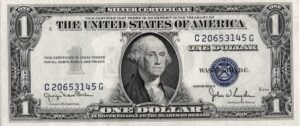
You want one large-size and one small-size example. For large-size, the Series 1896 “Educational” $1 (Friedberg 224 to 225) is the crown jewel of American currency design, but PMG VF-20 examples now sell for $400 to $600. A better budget choice is the Series 1886 or 1891 $1 Silver Certificate with the famous “tombstone” portrait of Martha Washington (Friedberg 215 to 222), which grades PMG VF-30 for approximately $175 to $300. For small-size, the Series 1934 $1 Silver Certificate (Friedberg 1606) in PMG 63 EPQ is routinely available for $35 to $65, and a 1957-B in 65 EPQ for under $30. Allocate slightly more here to get a nicer large-size piece. Budget: $400 combined.
Gold Certificates: $250 to $450
Small-size Gold Certificates from the Series 1928 are the only realistically affordable gold-seal notes for most collectors. The 1928 $10 Gold Certificate (Friedberg 2400, Woods/Mellon signatures) in PMG VF-30 runs approximately $200 to $325. The $20 (Friedberg 2402) in the same grade costs $275 to $400. Resist the temptation to buy a large-size Gold Certificate in poor condition just for the type; a small-size example in solid EF tells the story of gold-backed currency far more elegantly. Budget: $300.
National Bank Notes: $200 to $400
National Bank Notes are a universe unto themselves, but for type purposes you need only one example to represent the class. The Third Charter Period “Blue Seal” notes (Series 1902, Friedberg 639 to 663) are the most available and affordable. A $5 Third Charter Plain Back from a well-known state bank in PMG VF-25 sells for $150 to $275. Avoid obscure small-town banks for your type note, as these carry a premium that does not serve a type-set goal. Look for notes from large Eastern or Midwestern banks with solid print runs. Budget: $250.
When buying National Bank Notes for a type set (rather than a state collection), focus on notes from banks in states with high print runs such as New York, Ohio, Pennsylvania, and Illinois. These notes appear at auction far more frequently, giving you more options to find a well-centered, problem-free example at a fair price. Charter 1234 and similar low-charter banks from New York City were huge issuers and their notes remain very affordable in circulated grades.
Federal Reserve Bank Notes (Large Size): $200 to $350
The Series 1915 and 1918 Federal Reserve Bank Notes are among the most visually dramatic of all large-size US currency. The 1918 $1 “Battleship” note (Friedberg 708 to 746) featuring a portrait of George Washington and named for the battleship imagery on the reverse is a perennial favorite. In PMG VF-25, expect to pay $150 to $250 depending on district. The Atlanta and Dallas districts tend to run slightly cheaper than Boston or New York. Budget: $225.
Federal Reserve Notes (Large Size): $250 to $400
The Series 1914 Federal Reserve Notes represent the birth of the modern Fed note. The red-seal Series 1914 (Friedberg 890 to 951A) is more expensive than the blue-seal issue, but a blue-seal $5 or $10 in PMG VF-20 from a common district like Chicago or New York trades for $175 to $300. This is a critical type to represent well since Federal Reserve Notes now constitute all US paper money in circulation. Budget: $275.
Treasury Notes or Coin Notes (1890 to 1891): $300 to $500
This is your budget “stretch” piece. The Series 1890 and 1891 Treasury Notes (also called Coin Notes) are historically fascinating, issued to pay for silver bullion purchases under the Sherman Silver Purchase Act. The $1 1891 (Friedberg 352) in PMG Fine-15 runs approximately $250 to $375. The famous “Watermelon” $100 of 1890 is many thousands of dollars even in poor condition. Stick with a $1 or $2 example in solid Fine to Very Fine. Budget: $325.
Small-Size Federal Reserve Notes (Pre-1950): $75 to $150
The Series 1928 small-size Federal Reserve Notes are genuinely historic as the first of the modern small-size format introduced in July 1929. A Series 1928 $5 (Friedberg 1950 to 1953, various districts) in PMG EF-40 typically sells for $65 to $125 for common districts. The 1928-A $5 with light green seal is slightly more sought after. This is an area where condition is very achievable on a budget. Budget: $100.
Wild Card: Obsolete or Territorial Note: $150 to $300
Every serious type set benefits from at least one pre-Civil War obsolete bank note or a territorial issue to ground the collection in the chaotic monetary era that the National Currency system was created to replace. A PMG VF-25 example from a well-known antebellum bank, perhaps a $5 from the State Bank of Ohio or a Territory of Utah issue from the 1850s, adds enormous historical context. These can be found for $125 to $275 in solid grades at major auction houses. Budget: $200.
Budget approximately 8 to 10 percent of your total above the hammer price for auction buyer’s premiums, which at Heritage and Stack’s Bowers currently run 20 percent of the hammer price for most lots. A $250 hammer price becomes $300 out of pocket. Factor this into every budget line or you will overspend your allocation without realizing it until the invoice arrives.
Where and How to Buy
For a graded type set at this budget level, Heritage Auctions (ha.com) and Stack’s Bowers are your primary venues. Heritage archives going back years, so you can research realized prices for essentially any note type before you bid. GreatCollections.com has become an excellent source for small-size material in the $50 to $300 range, with lower buyer’s premiums than the majors. Avoid eBay for anything over $150 unless the note is already holdered by PMG or PCGS and you have done price comparison research. The Paper Money Show circuit (Memphis, Chicago, and the annual ANA World’s Fair of Money) is invaluable for buying directly from dealers at negotiated prices, often 10 to 15 percent below auction realized prices for common material.
The Role of Eye Appeal Within a Grade
Within any given PMG or PCGS grade band, note quality varies considerably. Two notes both graded PMG VF-30 can look dramatically different. One might be well-centered with bright paper and bold color; another might be off-center, have a small stain, or display ink wear that the grader deemed consistent with VF-30. Since you are building a display collection, always buy for eye appeal within grade. Look for notes with the EPQ (Exceptional Paper Quality) or PPQ designation from PMG or PCGS respectively, which indicates original paper without restoration, chemical treatment, or pressing. EPQ-designated notes command modest premiums (typically 15 to 25 percent over non-EPQ examples of the same grade) that are almost always worth paying.
When reviewing auction lot images for notes graded PMG 25 to 35, zoom into the margins and note the centering. A well-centered note in the mid-grade range photographs and displays far better than a higher-graded note with severe margin imbalance. For a type set displayed in a custom frame or collector binder, centering and visual presence matter enormously since the notes represent the full story of American currency at a glance.
Sample Budget Summary
Adding up the allocations above: Legal Tender Note ($250), Silver Certificates combined ($400), Gold Certificate ($300), National Bank Note ($250), Federal Reserve Bank Note large size ($225), Federal Reserve Note large size ($275), Treasury Note ($325), Federal Reserve Note small size ($100), and Obsolete or Wild Card ($200) totals $2,325 in hammer price or purchase price. With a 20 percent buyer’s premium on auction purchases, that becomes approximately $2,790. That leaves over $2,200 in reserve, which you can use to upgrade individual pieces over time, add an additional type such as a Fractional Currency note (Series 1863 to 1875 Fractional Currency can be had in PMG VF for $30 to $80 each), or pursue a star note variety to add an extra dimension to the collection.
| Note Type / Series | Denomination / Friedberg | Target Grade | Budget Accessibility |
|---|---|---|---|
| Series 1880 Legal Tender Note | $1 / Fr. 29-36 | PMG VF-20 to VF-30 | Common |
| Series 1891 Silver Certificate | $1 / Fr. 222-223 | PMG VF-25 to EF-40 | Common |
| Series 1928 Gold Certificate | $10 / Fr. 2400 | PMG VF-30 to EF-45 | Common |
| 1902 Third Charter National Bank Note | $5 / Fr. 598-612 | PMG VF-20 to VF-35 | Common |
| Series 1918 FRBN (Battleship $1) | $1 / Fr. 708-746 | PMG VF-25 to EF-40 | Common |
| Series 1914 Federal Reserve Note (Blue Seal) | $5 / Fr. 855-880 | PMG VF-20 to VF-30 | Scarce |
| Series 1891 Treasury (Coin) Note | $1 / Fr. 352 | PMG Fine-15 to VF-25 | Scarce |
| Series 1896 Educational Silver Cert. | $1 / Fr. 224-225 | PMG VF-20 to VF-30 | Scarce |
| Series 1928 Federal Reserve Note | $5 / Fr. 1950-1953 | PMG EF-40 to AU-55 | Common |
| Series 1915 Federal Reserve Bank Note | $5 / Fr. 793-832 | PMG VF-20 to VF-35 | Scarce |
| 1890 Treasury Note (Watermelon $100) | $100 / Fr. 376 | Any problem-free grade | Key Date |
| 1861 Demand Note | $5 / Fr. 1-5 | Any graded example | Rare |
Building Over Time: The Three-Year Strategy
A $5,000 type set is not built in a single weekend of bidding. The collectors who assemble the most coherent and visually impressive sets do so methodically over 24 to 36 months. In year one, focus on acquiring the affordable foundation pieces: the small-size Federal Reserve Notes, Silver Certificates, and Legal Tender Notes. These are available in quantity at every major auction and you can afford to be patient and selective. In year two, pursue the mid-range anchor pieces: the National Bank Note, Gold Certificate, and large-size Federal Reserve Note. In year three, use remaining budget and any windfall to go after the stretch pieces: the Treasury Note, a Fractional Currency complete set of types (Fifth Issue notes can be had in PMG Fine for $25 to $50 each), and any upgrades to earlier acquisitions where a clearly superior example appeared at the right price.
The $5,000 type set is not a consolation prize for collectors who cannot spend more. Approached with discipline and genuine historical curiosity, it is a coherent artifact of American monetary evolution, twelve to fifteen holdered notes telling the story of a nation that moved from gold and silver coin backing through the chaos of the Civil War greenback era to the modern Federal Reserve system. That story, told clearly in certified grades with eye appeal and historical breadth, is worth every dollar and every hour of research you invest in it.