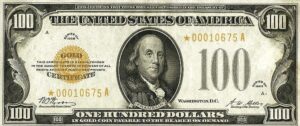
Pick up a Federal Reserve Note printed before 1969 and compare it side by side with one printed after, and the difference jumps out immediately. On the older note, a bold black circular seal sits to the left of the portrait, bearing the name of a specific Federal Reserve Bank, a district letter, and a district number. On the post-1969 note, that same position holds a seal that simply reads “Federal Reserve Note” around its perimeter, with no reference to any particular city or district. This change, implemented across all denominations beginning with the Series 1969 notes, was more than cosmetic. It represented a philosophical shift in how the Federal Reserve System chose to present its currency to the public, and it created a clear collecting boundary that numismatists still use today.
A Brief History of the Black District Seal
When the Federal Reserve Act of 1913 created the twelve-district central banking system, the currency it authorized reflected that regional structure directly on the face of every note. From the first Federal Reserve Notes of the Series 1914 issue through the notes of the mid-1960s, each bill bore a seal identifying its issuing bank by city name: Boston, New York, Philadelphia, Cleveland, Richmond, Atlanta, Chicago, St. Louis, Minneapolis, Kansas City, Dallas, or San Francisco. The seal also carried the district’s assigned letter, A through L, and a corresponding numeral, 1 through 12, in the four corner positions of the note face.
Throughout this era the seals were printed in black ink, creating a visually strong contrast against the green and black intaglio printing of the note face. The words around the seal’s perimeter spelled out the full bank name, for example “Federal Reserve Bank of Chicago” or “Federal Reserve Bank of San Francisco.” This design reinforced to the public that these notes were obligations of specific regional institutions, not simply of a single central bank in Washington.
By the late 1950s and through the 1960s, however, the Federal Reserve was moving toward a more unified public identity. The practical distinction between notes issued by different districts had long since ceased to matter to everyday commerce, and the Board of Governors decided the seal should reflect that reality.
What Actually Changed in 1969
The Series 1969 notes, signed by Treasurer Dorothy Andrews Elston and Secretary of the Treasury David M. Kennedy, introduced three simultaneous changes to the Federal Reserve Note design. First, the black district seal was replaced by a green seal reading “Federal Reserve Note” around its circumference, with a stylized eagle and the words “The United States of America” in the center band. Second, the series date placement was standardized. Third, the district identification was retained in the corner letter-number positions but lost its prominent seal-level presentation.
The green color of the new seal was not arbitrary. It harmonized the Federal Reserve seal with the Treasury seal, which had appeared in green ink on Federal Reserve Notes since the Series 1963 redesign that eliminated the red Treasury seal used on United States Notes and the blue seal used on Silver Certificates. From 1969 onward, both seals on a Federal Reserve Note were green, giving the face a more unified chromatic appearance.
When attributing a Federal Reserve Note to its correct series, always check the seal color first. A black left-side seal immediately tells you the note predates Series 1969. If both seals are green, the note is Series 1963 or later for United States Notes and Silver Certificates, but for Federal Reserve Notes specifically, dual green seals began with Series 1963 for the Treasury seal and Series 1969 for the district seal.
The Last Black-Seal Series by Denomination
One of the subtler points that trips up newer collectors is that the transition did not happen at exactly the same moment for every denomination. The Bureau of Engraving and Printing cycled through new printings denomination by denomination, so the final black-seal series varies slightly across the note types.
For the $1 Federal Reserve Note, Series 1963-B (Granahan-Fowler) is generally the last widely collected black-seal issue, though some district printings are dramatically scarcer than others. The $5, $10, $20, $50, and $100 denominations largely concluded their black-seal runs with Series 1963 or 1963-A, with the 1963-A notes carrying the Granahan-Fowler signatures replaced by Granahan-Barr for a brief period in late 1968. The $500, $1,000, $5,000, and $10,000 denominations, last printed in 1945 and officially withdrawn from circulation in 1969, never received the redesigned unified seal at all, making every high-denomination Federal Reserve Note a pre-reform black-seal piece by default.
Why Collectors Care: Variety, Scarcity, and the District Factor
The twelve-district structure of the black-seal era means that for every series and denomination, there are up to twelve distinct district varieties. Collectors specializing in this area, sometimes called “district collectors,” pursue complete sets of all twelve banks for a given series and denomination. For common series like 1963 $1 notes, assembling all twelve districts in circulated grades is straightforward. For scarcer series and higher denominations, certain districts can represent genuine key dates.
The Federal Reserve Bank of Minneapolis (District 9, letter I) and the Federal Reserve Bank of Kansas City (District 10, letter J) consistently produced smaller print runs than New York (District 2, letter B) or Chicago (District 7, letter G). In the $100 denomination, for example, some Minneapolis issues from the early 1960s had total print runs under two million notes for a given series, compared to New York runs exceeding forty million. In high grades, these low-print-run district notes can command multiples of catalog value.
The Friedberg catalog (“Paper Money of the United States” by Arthur L. and Ira S. Friedberg) is the standard reference for attributing black-seal Federal Reserve Notes. Each district issue within a series carries its own Friedberg number. For example, Series 1963 $1 notes range from Fr. 1900-A (Boston) through Fr. 1900-L (San Francisco). Learning the Friedberg numbering system will help you communicate precisely with dealers and fellow collectors.
Star Notes Across the Transition
Star notes, which the Bureau of Engraving and Printing uses as replacements for defective notes during printing, add another collecting dimension to this transition period. Black-seal star notes from districts like Atlanta (Fr. 1900-F*) or Dallas (Fr. 1900-K*) can be dramatically scarcer than their non-star counterparts. When Series 1969 arrived, star notes for the new unified-seal design began fresh print runs, and some early 1969 star note print runs were quite small as the BEP calibrated demand for the new design.
For the Series 1969 $1 notes specifically, the Atlanta Federal Reserve Bank star note (F*) had a reported print run of approximately 128,000 notes, making it among the key star note issues of the transitional era. Richmond (E*) and Minneapolis (I*) star notes from Series 1969 are similarly low-population in high grades, with PMG and PCGS census data consistently showing fewer than twenty examples graded 65 EPQ or better for certain districts.
The 1969 Signature Combinations and Their Sub-Series
Series 1969 itself spawned four sub-series as Treasury officials changed. The 1969 base series carries the Elston-Kennedy signatures. Series 1969-A uses Kabis-Connally, reflecting the appointment of Romana Acosta Banuelos as Treasurer (her notes appear in 1969-B) and later Virginia Hart Knauer. Series 1969-B carries Banuelos-Connally, and Series 1969-C carries Banuelos-Shultz. Each sub-series has its own print run profile, and 1969-C $100 notes from certain low-volume districts are noticeably tougher to locate in uncirculated condition than the base 1969 issue.
Collectors should note that not every denomination received all four sub-series. Higher denominations like the $50 and $100 received fewer signature variety printings than the high-volume $1 and $5, so the sub-series scarcity landscape differs substantially across denominations.
When buying raw (ungraded) transitional-era Federal Reserve Notes, examine the seal carefully under good light. The black district seal on pre-1969 notes should be crisp and fully inked with no bleeding into surrounding paper. A weak or partially inked seal may indicate a printing defect that affects the note’s grade and value, but in some cases it can also represent a collectible error variety worth further investigation.
Grading Considerations for the Transitional Period
Notes from the Series 1963 through 1969-C era are old enough to be genuinely scarce in gem uncirculated condition but recent enough that many examples did circulate heavily. For the black-seal notes, the most common grade encountered at coin shows is Very Fine (VF-25 to VF-35), reflecting one to two generations of moderate circulation. Extra Fine (EF-40 to EF-45) examples are desirable, and anything grading Choice Uncirculated (MS-63 or PMG 63) or better carries a meaningful premium, particularly for the key-district and star-note issues.
Paper quality matters significantly in this era. Notes from the early 1960s sometimes exhibit a slightly different paper texture than post-1969 issues due to changes in the fiber composition of Federal Reserve Note paper. Well-preserved examples should exhibit bright paper, full margins, and strong ink saturation on both the intaglio printing and the letterpress district seal.
| Series / Date | District or Variety | Print Run (Est.) | Rarity |
|---|---|---|---|
| 1963 $1 | New York (B) Standard | 195,840,000+ | Common |
| 1963 $1 | Minneapolis (I) Standard | 6,400,000 | Scarce |
| 1963-A $1 | Dallas (K*) Star | 640,000 | Rare |
| 1963-B $1 | Minneapolis (I) Standard | 3,200,000 | Scarce |
| 1969 $1 | Atlanta (F*) Star | 128,000 | Key Date |
| 1969 $1 | Richmond (E*) Star | 640,000 | Rare |
| 1969-B $100 | Minneapolis (I) Standard | 1,024,000 | Scarce |
| 1963-A $100 | Kansas City (J) Standard | 1,792,000 | Scarce |
| 1969-C $50 | San Francisco (L*) Star | 512,000 | Rare |
| 1963 $5 | Chicago (G) Standard | 86,400,000 | Common |
Building a Collection Around This Transition
One of the most satisfying collecting themes in modern United States currency is assembling a “before and after” set centered on the 1969 seal change. A focused collection might include one example of each denomination (from $1 through $100) in the last black-seal series, paired with the equivalent denomination in Series 1969. In circulated grades, such a set is achievable on a modest budget. In gem uncirculated grades, certain pairings, particularly the $50 and $100 denominations from low-volume districts, represent a genuine numismatic challenge and investment of time and funds.
For collectors with a regional focus, pursuing all twelve districts of a single denomination in the last black-seal series is a classic goal. The Series 1963-B $1 note set, for example, is popular precisely because it is the final black-seal $1 series and because twelve distinct Friedberg varieties exist within it. Budget-conscious collectors should begin with the high-population New York and Chicago district notes, then work toward Minneapolis, Kansas City, and Dallas to complete the set.
Conclusion
The Federal Reserve seal redesign of 1969 is one of those pivotal moments in United States currency history that reshapes what came before and after it into distinct collecting categories. Black-seal district notes carry the fingerprint of regional banking history and offer twelve-variant set-building opportunities that unified-seal notes cannot match. The Series 1969 unified-seal notes, meanwhile, opened an era of standardized Federal Reserve Note design that persists in modified form to the present day. Whether you are drawn to the historical significance of the district era, the challenge of completing a twelve-bank set, or the hunt for key-date star notes around the transitional series, this corner of United States paper money collecting rewards careful study and patient accumulation. The notes themselves, crisp or worn, are artifacts of a specific and fascinating moment when a decentralized banking system chose to present a single face to the world.