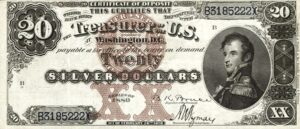
Pull a stack of circulated notes from your wallet and examine the serial numbers. Both the left and right serial numbers match exactly, the ink is crisp, and the numerals fall squarely inside their designated panels. That is precisely how every note is supposed to look. Now imagine a note where one or both of those serial numbers has been stamped twice, the second impression slightly offset or directly overlapping the first, creating a blurred, doubled, or even fully legible duplicate impression. That is a double serial number error, one of the most striking and collectible manufacturing mistakes in all of small-size United States currency.
How the Numbering Process Works, and Where It Goes Wrong
To appreciate why a double serial number error is so rare, you first need to understand the Bureau of Engraving and Printing’s production sequence. Small-size notes produced since 1929 go through at least three distinct press runs. The first printing lays down the back design. The second deposits the face design, including the Federal Reserve seal, the Treasury seal, and any district numerals. The third printing, sometimes called the overprint or letterpress stage, applies the serial numbers, district seals, and series year signatures in black or green ink.
On the third-pass numbering press, sheets pass through a series of numbering boxes that advance mechanically with each impression. If a sheet feeds through the press incorrectly, jams, or is inadvertently run through a second time, the result can be a second set of serial number impressions. Depending on the alignment and timing of the double feed, the second printing may land directly on top of the first (creating a heavy, blurred appearance), slightly offset (producing a ghost or shadow impression), or entirely clear of the first (yielding two fully readable but distinct serial numbers on a single note).
The error can affect one serial number panel or both. When both the left and right panels receive the duplicate impression, the note is cataloged as a double serial number error on both serials, and its value increases considerably over examples where only one panel was doubled.
Always examine suspected double serial number errors under magnification at a low angle using raking light. A genuine double print will show two layers of ink with clearly defined edges on each impression. A tampered note, where a serial number has been physically altered, typically reveals disturbed paper fibers, solvent ghosting, or uneven ink absorption that becomes obvious under a loupe at 10x magnification.
Varieties of the Error: Not All Doubles Are Equal
Collectors and dealers recognize several distinct sub-types of the double serial number error, and the distinctions matter greatly for value and cataloging.
The Overlapping Double
In this variety, the second impression lands almost directly over the first. The result is a thickened, slightly smeared serial number that can look, at first glance, like a simple misprint or ink smear. Under magnification, however, two discrete layers of numerals are visible. This is the most common form of the error and consequently the lowest valued, though “most common” in error note terms still means extraordinarily rare relative to normal production.
The Offset Double (Ghost Impression)
Here the second pass is visibly displaced from the first, leaving a clear ghost or shadow impression adjacent to or partially overlapping the primary serial number. The degree of offset varies dramatically. A shift of just a few millimeters is less dramatic than a full centimeter of separation, and value rises accordingly. The most spectacular offset doubles show two completely legible serial number strings with visible space between them.
The Complete Double on Both Panels
When the error affects both the left and right serial number panels equally, you have what many collectors consider the definitive form of this error type. Both panels exhibit the doubled impression, confirming that the sheet ran through the numbering press twice rather than suffering a mechanical malfunction affecting just one numbering box. These are the notes that command five-figure prices at major auctions.
Mixed-Panel Errors
Occasionally, only one panel doubles while the other prints cleanly. This can happen if one numbering box malfunctioned independently or if the sheet fed through at an angle. These are genuine errors but somewhat less dramatic in appearance than full bilateral doubles.
When purchasing a double serial number error, insist on a PMG or PCGS Currency certified holder that explicitly describes the error on the label. The label language matters: “Double Serial Number” or “Printed Twice” is the standard description. A vague label saying only “error note” without specifying the error type is a red flag worth investigating before bidding.
Authentication: The Critical Step
Because double serial number errors carry significant premiums, they attract both honest misidentifications and deliberate fraud. The two most common deceptions are chemically altered numbers, where ink has been removed and re-applied, and fantasy creations made by reprinting a real note through a home numbering device. Both frauds have appeared at auction and in dealer inventories over the years.
Genuine BEP serial number ink from the modern era has a very specific reflective quality under ultraviolet light and a consistent fluorescence pattern. The ink sits on top of the paper rather than soaking through it. On a genuine double print, both layers of ink will exhibit the same UV response. On a fraudulently added second impression, the ink chemistry is almost never identical, and UV examination will reveal the discrepancy immediately.
Paper fiber disturbance is the other tell. The BEP uses intaglio printing for the face and back designs, which leaves a characteristic embossed texture. The third-pass letterpress numbering does not significantly disturb the paper surface. Any note showing abraded, lifted, or re-laid fibers beneath a serial number panel should be treated as suspect until professionally examined.
Specific Examples and Auction Records
Documented auction results provide the clearest evidence of collector demand for this error type. The following examples represent confirmed sales by Heritage Auctions, Stack’s Bowers, and Lyn Knight Currency Auctions across multiple years.
A 1969-C $1 Federal Reserve Note from the Boston district (Series A) graded PMG 64 Choice Uncirculated, bearing a double serial number on both panels with a visible offset of approximately 4mm, sold for $4,200 at a Heritage Currency Auction in 2019. The note carried serial numbers in the A00000000A range consistent with early 1969-C Boston production. Its clear two-panel doubled impression and near-gem grade drove bidding well above the pre-sale estimate of $2,500.
A 1934-A $20 Federal Reserve Note from the Chicago district (Series G) with a partial double on the right panel only, graded PMG 45 Extremely Fine, realized $3,100 at a Stack’s Bowers sale in 2021. Large-size era collectors sometimes cross over to buy dramatic small-size errors from the classic 1934 series, and this example benefited from that crossover demand.
Perhaps the most cited recent result in this error category is a 1988-A $100 Federal Reserve Note from the New York district (Series B) graded PMG 63 Choice Uncirculated with an EPQ designation, showing a full bilateral double serial number with a striking 7mm offset on both panels. This example hammered at $14,400 at a Heritage U.S. Currency Signature Auction in January 2023, establishing a strong modern benchmark for the error type on a high-denomination note. The combination of a $100 face value, a New York district origin (historically the largest print runs, which paradoxically increases competition for dramatic errors), and a nearly uncirculated grade made this one of the most discussed error sales of that auction cycle.
On the more accessible end, a 1995 $1 Federal Reserve Note from the Atlanta district graded PMG 58 Choice About Uncirculated with a single-panel double (right panel only, offset approximately 2mm) sold for $575 at a mid-level Heritage internet auction in 2022. This type of entry-level certified double serial error is where many new collectors begin building an error note collection.
Series 1995 and 1999 Federal Reserve Notes are among the most frequently encountered double serial number errors in certified holders because those production years saw several documented press malfunctions. If budget is a concern, focusing your search on $1 and $5 notes from the mid-1990s in grades below 63 can yield genuine certified examples for under $1,000.
Denomination and District Considerations
Denomination plays a meaningful role in demand. A double serial number error on a $100 note will nearly always outperform the same error on a $1 note in the same grade, all other factors being equal, simply because the $100 denomination has more inherent visual impact and a higher base value. However, the error premium percentage is actually often larger on $1 notes, since the base note itself is essentially worthless, making the error solely responsible for the entire purchase price.
Federal Reserve district is less important for this error type than for star notes or district-specific varieties, but it is not irrelevant. Notes from low-print districts like Minneapolis (I) and Kansas City (J) on certain series attract additional scarcity premiums. A double serial number error from a low-production district, particularly if the serial number range can be traced to a documented short print, can command 20 to 40 percent more than the same error from a high-volume district like New York or Chicago.
| Series / Date | Denomination and Variety | Approx. Known Examples | Rarity |
|---|---|---|---|
| 1934-A | $20 FRN, Single Panel Double | 8 to 12 certified | Rare |
| 1950-B | $50 FRN, Bilateral Double | 3 to 5 certified | Key Date |
| 1963-A | $1 FRN, Offset Double (both panels) | 10 to 15 certified | Rare |
| 1969-C | $1 FRN, Overlapping Double | 20 to 30 certified | Scarce |
| 1977-A | $5 FRN, Single Panel Ghost | 15 to 25 certified | Scarce |
| 1988-A | $100 FRN, Full Bilateral Double | 6 to 10 certified | Rare |
| 1995 | $1 FRN, Single Panel Offset | 35 to 50 certified | Scarce |
| 1999 | $1 FRN, Overlapping Double | 40 to 60 certified | Common (for errors) |
| 2003-A | $20 FRN, Bilateral Offset Double | 8 to 14 certified | Rare |
| 2009 | $50 FRN, Single Panel Double | 4 to 6 certified | Key Date |
Building a Collection: Practical Strategy
For collectors new to error notes, the double serial number error is an excellent entry point because it is visually self-evident, well-documented in numismatic literature, and supported by a robust certification infrastructure. Unlike some error types that require significant technical knowledge to appreciate, a double serial number error announces itself immediately. You can show it to a non-collector friend and they will grasp the significance without any explanation.
The practical starting point is to establish a budget and decide whether you want to pursue the most dramatic bilateral examples or build depth across multiple error sub-types. A collection of five or six certified single-panel doubles from different series and denominations, assembled for under $5,000 total, tells a coherent story about manufacturing variation across decades of BEP production. A single landmark bilateral double from a high denomination in gem uncirculated grade may be a stronger long-term investment piece but requires a more concentrated outlay.
Resources worth consulting include the Standard Guide to Small-Size U.S. Paper Money by Dean Oakes and John Schwartz for production context, and Frederick Bart’s Comprehensive Catalog of United States Paper Money Errors for error-specific cataloging and pricing history. Heritage Auctions maintains a publicly searchable archive of past currency sales that allows you to track price trends for specific error types across multiple auction cycles, which is invaluable for making informed bids.
Register for auction house email alerts specifically tagged to “double serial” and “serial number error” in the currency categories. Both Heritage and Stack’s Bowers allow granular search alert customization. This way, you see every certified double serial number error that enters their pipeline before bidding opens, giving you time to research the specific serial number range and compare the example against past sales before committing a bid.
Conclusion: Rarity Built Into the Machine
Double serial number errors are not simply curiosities. They are documented, certifiable evidence that the BEP’s otherwise extraordinarily reliable production machinery occasionally falters in ways that transform an ordinary note into something genuinely one-of-a-kind. The auction record from 2023’s $14,400 hammer price on a 1988-A $100 note is not an outlier driven by a momentary bidding frenzy. It reflects a sustained collector demand for the most dramatic and well-preserved examples of an error type that, by definition, can never be replicated on purpose.
Whether you are examining your first certified error note or adding a landmark piece to a mature collection, the double serial number error rewards careful study, patient sourcing, and the kind of disciplined authentication diligence that separates confident collectors from easy marks. The payoff, both intellectually and financially, is demonstrably real.