Walk into any major currency show and you will see two distinct groups of collectors clustered around the dealer cases. One group gravitates toward the slabbed Gem Uncirculated notes with four-figure price tags. The other group, often the ones having more fun, are the hunters: picking through mid-grade material, turning notes over in the light, looking for original paper quality and honest wear. If you are new to collecting US paper money and you want to build something meaningful without mortgaging your future, Fine to Very Fine is the grade range that will change your collecting life.
A type set, for those just getting started, is a collection that assembles one example of each major design type issued by the United States government. Rather than chasing every date, district, or signature combination, you are building a representative cross-section of American monetary history. Done thoughtfully in Fine (F-12) through Very Fine (VF-35), a complete small-size type set is achievable for most collectors on a disciplined budget, and even a partial large-size type set becomes realistic when you understand where to spend and where to save.
Understanding the Grading Scale: Where Fine Fits
The Paper Money Guaranty (PMG) and PCGS Currency grading scales run from Poor-1 at the bottom to Superb Gem Uncirculated-70 at the top. For type set builders on a budget, the critical range to understand runs from Very Good (VG-8) through Very Fine (VF-35). Here is what each grade actually means when you are holding a note:
Very Good (VG-8 to VG-10): The note has seen significant circulation. Folds are heavy and often cross the central design. Margins may be uneven, and there can be minor soiling or small edge tears. Portrait detail remains visible but not crisp. For most type sets, VG is a grade to avoid unless price is genuinely the only consideration or the type is extremely rare in better grades.
Fine (F-12 to F-15): This is the collector sweet spot for budget type sets. A Fine note shows moderate circulation with several folds and creases, but the design remains fully intact and all lettering is sharp. Portrait detail is clear. There should be no missing paper, no significant staining, and no repairs. In Fine, most common small-size types retail for $15 to $75, making the grade genuinely affordable.
Very Fine (VF-20 to VF-35): A Very Fine note is the upgrade target. Folds are light to moderate, paper retains some crispness, and the color of Treasury seals and serial numbers remains vibrant. At VF-30 or VF-35, many notes still show original paper luster in the margins. This is the grade where eye appeal really begins to shine, and for most small-size issues it adds only 20 to 50 percent to the Fine price.
When evaluating Fine-grade notes raw (unslabbed), always check the folds under a raking light source held at a low angle. A note with three or four sharp, straight folds is generally more original and eye-appealing than one with a dozen soft crinkles, even if both technically grade Fine-12. Straight folds suggest the note was folded deliberately in a wallet or bundle rather than crumpled in general circulation.
Defining Your Type Set: Small-Size vs. Large-Size
Before spending a single dollar, decide which era you want to collect. This is the most important strategic decision a new collector makes, and it has enormous budget implications.
Small-Size Federal Reserve Notes (1928 to Present)
The modern small-size format was introduced in 1928 when the Treasury reduced note dimensions from the large “horse blanket” size to the familiar 6.14 x 2.61 inch format used today. A small-size Federal Reserve Note type set might include the 1928 Series with the distinctive brown or gold seal, the green-seal Series 1934 through the modern era, World War II Hawaii overprints (Fr. 2300 to 2302 and Fr. 2303), North Africa yellow-seal notes (Fr. 2306 to 2308), and the post-1963 issues that removed the “will pay to the bearer” obligation clause.
For beginners, small-size is the right starting point. Common dates in Fine condition are genuinely inexpensive. A 1928B $1 Legal Tender Note (Fr. 1501) in Fine retails for roughly $25 to $40. A 1934 $5 Federal Reserve Note in VF-25 can be found for $30 to $55 depending on the Federal Reserve District. Even the $500 and $1,000 denominations from the 1934 series, while expensive in any grade, are available in Fine for $750 to $1,500 and $1,800 to $3,500 respectively if you choose to include high denominations in your set.
Large-Size Notes (1861 to 1923)
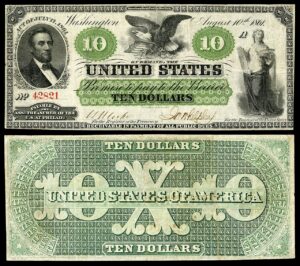
Large-size currency covers the Civil War era Demand Notes of 1861, the Legal Tender Notes (United States Notes) issued from 1862 onward, National Bank Notes, Silver Certificates, Gold Certificates, Treasury or Coin Notes, and Federal Reserve Notes before the 1928 redesign. This is the area where American currency reaches its artistic and historical pinnacle. The 1896 Educational Series Silver Certificates (Fr. 247 for the $1, Fr. 248 for the $2, and Fr. 249 for the $5) feature some of the most beautiful engraving ever produced for American paper money.
In Fine, large-size common types start around $75 to $150 and climb quickly for better types and higher denominations. A Fine example of the 1886 $1 Silver Certificate Martha Washington portrait (Fr. 215 to 221 depending on signature combination) typically retails for $175 to $300. Budget accordingly: a focused large-size type set in Fine is a two to five year project for most collectors building steadily.
For large-size notes in Fine or better, always prioritize original paper quality over technical grade. A note with honest, even wear and original paper is far preferable to a technically higher-graded example that has been pressed, cleaned, or has faded color. PMG and PCGS Currency both note pressing and cleaning on their holders with qualifier designations like “Pressed” or “Apparent” grades. Always buy problem-free examples even if it means waiting longer to find one.
Building the Small-Size Type Set: A Practical Roadmap
Here is a systematic approach to assembling a small-size type set in Fine or better, organized by currency class and approximate budget in current retail conditions.
Federal Reserve Notes: The Foundation
Start with post-1963 Federal Reserve Notes. The Series 1963 $1 (first year without the silver redemption clause) is common in all grades and retails for $5 to $15 in Fine. The Series 1969 issues introduced the new Treasury seal design. Series 1976 $2 Federal Reserve Notes (the first $2 FRN replacing the United States Note) are inexpensive in Fine at $8 to $20. The Series 1990 security thread introduction and Series 1996 large portrait redesign on the $100 represent important design types and are common in circulated grades.
The pre-1963 green-seal issues deserve more attention. A 1928 $1 Federal Reserve Note with the distinctive small serial font and no motto (Fr. 1500) retails for $35 to $85 in Fine. The 1928A through 1928F series each have their own collector following. The 1934 series in $5, $10, $20, $50, and $100 represents the classic mid-century American note design and all are available in Fine for moderate prices, typically $25 to $150 depending on denomination.
Silver Certificates: The Most Collected Small-Size Type
Small-size Silver Certificates were issued from 1928 through 1957B and represent some of the most beloved notes in American collecting. The $1 denomination alone includes seven design types: the 1928 blue seal (Fr. 1600 to 1604 by signature combination), the 1934 series, the 1935 series with its multiple sub-types including the experimental “R” and “S” notes of 1935A (Fr. 1609 and Fr. 1610, of which only 1,184,000 of each were printed), the mule varieties, and the 1957 series with the motto added to the reverse.
The 1935A Hawaii overprint ($1, Fr. 2300) is a type set essential. In Fine, expect to pay $120 to $200. The 1935A North Africa Yellow Seal (Fr. 2306) runs $80 to $150 in Fine. The 1928 $5 Silver Certificate (Fr. 1650) in Fine retails for $45 to $90. For $10 Silver Certificates, the 1933 (Fr. 1700 and Fr. 1701) is a key date that commands $300 or more even in Fine.
United States Notes: Red Seal History
Legal Tender Notes, issued as United States Notes with their distinctive red Treasury seals, continued in small-size format from 1928 through 1966 (for higher denominations) and the $2 denomination continued through 1963B. The 1928 $1 United States Note (Fr. 1500 series) in Fine is $25 to $45. The 1928 $2 (Fr. 1501) runs $30 to $60. Red seal $5 United States Notes from the 1928 series (Fr. 1525 to Fr. 1532) are affordable at $20 to $60 in Fine. The 1966 $100 United States Note (Fr. 1550) was the last Legal Tender Note issued for circulation and retails for $175 to $350 in Fine, making it a meaningful capstone for this series.
When building a red-seal United States Note type set, use the Friedberg catalog number to confirm you have distinct design types rather than just different signature combinations. Fr. 1500 through Fr. 1500c are all 1928 $1 Legal Tender Notes but differ by signature pair. For a true type set, one example suffices unless you are specifically pursuing signature varieties, which is a separate and more advanced collecting goal.
Gold Certificates and National Currency
Small-size Gold Certificates were issued only in the 1928 series ($10 through $1,000 denominations) and were recalled in 1933 when Franklin Roosevelt issued Executive Order 6102 requiring citizens to surrender gold. Examples that survived are legal to own today and are actively collected. A 1928 $10 Gold Certificate (Fr. 2400) in Fine retails for $80 to $160. The distinctive yellow-gold Treasury seal and serial numbers make these visually striking in any grade.
Small-size National Bank Notes from the 1929 series come in Type 1 (with the bank charter number printed twice on the face, in brown ink) and Type 2 (with the charter number printed four times). Any bank, any state, in the correct denomination satisfies the type requirement, making these one of the most affordable type set entries. A common 1929 $5 National Bank Note Type 1 in Fine retails for $35 to $75, though notes from small towns or unusual states carry premium pricing.
Grading Pitfalls Every New Collector Must Avoid
The Fine grade range is where problem notes are most likely to trap inexperienced buyers. Pressed notes, which have been ironed to appear crisper than their actual grade, are prevalent in mid-grade raw material. A pressed note may look like VF-25 but will grade Fine or lower when submitted to a third-party grading service. The telltale sign is a note that looks crisp under direct light but shows a web of tiny fiber cracks when held up to transmitted light at an angle.
Staining is another common issue. Light toning is acceptable in Fine-grade notes, but notes with corner stains, central staining, or foxing (rust-colored spots from mold or oxidation) should be avoided. Staining is one of the most common reasons PMG and PCGS Currency assign the “NET” (net grade) designation, meaning the note grades higher technically but is reduced due to the problem.
Edge tears are a third concern. A single small, closed edge tear on a $1 Silver Certificate in otherwise Fine condition might reduce value by 20 to 40 percent. Two or more tears, or any tear that extends into the design, should push you toward finding a cleaner example.
| Series / Friedberg No. | Type and Denomination | Est. Known in Fine or Better | Rarity |
|---|---|---|---|
| 1928 (Fr. 1500) | $1 Legal Tender Note | Common | Common |
| 1935A (Fr. 2300) | $1 Silver Cert. Hawaii Overprint | 35,000 to 50,000 est. | Scarce |
| 1935A (Fr. 2306) | $1 Silver Cert. North Africa Yellow Seal | 40,000 to 60,000 est. | Scarce |
| 1933 (Fr. 1700) | $10 Silver Certificate | Fewer than 10,000 known | Key Date |
| 1928 (Fr. 2400) | $10 Gold Certificate | 20,000 to 35,000 est. | Scarce |
| 1966 (Fr. 1550) | $100 Legal Tender Note | 15,000 to 25,000 est. | Scarce |
| 1928 (Fr. 2150) | $500 Federal Reserve Note | Fewer than 5,000 known | Rare |
| 1934A (Fr. 2302) | $5 Silver Cert. Hawaii Overprint | 8,000 to 15,000 est. | Rare |
| 1935A (Fr. 1609) | $1 Silver Cert. “R” Experimental | Approximately 5,000 to 8,000 | Key Date |
| 1929 Type 1 (various Fr.) | National Bank Notes (common banks) | Very common for major city banks | Common |
Buying Strategy: Where to Find Fine-Grade Notes
Heritage Auctions and Stack’s Bowers run regular currency auctions where Fine-grade material appears consistently. The advantage of major auctions is transparency: you see realized prices, condition is usually accurately described, and third-party graded notes remove the guesswork. For small-size common types, however, auction buyer’s premiums of 17 to 20 percent can add meaningful cost. For notes priced under $100, consider dealer fixed-price lists, currency shows, and established online dealers where the premium structure is more favorable.
The Numismatic Guaranty Company (NGC, which operates the PMG currency grading service) and PCGS Currency population reports are freely available online. Before paying a significant premium for any note, check the population report to understand how many examples have been graded in Fine and above. For truly common notes, raw unslabbed examples are perfectly fine for a type set and allow you to allocate your slabbing budget toward the genuinely rare pieces like the 1933 $10 Silver Certificate or 1935A experimental notes.
Consider submitting your own raw notes to PMG or PCGS Currency for the key dates in your type set, such as the Hawaii overprints, North Africa yellow seals, and 1933 Silver Certificates. The current PMG Economy tier grading fee is approximately $22 to $30 per note at shows, and having these pieces authenticated and graded in a holder protects your investment, confirms authenticity, and makes the notes significantly easier to sell or trade in the future.
Tracking Your Progress and Setting Priorities
Use the Friedberg catalog as your checklist. The 22nd edition of “Paper Money of the United States” by Arthur and Ira Friedberg is the standard reference and lists every major type with historical context, signature varieties, and rarity information. Each note in your type set should be logged with its Friedberg number, series date, grade, source, and price paid. This record-keeping habit pays dividends when you eventually upgrade, sell, or pass your collection to family members.
Prioritize the scarce and key-date notes early in your collecting journey. The 1933 $10 Silver Certificate, the experimental R and S notes, and the wartime overprint issues are the types that appreciate most meaningfully over time and are hardest to replace if prices rise. Build toward them systematically rather than buying common filler notes first and leaving the difficult pieces until your budget is depleted.
Conclusion: Why Fine Grade Is Not a Compromise
There is a persistent myth in numismatics that anything below Extremely Fine represents a compromise. For stamps, that may carry some weight. For US paper money, particularly for notes issued before World War II, a Fine example with honest wear, original paper, and vibrant color is a genuine historical artifact that has survived 70 to 100 years in circulation. Every fold in that 1934 Hawaii $1 Silver Certificate represents a transaction in a wartime economy under extraordinary circumstances. The grade is not a flaw. It is the biography of the note.
A type set built in Fine or better over three to five years represents one of the most intellectually satisfying achievements in currency collecting. You will develop a genuine understanding of American monetary policy, engraving history, and the evolution of Treasury security features that no amount of reading alone can provide. Start with what you can afford, buy problem-free examples, learn the Friedberg numbers, and upgrade when the right opportunity appears. That is not a budget strategy. That is simply good collecting.