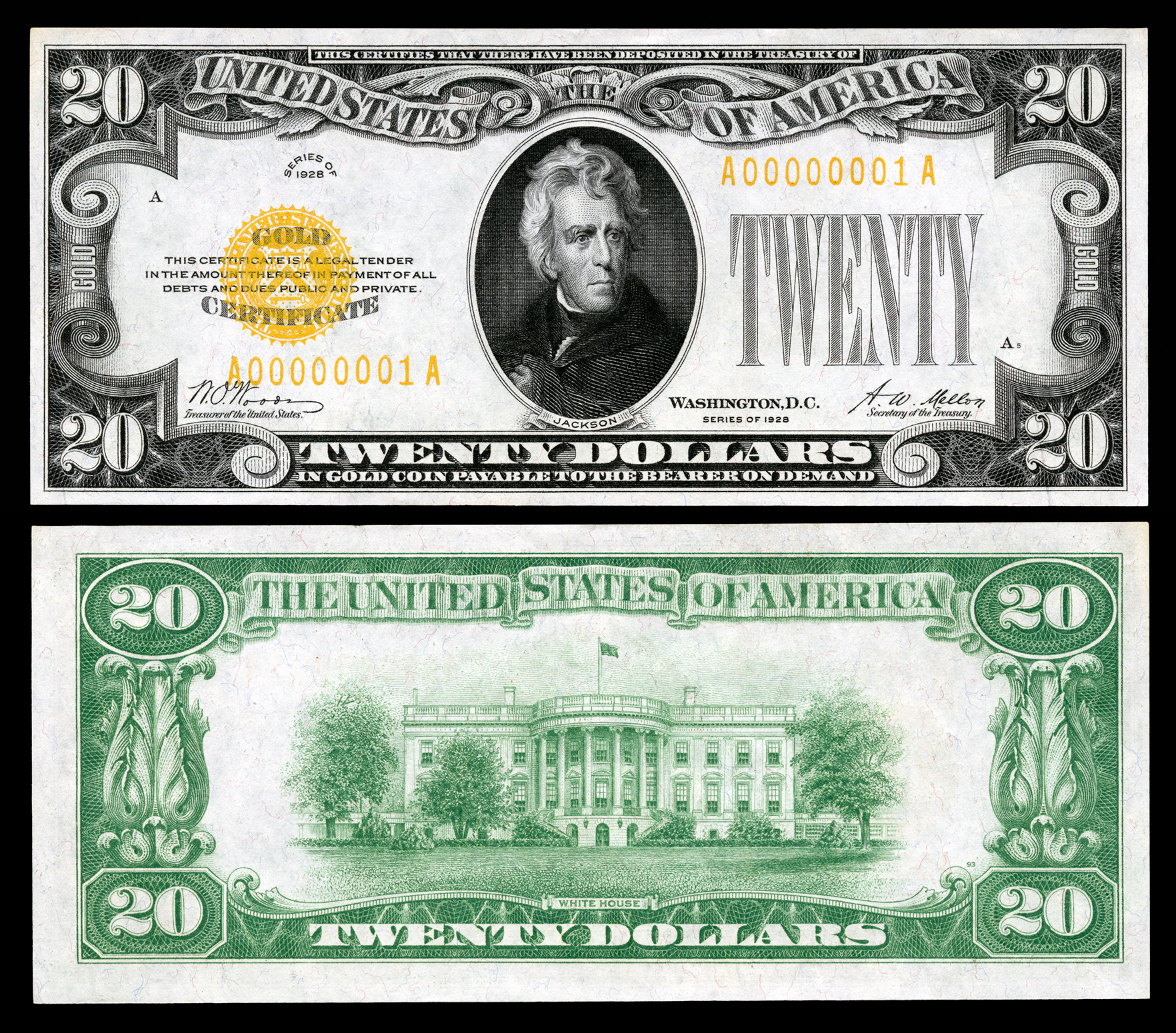
📷 Image source: National Numismatic Collection, National Museum of American History (via Wikimedia Commons). Images are selected by AI to represent the article topic and may not depict the exact note(s) described.
Pick up a raw Gold Certificate at almost any currency show and you will likely encounter the same frustrating scenario: a note with crisp paper, sharp corners, and reasonable centering that somehow feels wrong the moment you look at the seal. That brilliant yellow-orange Treasury seal, the single most visually defining feature of any Gold Certificate series, has faded to a washed-out lemon yellow or, worse, a ghostly cream tone that whispers of poor storage, humidity exposure, or decades spent in a damp album. The note grades Fine on paper but presents like a problem piece. Understanding why that seal matters so much, and how to evaluate it precisely, is what separates casual collectors from serious students of this magnificent series.
A Brief History of Gold Certificates and Their Distinctive Seals
Gold Certificates were issued by the United States Treasury from 1863 through 1933, serving as paper representatives of actual gold coin held on deposit. The earliest issues, the Series of 1863 and 1865, were large format notes intended primarily for bank-to-bank transfers rather than everyday commerce. It was not until the Series of 1882 that Gold Certificates began circulating more broadly among the public, and it was around this era that the vivid yellow-orange Treasury seal became the visual signature of the class.
The seal’s color was not decorative whimsy. It was a deliberate anti-counterfeiting measure, using a proprietary oil-based ink formulation that proved notoriously difficult to replicate with period printing technology. The Bureau of Engraving and Printing (BEP) refined this formulation across multiple series, and by the time the small-size Gold Certificates of 1928 were printed, the seal ink had reached what many numismatists consider its most vibrant expression. The 1928 series $10, $20, $50, and $100 notes carry seals that, when fully retained, display a rich, almost luminous orange-gold that is simply stunning against the note’s golden-tinted reverse.
The Chemistry of Fading: Why Gold Certificate Seals Are So Vulnerable
To understand why seal color is the paramount grading factor, you need to appreciate the chemistry at work. The yellow-orange pigment used in Gold Certificate seals is based on iron-oxide and chromate compounds suspended in a linseed oil carrier. This formulation bonds well to the cotton-linen paper substrate but is acutely sensitive to three environmental enemies: ultraviolet light, oxidation, and moisture.
UV exposure is the most common culprit for fading. A Gold Certificate stored in a windowed album or displayed in a frame near natural light can begin showing measurable seal degradation within just a few years. The chromate compounds bleach progressively, shifting the color from orange-gold toward yellow, then toward a pale straw, and finally toward near-white in severely damaged examples. Moisture accelerates the iron-oxide component’s oxidation, which paradoxically can shift the seal toward a brownish or rust tone rather than pure fading, producing what collectors call a “dirty seal” appearance that is equally penalized in grading.
When examining a Gold Certificate under a loupe, tilt the note at roughly 45 degrees under a warm incandescent light source, not LED or fluorescent. The original seal ink has a subtle sheen that becomes visible at an angle, helping you distinguish genuine color retention from a note where the surface pigment has been partially removed or, in rare fraud cases, re-tinted.
How the Major Grading Services Handle Seal Color
Both PCGS Currency and PMG have long recognized seal color as a special consideration for Gold Certificates, and their grading standards reflect this. PMG’s published guidelines specifically cite “originality of color” as a factor in the Gold Certificate category, and holders will sometimes carry a qualifier such as “Bright” to indicate exceptional seal retention in high-grade examples. PCGS Currency similarly uses positive descriptors for standout color and will note fading in their holder comments when it influences the grade.
In practical terms, a note with a numerical grade of 35 (Choice Very Fine) but carrying exceptional, fully saturated seal color will often command prices in the Very Fine 30 to Extremely Fine 40 range at auction, simply because buyers understand that color retention in that grade band is rare. Conversely, a numerically graded 63 note with a washed-out or faded seal can struggle to bring even strong Very Fine money. The seal color essentially operates as a parallel grading axis that intersects with and sometimes overrides the numerical grade in the marketplace.
Evaluating Seal Color: A Practical Framework
Developing an eye for Gold Certificate seal color takes deliberate practice. The following framework, built from studying hundreds of certified and raw examples, provides a reliable starting point.
Grade 1: Full Original Color (Exceptional)
The seal displays a deep, saturated orange-gold with no visible fading, browning, or washed areas. Under magnification, the ink surface appears fully intact with consistent pigment density throughout the entire seal disk and serrated border. This is the standard you should expect on any note grading 63 or above, and it should be present on most Extremely Fine examples from the 1928 series.
Grade 2: Original Color with Minor Peripheral Softening
The center of the seal retains strong color, but the outermost serrations or the edges of the disk show a slightly lighter tone. This is common on circulated notes that have been folded, as the fold stress can accelerate ink breakdown at precise crease locations. Appropriate for the Very Fine 20 to Extremely Fine 45 range.
Grade 3: Noticeable Fading, Color Shifted Toward Yellow
The seal reads as yellow-gold rather than orange-gold. The original chromate component has partially bleached. Notes in this category should be graded conservatively regardless of paper quality, and any premium for the series should be reduced accordingly.
Grade 4: Severe Fading or Discoloration
The seal appears pale yellow, cream, or shows browning and rust toning. This level of degradation indicates the note was stored in genuinely poor conditions. Even an otherwise high-grade note becomes a problem piece at this level.
When buying raw Gold Certificates at shows or through private sales, always ask to examine the note under the seller’s light source and then step away to examine it under a different, ideally cooler, light. Warm incandescent bulbs can mask yellowing by adding an orange cast to the entire note, making a faded seal look more vibrant than it truly is.
Series-Specific Notes on Seal Condition
Seal color vulnerability is not uniform across all Gold Certificate series. Large-size notes from the Series of 1882 and 1907 were printed on thicker, more absorbent paper stocks that tended to hold the seal ink somewhat more securely than later issues, though their age means genuinely bright examples are scarcer. The Series of 1906 $20 Gold Certificate, signed by Vernon-Treat (1906 to 1909) or Vernon-McClung (1909 to 1911), presents with particularly vivid seals when well-preserved, making it a collector favorite as a type note.
The 1922 $10 Gold Certificate, the last of the large-size issues and one of the most commonly encountered Gold Certificates in any grade, shows tremendous variance in seal color. Because tens of millions were printed, finding a circulated example is easy. Finding one with a fully original orange-gold seal, rather than the lemon-yellow tone that dominates the population, is genuinely challenging and worth a meaningful premium. The 1922 $10 with a Grade 1 seal in Very Fine condition outperforms many Extremely Fine examples with faded seals at major auction houses consistently.
For small-size Gold Certificates, the 1928 series across all denominations ($10 through $100) represents the most actively traded segment of the market. The $100 1928 Gold Certificate, bearing the signatures of Woods-Mellon, is the denomination where seal color debates are most financially consequential. High-grade examples with full original color in PMG 65 or PCGS 65 holders have sold for over $15,000, while comparably graded notes with softened seal color sit closer to $8,000 to $10,000. That gap is almost entirely attributable to the seal.
For type set collectors building a Gold Certificate collection on a budget, prioritize the 1928 $10 Gold Certificate with the Woods-Mellon signature combination. It is the most affordable denomination in the small-size series, and original-color, problem-free examples in Very Fine to Extremely Fine grades regularly appear at auction in the $300 to $700 range, offering excellent value relative to rarer denominations.
The Artificial Enhancement Problem
Because seal color commands such a premium, artificial enhancement of faded seals has been a documented problem in the hobby. Methods have ranged from light chemical tinting to the application of colored varnishes that temporarily restore the appearance of original pigment. Reputable third-party graders catch most of these alterations, but raw notes are genuinely at risk. Under UV light (a standard 365nm black light), original Gold Certificate seal ink fluoresces in a specific, dull pattern. Artificially added pigments almost universally fluoresce differently, often showing either a bright blue-white reaction or no reaction at all. Any serious collector buying a raw Gold Certificate should own a UV lamp and know this distinction.
Additionally, notes that have been “pressed” or cleaned sometimes show seal color that appears more uniform and vibrant than the underlying paper condition would suggest. A seal that looks too perfect on a note with otherwise circulated paper qualities is a red flag worth investigating further before purchase.
| Series / Date | Denomination and Signatures | Est. Known with Full Color | Rarity |
|---|---|---|---|
| 1863 | $20 Large, First Issue | Fewer than 10 | Key Date |
| 1882 | $20 Bruce-Gilfillan | Fewer than 50 | Rare |
| 1906 | $20 Vernon-Treat | 200 to 400 estimated | Scarce |
| 1907 | $10 Vernon-Treat | 300 to 600 estimated | Scarce |
| 1922 | $10 Speelman-White | 1,000 to 2,000 estimated | Scarce |
| 1922 | $50 Speelman-White | Fewer than 150 | Rare |
| 1928 | $10 Woods-Mellon | 2,000 to 4,000 estimated | Common |
| 1928 | $20 Woods-Mellon | 800 to 1,500 estimated | Scarce |
| 1928 | $50 Woods-Mellon | 200 to 400 estimated | Rare |
| 1928 | $100 Woods-Mellon | Fewer than 300 | Rare |
Storage Recommendations to Preserve Seal Color
If you already own Gold Certificates or are building a collection, protecting the seal color you have is as important as finding notes with good color to begin with. Store all Gold Certificates in Mylar D (polyester) holders rather than PVC-based sleeves. PVC off-gasses plasticizers over time that can react with the seal ink and accelerate browning. Keep your storage environment at a consistent temperature between 65 and 70 degrees Fahrenheit with relative humidity in the 40 to 50 percent range. Avoid any storage location with UV exposure, including display frames near windows, even through UV-filtering glass, which only reduces rather than eliminates the relevant wavelengths.
For long-term archival storage, acid-free currency albums with Mylar pages stored in a stable, dark environment represent the best practice. Notes in certified holders from PCGS or PMG are already in archival-quality encapsulation and require only proper temperature and humidity control.
Conclusion: Let the Seal Lead Your Buying Decisions
Gold Certificates occupy a unique and beloved place in American numismatic history. They are the physical embodiment of a monetary era when paper money carried a direct promise of gold coin on demand, and their visual identity rests almost entirely on that distinctive yellow-orange seal. When you approach any Gold Certificate transaction, whether at a show, through an online auction, or in a dealer’s inventory, train yourself to look at the seal first and everything else second. Ask the question that separates experienced collectors from beginners: is that color original, fully saturated, and chemically intact? If the answer is yes, you are looking at a note worth serious consideration. If the answer is anything less certain, let the price reflect it, or walk away entirely. The market has spoken clearly for decades: on a Gold Certificate, color is king.