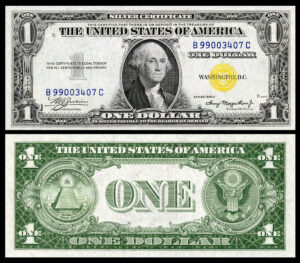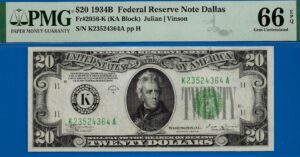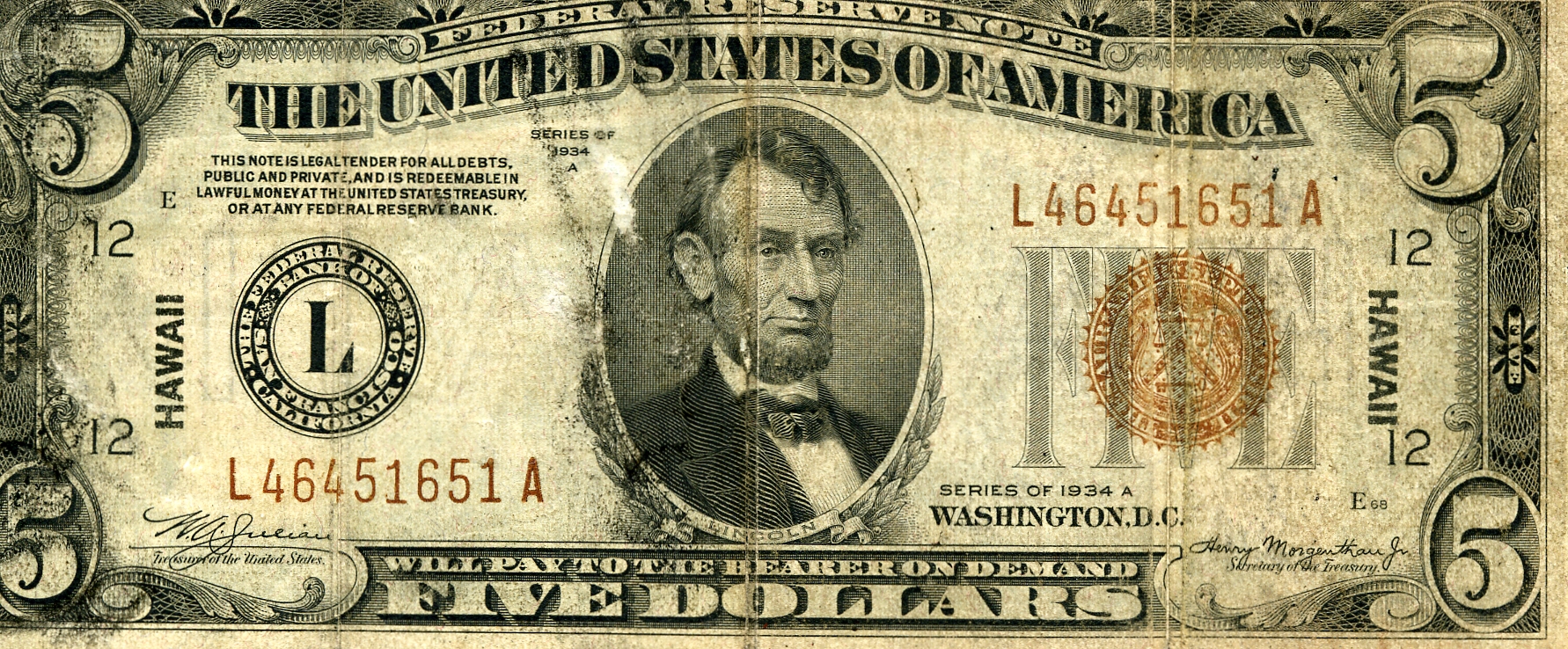
📷 Image source: Wikimedia Commons. Images are selected by AI to represent the article topic and may not depict the exact note(s) described.
Walk into any major currency auction and you will find Series 1934 Federal Reserve Notes generating spirited bidding far beyond what their face values suggest. The reason almost always comes down to two words collectors use constantly: light green and dark green. These terms refer to the color of the Treasury seal and serial numbers printed on the face of the note, and the difference between them is not merely cosmetic. It speaks to a specific moment in the Bureau of Engraving and Printing’s production history, varies dramatically by denomination, and creates collectible varieties with wildly different survival rates and market values. Whether you are assembling a type set or pursuing a district-by-district specialty collection, the 1934 green seal story is one you need to know cold.
Why Two Different Green Seals?
The Bureau of Engraving and Printing did not announce a formal policy change when it shifted the ink formulation for Treasury seals and serial numbers on Series 1934 Federal Reserve Notes. The transition happened organically as existing ink stocks were consumed and new batches were mixed. The earlier printings used an ink that produced a noticeably deeper, richer olive-tinged green, what collectors now call the dark green seal. As production continued into 1935 and the BEP adjusted its ink chemistry, the color shifted to a brighter, more vivid yellow-green, the light green seal familiar to virtually every collector who has handled circulated 1934 notes.
The distinction is immediately visible under good lighting when you place examples side by side. Dark green seals appear almost forest green and can carry a slightly brownish cast on heavily circulated notes. Light green seals have a crispness and brightness that reads as distinctly lime or chartreuse compared to their earlier counterparts. On uncirculated examples, the contrast is even more striking. Paper quality and storage conditions can shift perceived color somewhat, but the two varieties are genuinely distinct inks, not a matter of fading or environmental exposure.
The $5 Federal Reserve Note: 1934 Series
The Series 1934 $5 Lincoln note represents one of the most accessible entry points into the variety. Dark green seal examples exist from all twelve Federal Reserve districts, though some districts printed far fewer notes than others. The dark green seal $5 notes were produced in modest quantities relative to the massive wartime and post-war runs that followed under Series 1934A and beyond. Collectors assembling a twelve-district dark green set will find Boston (A) and Minneapolis (I) notes considerably more elusive than Chicago (G) or New York (B) examples. The light green seal $5 notes are substantially more common across all districts, reflecting the higher volume production that characterized mid-to-late 1930s printing. Star notes in the $5 denomination with dark green seals are genuinely scarce and command significant premiums in any grade above Very Fine.
When examining Series 1934 $5 notes for seal color, hold the note under a daylight-balanced light source rather than incandescent bulbs. Warm-toned lighting can mask the yellow-green brightness of light green seals and make them appear darker than they actually are, leading to misidentification, especially on circulated examples.
The $10 Federal Reserve Note: 1934 Series
The $10 Hamilton note in Series 1934 produces one of the most interesting variety distributions in the entire denomination. Dark green seal examples are the earlier and scarcer variety but are not exceptionally rare for Boston, New York, Philadelphia, Cleveland, Chicago, or San Francisco districts. The remaining six districts, Richmond (E), Atlanta (F), St. Louis (H), Minneapolis (I), Kansas City (J), and Dallas (K), present meaningful challenges for dark green seal collectors in problem-free circulated grades. Light green seal $10 notes are common type pieces in most districts. Experienced collectors focus on finding dark green seal star notes, which are legitimately rare for several Federal Reserve districts and have documented print runs well under 100,000 notes for the least common districts.
The $20 Federal Reserve Note: 1934 Series
The twenty-dollar denomination is where the light versus dark green seal story becomes genuinely exciting from a rarity standpoint. The $20 note was the workhorse denomination of American commerce in the 1930s, meaning print runs were substantial. However, the dark green seal variety across all districts represents a narrower window of production, and in grades of Extremely Fine or better, dark green seal examples attract serious collector interest. District F (Atlanta) and District I (Minneapolis) dark green $20 notes are particularly sought after. The light green seal $20, by contrast, is one of the most commonly encountered Series 1934 Federal Reserve Notes in the entire marketplace, making it an ideal type note for new collectors who want an affordable example of the series.
For the $20 Series 1934 dark green seal, prioritize purchasing notes that have been holdered by PCGS Currency or PMG. The dark green versus light green distinction is critical for accurate pricing, and third-party grading services specifically note the seal color variety on their certification labels, protecting you from overpaying for a misidentified light green example.
The $50 Federal Reserve Note: 1934 Series
Moving into the higher denominations, the collecting dynamic shifts considerably. The $50 Grant note in Series 1934 exists in both seal varieties, but overall survival rates are lower simply because higher denomination notes were redeemed and destroyed at faster rates relative to their print runs. Dark green seal $50 notes are legitimately scarce in grades above Very Fine for most districts, and for certain districts like Minneapolis (I), Dallas (K), and Kansas City (J), any example in Fine or better condition warrants attention. The light green seal $50 is more available but still far less common than lower denomination counterparts. Collectors specializing in the $50 denomination often find that building a complete twelve-district set of light green seals alone takes years of patient searching.
The $100 Federal Reserve Note: 1934 Series
The $100 Franklin note in Series 1934 represents the pinnacle of the green seal variety collecting challenge. Both the dark green and light green seal varieties exist, but the $100 denomination’s high face value meant that notes entering circulation were carefully tracked and returned to the Federal Reserve more promptly than smaller denominations. The result is that circulated examples in Fine to Very Fine grades predominate the surviving population, with truly choice Extremely Fine or Uncirculated examples being notable finds regardless of seal color. The dark green seal $100 is quite scarce for several districts, and any star note in either seal variety at the $100 denomination is a significant numismatic item. Collectors should expect to pay strong premiums for problem-free examples; pressed, cleaned, or repaired notes are unfortunately common in the $100 Series 1934 marketplace.
High denomination Series 1934 notes, particularly $50 and $100 values, are frequently encountered with counting or handling creases that have been professionally pressed. Always request a full scan of both faces before purchasing raw notes above $200 in catalog value, and examine the paper fibers under magnification for evidence of pressing or chemical treatment around the fold lines.
District-by-District Rarity Patterns
Across all denominations, certain Federal Reserve districts consistently appear as the toughest to source in dark green seal form. Minneapolis (I), Kansas City (J), and Dallas (K) served smaller regional economies and received proportionally smaller note allocations from the BEP during the initial 1934 printing run. This means their dark green seal examples are genuinely underrepresented in surviving populations. Boston (A) and Richmond (E) notes also trend scarce in dark green for denominations above $20. New York (B) and Chicago (G) are the most available districts across both seal varieties, owing to the sheer volume of commerce those Federal Reserve Banks serviced during the Depression era and World War II period.
Signature Combination and Series Context
All Series 1934 Federal Reserve Notes bear the signature combination of Secretary of the Treasury Henry Morgenthau Jr. and Treasurer of the United States William A. Julian. Morgenthau served as Treasury Secretary from January 1934 through July 1945, and Julian served as Treasurer from March 1933 through May 1949, making this one of the longer-running signature pairings in Federal Reserve Note history. The subsequent Series 1934A notes continue with the same signatures but reflect updated design elements and different print run characteristics. Collectors should not confuse 1934A, 1934B, 1934C, and 1934D series notes, which carry different signature combinations, with the original Series 1934 studied here. Only the original Series 1934 exhibits the light green versus dark green seal transition.
| Denomination | Seal Variety / District | Approx. Print Run | Rarity |
|---|---|---|---|
| $5 | Light Green, New York (B) | Millions | Common |
| $5 | Dark Green, Chicago (G) | Several million | Common |
| $5 | Dark Green, Minneapolis (I) | Under 500,000 est. | Scarce |
| $10 | Dark Green, Dallas (K) Star | Under 60,000 est. | Rare |
| $10 | Light Green, San Francisco (L) | Millions | Common |
| $20 | Dark Green, Atlanta (F) | Under 1 million est. | Scarce |
| $20 | Dark Green, Minneapolis (I) Star | Under 24,000 est. | Key Date |
| $50 | Dark Green, Kansas City (J) | Under 300,000 est. | Rare |
| $50 | Light Green, New York (B) | Several hundred thousand | Scarce |
| $100 | Dark Green, Any District Star | Under 12,000 est. | Key Date |
Grading Considerations Specific to 1934 Green Seal Notes
Grading Series 1934 Federal Reserve Notes requires particular attention to several characteristics that affect value more acutely than on later issues. Paper quality is paramount: notes from this era were printed on somewhat thicker stock than post-World War II issues, and genuine originality of paper texture adds significant premium. Collectors should look for full original embossing on the portrait and vignette areas, strong corner points on uncirculated examples, and vibrant seal and serial number color that has not been affected by moisture or chemical exposure. The green inks on these notes are somewhat susceptible to fading if stored improperly, particularly in humid environments, which can sometimes make a light green seal note appear darker or a dark green seal note appear washed out. A note graded PMG 64 or PCGS 64 in Choice Uncirculated will typically trade at a multiple of three to five times the value of a Fine-12 example for key district and denomination combinations.
Building a Series 1934 Green Seal Type Set
For collectors approaching this series for the first time, the most practical entry strategy is building a type set of one example per denomination in light green seal, then upgrading specific pieces to dark green seal as budget and opportunity allow. Light green seal examples of the $5, $10, and $20 in Very Fine to Extremely Fine grades are available at reasonable prices and provide an excellent foundation. From there, targeting dark green seal examples of the $5 and $10 from major districts like New York or Chicago provides genuine variety distinction without requiring the substantial outlays demanded by minor districts. The $50 and $100 dark green seals should be treated as medium-term goals for most collectors, acquired patiently through major auction houses such as Heritage Auctions, Stack’s Bowers, or Lyn Knight Currency Auctions, where quality consignments regularly appear.
The Standard Catalog of United States Paper Money by Krause and the Friedberg Paper Money of the United States guide are both essential references for Series 1934 collecting. Cross-reference both sources when evaluating catalog values, as the Friedberg numbers for light versus dark green seal varieties are listed separately and price differences can be substantial, particularly for higher denominations and minor districts.
Conclusion: A Variety Worth Chasing
The Series 1934 Federal Reserve Note light and dark green seal varieties represent exactly the kind of collecting specialty that rewards careful study and patient acquisition. The transition between ink formulations was not a deliberate collector-targeted event; it was a practical production reality at the Bureau of Engraving and Printing. Yet it created a genuine documentary record of a specific moment in American monetary history, and the survival patterns across denominations and districts give collectors a rich matrix of goals to pursue. From the readily available light green $20 type note to the genuinely rare dark green star notes of the minor Federal Reserve districts, Series 1934 offers something meaningful at virtually every budget level. Few series in twentieth-century American paper money combine historical depth, visual appeal, and collectible variety quite so compellingly.