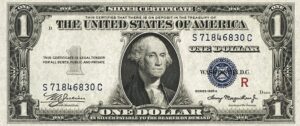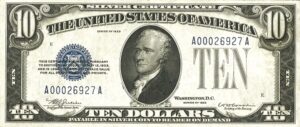
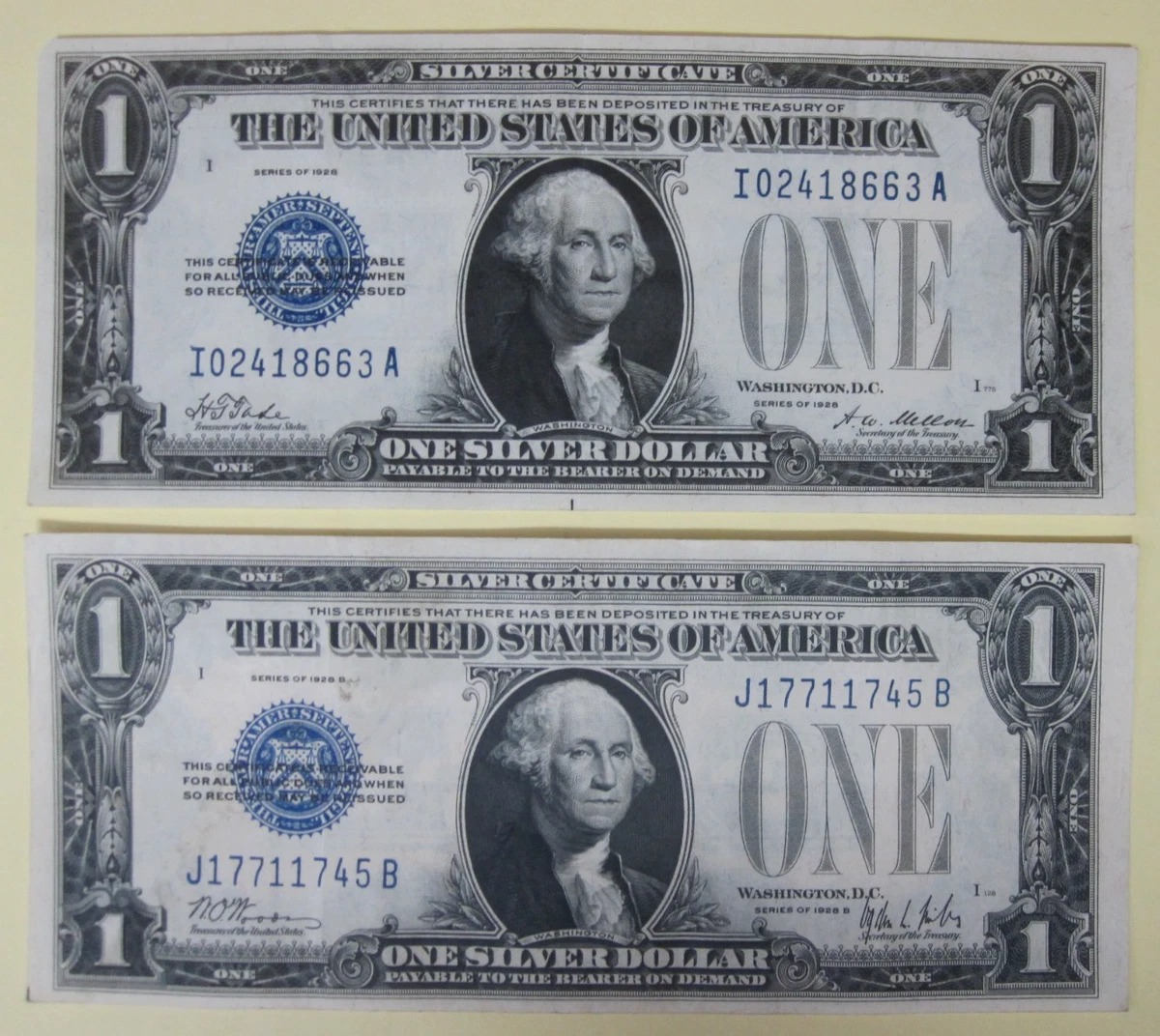
📷 Image source: Wikimedia Commons. Images are selected by AI to represent the article topic and may not depict the exact note(s) described.
Flip any small-size Federal Reserve Note over and glance at the serial number in the upper-left and lower-right corners. At first it looks like a string of random digits bracketed by letters. But those letters, the ones that bookend the eight digits, are actually a precise record-keeping language developed by the Bureau of Engraving and Printing over nearly a century of continuous refinement. Once you learn to read that language, every note in your collection tells a richer story.
The Birth of the Small-Size System: 1929 and the Original Format
When the United States transitioned from large-size to small-size currency in 1929, the Bureau of Engraving and Printing needed a serial number scheme capable of tracking enormous print runs across multiple note types, all compressed onto a currency measuring just 6.14 by 2.61 inches. The solution adopted was elegant in its simplicity: a single prefix letter, followed by eight digits, followed by a single suffix letter.
On the earliest small-size notes, Series 1928 United States Notes, Silver Certificates, and Gold Certificates, the prefix letter identified the specific block of serial numbers being used, while the suffix letter essentially served as a run counter, advancing from A through Z (minus O and Z themselves, which were excluded to avoid confusion with the numeral 0 and the numeral 2 in period typefaces) each time the eight-digit sequence cycled from 00000001 to 99999999. This gave the BEP a theoretical maximum of approximately 2.4 billion serials per denomination before the system needed to be reset, more than sufficient for production runs of the era.
The omission of the letters O and Z is a detail many beginning collectors overlook, but it has real implications when trying to identify complete runs. Effective suffix letters in the early system were A through Y, excluding O, giving 24 usable letters. That meant each prefix block could accommodate roughly 2.4 billion individual notes before exhaustion.
When examining Series 1928 Silver Certificates, check whether the suffix letter is A. Notes with the suffix A in the first block represent the earliest production examples for that denomination and type. A 1928 $1 Silver Certificate with serial A00000001A, while almost certainly not available to private collectors, anchors the series and helps you understand where any given note falls in production sequence.
Federal Reserve Notes and the District Letter Prefix
Federal Reserve Notes introduced an important wrinkle into the serial number conversation. Beginning with Series 1928 FRNs, the prefix letter on each note was not simply a sequential block indicator: it was locked to the issuing Federal Reserve District. The twelve districts received permanent letter assignments that remain in use to this day. Boston is A, New York is B, Philadelphia is C, Cleveland is D, Richmond is E, Atlanta is F, Chicago is G, St. Louis is H, Minneapolis is I, Kansas City is J, Dallas is K, and San Francisco is L.
This means the prefix letter on a Federal Reserve Note does double duty. It tells you both which district issued the note and which sequential block within that district’s production you are looking at. The suffix letter then advances as runs are completed. A note reading F12345678A came from the Atlanta district and was in the first suffix block; a note reading F12345678B is still Atlanta, but represents a second completed run of 99,999,999 notes.
This district-locked prefix system created immediate collecting opportunities. District scarcity varies enormously. Minneapolis (I) and Kansas City (J) consistently had lower regional demand, meaning shorter print runs and correspondingly scarcer notes across nearly every series. San Francisco (L) and New York (B) sit at the opposite extreme, with massive circulation demands producing enormous runs and widely available examples.
For Federal Reserve Notes from Series 1928 through 1950E, a complete district set across all twelve banks is a classic collecting goal. Minneapolis and Kansas City issues in grades above Very Fine command significant premiums. Before buying, cross-reference the serial number range against published production records in the Standard Guide to Small-Size U.S. Paper Money by Schwartz and Lindquist to confirm legitimacy.
The Shift to Two-Letter Prefixes: Accommodating Postwar Production Volumes
By the late 1940s and into the 1950s, the BEP faced a structural problem. Postwar economic expansion and population growth were driving currency demand to levels the original single-prefix system had not anticipated. High-volume districts like New York and Chicago were advancing through suffix letters at a pace that threatened to exhaust the available combinations within a single series run.
The solution, implemented progressively across note types, was the introduction of a two-letter prefix. Under this system, the first letter continued to serve as the district identifier for Federal Reserve Notes, while a second prefix letter functioned as the block counter that the old suffix letter had handled. The suffix letter at the end of the serial was retained, creating a format of two prefix letters plus eight digits plus one suffix letter.
For non-district notes such as United States Notes and Silver Certificates, which lacked the district-locking constraint, the two-letter prefix allowed purely sequential block advancement through a matrix of letter combinations. The first prefix letter advanced slowly, cycling from A onward, while the second prefix letter cycled more rapidly. This matrix approach multiplied available serial combinations dramatically and gave the BEP headroom for decades of expanded production.
Series 1963 Federal Reserve Notes represent an important transition point. These notes were among the first to see the two-letter prefix applied consistently across all twelve districts in standard circulation production. Collectors assembling type sets that span the prefix evolution will want at least one example each of a single-prefix and a two-prefix FRN to illustrate the change visually.
Star Notes and the Asterisk Replacement System
No discussion of serial number structure is complete without addressing star notes, the replacement notes the BEP prints when a defective note must be pulled from a run. Because print runs are numbered sequentially and destroying a misprinted note would leave a gap in the serial record, the BEP substitutes a replacement note with the same serial number format but with an asterisk replacing the suffix letter on pre-1996 notes, or added before the prefix letters on certain modern issues.
Star notes have been a collecting staple since the small-size era began. Their appeal is straightforward: star notes are always printed in smaller quantities than regular notes, making any given star serial inherently scarcer than its regular counterpart. The degree of scarcity varies wildly, however. Some star runs number in the millions while others, particularly for low-demand districts or late-series runs, may total fewer than 640,000 notes, the standard BEP print sheet run.
The Federal Reserve Bank of San Francisco produced one of the most sought-after star notes of the modern era in the Series 1995 $1 FRN. The Atlanta district star for Series 1995 had a reported run of approximately 128,000 notes, making it one of the key dates in modern small-size collecting. Values in Crisp Uncirculated grade can exceed several hundred dollars depending on centering and overall eye appeal.
Published star note production data has improved significantly since the BEP began releasing official run figures in the late 1980s. For notes before that period, rely on population reports from PCGS Currency and PMG alongside the research published by Doug Murray and Michael Abramson. When you encounter a star note from Series 1934 through 1950, treat any district example as potentially significant until you verify the run size.
Modern Serials: The Current Two-Prefix FRN Format and Its Nuances
The format in use on Federal Reserve Notes today presents the district letter as the first prefix character, a block-advancement letter as the second prefix character, eight digits, and a single suffix letter. High-production series like the Series 1999 and Series 2003 $1 FRNs for New York (B) advanced the second prefix letter all the way from A through multiple cycles, generating blocks like BA through BZ (again excluding O and Z) within a single series.
A subtle shift occurred with some large-denomination notes printed after the 1990s security upgrade campaigns. The $100 FRN series beginning with Series 1996 introduced the additional security thread and color-shifting ink, and the corresponding serial numbers continued the two-prefix format but were increasingly scrutinized for low serial numbers, which carry their own collector premiums irrespective of the block structure. A serial like MB00000100A on a Series 2009 $100 note from the Minneapolis district is a low-serial collectible precisely because of the digit string, not the letter arrangement.
Web press experimental notes from 1992 to 1996 represent another serial number curiosity. The BEP experimented with a web-fed intaglio press that printed notes in a continuous web rather than sheets. These notes, identifiable in part by their plate numbers and specific serial ranges, were produced in $1 denomination across five Federal Reserve districts: Atlanta, Chicago, Kansas City, New York, and San Francisco. The serial format remained standard, but the plate position identifiers on these notes differ from conventional sheet-fed production, and advanced collectors use serial ranges in conjunction with plate data to authenticate and attribute them.
| Series / Date | Variety or District | Approx. Print Run | Rarity |
|---|---|---|---|
| 1928 $1 FRN | Minneapolis (I) Block IA | Fewer than 1.5 million | Rare |
| 1928B $1 FRN | Boston (A) Star Note | Est. under 500,000 | Key Date |
| 1934 $500 FRN | All Districts, any block | Under 100,000 combined | Key Date |
| 1950E $100 FRN | Kansas City (J) Star | Est. 24,000 | Key Date |
| 1974 $1 FRN | New York (B) Block BA | Over 800 million | Common |
| 1988A $1 FRN | Atlanta (F) Star | 3,200,000 | Scarce |
| 1995 $1 FRN | Atlanta (F) Star | 128,000 | Key Date |
| 1995 $1 FRN | Minneapolis (I) Star | 640,000 | Rare |
| 1995 Web Press $1 FRN | Chicago (G), Kansas City (J) | Under 2 million each | Scarce |
| 2003A $1 FRN | New York (B) Block BA | Over 1 billion | Common |
What Serial Numbers Cannot Tell You (And What to Use Instead)
It is worth being honest about the limits of serial number analysis. The block letter and suffix letter system tells you the district, the approximate position within production, and whether a note is a star replacement. It does not, on its own, tell you the precise print date within a series, the specific plate used, or the face plate position of the individual note on its 32-subject sheet. For that level of attribution, collectors must combine serial number data with the plate serial numbers printed on the face and back of each note and consult BEP production records, some of which have been digitized and made available through the Society of Paper Money Collectors library.
Grading also interacts with serial number significance in subtle ways. A low-grade example of a key serial range, say a Fine-12 example of a 1950E Kansas City star, still has meaningful rarity value because the print run was so small that survivors in any grade are limited. Conversely, common block issues from high-production districts are worth premium prices only in the highest Gem Uncirculated grades with strong eye appeal, typically PMG 66 EPQ or PCGS 66 PPQ and above, because millions of examples exist and only flawless production specimens stand out.
Building a Collection Around the Serial Number Narrative
One of the most intellectually satisfying ways to approach small-size note collecting is to organize a collection that literally tells the story of serial number system evolution. Such a collection might begin with a Series 1928 $1 Legal Tender Note showing the original single-prefix format, advance through a Series 1935 Silver Certificate with an intermediate block, incorporate a Series 1963 FRN demonstrating the consolidated two-prefix approach, and culminate with a modern Gem example showing the fully mature system alongside a star note from one of the documented low-run districts.
This thematic framework has the advantage of being achievable on a modest budget for most of the type examples while still offering challenging key dates in the star note and low-district segments. It also produces a collection that is genuinely educational, the kind that holds up well at club meetings and paper money shows because every note anchors a specific chapter in the administrative history of American currency production.
Understanding prefix letters, suffix letters, block advancement, district locking, and star replacement mechanics transforms every serial number from a bureaucratic tracking code into a precise timestamp and production document. That shift in perspective is, ultimately, what separates a casual accumulator of old bills from a numismatist who reads currency the way an archaeologist reads a stratigraphic column: every layer telling a story, every detail placed there for a reason.