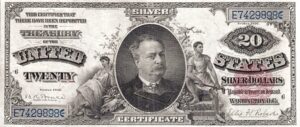
Walk into any major currency auction and you will find National Bank Notes commanding serious attention, and for good reason. Among the most historically rich and visually varied notes ever produced by the United States, nationals from the Third Charter Period occupy a special place in the hearts of collectors. Issued between 1902 and 1929, these notes bridge the gap between the ornate Victorian currency of the nineteenth century and the standardized Federal Reserve era that followed. Three distinct varieties emerged during this period: the Red Seal, the Date Back, and the Plain Back. Each has its own story, its own scarcity profile, and its own appeal. Sorting them out is both a practical necessity and a genuine pleasure.
A Brief History of the Third Charter Period
The National Banking System was established by the National Currency Act of 1863, later strengthened by the National Bank Act of 1864. Banks received federal charters that allowed them to issue currency backed by U.S. government bonds deposited with the Treasury. These charters ran for twenty-year terms, giving rise to three distinct charter periods with their own design families. The Third Charter Period began in 1902 when Congress authorized the renewal of charters and introduced a new set of note designs. These notes carry a Treasury seal and the signatures of the Treasurer of the United States and the Register of the Treasury on the left side, alongside the countersignatures of the bank’s president and cashier on the right.
What makes the Third Charter Period particularly fascinating is that it was not a monolithic design program. Political, economic, and administrative pressures caused the Treasury to modify the notes at least twice during the period’s run, producing three visually and historically distinct varieties that collectors now call the Red Seal, the Date Back, and the Plain Back. Each was produced concurrently with bank renewals and new charters, meaning the timing of when a specific bank received its charter or renewed it often determined which variety it issued.
Red Seals: The Opening Act, 1902 to 1908
The first notes of the Third Charter Period are the most visually striking. Issued from 1902 through approximately 1908, Third Charter Red Seals are distinguished by their vivid red Treasury seal and red serial numbers. The face designs introduced portraits that varied by denomination: the $5 featured Benjamin Harrison, the $10 depicted William McKinley, the $20 showed Hugh McCulloch, the $50 carried John Sherman, and the $100 featured John J. Knox. The reverse designs on these early notes are particularly ornate, featuring allegorical scenes that referenced American commerce, industry, and national progress.
Red Seals were produced only during the brief window before a congressional decision in 1908 altered the reverse design. This short production window, combined with the attrition of over a century, makes Red Seals significantly scarcer than the varieties that followed. Many issuing banks had relatively small circulation figures for this type. When you encounter a $5 Red Seal from a small-town bank in Nebraska or Tennessee, you are holding a note that may represent one of only a handful of survivors from that institution’s Third Charter issuance.
When evaluating Third Charter Red Seals, pay close attention to the sharpness of the red seal itself. Original red ink on well-preserved specimens retains a vivid, almost orange-red tone. Notes that have been cleaned or subjected to moisture often show a faded, brownish seal, which significantly affects both grade and value.
Date Backs: Congress Intervenes, 1908 to 1916
In 1908, Congress passed the Aldrich-Vreeland Act as an emergency currency measure, partly in response to the Panic of 1907. Among its provisions was a requirement that the reverse of National Bank Notes carry the dates “1902” and “1908” prominently displayed, a practice that gave this variety its collector name: Date Backs. The front design remained essentially the same as the Red Seals, retaining the red Treasury seal and red serial numbers. The difference is entirely on the reverse, where the two dates frame the central vignette.
Date Backs were issued from approximately 1908 through 1916, when another design modification produced the Plain Back. The Date Back reverse featured elaborate scrollwork and geometric designs surrounding the prominent dates. This variety is considerably more common than the Red Seal but still represents a meaningful collecting challenge, particularly in higher grades and for small-charter-number banks or institutions with limited circulation histories.
One nuance that trips up newer collectors is the overlap period. Some banks continued receiving shipments of Red Seal notes even as Date Backs were being prepared, while others transitioned immediately. The Bureau of Engraving and Printing did not instantly recall and replace all outstanding inventory, so there are transitional edge cases worth being aware of when attributing notes by date of issue versus date of printing.
Date Backs and Plain Backs are sometimes confused by newer collectors because both share the red seal and red serial numbers of the Third Charter Period. Flip the note over and look for the two dates flanking the central design. If you see “1902” and “1908” printed as part of the design, you have a Date Back. If those dates are absent, it is a Plain Back.
Plain Backs: Simplicity Reigns, 1916 to 1929
By 1916, Treasury officials determined that the dated reverses of the 1908 design were no longer necessary or appropriate, particularly as the Federal Reserve System had been established in 1913 and the broader currency landscape was changing rapidly. The solution was to remove the dates from the reverse entirely, producing what collectors call the Plain Back. The front design remained consistent with the earlier Third Charter notes, keeping the red seal and red serial numbers that define the period. The reverse was redesigned with the same general allegorical imagery but without the “1902” and “1908” date inscriptions.
Plain Backs were issued from 1916 through the end of the National Bank Note era in 1929. Because this variety covers the longest production window of the three Third Charter types and corresponds to a period when more national banks were in operation than at any earlier time, Plain Backs are by far the most common Third Charter variety in absolute numbers. However, rarity is always relative in the national bank note world. A Plain Back from a major city bank like the First National Bank of Chicago may exist in quantities of several hundred survivors, while a Plain Back from a tiny rural bank chartered in 1920 that failed by 1924 may be represented by fewer than ten known examples.
The end of the Plain Back era coincided with the transition to small-size currency in 1929. National banks continued issuing notes in the new small format under the Type 1 and Type 2 designations, but the large-size Plain Backs represent the final expression of a currency tradition stretching back to the Civil War era.
State-specific collecting is an excellent strategy for Third Charter Plain Backs. Assembling a set representing every national bank in a single state can be accomplished at a lower cost than attempting to collect by denomination or design type, and it produces a historically coherent collection that documents the banking history of an entire region.
Comparing the Three Varieties Side by Side
When placed together, the three Third Charter varieties tell a compact story about their era. All three share the same face portrait designs by denomination and the same red Treasury seal. The key distinctions lie on the reverse. Red Seals have the ornate original reverse without date inscriptions. Date Backs carry the prominent “1902” and “1908” years flanking the central vignette. Plain Backs present a cleaner reverse image with neither set of dates.
In terms of surviving populations, the relationship is roughly pyramidal. Red Seals are the scarcest as a class, though individual bank populations can vary enormously. Date Backs occupy the middle ground. Plain Backs are the most abundant, though again individual bank rarities can invert this hierarchy dramatically. The Hickman-Oakes census and the research compiled by Don Kelly in his National Bank Note reference volumes remain essential resources for understanding which specific bank-denomination-type combinations are genuinely rare versus merely infrequently offered.
Grading Considerations Specific to Third Charter Notes
Third Charter nationals present specific grading challenges. The red ink used for seals and serial numbers on all three varieties is particularly susceptible to fading and bleeding. Notes that have been stored in humid conditions frequently show ink migration into the surrounding paper fibers, creating a halo effect around the serial numbers that trained graders flag immediately. Original paper quality also varies: notes from western banks sometimes show a distinctly different paper texture than those from northeastern institutions, reflecting differences in regional paper stock distribution.
Centering is another consistent issue. Because these were printed in sheets and then cut by hand or early mechanical cutters, margins vary considerably. A well-centered Third Charter note in Very Fine condition may be more visually appealing and more valuable than a technically higher-graded example with severe miscut margins. The major third-party grading services, including PCGS Currency and PMG, apply a “net grade” approach when margin issues or other problems affect overall eye appeal, and collectors should familiarize themselves with these standards before purchasing certified examples.
Always examine Third Charter notes under ultraviolet light before purchase if possible. Washed or pressed notes that have been artificially brightened often reveal their treatment under UV as a flat, uniform fluorescence that contrasts sharply with the natural, uneven glow of original paper. Reputable dealers and auction houses will permit this examination, and it is standard practice among experienced collectors.
| Variety / Series | Denomination | Approximate Survivors | Rarity |
|---|---|---|---|
| Red Seal (1902) | $5 | 3,000 to 5,000 total | Scarce |
| Red Seal (1902) | $50 | Fewer than 500 | Rare |
| Red Seal (1902) | $100 | Fewer than 400 | Rare |
| Date Back (1902-1908) | $5 | 8,000 to 12,000 total | Scarce |
| Date Back (1902-1908) | $20 | 4,000 to 7,000 total | Scarce |
| Date Back (1902-1908) | $100 | Fewer than 800 | Rare |
| Plain Back (1902) | $5 | 20,000 or more | Common |
| Plain Back (1902) | $20 | 10,000 to 15,000 | Common |
| Plain Back, Small Bank | Any denomination | Fewer than 10 known | Key Date |
| Red Seal, Small Bank | $10 or higher | 1 to 3 known | Key Date |
Building a Third Charter Collection
There is no single correct way to collect Third Charter nationals, and that flexibility is part of the appeal. Some collectors pursue a type set: one example of each variety, perhaps in a single denomination, representing the Red Seal, Date Back, and Plain Back. This approach requires a modest budget for common Plain Backs and Date Backs but becomes demanding quickly when you add a Red Seal in presentable condition. A Fine-grade $5 Red Seal from a common bank can run from $500 to over $1,500 at current market prices, while scarcer banks command multiples of those figures.
Geography-based collections remain among the most satisfying approaches. Focusing on a single state, county, or even a single city lets you tell a coherent banking story. Some collectors seek out banks that are still operating today, or conversely, institutions that failed dramatically during the banking panics of the 1920s and 1930s, adding a narrative dimension that purely design-focused collections may lack.
Denomination specialists collect a single face value across all three varieties and sometimes extend their pursuit across all three charter periods. A complete run of $10 nationals, for example, from First Charter Original Series through Third Charter Plain Back, represents decades of research, thousands of dollars of investment, and a genuinely impressive historical document of American monetary history.
Conclusion: Three Varieties, One Indispensable Chapter
The Third Charter Period Red Seals, Date Backs, and Plain Backs together constitute one of the most rewarding areas of American currency collecting. They are numerous enough that patient collectors can still find affordable entry points, varied enough to sustain a lifetime of specialization, and historically significant enough to anchor any serious collection of large-size United States currency. Whether you are drawn to the vivid immediacy of a well-preserved Red Seal, the historical specificity of a Date Back’s congressional mandate, or the quiet dignity of a Plain Back from a bank that survived two world wars, the Third Charter Period offers something genuinely worth pursuing.
The research infrastructure supporting this field, from the Don Kelly reference volumes to online census databases maintained by collector organizations, has never been better. There is no excuse for buying blind. Study the populations, learn the printing history, and above all, handle as many authentic examples as you can before committing serious money to any purchase. That tactile education, combined with solid reference knowledge, is what separates the advanced collector from the casual accumulator.