📷 Image source: banknote.ws (World Banknote Gallery). Images are selected by AI to represent the article topic and may not depict the exact note(s) described.
There is a moment, familiar to many seasoned currency collectors, when a note transcends its monetary function and becomes something closer to a work of art. The reverse of the 1896 $5 Educational Silver Certificate is precisely such an object. Printed by the Bureau of Engraving and Printing at the height of America’s gilded confidence in its own institutions, it carries the faces of two men whose names were synonymous with Union victory: Ulysses S. Grant and Philip Henry Sheridan. But to call it merely a portrait note undersells the ambition of its designers. This is a monument in miniature, a compressed celebration of military valor, national healing, and the romantic idealism that defined American civic art in the 1890s.
The Educational Series in Context
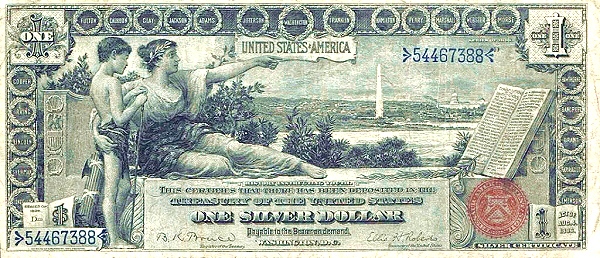
The 1896 Silver Certificates are collectively known as the Educational Series, a nickname earned by the allegorical obverse designs that treat each denomination as a lesson in civic virtue. The $1 note presents History instructing Youth; the $2 depicts Science presenting Steam and Electricity to Commerce and Manufacture. The $5 takes a different and more martial tone, reserving its most striking imagery for the reverse rather than the obverse. While the obverse of the $5 carries a large central portrait of Ulysses Grant flanked by decorative lathe work, it is the reverse that stops collectors cold.
Designed by engraver Charles Schlecht and drawn in part from compositions overseen by the Bureau’s own artistic staff, the reverse presents Grant on the left and Sheridan on the right, each rendered in exquisite intaglio engraving against an intricate geometric background. The two portraits are not simply set side by side. They are framed within an architectural and symbolic composition that consciously references the neoclassical vocabulary of public commemoration, the same visual language used for Civil War monuments being erected across the country during this same decade.
When examining the reverse under magnification, look closely at the fine cross-hatching behind each portrait. Wear on these geometric backgrounds is one of the first signs of circulation and will heavily influence a note’s grade. A crisp, unworn background on both the Grant and Sheridan vignettes is a strong indicator of high-grade condition, often the difference between an EF-45 and an AU-55 designation from PCGS or PMG.
Why Grant and Sheridan?
The pairing of Ulysses S. Grant and Philip H. Sheridan was not arbitrary. By 1896, both men were dead: Grant had succumbed to throat cancer in July 1885, and Sheridan had died of heart failure in August 1888. Their deaths within three years of each other had triggered enormous national outpourings of grief, and by the mid-1890s, both occupied a firmly heroic position in American public memory. Grant was the general who had forced Lee’s surrender at Appomattox and later served two terms as president. Sheridan was the aggressive cavalry commander whose Shenandoah Valley Campaign of 1864 became one of the most celebrated and debated military operations of the war.
Placing them together on a $5 note was a deliberate act of national mythology-making. The Treasury Department and the Bureau of Engraving and Printing were not neutral actors in this process. By the 1890s, the Republican Party had long used the memory of the Civil War, a strategy historians would later call “waving the bloody shirt,” as a political tool. Honoring Grant and Sheridan on currency was consistent with that impulse, though the artistic execution elevated the sentiment far beyond partisan propaganda.
It is also worth noting that Sheridan’s inclusion was relatively unusual for currency portraiture. Most Civil War generals who appeared on notes were either presidents (Lincoln, Grant) or figures with explicit financial or governmental connections. Sheridan was a pure military hero, chosen specifically for the symbolic weight his name and face carried. His portrait on this note remains one of only a handful of times he appeared on circulating U.S. paper money.
Do not confuse the 1896 $5 Silver Certificate with the later 1899 $5 Silver Certificate, which carries a different design entirely, featuring the “Running Antelope” portrait of the Onepapa Sioux chief Tatanka Ptecila. The two series are catalogued under entirely different Friedberg numbers and carry very different values. The 1896 issue is consistently the more prized of the two among serious Educational Series collectors.
The Engraving: A Technical Marvel
The intaglio engraving on the reverse of the 1896 $5 is regarded by currency scholars as among the finest produced by the Bureau of Engraving and Printing in the 19th century. The portraits of Grant and Sheridan were engraved from approved photographic sources, a relatively new technique that the Bureau had been refining since the 1870s. The engravers responsible for translating these photographs into steel-plate engravings worked at a level of detail that remains impressive even under modern 10x magnification.
Charles Schlecht, the engraver most closely associated with the reverse portraits, was a German-trained craftsman who joined the Bureau in the 1870s and became one of its most accomplished portrait engravers. His rendering of Grant in particular captures the general’s characteristically firm, almost stoic expression without the hagiographic softening common to lesser commemorative portraits of the period. Sheridan, shown with his distinctive short, rounded head and cavalry mustache, is rendered with equal precision.
The background engraving, composed of engine-turned geometric patterns called lathe work, required an entirely different set of skills and was executed by the Bureau’s geometric lathe operators rather than by Schlecht himself. The combination of portrait engraving and lathe work on a single plate required extraordinary registration precision. When this registration is slightly off, a condition visible in some heavily circulated examples, the portraits appear to float slightly against their backgrounds, a subtle defect that trained graders note immediately.
Signature Combinations and Series Varieties
The 1896 $5 Silver Certificate was issued with four different signature combinations, reflecting the Treasury officials in office during the note’s production run. These combinations are catalogued in the standard Friedberg reference as Fr. 268 through Fr. 271.
The Fr. 268 pairing of Register Tillman and Treasurer Morgan is the most commonly encountered variety and represents the bulk of the original print run. The Fr. 269 (Tillman-Roberts) and Fr. 270 (Bruce-Roberts) combinations are considerably scarcer. The Fr. 271 (Lyons-Roberts) is the rarest of the four, appearing in relatively few collections and commanding substantial premiums even in lower circulated grades. It is worth emphasizing that all four varieties share the identical reverse design, so condition and signature combination together drive most of the valuation differences collectors encounter in practice.
Authentication is critical when purchasing any Educational Series $5 note. High-quality photographic reproductions and period forgeries both exist. Always insist on a note graded and encapsulated by PMG or PCGS Currency. For raw notes, use a loupe to examine the fine portrait lines around Grant’s collar and coat lapels: genuine intaglio printing raises ink slightly off the paper surface, producing a texture that photographic reproductions cannot replicate.
Paper and Printing Specifics
Like all Silver Certificates of the era, the 1896 $5 was printed on distinctive currency paper incorporating red and blue silk fibers embedded in the sheet during manufacture. These fibers, visible to the naked eye in unfolded examples, serve both as a security feature and as a grading aid: a note whose fibers remain bright and clearly visible without heavy toning has almost certainly been stored in reasonable conditions and is more likely to grade in the fine-to-very-fine range or better.
The notes were printed in sheets of four subjects using wet printing techniques standard to the Bureau at the time. The distinctive reddish-orange Treasury seal on the obverse, applied as a separate overprint after the main face and back impressions, is one of the most immediately recognizable visual features of the series. A bold, well-centered red seal on the obverse, combined with a sharp and unsmudged reverse impression, is the hallmark of a premium quality example.
Market Values and Collector Demand
Educational Series notes occupy a permanent position near the top of 19th-century U.S. paper money want lists, and the $5 denomination is no exception. In circulated grades from Very Good through Very Fine, examples of the Fr. 268 variety trade regularly at auction, with prices typically ranging from several hundred dollars for heavily circulated Fine examples to several thousand dollars for Choice Very Fine specimens with original paper quality.
Uncirculated examples are a different matter entirely. A PCGS or PMG-graded 64 or 65 example of the Fr. 268 can realize five figures at major auction houses, and the scarcer signature combinations in similar grades have brought substantially more. A PMG Gem Uncirculated 65 EPQ (Exceptional Paper Quality) designation on any variety of the 1896 $5 represents a collecting achievement that few numismatists accomplish, partly because finding a note with both superb centering and original paper surfaces is genuinely difficult.
| Friedberg Number | Signature Combination | Estimated Survivors | Rarity |
|---|---|---|---|
| Fr. 268 | Tillman-Morgan | Several thousand | Common |
| Fr. 268 (Unc.) | Tillman-Morgan, CU or better | Fewer than 200 graded | Scarce |
| Fr. 269 | Tillman-Roberts | Several hundred | Scarce |
| Fr. 270 | Bruce-Roberts | Several hundred | Scarce |
| Fr. 271 | Lyons-Roberts | Under 100 known | Rare |
| Fr. 271 (Unc.) | Lyons-Roberts, CU or better | Fewer than 10 known | Key Date |
| Fr. 268 EPQ | Tillman-Morgan, PMG 65 EPQ | Extremely few | Rare |
| Any Var. (Star) | Replacement Notes | None confirmed | Key Date |
A Legacy in Steel and Ink
The 1896 Educational Series was retired relatively quickly, replaced by the more conventional portrait designs of the 1899 Silver Certificate series. Treasury officials had received complaints from the public that the allegorical and historical imagery was confusing, and there were practical concerns about the difficulty of distinguishing denominations at a glance. By 1899, all three Educational Series denominations were being phased out, and within a few years the notes had largely left circulation.
That brevity of issue is part of what makes the series so compelling to collectors today. The $5 Educational note existed in active circulation for only a handful of years, yet during that time it passed through thousands of hands carrying one of the most sophisticated artistic programs ever attempted on American currency. Every worn example tells a story of daily commerce in the McKinley era; every uncirculated specimen represents the extraordinary luck of a note that was set aside before the world could diminish it.
For collectors who want to own a piece of American numismatic art at the intersection of Civil War memory, Gilded Age aesthetics, and master engraving craft, the reverse of the 1896 $5 Silver Certificate offers all of that in a single, holdable object. Grant and Sheridan stare back from the note with the quiet authority of men who believed they had saved something worth saving. Nearly 130 years later, the engravers who captured them seem to have felt exactly the same way.