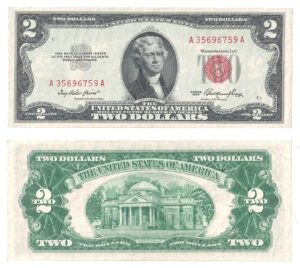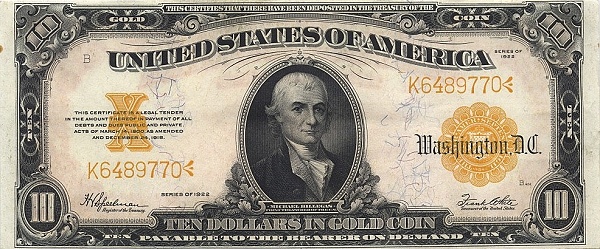
📷 Image source: banknote.ws (World Banknote Gallery). Images are selected by AI to represent the article topic and may not depict the exact note(s) described.
There is something quietly profound about holding a Series 1922 $1 Gold Certificate. It is a note that does not announce its importance with a towering denomination or a dramatic historical vignette. Instead, it carries its weight in context: this modest one-dollar bill was among the last large-size gold certificates the United States government ever produced, printed at the tail end of an era when American paper currency was literally backed by, and redeemable for, gold coin. Within a decade of its issue, the gold standard for domestic circulation would be gone, and notes like this would become relics of a financial philosophy that shaped the republic for generations.
A Brief History of Gold Certificates in America
Gold certificates were first authorized by Congress in 1863, initially circulating only between banks and not in everyday commerce. It was not until the Act of March 14, 1900, which put the United States firmly on a monometallic gold standard, that gold certificates were made fully legal tender and opened to general public circulation. From that point forward, the notes served as a convenient paper substitute for gold coin, each note representing a specific quantity of gold held on deposit at the United States Treasury.
Large-size gold certificates were issued across several series for denominations ranging from $1 up to $10,000. The $1 denomination in the large-size format was produced under Series 1907 and then again under Series 1922, making the 1922 issue the final iteration of the one-dollar large-size gold certificate. When the government transitioned to small-size currency beginning with the Series 1928 notes, gold certificates were included in the new format briefly, but the domestic redemption of gold certificates was effectively ended by Executive Order 6102 in April 1933 under President Franklin D. Roosevelt, which prohibited private gold hoarding and required citizens to turn in gold coins and gold certificates to Federal Reserve Banks.
Design and Physical Characteristics
The Series 1922 $1 Gold Certificate is a large-size note, measuring approximately 7.375 inches by 3.125 inches, noticeably larger than the modern currency we handle today. The face of the note features a central portrait of George Washington, the same founding father who graces the modern dollar, but rendered here in a more formal engraved style consistent with the era’s printing standards. The most immediately recognizable feature is the distinctive gold or yellow-orange Treasury seal printed on the right side of the face, which identifies the note as a gold certificate. This warm amber seal stands in sharp contrast to the red seals of Legal Tender Notes and the blue seals of Silver Certificates from the same period.
The back of the note is printed in a rich golden-yellow ink, a deliberate design choice that reinforced the note’s connection to gold. This back color, often called “goldenrod” by collectors, is one of the most visually appealing elements of the series and contributes to the note’s collectible appeal. The obligation printed on the face reads: “This certifies that there have been deposited in the Treasury of the United States of America One Dollar in Gold Coin payable to the bearer on demand.” That promise, so plainly stated, is part of what makes these notes historically resonant.
When examining the seal on a Series 1922 $1 Gold Certificate, look for consistent ink saturation across the entire seal. Faded or washed-out seals, often caused by improper storage or exposure to moisture, significantly reduce eye appeal and can push an otherwise Fine note into a lower grade category. Strong, vibrant seal color is one of the first things experienced collectors check.
The Speelman / White Signature Combination
All Series 1922 $1 Gold Certificates carry the signatures of Register of the Treasury Houston B. Speelman and Treasurer of the United States Frank White. Speelman served as Register from 1921 to 1928, and White served as Treasurer from 1921 to 1928 as well, both appointed under President Warren G. Harding. This is the only signature combination found on the 1922 series, and there are no known major signature varieties or mule combinations for this issue, which simplifies variety collecting somewhat compared to Federal Reserve Notes of the same era.
It is worth noting that the Series 1907 $1 Gold Certificate, the immediate predecessor, was issued with the Speelman / White combination as well as earlier pairings including Vernon / Treat, Vernon / McClung, Napier / McClung, Napier / Thompson, and Parker / Burke. Collectors building a complete signature variety set of the $1 gold certificate type will find the 1907 issue far more challenging in that regard, while the 1922 offers a single, attainable target.
Print Runs, Survival Rates, and Condition Rarity
The Bureau of Engraving and Printing produced a substantial number of Series 1922 $1 Gold Certificates. Estimates based on BEP records suggest that approximately 65 to 70 million notes were printed across multiple delivery groups, which is a large number by historical standards for a gold certificate denomination. On the surface, this might suggest the notes are common, and in circulated grades such as Very Good through Extremely Fine, they are indeed among the more accessible large-size type notes. A circulated example in Fine-12 can often be acquired for $80 to $150 in today’s market, making entry into the series straightforward for new collectors.
But the story changes dramatically when the condition conversation turns to Uncirculated and gem grades. Here is where the Series 1922 $1 Gold Certificate earns its reputation as a condition rarity of the highest order. Because these notes circulated widely as everyday currency, the survival rate of pristine examples is startlingly low relative to the original print run. The goldenrod ink on the back, while beautiful, is notoriously fragile. It abrades easily, shows handling marks quickly, and is prone to developing what graders describe as “ink flaking” along fold lines. A single fold through the center of the note can damage the back printing sufficiently to prevent a Crisp Uncirculated grade even if the paper itself retains its original stiffness.
The goldenrod back printing on Series 1922 $1 Gold Certificates is highly susceptible to abrasion. When evaluating a potential purchase, examine the back under magnification or a good loupe. Even faint handling rubs on the gold ink, visible as lighter streaks or dulling of the surface sheen, can mean the difference between an EPQ (Exceptional Paper Quality) designation and a standard grade holder, and hundreds of dollars in value.
Population data from the major grading services, PMG and PCGS Currency, bear out this condition scarcity. Notes graded PMG 64 or higher in Choice Uncirculated and above are genuinely rare, and those achieving Gem Uncirculated 65 EPQ or better represent some of the finest known examples of any large-size type note. Auction records for high-grade 1922 $1 Gold Certificates show significant price premiums: a PMG 66 EPQ example sold at Heritage Auctions for over $2,400 in 2019, a remarkable figure for a one-dollar note that in circulated condition trades for under $200. The spread between circulated and gem examples is one of the widest of any common large-size type, making grade the single most important variable in pricing this issue.
Star Notes and Their Scarcity
Star notes, or replacement notes, for the Series 1922 $1 Gold Certificate are among the most elusive varieties in all of large-size currency collecting. The BEP used star-suffix serial numbers (indicated by an eight-pointed star replacing the letter that would normally follow the serial number) to replace defective notes in a printing run. For the 1922 $1 Gold Certificate, star notes are confirmed but genuinely rare in any grade. Estimates suggest fewer than a few hundred examples are known to survive, and high-grade stars are genuine trophy notes. A collector finding a circulated star note in Fine condition at an estate sale has made a significant find; a gem star is essentially a once-in-a-generation offering at major auction.
To identify a star note on a Series 1922 $1 Gold Certificate, look for an eight-pointed decorative star at the end of the serial number rather than the alphabetical suffix letter found on regular issues. The serial numbers on star notes run separately from the regular series. If you encounter one in a dealer’s stock or at a show, verify authenticity with a third-party grading service before paying a premium, as altered serial numbers do occasionally appear in the marketplace.
The Historical Endpoint: Why 1922 Was the Last
The Series 1922 $1 Gold Certificate was printed and issued during the early 1920s but remained in active use throughout the decade. The transition to small-size currency, implemented starting in 1929, rendered all large-size notes obsolete for production purposes, though they remained legal tender. Gold certificates in small-size format were produced briefly under Series 1928, but these too were pulled from circulation by FDR’s gold recall order in 1933. The combination of the 1929 format change and the 1933 recall meant that most circulating examples of the Series 1922 $1 were either worn out, destroyed, or turned in to the Treasury over a relatively short window.
Importantly, gold certificates remained illegal to privately own in the United States from 1933 until December 31, 1964, when the Treasury Department finally lifted the prohibition. This three-decade period of illegality meant that many notes that survived the recall were hidden away, spent quietly before the law could be enforced, or genuinely destroyed by patriotic or fearful citizens. It also means that the surviving population is almost entirely composed of notes that were somehow kept outside the banking system during that era, a factor that contributes to the disproportionately low survival rate in high grades.
| Series / Variety | Signature Combination | Est. Print Run | Rarity |
|---|---|---|---|
| 1922 Regular Issue (circulated) | Speelman / White | ~65-70 million | Common |
| 1922 Uncirculated (CU 63-64) | Speelman / White | Survivor est. <5,000 | Scarce |
| 1922 Gem Uncirculated (65 EPQ+) | Speelman / White | Survivor est. <300 | Rare |
| 1922 Star Note (any grade) | Speelman / White | Survivor est. <400 | Rare |
| 1922 Star Note (CU 63+) | Speelman / White | Survivor est. <50 | Key Date |
| 1907 $1 Gold Cert. (Napier / McClung) | Napier / McClung | Fewer than 1922 | Scarce |
| 1907 $1 Gold Cert. (Parker / Burke) | Parker / Burke | Lower delivery totals | Rare |
| 1907 $1 Gold Cert. Star Note | Various | Extremely few known | Key Date |
Buying, Grading, and Building a Collection
For collectors entering the large-size gold certificate series, the 1922 $1 is the logical starting point. Its relative availability in circulated grades and its modest price floor make it accessible, while the pursuit of higher-grade examples provides a long-term challenge that can occupy even veteran collectors for years. A well-rounded approach might begin with acquiring a solid Very Fine or Extremely Fine example for type purposes, then gradually seeking upgrades as budget and opportunity allow.
Third-party grading is strongly recommended for this issue, particularly for any note claimed to be in Uncirculated or near-Uncirculated condition. Both PMG and PCGS Currency grade and encapsulate large-size gold certificates, and their holder populations give collectors a useful benchmark for rarity assessment at each grade level. The EPQ (Exceptional Paper Quality) or PPQ (Premium Paper Quality) designations from these services are especially meaningful for the 1922 $1, given how often otherwise high-graded notes suffer from paper issues or ink problems that affect their desirability and value.
When buying raw (ungraded) Series 1922 $1 Gold Certificates, pay particular attention to the paper margins. Trimmed notes, where the borders have been cut down to improve the apparent sharpness of corners, are a known problem in large-size currency. Genuine uncirculated examples should have even borders on all four sides measuring roughly 3 to 4 millimeters from the printed design to the edge of the note. Unusually narrow margins on one or more sides warrant close scrutiny before purchase.
Conclusion: A One-Dollar Note Worth Far More Than a Dollar
The Series 1922 $1 Gold Certificate occupies a unique position in American numismatic history. It is common enough to be attainable, yet rare enough in gem condition to present a genuine long-term collecting challenge. It represents the final expression of a monetary promise that the United States made to its citizens for over half a century: that this paper note, however humble its denomination, was as good as gold. When you hold one, you are holding the end of an era, the last large-size dollar the Treasury ever issued with that golden seal and that golden back, the last one that said, plainly and officially, that the bearer could walk into the Treasury and walk out with a gold coin in hand. That story, compressed into a 7-by-3-inch piece of engraved paper, is worth far more than a dollar to anyone who appreciates what American currency once was.