📷 Image source: Wikimedia Commons. Images are selected by AI to represent the article topic and may not depict the exact note(s) described.
In the summer of 1861, the United States Treasury faced a crisis that threatened to end the Civil War before it truly began. The federal government needed hundreds of millions of dollars to fund an army, and the traditional method of selling large bond lots to wealthy Eastern banking syndicates was failing badly. Enter Jay Cooke, a 40-year-old Philadelphia banker who would fundamentally reinvent American finance, and in doing so, shape the very notes that currency collectors prize today. His story is inseparable from the physical paper money of the Civil War era, because Cooke’s success directly influenced the volume, design urgency, and distribution of the Treasury instruments that flowed out of Washington between 1861 and 1865.
The Financial Crisis of 1861 and the Demand Note Stopgap
When Fort Sumter fell in April 1861, Treasury Secretary Salmon P. Chase confronted a staggering arithmetic problem. The federal government had authorized virtually no wartime financing mechanism. The existing national debt stood at around $90 million, and the annual budget deficit was already severe before a single battle had been fought. Chase turned first to a familiar instrument: short-term treasury notes payable on demand in coin.
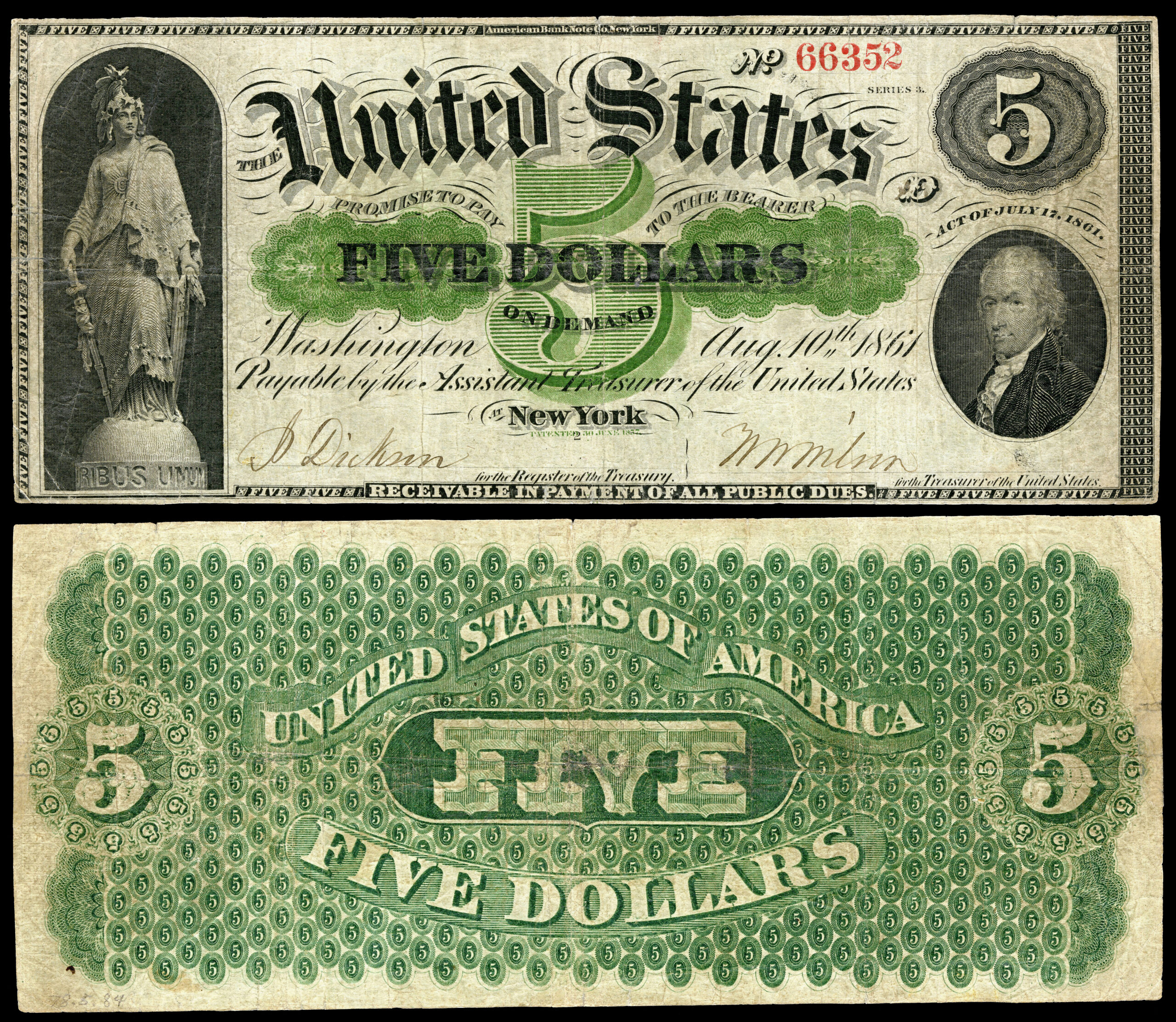
The Act of July 17, 1861 authorized the issuance of $50 million in Demand Notes, the first federal paper currency since the Treasury Notes of the Mexican War era. These notes, printed by the American Bank Note Company and the National Bank Note Company working in tandem, carried no interest and were receivable for all government dues. Collectors today recognize them by their distinctive green ink on the reverse, which gave rise to the popular nickname “greenbacks.” The Demand Notes were issued in denominations of $5 (Friedberg catalog number Fr. 1), $10 (Fr. 6), and $20 (Fr. 11), with the $5 carrying a portrait of Alexander Hamilton on the face and a vignette of the Capitol building still under construction on the reverse.
However, Demand Notes were a stopgap measure, not a solution. By December 1861, New York banks suspended specie payments, and Chase knew that borrowing at scale required a more sophisticated approach. This is where Jay Cooke enters the story in a decisive way.
Demand Notes (1861) are among the most valuable Civil War-era currency for collectors. All three denominations are scarce, but the $5 and $10 with “For the” handwritten before “Register of the Treasury” in the payable clause are particularly sought after. In VF-20 condition, a $5 Demand Note (Fr. 1) can bring $3,500 or more at auction. Always check for the distinctive fully green back and the absence of any “Legal Tender” inscription, which distinguishes them from the later Legal Tender Issues.
Jay Cooke’s Appointment and the Birth of Mass Marketing
Cooke had established Jay Cooke and Company in Philadelphia in 1861 after a successful early career at the banking house of E.W. Clark and Company. He had powerful political connections, including a close friendship with Ohio Governor William Dennison and eventually a working relationship with Treasury Secretary Chase himself. In the summer of 1861, Cooke used his own newspaper contacts to write a series of anonymous but persuasive articles in the Philadelphia Inquirer arguing that ordinary citizens, not just bankers, should buy government bonds. It was a radical idea for the time.
Chase, desperate, gave Cooke an informal test run in the fall of 1861, asking him to help sell a $3 million Pennsylvania state loan. Cooke sold it in days, using a network of sub-agents and newspaper advertising that Chase had never seen applied to bond selling. On October 1, 1862, Chase formalized the relationship, appointing Cooke as the sole subscription agent for the new 5-20 bonds, so called because they matured in not less than five years and not more than twenty years, bearing 6 percent interest paid in gold.
What Cooke did next had no precedent in American financial history. He built a network of 2,500 sub-agents across the Northern states, including bankers, insurance agents, postmasters, and even ministers. He blanketed 5,000 newspapers with paid advertisements that spoke not to Wall Street speculators but to farmers, mechanics, shopkeepers, and clerks. The advertisements promised security, patriotism, and profit in equal measure. “The man who lends money to his government,” one Cooke advertisement read, “lends it in the most secure form possible.”
The Intersection with Legal Tender Notes
The Legal Tender Act of February 25, 1862 fundamentally changed the currency landscape that Cooke was operating within. The Act authorized $150 million in United States Notes, the true “greenbacks” of collector lore, which were declared legal tender for all debts public and private except customs duties and interest on the public debt. A second Legal Tender Act on July 11, 1862 authorized another $150 million, and a third act on March 3, 1863 added $150 million more, bringing the authorized total to $450 million.
These notes, printed by the Treasury’s own Bureau of Engraving and Printing (then called the Currency Bureau), carried red Treasury seals on the Series of 1862 and 1863 issues. The signatures of Register Lucius Chittenden and Treasurer Francis Spinner appear on early Series 1862 notes, while later 1862 series notes carry the signatures of Register S.B. Colby. The $1 Legal Tender (Fr. 16-17), the $2 (Fr. 41-42), and the $5 “woodchopper” note (Fr. 61-67) are among the most frequently encountered by new collectors entering the Civil War currency market.
Cooke’s bond-selling machine created an enormous appetite for these notes. Because the 5-20 bonds paid interest in gold but were purchasable with greenbacks, ordinary citizens needed greenbacks to buy bonds. Cooke’s agents, scattered across the country, actively circulated Legal Tender Notes as the medium of exchange for bond subscriptions. In a very real sense, Cooke’s network democratized paper money just as it democratized bond ownership.
When examining Series 1862 and 1863 Legal Tender Notes, pay close attention to the Treasury seal color and the signature combination. The Series 1862 $1 note with Chittenden-Spinner signatures (Fr. 16) is cataloged separately from the Colby-Spinner version (Fr. 17). Both can appear similar to the untrained eye, but the Chittenden-Spinner pairing commands a significant premium in higher grades. Use a loupe to read the printed signatures carefully before attributing any 1862-series note.
The 7-30 Notes: Cooke’s Most Personal Instrument
If the 5-20 bonds were Cooke’s early triumph, the Treasury Notes bearing 7.30 percent annual interest became his signature achievement and his most direct contribution to what currency collectors now call “paper money history.” The 7-30 Treasury Notes, authorized by the Act of June 30, 1864, were issued in three series totaling $830 million in face value. They bore interest at the rate of two cents per day per $100, which conveniently worked out to 7.30 percent per year, a figure Cooke’s advertising made famous as “seven-thirty.”
These instruments were sold in denominations of $50, $100, $500, $1,000, and $5,000, though the $50 denomination was specifically intended for small investors and working people. The notes were convertible into 5-20 gold bonds and bore coupons for semi-annual interest payments. The physical notes themselves, engraved by the National Bank Note Company, featured a portrait of Secretary of the Treasury Chase on the $50 and $100 denominations, a politically motivated choice that Chase himself encouraged.
Cooke sold the first series of $400 million in 7-30 notes largely through 1864. He then undertook an even more ambitious campaign for the second and third series in 1865, selling at the astonishing peak rate of $2 million per day during the final weeks of the war. His total sales for all three series exceeded $830 million, a figure that had been considered impossible by virtually every banker in America just four years earlier.
The Newspaper Network and the Democratization of Financial Literacy
One of Cooke’s most lasting contributions was not a financial instrument but a communications strategy. He spent approximately $1.3 million on newspaper advertising over the course of the war, an almost incomprehensible sum for the era. His advertisements appeared in daily and weekly papers from Maine to Wisconsin, many of them written by Cooke’s own staff in language deliberately stripped of financial jargon.
These advertisements did something unprecedented: they explained compound interest, bond maturity, and currency convertibility to people who had never owned a financial instrument in their lives. Cooke hired former journalists as publicists, sent agents to factories to speak directly with workers on payday, and arranged for payroll deductions at some large Northern employers so that workers could buy bonds in $50 increments. By the end of the war, an estimated one million individual Americans had purchased some form of Union war bond or Treasury note, up from the handful of large institutions that had dominated federal borrowing before 1861.
The 7-30 Treasury Notes of 1864-1865 are scarce in any grade and extremely rare in condition above VF. Most survivors were redeemed or converted to 5-20 bonds, which is precisely why the few that escaped have such strong collector demand. The $50 denomination with the Chase portrait is the most commonly encountered in auction but still commands $800-$2,500 depending on condition. Look for examples that retain their interest coupons, as intact coupon sheets add significant numismatic premium.
Compound Interest Notes and the Spectrum of Civil War Paper
Cooke’s network also helped distribute Compound Interest Treasury Notes, authorized by the Act of June 30, 1864 alongside the 7-30s. These notes, issued in denominations from $10 to $1,000, bore interest at 6 percent compounded semi-annually and were printed with interest tables directly on the back so that any holder could calculate their accumulating value. The $10 Compound Interest Note (Fr. 190c) and the $20 (Fr. 191) are the denominations most accessible to today’s collectors, though even circulated examples are priced well above face value.
The combination of Legal Tender Notes, Interest-Bearing Treasury Notes, Compound Interest Notes, and the bond instruments Cooke was selling created a complex financial ecosystem that Cooke’s agents had to explain to buyers with no financial background. This necessity for simplification had long-term consequences for American financial culture, establishing an expectation that government financial instruments could and should be accessible to ordinary citizens.
The Legacy in Collector Terms
Jay Cooke’s financial collapse in September 1873, triggered by the failure of his Northern Pacific Railroad financing, triggered the Panic of 1873 and ended his career as the dominant figure in American finance. But the infrastructure he built, the network of small investors, the newspaper advertising model, the payroll deduction concept, were all revived and expanded during World War I Liberty Bond drives and World War II War Bond campaigns. The lineage runs directly from Cooke’s 1863 newspaper advertisements to the Series E Savings Bonds that millions of Americans owned in the 1950s.
For currency collectors, the Civil War era notes that passed through Cooke’s vast distribution network represent some of the most historically significant paper money ever printed in the United States. Each Demand Note, each Legal Tender Note with its red Treasury seal, each 7-30 or Compound Interest Note carries within it the story of a nation that financed its survival not through the exclusive dealing rooms of Wall Street but through the savings of farmers, factory workers, and shopkeepers who responded to Jay Cooke’s patriotic call.
| Issue / Friedberg Number | Denomination and Type | Est. Known Population | Rarity |
|---|---|---|---|
| Fr. 1 (1861) | $5 Demand Note, “For the” variety | Fewer than 150 graded | Key Date |
| Fr. 6 (1861) | $10 Demand Note | Approx. 200 graded | Rare |
| Fr. 11 (1861) | $20 Demand Note | Approx. 125 graded | Key Date |
| Fr. 16 (1862) | $1 Legal Tender, Chittenden-Spinner | Several thousand graded | Scarce |
| Fr. 61 (1862) | $5 Legal Tender “Woodchopper” | Moderate survivors | Common |
| Fr. 190c (1864) | $10 Compound Interest Note | Under 400 graded | Rare |
| Fr. 191 (1864) | $20 Compound Interest Note | Under 300 graded | Rare |
| 7-30 Note, $50 (1864) | Chase Portrait, First Series | Under 500 known | Scarce |
| 7-30 Note, $100 (1865) | Third Series, intact coupons | Under 100 with coupons | Key Date |
| Fr. 212 (1863) | $100 Legal Tender, Colby-Spinner | Fewer than 200 graded | Rare |
Practical Advice for Building a Civil War Treasury Note Collection
Collectors approaching this era for the first time should begin with the Series 1862 and 1863 Legal Tender Notes in the lower denominations. The $1 and $2 Legal Tender issues are the most affordable entry points, with circulated examples of Fr. 16 available in the $300-$600 range from established dealers. Grading is critical with all Civil War paper: the Bureau of Engraving and Printing was still refining its printing techniques, and issues like ink smears, plate cracks, and slightly miscut margins are considered normal and do not significantly penalize a note’s grade unless severe.
For collectors with larger budgets, the Demand Notes represent the ultimate Civil War currency challenge. All Demand Notes were officially called in and replaced by Legal Tender Notes after the Legal Tender Act, which means that most were redeemed and destroyed. The survivors exist primarily because some were kept as souvenirs or lost in desk drawers and attics. PCGS Currency and PMG both have strong populations of these notes in their registries, and consulting those online resources before any significant purchase is strongly recommended.
The story of Jay Cooke reminds collectors that the paper they hold is never just paper. Every Civil War Treasury note is a surviving artifact of a mass mobilization effort unlike anything the American financial system had ever attempted. Cooke made it possible for a farmer in Ohio or a seamstress in Massachusetts to hold a piece of the Union’s future in their hands. When you hold one of these notes today, you hold that same promise, now fulfilled by history itself.