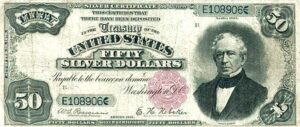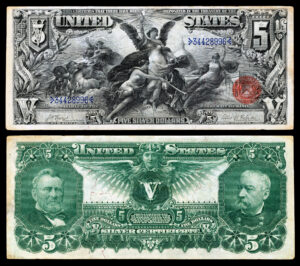
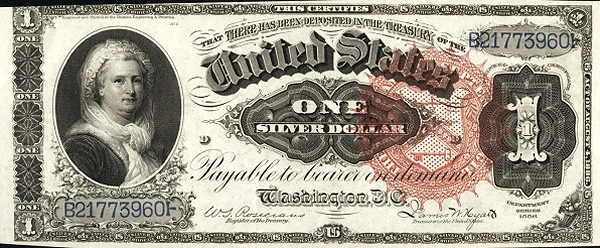
📷 Image source: banknote.ws (World Banknote Gallery). Images are selected by AI to represent the article topic and may not depict the exact note(s) described.
A Note That Stopped Collectors in Their Tracks
Walk into any major currency auction and place a graded example of the Series 1886 $10 Silver Certificate on the table. Watch the room shift. Few large-size notes command that kind of immediate visual authority: a commanding portrait of Robert Morris on the face, and on the reverse, a design so architecturally bold that generations of collectors have simply called it the “Tombstone” back. But calling it a tombstone does a disservice to what is, in fact, one of the most refined pieces of engraving the Bureau of Engraving and Printing ever committed to paper.
The 1886 $10 Silver Certificate occupies a singular position in the large-size series. It bridges the ornate Victorian sensibility of the 1870s and 1880s with a transitional energy that would eventually give way to the Educational Series of 1896. Understanding it means understanding the full arc of American currency design, and for collectors, it means grappling with a note whose rarity, condition sensitivity, and variety complexity reward serious study.
Robert Morris and the Choice of Portrait
The decision to place Robert Morris on the face of the 1886 $10 Silver Certificate was both historically appropriate and symbolically loaded. Morris, the Philadelphia merchant and Founding Father who essentially financed the Continental Army out of his own credit during the Revolutionary War, was a fitting face for a note backed by silver. He had, after all, served as Superintendent of Finance for the fledgling United States from 1781 to 1784, and had championed the establishment of the Bank of North America, the country’s first chartered bank.
The engraved portrait used on the 1886 issue was based on a well-known oil painting. The BEP’s master engravers rendered Morris in the three-quarter format typical of the era, with fine crosshatching that catches light differently depending on viewing angle. The surrounding lathe work and geometric counter patterns were designed partly as anti-counterfeiting measures and partly as pure Victorian aesthetic expression. In Fine to Very Fine grades, the detail in Morris’s collar and coat lapel remains crisp and satisfying.
When evaluating the face of an 1886 $10, focus on the fine scroll work flanking the portrait oval and the delicate crosshatching in the upper corners. These are the first areas to show wear, and a note that retains strong detail here is grading significantly better than one that looks superficially “clean” but has softened engraving lines.
The Tombstone Reverse: Architecture as Currency Design
The reverse of the Series 1886 $10 Silver Certificate is the note’s defining feature, and the nickname “Tombstone” has stuck precisely because it captures something true about the design. The dominant element is a large, arch-topped oval containing the denomination numeral “TEN DOLLARS” in layered Gothic lettering, framed by a heavy border structure that does evoke the silhouette of a Victorian funerary monument. Yet this description understates the sophistication of the execution.
The BEP engravers used geometric lathe work to create an almost hypnotic radiating pattern around the central oval. The lettering itself is rendered in multiple tones achieved through varying ink density, a technique that required extraordinary press registration. The overall composition is formally symmetrical in a way that most currency reverses are not, which gives the 1886 $10 a meditative, almost architectural quality when viewed in high grade.
Some numismatic historians have noted a conceptual connection between the Tombstone back and the earlier work of Tiffany and Company on high-denomination bond certificates and stock engravings of the 1860s and 1870s. While the BEP designed the note internally, the aesthetic vocabulary of heavy Gothic lettering set within ornate geometric frames was thoroughly absorbed from the commercial security printing world that Tiffany’s engravers had dominated. This is why some specialist collectors use the informal shorthand “Tiffany back” when discussing the 1886 $10 reverse, acknowledging that cultural debt.
The reverse of the 1886 $10 is especially vulnerable to counting folds that run diagonally through the central oval. Even a single strong diagonal fold through the “TEN DOLLARS” inscription will drop a note from Extremely Fine territory into the VF range in most graders’ assessments. Always examine reverses under good raking light before purchase.
The Three Friedberg Varieties: Signatures That Define Rarity
The Series 1886 $10 Silver Certificate was issued in three distinct signature combinations, each assigned its own Friedberg number in the standard reference. These are not minor variations: the signature pairings directly reflect different Treasurer and Register of the Treasury appointments, and the print runs associated with each combination differ substantially, creating a clear rarity hierarchy that collectors must understand before building a set.
Fr. 289: Rosecrans and Jordan
The first variety, Fr. 289, bears the signatures of Treasurer William S. Rosecrans and Register of the Treasury William S. Jordan. Rosecrans served as Treasurer from 1885 to 1891, and Jordan as Register from 1885 to 1887. This places the Fr. 289 printing firmly in the initial release window for the series. It is the most commonly encountered of the three varieties, though “commonly encountered” is very much a relative term for any 1886 $10. In circulated grades from Fine through Very Fine, examples trade in the $1,200 to $2,500 range depending on eye appeal and paper quality. Certified examples in Extremely Fine 40 to 45 have brought $4,000 to $6,500 at major auction houses including Heritage and Stack’s Bowers.
Fr. 290: Rosecrans and Huston
The second variety, Fr. 290, pairs Rosecrans with a different Register: James E. Huston, who served from 1889 to 1891. This combination represents a shorter printing window and carries meaningfully lower surviving populations than the Jordan pairing. Fr. 290 is considered scarce across all grades and genuinely rare in Uncirculated. The PCGS Currency and PMG population reports show fewer than thirty examples certified in all grades combined as of recent data, making it a note that requires patience to acquire. Auction realizations for Fine examples hover around $3,000 to $5,000, while VF specimens have exceeded $8,000 when strong eye appeal is present.
Fr. 291: Rosecrans and Nebeker
The third and rarest variety is Fr. 291, pairing Rosecrans with Register James F. Nebeker, who held the post only briefly from 1891 to 1892. The extremely compressed printing window for this combination produced what many specialists consider the key note in the 1886 $10 set. Population data is stark: PMG has graded fewer than twenty examples across all grades, and the PCGS Currency census is similarly thin. A Very Fine 25 example sold at a Heritage Currency Signature Sale for over $14,000. Uncirculated examples, when they appear, are legitimately significant auction events. Collectors targeting a complete set of 1886 $10 Silver Certificates will spend the most time and money tracking down a presentable Fr. 291.
When assembling a type set that includes the 1886 $10, the Fr. 289 is the logical starting point for budget-conscious collectors. But if you are building a complete signature variety set, secure the Fr. 291 first when an opportunity arises, even if the grade is lower than ideal. These notes do not come to market frequently, and waiting for a “better” example can mean waiting years.
Paper Quality, Centering, and the Condition Sensitivity Problem
The 1886 $10 Silver Certificate was printed on large-size currency paper measuring 7.375 inches by 3.125 inches, consistent with all large-size notes of the period. The paper itself was a relatively high-rag-content stock, which means that well-preserved survivors often exhibit pleasingly crisp paper even in Very Fine grades. However, this note is particularly susceptible to two condition problems that collectors must watch for carefully.
First, centering: the BEP’s printing registration on the 1886 issues was not always consistent, and many examples show margins that are appreciably wider on one side than the other. PCGS Currency and PMG both factor centering into their holistic grade assessment, but a note with dramatic centering variance may carry a “margins” qualifier that affects value even at a given numeric grade. Well-centered examples of any signature combination command a premium of 15 to 25 percent over poorly centered notes at the same numeric grade.
Second, ink oxidation: the red Treasury seal used on all three 1886 $10 varieties can oxidize over time, especially when notes have been stored in acidic environments. A seal that has faded to orange-pink rather than retaining its original vibrant red is a significant detractor. Examine seal color carefully and compare against certified reference examples before committing to a purchase.
The Predecessor Context: Where the 1886 $10 Fits in the Design Lineage
To fully appreciate the 1886 $10, it helps to understand its place in the broader lineage of $10 Silver Certificates. The Series 1880 $10 Silver Certificate had used a different portrait arrangement and a less architecturally ambitious reverse. The 1886 series represented a deliberate design escalation, and the Tombstone back was a significant departure from the more conventional lathe-work reverses that had preceded it.
The notes that followed tell the rest of the story. The Series 1891 $10 Silver Certificate retained the Robert Morris portrait but replaced the Tombstone reverse with an entirely different design, sometimes called the “educational precursor” back for its lighter, more classical feel. Then came the Series 1908 $10 Silver Certificate with yet another redesign. Placing an 1886 $10 next to its successors makes the Tombstone’s boldness immediately apparent. It was, and remains, a design that made a statement.
| Friedberg No. | Signature Combination | Est. Surviving Population | Rarity |
|---|---|---|---|
| Fr. 289 | Rosecrans / Jordan | 150-200 known | Scarce |
| Fr. 289 (VF or better) | Rosecrans / Jordan | 60-80 known | Scarce |
| Fr. 289 (Unc. 60 or better) | Rosecrans / Jordan | Fewer than 15 known | Rare |
| Fr. 290 | Rosecrans / Huston | 25-35 known all grades | Rare |
| Fr. 290 (VF or better) | Rosecrans / Huston | Fewer than 12 known | Rare |
| Fr. 290 (Unc. 60 or better) | Rosecrans / Huston | 3-5 known | Key Date |
| Fr. 291 | Rosecrans / Nebeker | 15-20 known all grades | Key Date |
| Fr. 291 (VF or better) | Rosecrans / Nebeker | Fewer than 8 known | Key Date |
| Fr. 291 (Unc. 60 or better) | Rosecrans / Nebeker | 1-2 known | Key Date |
Grading Standards and What to Expect at Each Level
For collectors new to large-size Silver Certificates, it is worth spelling out what each major grade range looks like on the 1886 $10 specifically. In Good to Fine grades, expect a note that has seen genuine circulation. The Morris portrait will show flattened hair detail, the scroll work will be reduced to outlines, and the reverse will likely carry at least two or three fold intersections across the central oval. These are the most affordable entry points, typically $800 to $1,500 for Fr. 289, and they are legitimate representatives of the type for collectors on a budget.
Very Fine examples, grading VF 20 through VF 35, retain most of the design detail with only light to moderate circulation evidence. The signature area will be readable and sharp, the seal will show good color, and the paper will have some body left. These are the sweet-spot notes for many serious collectors: meaningful eye appeal without the premium of Extremely Fine and above.
Extremely Fine and About Uncirculated examples, grading EF 40 through AU 58, are genuinely impressive pieces. The engraving is essentially complete, the paper has minimal compromise, and the Tombstone reverse reads with full impact. At this level, collectors are paying for authenticity of preservation and visual drama in equal measure. Certified EF to AU examples of Fr. 289 regularly bring $5,000 to $10,000 at major auctions.
Always request the full certification insert image and, when possible, the raw pre-certification images before bidding on an 1886 $10 in any grade. Press and cleaning treatments can be difficult to detect in standard catalog photos but may be visible in high-resolution scans of the note’s surface texture. Both PCGS Currency and PMG will note “apparent” grades when these treatments are detected, which significantly affects resale value.
Building a Collection Around the 1886 $10
There are several coherent collection frameworks that include the 1886 $10 Silver Certificate. The most common is a type set of large-size $10 notes, where the 1886 is typically represented by a single Fr. 289 example. A more ambitious project is a complete signature variety set of all three Friedberg numbers, which is a genuinely challenging undertaking given the rarity of Fr. 290 and Fr. 291. Only a handful of collectors have completed this set in any grade.
Another approach, popular among thematic collectors, is assembling all large-size Silver Certificates featuring Robert Morris across multiple series and denominations. The portrait appears on the $10 denomination through the 1891 series, giving this sub-collection a manageable scope while spanning interesting design evolution.
Conclusion: A Note Worth the Study
The Series 1886 $10 Silver Certificate rewards the collector who takes the time to understand it fully. Its Tombstone reverse is not just a visual curiosity but a document of a specific moment in American design history when the Victorian impulse toward architectural grandeur found its way onto currency paper. Robert Morris’s portrait connects the note to the nation’s financial origins. The three signature varieties create a rarity structure that makes collecting the complete set a legitimate lifetime pursuit.
Whether you are acquiring your first large-size Silver Certificate or hunting the elusive Fr. 291 to complete a decades-long set, the 1886 $10 demands respect and offers genuine satisfaction. Few notes in the American large-size series combine historical significance, design ambition, and collector challenge in the same proportions. That combination is why serious collectors keep coming back to this issue, and why strong examples continue to set records whenever they come to market.