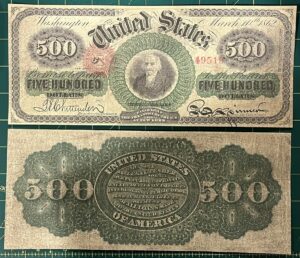
Picture a $10 Silver Certificate tucked inside a sourdough prospector’s boot, carried through the Klondike mud of 1902, passed across a trading post counter in Skagway, and eventually folded into the lining of a dog-sled bag for three winters running. The physical abuse that federal notes endured in pre-statehood Alaska was extraordinary, and today those survivors, along with the institutional story of how currency reached the territory at all, represent one of the most overlooked frontiers in American paper money collecting.
A Territory Without a Banking Infrastructure
When the United States purchased Alaska from Russia for $7.2 million in 1867, the federal government inherited a vast land with almost no financial infrastructure. The Russian-American Company had operated a barter-heavy economy supplemented by scrip and fur-trade credit systems. American greenbacks, the Legal Tender Notes issued under the Acts of 1862 and 1863, began trickling into the territory through Army payrolls and government contractors almost immediately, but there was no bank, no clearing house, and no mechanism for replacing worn or mutilated notes closer than Seattle or San Francisco.
This isolation had a direct and dramatic effect on how currency was treated. In the continental United States, a badly worn note could be exchanged at the nearest national bank or sub-treasury. Alaska had no sub-treasury until relatively late in the territorial period, and the nearest redemption point was often a week or more away by ship. Notes circulated until they were literally falling apart, and local merchants sometimes pinned, taped, or stitched torn notes together to keep them in circulation. These improvised repairs are well documented in surviving examples and are a recognized feature of Alaskan territory currency today.
The Gold Rush and the Currency Flood of 1897 to 1899
The Klondike Gold Rush changed the currency landscape of the entire Pacific Northwest almost overnight. Skagway, Dyea, and later Fairbanks became chaotic boom towns where a single note might change hands dozens of times in a week. The Treasury Department’s records from this period show significantly increased shipments of currency to the Pacific Coast to accommodate the gold-rush economy, though specific Alaska-destination manifests are difficult to isolate from broader Pacific Fleet payroll records.
The notes most commonly encountered in Alaska during this era were Series 1891 and 1899 Silver Certificates, Series 1890 and 1891 Treasury Notes (also called Coin Notes), and the ubiquitous Legal Tender Notes in the $1 and $2 denominations. The Series 1899 $1 Silver Certificate, known to collectors as the “Black Eagle” note, was issued in enormous quantities and formed the backbone of small transactions throughout the territory. Catalog reference Friedberg-226 through Friedberg-236 covers the signature combinations for this series, with the Lyons-Roberts (Fr. 226) and Parker-Burke (Fr. 235) signatures being the most frequently encountered in circulated survivor examples attributed to Pacific Northwest circulation.
When evaluating Silver Certificates or Legal Tender Notes described as having “Alaskan provenance,” look carefully at the nature of the wear. Genuine heavy-circulation Alaska territory notes often show a distinctive combination of fold fatigue along multiple axes, edge fraying consistent with leather-pouch storage, and occasional rust or mineral staining from mining-camp environments. This pattern differs from notes that were simply heavily circulated in urban settings, where corner wear and ink transfer from stacking are more typical.
National Bank Notes from Alaska: Charter Numbers and Scarcity
For collectors of National Bank Notes, Alaska is genuinely hallowed ground. The territory produced only a handful of chartered national banks, making Alaska-issued Nationals among the rarest of all territorial bank note issues. The First National Bank of Juneau received Charter Number 5117 in 1898, making it the first national bank organized under federal charter in Alaska. It issued notes across the Series 1882 Brown Back and Date Back series, as well as later Series 1902 issues.
Charter 5117 Brown Back notes (Series 1882) are cataloged in the Standard Catalog of National Bank Notes by Hickman and Oakes, and surviving examples are routinely graded by PMG and PCGS Currency. A fine-condition $10 Brown Back from Charter 5117 has sold at major auctions for well over $15,000, reflecting both the absolute scarcity of the issue and the collector premium attached to territorial Alaska provenance. The total note issuance from Charter 5117 across all series was modest, with researchers estimating fewer than 15 notes confirmed surviving across all denominations.
A second institution, the Washington-Alaska Bank in Skagway, also issued notes briefly, though it operated under territorial banking laws rather than federal charter and its scrip-adjacent issues occupy a gray area between formal currency and trade notes. Collectors interested in this area should consult the specialized literature by historian Ted Hinckley and the Alaska State Historical Society archives in Juneau.
Later charters include the First National Bank of Fairbanks (Charter 7718), organized in 1905 during the interior gold boom, and the First National Bank of Anchorage (Charter 12214), which began operations in 1916. Charter 7718 produced Series 1902 Date Back and Plain Back notes that are considerably more accessible than the Juneau issues, though still scarce by any national standard. A circulated $5 Plain Back from Fairbanks might trade in the $3,000 to $6,000 range depending on grade and signature combination.
The census of surviving Alaska National Bank Notes is actively maintained by several collector societies. Before purchasing any note attributed to an Alaska charter, request the PMG or PCGS certification number and cross-reference it against the known population reports. With some issues having fewer than ten confirmed survivors, authentication is critical and a certified example commands a significant premium over an uncertified one, even in lower grades.
Federal Reserve Notes and the San Francisco Connection
After the Federal Reserve System was established in 1913, Alaska fell squarely within the Twelfth Federal Reserve District, headquartered in San Francisco. All Federal Reserve Notes circulating in the territory bore the distinctive “L” district letter and the numeral 12 in the four corner medallions, along with the green San Francisco Federal Reserve Bank seal. This geographic assignment held from the first Federal Reserve Note issues through statehood in 1959 and beyond.
Because virtually all paper currency entering Alaska during the Federal Reserve era came through San Francisco, collectors sometimes attempt to identify heavy-circulation San Francisco district notes with possible Alaskan provenance. While definitive attribution is rarely possible without accompanying documentation, the broader category of “Pacific Northwest and Alaska circulation” notes from the 1914 through 1935 era is a recognized collecting focus. Series 1914 Federal Reserve Notes with the blue seal (Fr. 1083-1132 for the $10 denomination range) and the San Francisco district designation are worth examining closely in high-grade circulated examples.
During World War II, the Treasury Department issued a special series of notes for use in Hawaii, overprinted with “HAWAII” on both faces to allow rapid demonetization if the islands fell to Japanese forces. Alaska, despite being invaded at Attu and Kiska in June 1942, received no such overprinted currency. This has been a point of significant collector curiosity for decades. The decision not to issue overprinted Alaskan currency is generally attributed to the logistical difficulty of the territory and the assessment that the Japanese occupation of the Aleutians was unlikely to penetrate to population centers with significant currency reserves. Standard Federal Reserve Notes continued to circulate throughout the Alaska defense buildup.
Military Payment Certificates (MPCs) used by U.S. troops stationed in Alaska during and after World War II are a closely related collecting area that often appeals to the same buyers as pre-statehood Alaskan currency. Series 461, 471, and 481 MPCs from the late 1940s and early 1950s were used at bases including Fort Richardson and Elmendorf Air Force Base. These are cataloged separately from federal currency but appear regularly in the same auction lots as territorial Alaska material.
The Physical Evidence: Identifying Alaskan Circulation
One of the most practically useful skills for collectors in this niche is learning to distinguish genuine territorial wear from artificial aging or ordinary heavy circulation. Notes that spent years in Alaskan frontier conditions often exhibit several characteristic features working in combination. First, there is the matter of staining: iron pyrite (fool’s gold) and actual placer gold dust both leave distinctive mineral traces on paper, and notes that passed through mining operations sometimes show faint metallic shimmer in the fiber. Second, extreme temperature cycling, common in a climate that can swing from minus forty degrees Fahrenheit to summer warmth, causes paper fibers to compress and relax repeatedly, producing a characteristic softness and a slight translucency along heavily folded areas that differs from the brittleness of simple age. Third, smoke exposure from wood-burning structures common in frontier Alaska often imparted a light brown cast to note surfaces, particularly along edges.
None of these characteristics alone constitutes proof of Alaskan origin, and grading services do not make geographic attribution as part of their standard services. However, accompanying documentation such as letters, estate inventories, or photographs showing notes in context can support provenance claims and substantially affect market value.
| Issue / Charter | Type or Series | Est. Survivors | Rarity |
|---|---|---|---|
| First National Bank of Juneau, Ch. 5117 | Series 1882 Brown Back, $10 | Fewer than 6 known | Key Date |
| First National Bank of Juneau, Ch. 5117 | Series 1902 Plain Back, $5 | Approximately 8 to 10 known | Key Date |
| First National Bank of Fairbanks, Ch. 7718 | Series 1902 Date Back, $10 | 15 to 20 known | Rare |
| First National Bank of Fairbanks, Ch. 7718 | Series 1902 Plain Back, $5 | 25 to 35 known | Rare |
| First National Bank of Anchorage, Ch. 12214 | Series 1902 Plain Back, $10 | 40 to 60 known | Scarce |
| First National Bank of Anchorage, Ch. 12214 | Series 1929 Type 1, $5 | 60 to 80 known | Scarce |
| Series 1899 Black Eagle $1 Silver Certificate, Fr. 226 | Lyons-Roberts, heavy Pacific circ. | Common overall, documented Alaska examples very scarce | Scarce |
| Series 1882 Treasury Note $1, Fr. 347 | Rosecrans-Nebeker | Rare in any grade, Alaska-attributed essentially unique | Rare |
| Series 1914 FRN $10, San Francisco, Fr. 923 | Burke-McAdoo, Blue Seal | Uncommon in VF or better | Scarce |
| WWII-era MPC Series 461 | Alaska military base circulation | Common in low grade, choice examples scarce | Common |
Building an Alaska Territory Currency Collection Today
Collectors approaching this field in the current market face a landscape that is simultaneously thin in supply and rich in research opportunity. The major auction houses including Heritage Auctions, Stack’s Bowers, and Lyn Knight Currency Auctions bring Alaska National Bank Notes to market perhaps four to eight times per year in total across all venues. When Charter 5117 or 7718 notes appear, they typically attract competitive bidding from both territorial note specialists and Alaska history collectors, driving prices well above catalogue minimums.
For collectors with more modest budgets, the San Francisco Federal Reserve Note series from 1914 through 1934 offers a thematically connected but far more affordable entry point. Building a complete type set of San Francisco district notes from the Federal Reserve Bank Note (Series 1918) through the Series 1934-D small-size issues creates a coherent collection representing every denomination of currency that would have reached Alaskan shores during the territorial period. The Series 1918 $1 and $2 Federal Reserve Bank Notes (Fr. 708-746) are particularly appealing in this context because they were issued in relatively modest quantities and circulated heavily throughout the Pacific theater of the early Federal Reserve era.
Research resources worth consulting include the Society of Paper Money Collectors (SPMC) library, the Hickman-Oakes Standard Catalog of National Bank Notes (second edition, 1982, with later supplements), and the National Archives holdings in Seattle, which contain records of the Alaska territorial government’s financial correspondence from the 1880s through the 1950s. The Alaska State Library Historical Collections in Juneau holds several photographic collections that include images of currency in use at trading posts and mining operations, providing valuable contextual documentation for the serious researcher.
Conclusion: A Frontier Still Worth Exploring
Pre-statehood Alaska currency represents one of those collecting niches where genuine historical drama and real numismatic scarcity intersect. The notes that passed through Skagway during the Klondike rush, that paid for dog teams and frostbite remedies in Fairbanks, that sat behind the counter of a Kodiak trading post for a decade before anyone had a chance to bank them: these are objects that carried the entire weight of American frontier commerce in one of the most unforgiving environments on earth. Whether you are drawn to the absolute key-date rarity of Charter 5117 Juneau Nationals or simply want to hold a well-worn Black Eagle Silver Certificate and imagine where it might have traveled, the currency of territorial Alaska rewards attention, patience, and a genuine appetite for the stories that paper money carries across time.