15 min read
📷 Image source: banknote.ws (World Banknote Gallery). Images are selected by AI to represent the article topic and may not depict the exact note(s) described.
A Symbol Older Than the Republic It Adorned
Walk into any major currency show and ask a dealer to pull out a Fractional Currency shield or a high-grade 1914 Federal Reserve Note, and you will eventually find yourself staring at one of Western civilization’s oldest symbols of civic authority: the fasces. A tight bundle of wooden rods, traditionally elm or birch, bound together with a leather strap and flanked by a projecting axe blade, the fasces predates Rome itself, tracing back to Etruscan lictors who carried them before magistrates as a visible warning that the state held the power to punish, imprison, and execute. By the time the American republic was founded, the fasces had become a standard element of neoclassical iconography, appearing on everything from architectural friezes to the Speaker’s rostrum in the US House of Representatives. Its journey onto paper money is longer, more varied, and more collectible than most currency enthusiasts realize.
Symbol Origin
Etruscan/Roman, circa 700 BCE
First US Paper Appearance
Third Issue Fractional Currency, 1864
Key Fractional Note
Fr. 1227 5-cent, Meredith essay
Classic Large-Size Note
1914 $5 FRN, Fr. 851-890
Modern Survival
Lincoln Memorial reverse, $5 FRN
Collector Price Range
$15 (VG Fractional) to $4,500+ (CU 1914 $5)
Why Rome Mattered to the American Founders
The founders were steeped in classical education. Jefferson owned multiple Latin editions of Cicero. Hamilton and Madison peppered the Federalist Papers with Roman allusions. When Pierre Charles L’Enfant laid out Washington, DC, he envisioned it as a new Rome on the Potomac, and the Capitol building itself borrowed freely from the Pantheon. It was entirely natural, then, that early American designers reached for Roman republican symbols when creating the visual language of the new nation. The fasces, critically, was associated with the republic rather than with imperial dictatorship. In republican Rome, the axe blade was removed from the bundle when a magistrate entered the city walls, symbolizing that even the most powerful official submitted to the law inside Rome’s boundaries. This distinction mattered to founders worried about tyranny: the fasces represented authority restrained by law, not unchecked power.
That nuance is why the fasces appears on the Mercury dime (1916-1945), behind the Lincoln Memorial’s central columns on the reverse of Lincoln cents from 1959 onward, on the official seal of the US Senate, and in numerous engravings on paper currency. By the time Benito Mussolini adopted the fasces as the emblem of his Fascist Party in 1921, giving the symbol its darkest modern association, American currency designers had already been using it for more than fifty years.
Fractional Currency: The First Paper Appearances
The most explicit fasces imagery on US paper money appears in the Third Issue Fractional Currency series authorized under the Act of March 3, 1863, and issued beginning in late 1864. The Bureau of Engraving and Printing (then still the Treasury Department’s note-printing operation, not yet an independent bureau) produced these small-denomination notes to address the chronic shortage of coins during the Civil War. Hoarding had swept nearly every silver and copper coin out of circulation, and these diminutive notes filled the gap.
The Third Issue 5-cent note (Friedberg 1238-1240) features a portrait of Spencer Clark, superintendent of the National Currency Bureau, on the obverse, surrounded by an intricate lathe-work border. The reverse, printed in red ink on the 1238 variety and green on the 1239, incorporates a central ornamental design that includes stylized fasces-like bundled rods as part of its counter and lathework scrollwork. This was more decorative than consciously symbolic, but it established the motif’s presence in small-denomination paper.
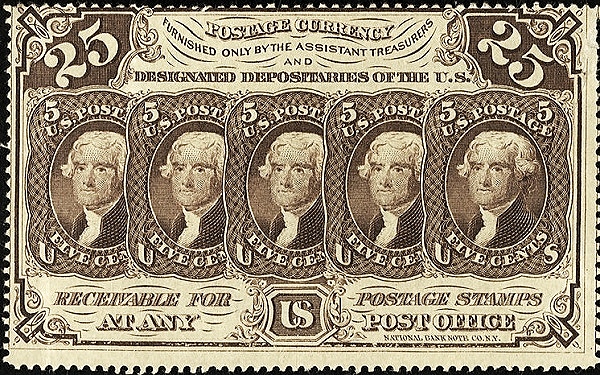
More significant is the 25-cent Third Issue note (Fr. 1290-1294). The back design, particularly on the green-reverse variety (Fr. 1290), uses a pair of crossed fasces flanking the central denomination numeral as part of the elaborate security printing meant to deter counterfeiting. Crisp Uncirculated examples of Fr. 1290 currently trade in the $85 to $150 range at major auction, making them genuinely accessible to new collectors who want to own a piece of Civil War-era monetary history with legitimate classical symbolism.
Collector Tip
Third Issue Fractional Currency frequently shows foxing and toning from the thin, porous paper used during wartime production. When grading these notes yourself before submission to PCGS Currency or PMG, look first at the edges and corners: soft folds that merge into the paper without fiber separation usually grade Fine to Very Fine, while sharp right-angle creases that break surface fibers will drop a note to Good or AG regardless of overall eye appeal. Avoid examples with pinholes near the center, which were common from period storage but significantly reduce collector value.
Large-Size Federal Reserve Notes: The 1914 $5 and Its Iconic Reverse
The single most collectible fasces-bearing paper money in American numismatics is the Series 1914 $5 Federal Reserve Note, Friedberg numbers 851 through 890a. Designed under the supervision of the Bureau of Engraving and Printing in 1914, when the Federal Reserve System was just beginning operations, this large-format note (7.375 by 3.125 inches) carries one of the most visually dramatic reverses ever placed on American paper money. The central vignette depicts Columbus’s flagship the Santa Maria in the left panel and a Pilgrim landing scene at Plymouth in the right panel, but it is the flanking architectural elements that concern us here: each side of the reverse is framed by a standing female figure, Liberty or Columbia in classical robes, resting her hand on a tall, elaborately rendered fasces.
The fasces on the 1914 $5 FRN is not subtle. The bundle of rods is clearly delineated, bound at three intervals with leather thongs, with the axe blade projecting from the left side of the bundle and the handle extending below. The figure’s posture, leaning slightly on the shaft as one might lean on a scepter, deliberately invokes Roman lictor iconography. Engraver Marcus W. Baldwin, who executed portions of the reverse design, drew directly from neoclassical allegorical conventions that had been standard in American engraving since the late eighteenth century.
The 1914 $5 notes were printed across all twelve Federal Reserve Districts: Boston (A), New York (B), Philadelphia (C), Cleveland (D), Richmond (E), Atlanta (F), Chicago (G), St. Louis (H), Minneapolis (I), Kansas City (J), Dallas (K), and San Francisco (L). Two signature combinations exist: Burke-McAdoo (the earlier and typically scarcer pairing) and Burke-Glass. Friedberg numbers differentiate by district and signature combination, running from Fr. 851 (Boston, Burke-McAdoo) through Fr. 890a (San Francisco, Burke-Glass).
In Very Fine 25 condition, most district and signature combinations trade between $175 and $350. The key rarity is the Dallas district Burke-McAdoo combination (Fr. 879), which in Fine 15 has realized $1,800 to $2,400 at Heritage and Stack’s Bowers sales. In Choice Uncirculated 63 or better, any Burke-McAdoo example becomes a serious investment-grade note, with prices regularly exceeding $3,500 at major auctions. The Minneapolis Burke-McAdoo (Fr. 873) and Atlanta Burke-McAdoo (Fr. 861) are likewise considered scarce in grades above Very Fine.
Collector Tip
When examining 1914 $5 Federal Reserve Notes for potential purchase, pay close attention to the red Treasury seal. On genuine notes the seal shows crisp, sharp points on the outer ring with no merging. Cleaned or pressed notes often show artificial brightness in the seal area, and ink sometimes migrates slightly into the paper fibers in a way that becomes visible under 5x magnification. Also check the serial numbers: ink fill inconsistencies on individual digits can indicate a note that has been “improved” with chemical brighteners, which will cause grading services to return the note body with a “net” qualifier.
The 1914 $10 and $20 Notes: Supporting Fasces Imagery
The 1914 $10 Federal Reserve Note (Fr. 892-941b) features a reverse design centered on a farming and industry allegory. While less prominent than the $5’s standing figures, the $10 reverse includes subsidiary fasces-like bundled elements woven into the border engraving, consistent with the BEP’s house style for large-size Federal Reserve Notes. These are more architectural ornament than deliberate symbolism, but knowledgeable collectors recognize them as part of the same design vocabulary.
More explicit is the 1914 $20 Federal Reserve Note (Fr. 960-1012b), whose reverse vignette depicts a steam locomotive on the left and an ocean liner on the right, representing American industrial and commercial progress. The allegorical border figures flanking these central scenes again carry abbreviated fasces staffs. The $20 series is substantially more available in circulated grades than the $5, with most district and signature combinations obtainable in Very Fine for $200 to $450, though the Burke-McAdoo signature on any district commands a premium of 40 to 80 percent over the Burke-Glass equivalent.
Legal Tender Notes and Silver Certificates: Subtler Appearances
The fasces makes supporting, less prominent appearances in several other large-size note series. The Series 1901 $10 Legal Tender Note, commonly called the “Bison Note” (Fr. 114-122), is among the most celebrated pieces of American currency art. Its reverse, dominated by the words TEN DOLLARS and elaborate border engraving, incorporates stylized fasces bundles as part of the lathe-work corner ornaments. In high grade this is one of the most desirable notes of the entire series, with PMG 65 EPQ examples having realized over $8,000 at auction.
The Series 1899 $5 Silver Certificate (Fr. 269-281), known to collectors as the “Indian Chief” or “Running Antelope” note, features decorative border elements on its reverse that include bundled-rod motifs consistent with fasces iconography. These are not as explicitly rendered as on the 1914 FRN series, but they reflect the same design tradition. Circulated examples of Fr. 271 (Blue Eagle variety) in Fine to Very Fine condition are common enough to find for $150 to $300, making them excellent entry points for collectors building a themed type set around classical American imagery.
National Bank Notes: Fasces in the Charter Borders
Original Series and Series 1875 National Bank Notes used a set of standardized border designs developed by the BEP in cooperation with the Comptroller of the Currency. Several of the back border designs for Original Series $1, $2, and $5 denominations incorporated small fasces devices within the geometric lathe-work patterns. These were entirely decorative in intent but demonstrate how thoroughly the symbol had permeated official American graphic design by the 1860s and 1870s.
By the time of the Series 1882 Date Back and Value Back National Bank Notes, the border designs had been simplified and the explicit fasces motifs largely eliminated in favor of more abstract geometric patterns. The transition reflects a broader shift in American graphic design away from overt classical symbolism and toward a more industrial aesthetic, though the fasces survived on numismatic pieces long after it faded from general iconographic currency use.
Collector Tip
Building a themed collection around fasces-bearing US currency is a realistic and rewarding project that can be accomplished at multiple budget levels. A starter set comprising a circulated Third Issue Fractional 25-cent note, a mid-grade 1914 $5 FRN from a common district such as Chicago or New York, and a Fine-grade 1901 $10 Bison Note can be assembled for under $700 if you shop patiently at shows and monitor Heritage and Stack’s Bowers floor lots rather than Buy-It-Now online prices. Add a PCGS or PMG-graded example of the 1916 Mercury dime for numismatic cross-reference and you have a display set that tells the complete story of the symbol in American commerce.
Modern Federal Reserve Notes: The Lincoln Memorial Connection
Most collectors are surprised to learn that fasces imagery persists on circulating US currency to this day, hiding in plain sight on every small-size $5 Federal Reserve Note issued since 1963. The reverse of the Lincoln Memorial cent, adopted in 1959 to mark the 150th anniversary of Lincoln’s birth, clearly shows two vertical fasces positioned behind the central columns of the Memorial building. Since the Lincoln Memorial reverse cent design is depicted in the central vignette on the back of the $5 bill, those same fasces transfer, in miniaturized engraved form, to the paper note.
Under 10x magnification, particularly on high-grade notes from the Series 1963 through 1969-C issues printed by the BEP before the introduction of the Web press, the fasces behind the Lincoln Memorial columns are clearly distinguishable in the engraving. The detail degrades somewhat on later offset-printed notes and becomes increasingly abstracted on notes printed after the Series 1990 introduction of security threads, though the architectural elements are preserved. On the completely redesigned Series 1999 and subsequent $5 FRNs, the memorial engraving was recut and the fasces remain, though at a scale where they function more as architectural detail than symbolic statement.
This means that every single $5 bill in circulation today carries a direct descendent of the Roman fasces on its reverse. Whether that constitutes meaningful symbolism or merely architectural accuracy is a matter of debate among collectors and historians, but it is an inescapable numismatic fact that rewards the attentive collector who looks carefully at America’s most ordinary piece of paper money.
Political Complications: The Twentieth Century and the Symbol’s Contested Legacy
The rise of Italian Fascism between 1919 and 1945 created obvious difficulties for the fasces as an American symbol. Mussolini’s Fascist Party took its name directly from the fasces, and the symbol appeared prominently on Italian state iconography, military insignia, and currency throughout the fascist period. American numismatists and currency designers faced an awkward reality: the Mercury dime, introduced in 1916 with prominent fasces imagery, was in full circulation throughout World War II, as were 1914-series Federal Reserve Notes.
The BEP and Treasury made no effort to redesign notes or coins to remove fasces imagery during the war, a decision that reflected their confidence in the symbol’s distinct American meaning. Treasury Department correspondence from 1942, preserved in the National Archives, explicitly addresses the question, noting that the fasces on American numismatic items represented republican law and collective strength, not fascist political ideology. The Mercury dime continued in production until 1945, when it was replaced by the Roosevelt dime, a change driven by the desire to honor the recently deceased president rather than by any discomfort with the fasces design.
On paper money, the large-size 1914 notes had passed out of circulation by the early 1940s, replaced entirely by small-size Federal Reserve Notes beginning in 1929. The explicit fasces symbolism of the large-size era effectively ended with the transition to small-size currency, surviving only in the indirect form of the Lincoln Memorial reverse.
| Issue / Series |
Denomination and Variety |
Estimated Survivors (Fine+) |
Rarity |
| Third Issue Fractional, 1864 |
25-cent, Fr. 1290 (green reverse) |
15,000+ |
Common |
| Third Issue Fractional, 1864 |
5-cent, Fr. 1238 (red reverse) |
8,000+ |
Common |
| Series 1901 Legal Tender |
$10 Bison Note, Fr. 114-122 (VF+) |
2,500-4,000 |
Scarce |
| Series 1914 FRN |
$5, Fr. 851-890a (all districts, VF) |
10,000-18,000 |
Common |
| Series 1914 FRN |
$5, Fr. 861 Atlanta Burke-McAdoo (VF+) |
400-700 |
Rare |
| Series 1914 FRN |
$5, Fr. 873 Minneapolis Burke-McAdoo (VF+) |
350-550 |
Rare |
| Series 1914 FRN |
$5, Fr. 879 Dallas Burke-McAdoo (Fine+) |
200-350 |
Key Date |
| Series 1914 FRN |
$20, Fr. 960-1012b (all districts, VF) |
8,000-14,000 |
Common |
| Series 1899 Silver Certificate |
$5 “Indian Chief” Fr. 271, Fine-VF |
5,000-9,000 |
Scarce |
| Series 1963-Present FRN |
$5, Lincoln Memorial reverse (CU) |
Billions printed |
Common |
Assembling a Fasces Collection: Practical Guidance
A fasces-themed currency collection offers one of the most intellectually coherent organizing principles available to the paper money specialist. Unlike a straightforward type set organized by denomination or series, a fasces collection demands research, an eye for design detail, and a willingness to cross traditional collecting boundaries between fractional currency, large-size notes, and modern issues.
Begin with accessible fractional currency. Third Issue 25-cent notes in Fine to Very Fine can be found for $40 to $90 at most major shows and through established dealers including Lyn Knight Currency Auctions and Coin and Currency Institute dealers. These notes are robust enough for handling, affordable enough to be a no-pressure first purchase, and historically significant as wartime emergency currency. Buy a PMG-slabbed example for your display and keep a raw example for study.
The 1914 $5 FRN is the centerpiece of any serious fasces collection. Budget collectors should target a common district such as Chicago (Fr. 871-872) or New York (Fr. 853-854) in Very Fine 25 to Extremely Fine 40 condition. These trade routinely for $200 to $350 and represent excellent value. Intermediate collectors might target the Burke-McAdoo signature on a mid-tier district such as Richmond or St. Louis, attainable in Fine to Very Fine for $300 to $600. Advanced collectors building for long-term value should focus on the Dallas, Minneapolis, or Atlanta Burke-McAdoo combinations in grades of 40 or better, where price appreciation has been consistent over the past two decades of auction records.
Complete your set with a high-grade example of the 1901 $10 Bison Note, which represents both the apex of large-size American note design and one of the most beautiful uses of classical border imagery in US currency history. Even in Very Good 10, the Bison Note carries immediate visual impact and trades for $275 to $450, while VF examples at $1,200 to $2,000 reward the patient buyer who waits for a well-centered specimen with original paper quality.
Conclusion: Authority, Unity, and the Enduring Grammar of American Money
The fasces endured on American paper money for more than 150 years not because designers were making overt political statements, but because the symbol had become part of the visual grammar of civic authority in Western civilization. Every time a BEP engraver reached for a classical allegorical figure, a Roman architectural motif, or a republican virtue personification, the fasces came naturally as an accompanying element, as automatic as columns on a courthouse or an eagle on a seal.
For collectors, this deep symbolic consistency creates a genuine intellectual pleasure in the hunt. A Third Issue Fractional note from 1864, a 1914 $5 Federal Reserve Note, and a current-issue $5 bill from your wallet are separated by 160 years of American history, and yet the same Roman symbol connects them across every one of those years. That continuity is not an accident. It is a deliberate, if often unconscious, choice to frame American monetary authority within the longest tradition of republican governance the Western world has known. Few collecting themes offer that kind of depth.