📷 Image source: banknote.ws (World Banknote Gallery). Images are selected by AI to represent the article topic and may not depict the exact note(s) described.
Somewhere in the vast taxonomy of United States paper money sits a type so obscure that even experienced collectors sometimes encounter it for the first time at a major auction and assume it must be a foreign note or an elaborate counterfeit. The Refunding Certificate of 1879 is neither. It is a fully authorized, Treasury-issued obligation of the United States government, bearing a face value of ten dollars and a promise that would become increasingly awkward as the decades rolled on: the note accrued interest at four percent per annum, forever, with no stated maturity date. Congress eventually had to act to stop the bleeding. The story of how these notes came to exist, what they look like up close, and why they remain prized by collectors today is one worth telling in full.
Legislative Origins: Why Did Congress Create an Interest-Bearing Note?
The late 1870s were an era of intense political pressure surrounding American monetary policy. The country had been operating on an inconvertible greenback system since the Civil War, and the Resumption Act of 1875 had set January 1, 1879, as the date on which the Treasury would restore specie payments, redeeming legal tender notes in gold on demand. As that date approached, Treasury Secretary John Sherman was deeply concerned about the government’s ability to maintain adequate gold reserves while simultaneously encouraging ordinary citizens to invest in U.S. bonds.
The solution Congress landed on with the Act of February 26, 1879, was elegantly simple, if ultimately flawed in its long-term execution. The Treasury would issue $10 certificates that functioned simultaneously as currency and as a savings instrument. A holder could spend the note at face value, but if they chose to hold it, the certificate would accumulate interest at four percent annually, convertible at any time into a four percent consol bond of the United States. The intent was to draw small savings from ordinary Americans into government coffers while also, in theory, keeping the notes in circulation as a stimulus to commerce.
The problem was the open-ended interest accrual. Congress had not specified a date on which the interest would stop. By the early twentieth century, notes that had been held since 1879 had theoretically more than doubled in value through interest alone. On July 12, 1882, Congress passed legislation halting further interest accrual on Refunding Certificates, capping the total interest a note could earn. At that point, a $10 Refunding Certificate from 1879 held continuously since issue had accumulated roughly $1.30 in interest, bringing its redemption value to $11.30. Notes presented after that date received no additional interest beyond that amount.
Physical Description: What Does a Refunding Certificate Actually Look Like?
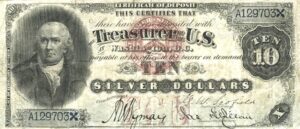
Refunding Certificates are horizontal-format notes measuring approximately 7.42 inches by 3.13 inches, consistent with the “large size” dimensions of the era. The face is dominated by a central vignette depicting Benjamin Franklin, the same statesman who would later grace the modern $100 bill, though rendered here in a more classical engraving style typical of the American Bank Note Company’s work of that period. The portrait is framed by ornate lathe-work patterns in red and black ink.
The obligation text on the face reads: “This certifies that _____ has deposited with the Treasurer of the United States TEN DOLLARS, redeemable in lawful money of the United States, at the office of the Treasurer, or either of the Assistant Treasurers, on demand, or may be converted into 4 per cent. consols of 1907, in sums of $50 and multiples thereof.” Below the main panel, in clear black type, appears the four-percent interest notice.
The back of the note is printed in a distinctive green ink and features an elaborate geometric lathework design centered on large “10” numerals. There is no complex scenic vignette on the reverse, which gives the back a somewhat sparse appearance compared to contemporaneous Legal Tender notes or Silver Certificates of the same era.
Two Treasury officials’ signatures appear on the face: those of Register of the Treasury James Gilfillan and Treasurer of the United States David W. Niles, the only signature combination known for this type. The Treasury seal on the face is red, consistent with the Legal Tender note lineage of this obligation class.
When examining a Refunding Certificate, pay close attention to the crispness of the obligation text near the bottom of the face. This area is often the first to show weakness from folding, and a sharp, fully legible interest clause is a positive grading indicator that can meaningfully affect value at auction.
Serial Numbers, Print Runs, and Known Survivors
The Bureau of Engraving and Printing issued Refunding Certificates with serial numbers running from a low range up through approximately 37,000 notes, though not all of that number necessarily entered circulation. Some references cite the total issued figure at closer to 36,947, based on BEP production records. Serial numbers appear in red ink on the face, flanking the central portrait. The serial numbering format uses a simple numeric sequence without alpha prefixes, distinguishing these certificates from the more complex serial systems used on National Bank Notes of the same period.
The survival rate is extraordinarily low. Because these notes accrued interest, many holders converted them to bonds rather than spending them or saving them as currency. Others were redeemed in the years after 1882 once interest stopped accumulating. Current population data from PCGS and PMG combined suggests fewer than 150 examples are known to exist across all grades, and some specialists believe the true census of unencountered survivors is lower still. The Friedberg reference catalogs this type as a single variety, Fr. 214, with no major sub-varieties distinguished by signature or seal type since only one combination exists.
Both PMG and PCGS Population Reports are worth checking before bidding on a Refunding Certificate at auction. Because the known population is so small, even a single new graded example can shift the rarity landscape. As of recent reporting, PMG has graded fewer than 80 examples total across all grades, making any certified specimen genuinely scarce.
Condition Census and Collector Values
For a type this rare, condition spreads are dramatic. In lower circulated grades, such as Good (G-4) through Very Good (VG-8), Refunding Certificates appear at major auctions every few years and typically realize between $3,500 and $6,500 depending on eye appeal, margins, and the presence of any repairs or missing corners. A problem-free Fine (F-12) example can push past $8,000 to $10,000 at Heritage, Stack’s Bowers, or Lyn Knight sales.
The jump to Very Fine (VF-20 and above) is where values climb steeply. A VF-30 example with strong color and no splits along the folds might bring $14,000 to $18,000 in a competitive auction room. Extremely Fine (EF-40 to EF-45) survivors, of which very few are certified, have realized prices north of $25,000. As for uncirculated examples, they are the stuff of registry set dreams. Fewer than a handful of Mint State Refunding Certificates are documented, and any example grading MS-62 or above would be expected to set new records in a specialized collection sale, with realistic estimates exceeding $75,000 to $100,000 based on comparable Type rarities from the same era.
It is worth noting that several known examples bear evidence of having been pasted into scrapbooks or framed as curiosities, particularly in the late nineteenth and early twentieth centuries when the notes’ unusual interest-bearing feature made them objects of conversation. These “apparent” problem notes require careful examination by a professional grader and should be approached with caution by newer collectors purchasing from non-certified sources.
Never purchase an uncertified Refunding Certificate without consulting a specialist dealer or submitting the note to PMG or PCGS first. Skillful alterations of more common large-size $10 notes do occasionally appear on the market, and the premium commanded by genuine Refunding Certificates makes them a target for fraudulent modifications. Certification is non-negotiable at this value level.
Placing Refunding Certificates in Your Collection
For collectors building a type set of all major United States currency classifications, the Refunding Certificate is an unavoidable and formidable challenge. It sits alongside the Compound Interest Treasury Note and the Interest Bearing Note series as one of those type categories that can elude a collector for years before the right example at the right price finally presents itself. Unlike the Interest Bearing Notes, which exist in multiple denominations and series, the Refunding Certificate offers only one denomination and one variety, which paradoxically makes it both simpler and more daunting to acquire.
Budget-conscious collectors building a representative type set sometimes choose to represent this category with a lower-grade circulated example rather than waiting for an unaffordable gem. A G-6 or VG-8 example with honest wear, no repairs, and all the key design elements visible is a perfectly respectable placeholder and a conversation piece of the highest order. Meanwhile, specialists in the 1870s Treasury note era often pursue Refunding Certificates as a centerpiece of a focused collection surrounding the Resumption of Specie Payments period, pairing them with Series of 1875 and 1878 Legal Tender Notes, Gold Certificates of the 1870s, and the earliest Silver Certificates of 1878 and 1880.
| Type / Grade Range | Friedberg Number | Estimated Survivors | Rarity |
|---|---|---|---|
| Refunding Certificate 1879, Good to Very Good | Fr. 214 | 50-65 known | Rare |
| Refunding Certificate 1879, Fine to Very Fine | Fr. 214 | 30-45 known | Rare |
| Refunding Certificate 1879, Extremely Fine | Fr. 214 | 8-12 known | Key Date |
| Refunding Certificate 1879, About Uncirculated | Fr. 214 | 3-5 known | Key Date |
| Refunding Certificate 1879, Mint State (any grade) | Fr. 214 | 2-3 known | Key Date |
| Series 1878 $10 Silver Certificate (Fr. 286) | Fr. 286 | Approx. 100 known | Rare |
| Series 1875 $10 Legal Tender (Fr. 113) | Fr. 113 | Approx. 200 known | Scarce |
| Series 1878 $10 Legal Tender (Fr. 114) | Fr. 114 | Approx. 300 known | Scarce |
| Series 1880 $10 Legal Tender, Brown Seal (Fr. 116) | Fr. 116 | Several hundred known | Scarce |
The Interest Accrual Mystery: What Was a Note Actually Worth at Redemption?
One question that delights numismatic researchers is the practical accounting of interest on a note held from 1879 to 1882. At four percent per annum on a $10 principal, the note earned $0.40 in year one, another $0.40 in year two, and a partial amount in year three before Congress halted further accrual on July 12, 1882. The total interest earned was approximately $1.30 to $1.32 depending on the exact date of calculation, giving a redemption value of $11.30 to $11.32 at a Treasury office. This modest premium over face value likely contributed to the notes’ relatively brief life in circulation: the incentive to hold was real but small, and many holders simply spent the notes rather than waiting for a marginally higher redemption.
A smaller number of Refunding Certificates were converted to “4 percent consol bonds of 1907” as the face text permitted, in lots of $50 face value (requiring five notes). Those conversions removed notes from circulation permanently and contribute to the low survival rate seen today.
Auction archives from Heritage Auctions and Stack’s Bowers going back to the 1990s are publicly searchable online and provide an invaluable record of past Refunding Certificate sales. Studying these realized prices over time not only helps you gauge current fair market value but also reveals which specific serial numbers have appeared multiple times, giving you a clearer picture of the true known population for this rare type.
Conclusion: A Unique Intersection of Monetary Policy and Collectible Art
The Refunding Certificate of 1879 occupies a singular position in American numismatic history. Born from the anxious fiscal politics of post-Civil War resumption, designed to serve simultaneously as pocket money and savings vehicle, and retired from interest-bearing status after barely three years, these $10 notes encapsulate a moment when the Treasury was improvising solutions to monetary challenges that had no precedent. The Franklin portrait, the red serial numbers, the green back with its geometric confidence, and the quietly extraordinary promise of perpetual interest printed right on the face make each surviving example a small window into a very particular American economic moment.
For the collector willing to be patient and to budget appropriately, acquiring a Refunding Certificate, even in circulated grade, is one of the most satisfying achievements in large-size United States currency collecting. It is a note with a genuine story, a specific purpose, a fixed population, and a guaranteed place at the center of any serious type set. Few pieces in American paper money history can claim all four of those distinctions at once.