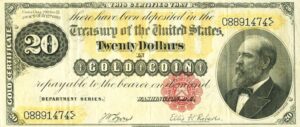
Pick up any Federal Reserve Note from your wallet right now and hold it up to a strong light. Before you look at the printing, look at the paper itself. You will see a faint web of interlocking fibers, and scattered through that web, tiny strands of red and blue. That paper is not an accident. It is the product of more than 150 years of deliberate engineering, and every characteristic of it, from the fiber ratio to the thread placement, carries direct consequences for how a note grades, ages, and survives in a collection. Most collectors spend their energy studying signatures, seals, and serial numbers, which is entirely reasonable. But the substrate those elements are printed on is every bit as important, and it is chronically underappreciated.
The History of Currency Paper in the United States
The United States government did not always use a standardized currency paper. The Demand Notes of 1861, the very first federal paper money, were printed on relatively inconsistent stock sourced from private contractors. The quality varied enough that some sheets were noticeably thicker or more porous than others, which is part of why well-preserved examples of the 1861 $5 and $10 Demand Notes are so difficult to grade above Fine: the paper itself was not built to last.
The turning point came in 1879, when the Bureau of Engraving and Printing formalized its relationship with Crane and Company of Dalton, Massachusetts, which remains the sole supplier of currency paper for the BEP to this day. Crane standardized the cotton-linen blend that would define American currency paper for the next century and a half. The choice of cotton and linen over wood-pulp paper was not merely traditional. It was functional. Wood-pulp paper, which is used in ordinary books and documents, contains lignin, an organic compound that oxidizes and causes yellowing and brittleness over time. Cotton and linen fibers are nearly pure cellulose, far more chemically stable, and they interlock in a way that gives the sheet resilience against folding and moisture.
Cotton vs. Linen: What Each Fiber Does
The current specification of 75 percent cotton and 25 percent linen has not always been the formula. Early notes from the 1860s through roughly the 1920s used blends that leaned more heavily on linen, sometimes as high as 40 to 50 percent linen content depending on the supplier and contract period. This matters enormously for collectors, because linen and cotton age differently and respond differently to handling.
Cotton fibers are longer, softer, and more uniform in diameter. They create a smooth, slightly supple feel in a fresh note. Cotton-dominant paper takes intaglio ink exceptionally well, which is why the raised print on modern Federal Reserve Notes feels so crisp to the touch. However, cotton is somewhat more susceptible to moisture absorption than linen, which means a cotton-heavy note exposed to humidity will develop limpness and, over time, foxing or mold staining more readily than a linen-heavy counterpart.
Linen fibers are shorter, stiffer, and slightly irregular. Higher linen content gives a note a crisper, almost papery snap when you hold a corner and let it fall. Collectors often describe early large-size notes, particularly Series 1899 Silver Certificates or Series 1901 Legal Tender Notes (the famous Bison note, Fr. 114-120), as having a distinctive stiffness and a slightly rough texture compared to modern issues. That is linen at work. The trade-off is that linen can develop subtle surface cracks along fold lines faster than cotton, which is why heavily circulated pre-1920s notes sometimes show crazing or splitting at the creases that you simply do not see as often in post-1940s issues.
When examining a large-size note from before 1920, hold it by one corner and give it a very gentle shake. A higher linen content will produce a crisper, more audible rustle compared to the softer sound of a modern cotton-dominant note. This tactile and auditory test will not grade a note for you, but it helps calibrate your sense of what original paper character should feel and sound like for a given era.
Why Fiber Composition Directly Affects Grading Outcomes
Professional Currency Graders, whether at PCGS Currency, PMG, or legacy services, assess paper quality as a core component of every grade assigned. The PMG grading standard, for example, explicitly evaluates paper quality in tandem with circulation wear, and a note with compromised paper quality due to environmental damage will be net graded downward even if the printing is sharp. Understanding why certain types of fiber damage occur helps you predict what you will see in circulated examples and what red flags to watch for when buying raw notes.
Cotton fiber failure tends to manifest as limpness, soiling along handling edges, and in extreme cases a rag-like softness in the center of the note where repeated folding has broken down the fiber lattice. Linen failure looks different: it produces small surface lifts, a phenomenon sometimes called delamination in which a thin layer of fibers separates from the sheet surface, and it can create a faint white dusting at fold intersections where linen fibers have actually fractured.
For graders, these distinctions matter because they inform whether damage is original and expected for the type, or whether it indicates improper storage or cleaning. A Series 1923 $1 Silver Certificate (Fr. 237) in Fine condition with stiff linen-feel paper and clean, unenhanced creases is simply a circulated note. The same note with limp, washed-feeling paper and suspicious brightness along the fold lines suggests cleaning, and that will result in a details grade regardless of the note’s visual sharpness.
Cleaning is among the most common reasons notes receive details grades from PMG and PCGS Currency. Cleaned notes typically feel softer and more limp than original-paper examples of the same type, because the cleaning process partially breaks down the cellulose lattice. If a circulated large-size note feels unusually soft or silky for its apparent grade, treat that as a significant warning sign before purchasing.
The Red and Blue Threads: More Than Decoration
The randomly distributed red and blue silk threads embedded in U.S. currency paper are one of the most recognizable features of American banknotes, and they are also among the most misunderstood. Many new collectors assume they are a relatively modern security feature, or that they serve a purely aesthetic purpose. Neither assumption is correct.
The use of embedded colored silk threads in U.S. currency paper dates to 1869, introduced specifically as a counterfeit deterrent. At the time, photographic reproduction technology was advancing rapidly, and Treasury officials were concerned about the reproducibility of printed security features. Embedding physical fibers directly in the paper stock during the manufacturing process at Crane created a feature that could not be replicated by printing or engraving alone. A counterfeiter who printed the appearance of threads was creating an image on the surface; genuine threads actually pass through the paper, visible from both sides, and can be pulled out with a needle without damaging the fibers themselves.
The threads are distributed randomly, not in a pattern, which means no two notes from the same series will have threads in exactly the same positions. This randomness is itself a security feature. For collectors, the threads serve as both an authenticity marker and a condition indicator. In a new, uncirculated note, the threads sit cleanly within the paper matrix and show no surface fraying. As a note circulates and the fiber lattice breaks down around them, the threads can become slightly raised or even partially exposed along heavy fold lines. A note in Very Fine or better condition should show threads that are fully embedded and show no mechanical disturbance.
Interestingly, the color and density of the threads have been adjusted at various points in history. Notes from the 1860s and 1870s used a slightly different thread gauge than notes from the 1920s, and the intensity of the red dye has varied across contract periods. For the specialist collector of, say, Series 1882 National Bank Notes or Series 1886 Silver Certificates, comparing thread characteristics can sometimes help attribute a note to a specific paper lot or printing period, though this level of analysis requires reference examples and a good loupe.
The Polyester Security Thread: A Different Animal
Beginning with Series 1990 $100 Federal Reserve Notes, the BEP introduced an embedded polyester security thread as an additional counterfeit deterrent, separate from and in addition to the traditional red and blue silk threads. This thread is a narrow strip of clear polyester printed with microtext reading USA 100 (or the appropriate denomination), visible only under transmitted light. It was extended across additional denominations through the early 1990s, appearing on $50 notes in 1991 and eventually working down to $5 notes by 1993.
The polyester thread interacts with the fiber matrix differently than silk threads do. Because it is a uniform flat strip rather than a round fiber, it creates a very faint but detectable surface ridge on high-grade examples. On MS-63 and above notes from the Series 1990 through Series 1996 issues, you can sometimes see the ghost of this ridge under raking light. More importantly for graders, the polyester thread can occasionally delaminate slightly from the surrounding fiber matrix in notes that have experienced humidity cycles, creating a subtle waviness in the paper plane around the thread location. This is considered a paper quality defect and will affect grading.
When evaluating Series 1990 to Series 1999 Federal Reserve Notes in higher grades, hold the note at a low angle under a single light source and look for any waviness or rippling near the security thread location. This subtle delamination is most common on notes that were stored in fluctuating humidity conditions. It is easy to overlook in flat overhead lighting but becomes visible immediately under raking illumination.
Paper Originality and the Premium It Commands
In the current collector market, paper originality commands a significant premium over otherwise equal notes with compromised paper. A raw Series 1934 $500 Federal Reserve Note (Fr. 2201) with original, unrestored paper and natural even circulation will outperform a cleaned, pressed example with sharper visual detail at almost every major auction. The 2019 Heritage Currency Platinum Night sale demonstrated this clearly when an original-paper Series 1928 $500 Gold Certificate (Fr. 2407) in PMG Very Fine 30 brought $16,800, while a similarly graded but net-graded (cleaned) example from the same series brought only $9,600 in the same sale context.
For small-size issues, paper originality becomes especially critical in the Gem Uncirculated range. A Series 1928B $2 Legal Tender Note (Fr. 1501) graded PMG 65 EPQ, where EPQ designates Exceptional Paper Quality, will trade at a substantial premium over a PMG 65 without the EPQ qualifier. The EPQ designation specifically certifies that the paper is bright, fresh, and free from any chemical or physical alteration. This designation has become so important in the market that the difference between a PMG 64 EPQ and a PMG 64 without EPQ on a common note can represent a 30 to 50 percent price differential.
| Series / Issue | Denomination and Type | Notes in Top Grade (PMG 65+ EPQ) | Rarity |
|---|---|---|---|
| 1899 | $5 Silver Certificate (Fr. 270-281), Chief note | Fewer than 40 certified EPQ | Rare |
| 1901 | $10 Legal Tender (Fr. 114), Bison note | Fewer than 25 certified EPQ | Key Date |
| 1923 | $1 Silver Certificate (Fr. 237), Porthole note | Approximately 60 certified EPQ Gem | Scarce |
| 1928 | $500 Gold Certificate (Fr. 2407) | Under 15 in any EPQ grade | Key Date |
| 1934A | $1,000 Federal Reserve Note (Fr. 2212) | Fewer than 20 in PMG 64+ EPQ | Rare |
| 1953 | $2 Legal Tender (Fr. 1509), all districts | Common in Gem, EPQ examples abundant | Common |
| 1963A | $1 Federal Reserve Note, most districts | Very common, EPQ examples widely available | Common |
| 1976 | $2 Federal Reserve Note (Fr. 1935), first day issues | Moderate supply of EPQ examples | Scarce |
Practical Notes on Storage to Protect Fiber Integrity
Everything discussed above about fiber behavior has direct practical implications for how you store your collection. Cotton-linen paper is hygroscopic, meaning it absorbs and releases moisture from the environment continuously. Repeated cycles of expansion and contraction are what cause fiber fatigue, softening, and eventually the kind of damage that costs you grades and value. The ideal storage environment for paper currency is 65 to 70 degrees Fahrenheit with relative humidity between 45 and 55 percent. Fluctuation is the enemy, more so than any specific point within that range. A note stored consistently at 60 percent humidity will fare better than one that swings between 30 and 70 percent seasonally.
Mylar holders, specifically polyester film of archival quality meeting ASTM D4272 standards, are the appropriate housing for valuable notes. PVC-based holders, which are still sold in many hobby shops, off-gas plasticizers over time that attack cellulose directly and cause the characteristic brown spotting and surface tackiness you will sometimes see on notes stored in inferior holders during the 1970s and 1980s. If you acquire a raw collection that has been stored in non-archival plastic, prioritize re-housing it before the contamination becomes permanent.
Conclusion: The Paper Is the Note
Every time you evaluate a piece of U.S. paper money, you are really evaluating two things at once: the printing and the substrate. The fiber composition beneath the ink determines how well a note has survived its journey to your hands, how reliably it will hold its grade over time, and ultimately how the market will price it against comparable examples. Understanding that the 75/25 cotton-linen blend, the randomly placed red and blue threads, and the specific tactile qualities of different eras are not background details but central facts of the instrument you are collecting will make you a sharper buyer, a better seller, and a more complete numismatist. The paper is not just what the money is printed on. In a very real sense, the paper is the money.
Before submitting any note for grading, photograph it under both flat overhead light and raking side light. The raking photo will reveal paper surface issues, rippling, fiber lifting, and cleaning residue that flat photography conceals entirely. Comparing both photographs gives you the most accurate pre-submission assessment of what grade and whether an EPQ qualifier is realistic for your note.