Picture pulling a $1 bill from your wallet and noticing the serial number reads 77777777. Every single digit, identical. Your heart rate ticks up a notch. That is the magic of solid serial numbers, the most coveted category in the entire world of fancy notes. Unlike ladders, radars, or repeaters that reward patience and a sharp eye, solids are so statistically improbable that many collectors go decades without ever finding one in circulation. When they do appear at auction, bidding wars erupt fast.
What Exactly Is a Solid Serial Number?
A solid serial number note is one where all eight digits of the serial number are identical: 11111111, 22222222, 33333333, and so on up through 99999999. The zero solid (00000000) does not technically exist in Federal Reserve Note production because the BEP numbering system begins at 00000001 and ends at 99999999 within each run. This gives us exactly nine possible solid combinations per prefix letter, per denomination, per Federal Reserve district.
These notes are not randomly stumbled upon by the Bureau of Engraving and Printing. They print naturally as part of normal production, but because each 32-subject or 50-subject sheet run contains millions of notes, only one note per 11,111,111 carries any given solid number. In a typical modern Federal Reserve district run of 3.2 million notes, statistically zero solids will appear. Longer runs of 640 million or more, like those produced for the $1 Federal Reserve Note across all twelve districts, guarantee that every solid from 11111111 through 99999999 will eventually be printed, but they are scattered across decades of production.
The Hierarchy of Solid Numbers: Not All Solids Are Equal
Within the world of solids, collectors have established a clear pecking order based on visual impact, cultural significance, and relative scarcity by denomination.
The 1s: 11111111
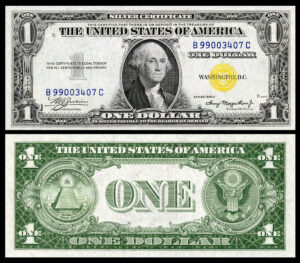
The solid 1 note holds a special place because of its association with beginnings and its crisp, clean visual appearance. On modern Federal Reserve Notes, the first 11111111 in any new series is also often the first properly printed note after a series change, giving it additional historical resonance. Examples from the Series 1935A $1 Silver Certificate and Series 1963 $1 Federal Reserve Notes have sold in the $2,000 to $4,500 range in circulated grades, while Gem Uncirculated examples routinely exceed $6,000.
The 8s: 88888888
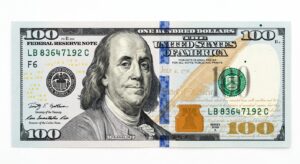
Among Asian collectors especially, the number 8 carries profound cultural significance as a symbol of prosperity and good fortune. This demand from an international buyer base has pushed solid 8 notes to premiums that sometimes surpass even solid 1s. A $100 Federal Reserve Note Series 2009A with serial number LF 88888888 A graded PMG 66 Exceptional Paper Quality hammered at $14,400 at Heritage Auctions in March 2022, a record for a modern solid at that denomination. On $1 notes, solid 8s in CU grades regularly bring $1,500 to $3,000 depending on the district and series.
The 7s: 77777777
Lucky sevens command strong premiums in Western collector markets. The 77777777 serial is arguably the most universally recognized lucky number pattern, and notes bearing it move quickly at major shows and auctions. Expect to pay $800 to $2,000 for a circulated $1 solid 7 and $2,500 or more for a PMG 65 EPQ example.
When evaluating a solid note for purchase, always verify the serial number under magnification before committing. Altered notes with printed or stamped digits have appeared in the market. Genuine solids will show the same ink thickness, font weight, and impression depth on every digit, matching the prefix and suffix letters perfectly.
The 2s Through 6s and 9s
Solids featuring digits 2 through 6 and 9 are generally considered slightly less desirable, though they remain legitimately rare and collectible. The solid 9 note carries some premium as the highest single digit and has a bold visual presence. Solid 2s through 6s typically trade at modest discounts to the 1s, 7s, and 8s, running $600 to $1,500 for $1 notes in VF to CU grades. Do not let the relative discount fool you: any solid in Gem Uncirculated condition is a significant find.
High-Denomination Solids: Where the Real Money Lives
The higher the face value of the note, the rarer the solid, simply because fewer high-denomination notes are printed per run. Consider that a single print order for $100 Federal Reserve Notes from a given district might be 3.2 million notes, meaning statistically only about 0.29 solids would appear in that run. This explains why $100 solids are dramatically scarcer than $1 solids even when both notes are from the same series year.
Catalogued examples of $50 solids in the PMG holder are few enough to be listed individually in major dealer inventories. A Series 2004A $50 Federal Reserve Note from the Atlanta district bearing serial number F 55555555 A graded PMG 63 Choice Uncirculated sold for $8,400 in a 2021 Stack’s Bowers sale. For the $100 denomination, verified Gem Uncirculated solids are five-figure notes with essentially no ceiling when condition and digit desirability combine favorably.
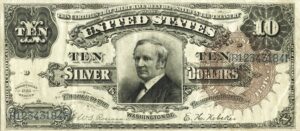
Older large-size solids, from series prior to 1928, are in a category unto themselves. A solid serial from a 1902 Plain Back National Bank Note or a 1899 $5 Silver Certificate “Chief” note would represent a once-in-a-generation find. No comprehensive catalog of known large-size solids exists, and dealers at major shows like the PNG National Money Show have reported that even circulated examples from the large-size era command $10,000 or more based purely on the serial alone.
Solid serial notes on Star Notes (*) are dramatically rarer because star note print runs are a fraction of regular issue runs, sometimes as small as 640,000 notes. A solid on a star note from a short-run district like Minneapolis or San Francisco can be one of only a handful of confirmed examples. Always check star note population reports at PMG and PCGS Currency before bidding.
Star Note Solids: The Ultra-Rarities
The intersection of two fancy note categories, solids and star notes, creates some of the most desirable pieces in modern US currency collecting. Star notes are printed to replace defective notes during production, and their runs are always shorter than regular issues. When a solid serial falls within a star note run, the resulting note can be genuinely one-of-a-kind or one of only two or three known examples across all grades.
The Series 1988A $1 star notes from the Minneapolis Federal Reserve district had a total print run of just 640,000 notes. Statistically, the chance that any solid fell within that specific run is less than 6 percent. Confirmed star note solid examples from low-run districts have sold for multiples of $5,000 even in lower circulated grades, simply because collectors understand how improbable their existence is.
Grading Solids: Why Condition Matters More Than You Think
Fancy notes at every level benefit from professional grading, but for solids the condition premium is especially steep. The gap between a PMG 64 Choice Uncirculated and a PMG 66 Exceptional Paper Quality on the same solid can easily be $1,000 or more on a $1 note, and $3,000 to $5,000 on higher denominations. This is because the collector pool for solids skews toward serious numismatists who understand value and will pay aggressively for the finest known example.
The EPQ (Exceptional Paper Quality) designation from PMG, or the PPQ (Premium Paper Quality) designation from PCGS Currency, signals that the note has original paper surfaces free of pressing, cleaning, or other enhancement. For solids, where the visual impact of the serial number is the primary attribute, a fresh, bright, unprocessed note creates a dramatically superior display piece. Avoid purchasing raw solids above VF grades unless you can personally examine them under magnification for counting folds or subtle cleaning.
Before spending significant money on a solid note, search the PMG and PCGS Census databases for pop reports on that specific serial prefix, district, and series. Knowing whether a given solid is a single pop (finest and only graded example) versus one of a dozen graded examples gives you critical leverage when negotiating or bidding at auction.
Building a Solid Collection: Strategies for Different Budgets
For collectors entering the fancy note market with a budget under $500, the most accessible solids are circulated $1 Federal Reserve Notes bearing digits 2 through 6. These can sometimes be found at coin shows from dealers who specialize in error and fancy notes, priced in the $300 to $500 range for Fine to Very Fine examples. Joining the Paper Money Collectors forum community and the SPMC (Society of Paper Money Collectors) connects you with dealers who specifically track these notes.
Mid-range collectors with $500 to $2,500 to spend can target Uncirculated to Choice Uncirculated $1 solids across multiple digits, building a complete set of all nine solid digits from a single series. A complete set of Series 2017A $1 solids, all nine digits from the same Federal Reserve district in matched grades, would be a genuinely exhibition-worthy collection that few numismatists have assembled.
For advanced collectors, the challenge and the prize lies in assembling solids across multiple denominations from a single series year. A solid set spanning $1 through $100 from Series 2006 Federal Reserve Notes, all graded PMG 65 EPQ or above, would represent perhaps the most sophisticated fancy note collection imaginable and would certainly exceed $50,000 in total market value.
| Note Type / Denomination | Digit / Variety | Approx. Frequency Per Run | Rarity |
|---|---|---|---|
| $1 FRN, Modern Series | Any digit, regular issue | 1 per 11.1 million notes | Scarce |
| $1 FRN, Star Note | Any digit, short-run district | Fewer than 1 per typical star run | Rare |
| $5 FRN, Modern Series | Any digit, regular issue | 1 per 11.1 million notes | Scarce |
| $20 FRN, Modern Series | Any digit, regular issue | 1 per 11.1 million notes | Rare |
| $50 FRN, Modern Series | Any digit, regular issue | Statistical fraction of most runs | Rare |
| $100 FRN, Modern Series | 88888888, graded gem | Confirmed examples: under 20 known | Key Date |
| $1 Silver Certificate, 1935 Series | Any digit | Unknown, very few confirmed | Key Date |
| Large-Size Note, Pre-1928 | Any digit, any type | Extremely rare, no census | Key Date |
| $1 FRN, Solid 1s or 8s, Gem | 11111111 or 88888888, PMG 65+ | Single digit pops per district | Rare |
| $2 FRN, Any Solid | Any digit | Very limited print runs per series | Key Date |
Market Trends and Where to Buy
The market for solid serial numbers has strengthened noticeably since 2018, driven by increased crossover interest from Asian buyers (particularly for solid 8s), the growth of online auction platforms like Heritage Auctions and Stack’s Bowers, and a new generation of collectors who discovered fancy notes through social media communities. The COVID-era surge in collectible markets pushed solid premiums to historic highs in 2020 and 2021, with some pullback in 2022 and 2023, but top-grade examples have held their value well.
For purchasing, Heritage Auctions and Stack’s Bowers Galleries handle the most significant solids through their currency auction sessions. The PCGS CoinFacts and PMG note registry databases let you track recent sales prices. For circulated examples at more accessible price points, dealers at major currency shows including the ANA World’s Fair of Money, the FUN Convention, and the Memphis International Paper Money Show typically carry inventory of lower-grade solids priced fairly for the market.
When storing solids in your collection, use individual Mylar currency sleeves rather than multi-pocket album pages. The serial number on a solid is its primary value driver, and protecting it from surface abrasion, humidity, and light exposure is critical. Maintain 45 to 55 percent relative humidity and store away from direct light to preserve paper quality and original color.
Conclusion: The Enduring Appeal of the Solid
Solid serial numbers sit at the top of the fancy note hierarchy for good reason. They are statistically improbable, visually stunning, and deeply satisfying to own. Whether you are examining a circulated $1 with 33333333 purchased at a coin show for $400, or bidding on a Gem Uncirculated $100 note with 88888888 at a major auction, the appeal is universal: this note is unlike any other in circulation, and it always will be. The combination of genuine rarity, broad collector appeal, and increasing institutional attention from grading services makes solids one of the most compelling long-term collecting categories in all of United States paper money. Start with what your budget allows, learn the market thoroughly, and never pass up a solid in your change without at least pausing to appreciate just how rare that moment truly is.