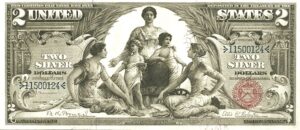
Walk into the United States Capitol Rotunda today and you will find John Gadsby Chapman’s 1840 oil painting The Baptism of Pocahontas occupying a prominent panel in the great circular room. It measures roughly twelve by eighteen feet, a commanding canvas depicting the 1613 conversion of the Powhatan princess at Jamestown. Few visitors realize that a miniaturized version of this same scene traveled through American commerce for decades, printed in black ink on the backs of $20 National Bank Notes issued between the 1860s and the 1870s. The connection between Capitol art and federal currency is one of the most rewarding rabbit holes a collector of large-size nationals can explore.
Chapman’s Canvas and the Currency Connection
John Gadsby Chapman received his Capitol commission in 1837, one of four artists awarded contracts to fill the large rectangular panels ringing the Rotunda’s lower level. The other three panels went to John Trumbull (two scenes) and Robert Weir. Chapman spent years on the subject, choosing the Pocahontas baptism partly for its narrative drama and partly because it represented the first recorded Christian conversion in English colonial America, a theme he believed would resonate with the young republic’s sense of providential destiny.
The painting was installed in 1840 and almost immediately became one of the most reproduced images in the country. Engravers at the American Bank Note Company (ABNCo) and its predecessor organizations recognized that the Rotunda paintings carried enormous symbolic prestige. By including vignettes derived from these canvases on federal and national bank currency, the Bureau of Engraving and Printing (and the private bank note firms that preceded it) literally circulated national identity through commerce. The Pocahontas vignette on the $20 National Bank Note back is not an incidental decoration. It is a deliberate statement about American origins and legitimacy.
When examining the back of your $20 Original Series or Series 1875 National Bank Note, use a loupe at 5x to 10x magnification to appreciate the fine line engraving in the Pocahontas vignette. The kneeling figure, the bishop’s robes, and the background foliage are rendered in extraordinary detail by the ABNCo engravers. Notes graded VF or better will show crisp definition in these fine lines, which is one reason grade matters so dramatically to value in this series.
The Original Series Notes: First Appearances
National Bank Notes were authorized by the National Currency Act of February 25, 1863, and the first $20 nationals began circulating later that year. These Original Series notes were printed by private bank note firms under contract, primarily the ABNCo and the National Bank Note Company, before the Bureau of Engraving and Printing absorbed the work in the early 1870s. The face design featured a large vignette of the White House at left, with a smaller vignette at right that varied slightly by printing firm.
The back, however, is where collectors focus their attention for the Pocahontas connection. The center of the back carries the large horizontal vignette adapted from Chapman’s painting, with allegorical figures flanking the central baptism scene. The green lathe work surrounding the vignette, combined with the crisp black ink of the engraving, creates a visual hierarchy that naturally draws the eye to Pocahontas kneeling before Bishop Alexander Whitaker. The engraving renders roughly fifteen figures from Chapman’s composition, condensing the twelve-by-eighteen-foot original into a space of approximately two by four inches.
Original Series $20 nationals (Friedberg numbers 426 through 433, organized by signature combination) are exceedingly scarce today. Most surviving examples grade between Good and Very Fine, with anything above Extremely Fine considered a trophy note. The Colby-Spinner signature combination (Fr. 426) is one of the most commonly encountered but is still far from plentiful in higher grades.
Series 1875: The Refined Version
The Series 1875 $20 National Bank Notes (Fr. 434 through Fr. 446) represent the mature expression of this design. By 1875, the Bureau of Engraving and Printing had taken full control of national currency production. The notes continued to bear the Pocahontas back vignette with only minor engraving refinements. Charter numbers were now printed in red on the faces, and the overall printing quality benefited from the greater consistency of centralized production.
Series 1875 notes are more frequently encountered than Original Series, but that is relative: well-preserved examples with strong back color and sharp vignette detail remain genuinely scarce in the marketplace. Collectors should note that the back color can range from a deep olive-green to a brighter emerald depending on ink batch and storage history, and both are correct for the series.
When buying a $20 National Bank Note with the Pocahontas back, always request a high-resolution scan of both sides before purchasing. The back vignette is prone to ink smearing in notes that were handled heavily in circulation. A note grading VF-25 with a clean, smear-free Pocahontas scene is often more visually appealing and collectible than a technical EF-40 with back issues. PCGS Currency and PMG holders will note ink smears as a qualifier, so check the holder remarks carefully.
The Artistic Fidelity of the Engraving
Comparing the currency vignette directly to Chapman’s Capitol painting reveals how faithfully the ABNCo engravers worked. Pocahontas occupies the center of both compositions, kneeling in profile before the officiating clergyman. Her brother Nantaquaus stands to her left in the painting; he appears in abbreviated form in the engraving. John Rolfe, who would marry Pocahontas shortly after the baptism event, stands at right in Chapman’s original, and his figure survives in the currency vignette as a bearded man in period dress.
The engravers made compositional compromises to fit the horizontal note format. Chapman’s painting is roughly landscape in proportion but taller than the note’s back panel. The engraving consequently flattens the spatial depth of the scene and redistributes some figures. The architectural colonnade that frames the upper portion of Chapman’s painting is reduced to a hint of stonework, while the foreground figures are enlarged slightly relative to the background crowd. These are the kinds of artistic decisions that skilled intaglio engravers navigated constantly when translating oil paintings to banknote vignettes.
Pocahontas in American Currency History: Broader Context
The $20 National Bank Note was not the only place Pocahontas appeared on American paper money. Her image and story had circulated on obsolete state bank notes from the 1820s through the 1850s, reflecting her enduring status as a founding-era romantic figure. Various Virginia and Virginia-adjacent state banks issued notes with Native American vignettes broadly associated with the Pocahontas narrative. The leap to federal currency under the National Banking System formalized and nationalized this imagery in a way the earlier state issues never could.
It is also worth noting that the Capitol Rotunda paintings as a group appeared on multiple denominations of National Bank Notes and United States Notes during the 1860s and 1870s. John Trumbull’s Declaration of Independence appeared prominently on $100 Legal Tender Notes (the “Watermelon Note” and related issues), and Robert Weir’s Embarkation of the Pilgrims appeared on other denominations. The Treasury Department’s systematic use of Rotunda imagery created a coherent visual program across the federal currency of the era, one that modern collectors can study and appreciate as a unified artistic statement.
Grading Considerations Specific to This Note
Grading $20 Nationals with the Pocahontas back requires attention to several note-specific issues. First, the back vignette is the single most important aesthetic element, and any weakness in its printing dramatically affects collector appeal regardless of technical grade. Second, the paper used for nationals was linen-cotton stock that can develop a characteristic yellow-tan toning over 150 years; light, even toning is acceptable to most collectors, but heavy foxing or staining near the vignette is considered a significant problem. Third, corner wear is common because these were circulating commercial instruments, and VF examples frequently show rounded corners with otherwise excellent surface quality.
Third-party grading by PMG or PCGS Currency is strongly recommended for any Original Series example and for Series 1875 notes in EF or better. The population reports for these grades are illuminating: PMG has certified fewer than forty Original Series $20 Nationals across all signature varieties in grades of VF-25 or better as of recent registry data, underscoring the genuine rarity of quality survivors.
Building a type set of the Capitol Rotunda vignette notes is a rewarding and focused collecting goal. If you acquire one $20 National with the Pocahontas back, consider pairing it with a $100 Legal Tender Note (Fr. 167 through Fr. 172) bearing the Trumbull Declaration of Independence vignette and a $50 National Bank Note featuring the Washington Crossing the Delaware scene. Together they represent the Treasury Department’s deliberate effort to embed American historical narrative directly into the nation’s money supply.
Issuing Banks and Geographic Rarity
National Bank Notes were issued by thousands of individual chartered banks across the country, and the identity of the issuing bank dramatically affects both rarity and value. A $20 Original Series note issued by the First National Bank of New York City, one of the earliest and largest issuers, is scarce. The same note issued by the First National Bank of a small Wyoming or Nevada territorial town may be unique. Collectors who specialize in state or territorial nationals often prize the Pocahontas-back $20 for its combination of historical imagery and geographic rarity.
Charter numbers below 200 are particularly desirable because they identify the earliest nationally chartered banks, mostly located in large northeastern cities. Charter number 1, the First National Bank of Philadelphia, issued Original Series notes in multiple denominations, and any surviving $20 from this charter commands significant premiums. By contrast, late-chartered banks from the western territories that happened to issue Original Series or early Series 1875 notes before switching to the Series 1882 design are rare for entirely different geographic reasons.
| Series / Fr. Number | Signature Combination | Estimated Survivors (All Grades) | Rarity |
|---|---|---|---|
| Original Series, Fr. 426 | Colby-Spinner | Approx. 200-300 | Scarce |
| Original Series, Fr. 427 | Jeffries-Spinner | Fewer than 50 | Rare |
| Original Series, Fr. 428 | Allison-Spinner | Approx. 100-150 | Scarce |
| Original Series, Fr. 429 | Allison-New (First Charter) | Approx. 75-100 | Scarce |
| Original Series, Fr. 430 | Allison-Wyman | Fewer than 30 | Key Date |
| Series 1875, Fr. 434 | Allison-New (1875) | Approx. 300-500 | Scarce |
| Series 1875, Fr. 437 | Scofield-Gilfillan | Approx. 400-600 | Scarce |
| Series 1875, Fr. 444 | Bruce-Wyman | Approx. 150-250 | Scarce |
| Territorial Issuers (any series) | Various | Often unique or 2-3 known | Key Date |
| Charter 1 (First NB of Philadelphia) | Various | Fewer than 10 known | Rare |
Current Market Values and Where to Find These Notes
Market values for $20 Nationals with the Pocahontas back span an enormous range depending on grade, issuing bank, and signature variety. In Fine-12 condition, an Original Series example from a common northeastern bank might sell for $800 to $1,500. The same note grading Very Fine-25 could bring $2,500 to $4,500 at auction. Choice examples in Extremely Fine or better regularly exceed $6,000 to $10,000, and any note with a territorial or small-town issuer commands multiples of these figures regardless of grade.
Heritage Auctions, Stack’s Bowers, and Lyn Knight Currency Auctions are the primary venues where quality examples appear. The Whitman Expo shows in Atlanta, Philadelphia, and Baltimore also generate dealer activity in this material. Online fixed-price sales through Currency World and similar specialist dealers fill in the lower-grade inventory. Given the genuine scarcity of these notes, patient collectors who attend major shows and maintain relationships with a few specialist dealers will have better luck than those relying solely on online platforms.
Conclusion: Art, History, and the Thrill of the Find
The $20 National Bank Note with its Pocahontas back vignette occupies a unique position in American numismatic history. It is simultaneously a piece of art history, a document of the National Banking System’s formative years, a record of individual bank charters from coast to coast, and a connection to the grandest public art program of the nineteenth century. When you hold one of these notes, you hold a miniature reproduction of a Capitol Rotunda painting that has looked down on presidents, foreign dignitaries, and millions of ordinary Americans for nearly two centuries.
For collectors, the research opportunities are as compelling as the notes themselves. Tracing the engraving’s artistic lineage back to Chapman’s 1840 canvas, identifying the charter bank and its community, cross-referencing the signature combination to the precise years the note could have been issued, and then finding a quality example in the marketplace: this is numismatics at its most satisfying. The Pocahontas-back $20 is not an easy note to collect. It is a rewarding one.