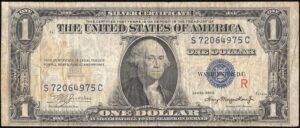
A Misprint That Tells You Exactly Where It Went Wrong
Most error note collectors focus on the dramatic: the dramatic butterfly fold, the dramatic miscut, the dramatically mismatched serial numbers. But there is a category of error that rewards careful, close reading of the serial number itself. When a Federal Reserve Note displays what numismatists call a repeated district letter error, the Federal Reserve Bank prefix letter that should appear only once at the head of the serial number instead appears twice, occupying both the prefix and the first numeral position of the serial block. The result is something like “FF 00000001 A” where only a single “F” prefix belongs. These are not ink smears or misaligned overprints. They are mechanical errors rooted in the Bureau of Engraving and Printing’s (BEP) serial numbering process, and they are genuinely scarce.
Understanding the Serial Number Architecture of Federal Reserve Notes
To appreciate why a repeated district letter error is meaningful, you first need to understand how the BEP constructs a Federal Reserve Note serial number. Every serial number on a modern Federal Reserve Note follows a precise format: one letter prefix identifying the Federal Reserve Bank district, eight digits, and one letter suffix identifying the series run. Since 1996, this format has been applied through high-speed Super COPE (Computer Operated Plate Equipment) presses and, later, LEPE (Large Examining and Processing Equipment) lines at the BEP facilities in Washington, D.C. and Fort Worth, Texas.
The twelve Federal Reserve Bank district letters are as follows: A (Boston), B (New York), C (Philadelphia), D (Cleveland), E (Richmond), F (Atlanta), G (Chicago), H (St. Louis), I (Minneapolis), J (Kansas City), K (Dallas), and L (San Francisco). These letters are applied during the third printing pass, which lays down the green Treasury seal, the green serial numbers, and the Federal Reserve seal simultaneously on pre-printed face stock. When the numbering wheel or the digital equivalent in a COPE-BEP line misfeeds or a plate is improperly set, the district letter can be duplicated in the first digit position of the eight-numeral field.
How the Error Physically Occurs
The mechanical explanation for a repeated district letter error changed between older intaglio-era production and modern high-speed printing. On pre-1990s notes produced with older currency presses, the serial number was applied by individual numbering boxes, each containing a rotating drum of alphanumeric characters. If a drum stuck, advanced incorrectly, or was loaded with an incorrect character slug in the first numeral position, the result could be a letter appearing where a zero or another digit was expected.
On modern COPE presses introduced in the late 1980s, the numbering mechanism is more precisely controlled by computer, which actually makes mechanical slippage rarer and therefore makes surviving examples more collectible. When errors do occur on COPE-era notes, they tend to occur in short runs before quality control catches them, meaning the surviving population is often quite small. BEP quality control at the examination stage is designed to catch mismatched and abnormal serials, but because the repeated letter error can look superficially like a valid serial at a glance, some pieces do escape. Estimates from Frederick Bart’s research suggest that for any given district and series combination exhibiting this error, surviving examples in collector hands number in the low dozens at most.
When examining a suspected repeated district letter error, use a loupe at 5x to 10x magnification. The repeated letter in the numeral field is printed with the same type face and ink density as the prefix letter. If the character looks lighter, thinner, or offset from the numeral baseline, you may be looking at an ink smear or a different type of error entirely. Consistency of impression is the hallmark of a genuine doubled-prefix error.
Which Districts and Series Produce the Most Notable Examples
Not every district is equally represented among confirmed examples, partly because of production volume differences and partly because of how BEP lot assignments work. New York (B prefix) and Chicago (G prefix) notes are printed in the highest volumes, so statistically more errors enter circulation from those districts. However, the most numismatically coveted repeated district letter errors tend to come from lower-volume districts such as Minneapolis (I prefix) and Kansas City (J prefix), where the smaller print runs mean fewer total notes and therefore a smaller survival pool for any given error type.
Among confirmed series, the Series 1985 $1 Federal Reserve Notes are notable because they were produced during a transitional period when the BEP was updating its numbering equipment. Several F (Atlanta) and G (Chicago) district examples with repeated prefix letters from this series have appeared at major auction houses, including Heritage Auctions and Stack’s Bowers, with hammer prices ranging from $400 to $900 in grades of Very Fine 25 to Extremely Fine 40.
The Series 1988A $1 notes produced an interesting cluster of repeated prefix errors, predominantly from the B (New York) district. These notes are sometimes found with the serial reading “BB” followed by six digits and the suffix letter. A PMG-graded Gem Uncirculated 65 example from this series sold at a 2019 Heritage Currency Auction for $1,320, a figure that reflects both the eye appeal and the scarcity of uncirculated error survivors.
On higher denominations, repeated district letter errors are dramatically scarcer simply because the BEP applies more stringent examination to $10, $20, $50, and $100 notes before they are packaged and shipped to Federal Reserve Banks. The few documented examples on $20 notes from the Series 1993 and Series 1995 printings command values that can exceed $2,500 in uncirculated grades, according to retail price data from PCGS Currency and PMG-tracked auction results.
For Series 1985 through Series 1999 Federal Reserve Notes, always cross-reference the district letter with the Federal Reserve Bank seal on the left face of the note. On a genuine repeated district letter error, the seal letter and the first character of the serial number will match, but the serial will then show the same letter again in the position immediately following, where a digit should begin. If the seal letter does not match the prefix letter at all, you are looking at a mismatched district error, which is a separate and equally collectible category.
Authentication Challenges and Third-Party Grading
The repeated district letter error sits in an awkward position from an authentication standpoint. Unlike a missing overprint or a dramatic fold error that alters the note’s physical structure, this error is purely typographic. That means it is theoretically possible, though practically very difficult, to chemically alter a serial number character. Third-party grading services including PMG (Paper Money Guaranty) and PCGS Currency both authenticate and certify error notes, and their holders carry significant weight in the marketplace.
PMG began specifically noting repeated district letter errors in their holder inserts around 2010, using the designation “Serial Number Error” with a description in the comments field. PCGS Currency uses similar language. For notes graded before this standardization, it is worth reviewing auction archives to confirm error documentation. The Numismatic Guaranty Company’s population report does not separately track repeated district letter errors as a subcategory, which makes estimating true surviving populations challenging for researchers.
Collectors should also be aware that not every currency dealer is familiar with this specific error type. It is not unusual to find repeated district letter errors in general inventory at coin shows priced as ordinary circulated notes, simply because the seller did not notice the anomaly. Patient searching through raw note dealer stock at shows like the Chicago International Coin Fair or the Florida United Numismatists (FUN) convention has rewarded sharp-eyed collectors with significant finds at face value or modest premiums.
The Fort Worth Connection
Beginning with Series 1988A, notes printed at the BEP’s Fort Worth, Texas facility carry a small “FW” plate position identifier on the face of the note. This identifier appears in the lower right quadrant of the note face, to the right of the back plate number. Repeated district letter errors originating from the Fort Worth facility are distinguishable from their Washington, D.C. counterparts by this mark, and some collectors specifically pursue FW-marked error notes as a sub-specialty. The Fort Worth facility has produced documented repeated prefix errors primarily on $1 and $5 denominations across the Series 1993, 1995, 1999, and 2001 printings.
If you are building a district-by-district error note collection, prioritize obtaining third-party-graded examples for your anchor pieces while allowing raw finds from dealer stock to fill secondary slots. The price differential between a PMG or PCGS-certified repeated district letter error and an ungraded example of similar apparent quality can be 40 to 60 percent, so raw finds represent the best value for experienced collectors who can self-authenticate.
Rarity by District and Series
The table below consolidates available auction data, BEP production records, and numismatic literature to provide the most current rarity assessment for repeated district letter errors across key series and districts. Print run figures represent total notes produced for the series-district combination; confirmed error survivors are estimated from auction records and population data reported by major TPG services through 2024.
| Series / Date | District (FRB) | Approx. Total Print Run | Rarity |
|---|---|---|---|
| 1985 $1 | F – Atlanta | 1.024 billion | Scarce |
| 1985 $1 | G – Chicago | 1.152 billion | Scarce |
| 1988A $1 | B – New York | 2.048 billion | Scarce |
| 1993 $1 | L – San Francisco | 896 million | Rare |
| 1995 $1 | I – Minneapolis | 448 million | Key Date |
| 1995 $5 | D – Cleveland | 384 million | Rare |
| 1993 $20 | B – New York | 512 million | Key Date |
| 1999 $1 | J – Kansas City | 512 million | Rare |
| 1999 $5 | G – Chicago (FW) | 320 million | Rare |
| 2001 $1 | E – Richmond | 768 million | Common (Relative) |
Building a Collection Around This Error Type
For collectors who want to specialize in repeated district letter errors, there are several productive strategies. The most systematic approach is to focus on a single denomination, such as the $1 Federal Reserve Note, and attempt to assemble one example from each of the twelve districts across multiple series. This “type set” approach is achievable, though completing it may take five to ten years of active searching given the scarcity of some district-series combinations.
A faster path to a meaningful collection is to focus on a single series year, such as Series 1988A or Series 1995, and document every district example you can locate. This approach benefits from clear parameters and allows for deeper research into BEP production records for that specific series. The BEP’s production figures, published annually in the U.S. Currency Education Program’s reports and historically compiled by researchers like Gene Hessler and Don Kelly, provide the baseline data for understanding which district-series combinations had lower print runs and are therefore more likely to yield scarce errors.
Pricing for entry-level examples remains accessible. A circulated repeated district letter error on a $1 note in Very Fine condition from a higher-volume district and common series can be acquired for $150 to $300 from a knowledgeable dealer or at auction. Uncirculated examples, particularly those with bold, well-centered serial numbers, escalate sharply in value and represent genuine long-term numismatic investments based on historical auction appreciation data from the past fifteen years.
Conclusion: An Error Worth Seeking Out
Repeated district letter errors on Federal Reserve Notes occupy a fascinating niche in U.S. paper money collecting. They are specific enough to require real knowledge to identify, scarce enough to remain genuinely challenging to acquire, and visually distinctive enough to make compelling display pieces. Whether you are a new collector who stumbled across an odd-looking serial number in circulation or a seasoned numismatist looking to add a focused error specialty to an already deep collection, these notes reward the effort invested in finding them.
The intersection of BEP production history, district geography, and mechanical error mechanics gives this error type a richness that purely cosmetic errors sometimes lack. Every confirmed example is a small documentary artifact of a specific moment in American currency manufacturing, a moment when a numbering mechanism quietly misfired and sent something unusual into the world. For collectors, that is exactly the kind of story that makes paper money worth studying.