November 16, 1907: The Day a Territory Became a Currency Goldmine
At 10:16 in the morning on November 16, 1907, President Theodore Roosevelt signed the Oklahoma Enabling Act proclamation in Washington, merging Oklahoma Territory and Indian Territory into the forty-sixth state of the Union. Within days, bankers across the new state were filing paperwork with the Office of the Comptroller of the Currency, eager to convert existing territorial charters or apply for brand-new ones under the prestigious “National Bank” designation. What followed was a seven-year sprint of chartering activity that produced thousands of large-size National Bank Notes from towns ranging from bustling Tulsa and Oklahoma City to tiny agricultural communities that no longer exist on modern maps. For currency collectors, this episode represents one of the most rewarding regional specialties in all of American paper money.
The Territorial Prelude: Notes Before Statehood
To fully appreciate the statehood surge, collectors must understand the currency landscape that preceded it. Oklahoma Territory, established in 1890 after the famous Land Run of 1889, already hosted a modest number of nationally chartered banks by the early 1900s. Guthrie, which served as the territorial capital, was home to several institutions including the First National Bank of Guthrie (Charter 4670), chartered in 1892. These territorial-era banks issued Series 1882 Brown Back notes and, after 1902, the early Series 1902 Red Seal notes, all bearing the imprint of “Oklahoma Territory” rather than simply “Oklahoma.” This geographic designation makes pre-statehood Oklahoma Territory nationals a distinct and highly coveted subset. A Series 1882 Brown Back from any Oklahoma Territory town commands serious collector attention, with mid-grade examples often starting above $2,000 and known rarities fetching multiples of that at major auction.
When examining an Oklahoma national note, look carefully at the geographic imprint on the face. Notes reading “Oklahoma Territory” were issued before November 16, 1907, and carry a substantial premium over post-statehood notes from the same bank. The territorial designation appears in the city and state line just below the bank name, and even a well-worn territorial note outranks a fine-grade statehood issue in many collectors’ eyes.
The Charter Wave: 1907 Through 1914
The numbers tell the story clearly. In the years immediately preceding statehood, Oklahoma Territory hosted roughly 35 to 40 nationally chartered banks. By the end of 1908, barely thirteen months after statehood, that number had more than tripled. By 1910 it had reached well over 200 active national bank charters in the state, and by the peak year of approximately 1913 to 1914, Oklahoma boasted more than 500 national bank charters, placing it among the top tier of states by sheer volume of banking institutions relative to its age.
The Comptroller of the Currency assigned charter numbers sequentially across the entire country, so Oklahoma’s statehood-era charters fall across a broad range rather than forming a tidy block. Banks chartered in late 1907 and 1908 received numbers generally in the 8,600 to 9,200 range, interleaved with charters from other states. By 1914, charters were reaching into the low 10,000s. This means that building a comprehensive Oklahoma collection requires cross-referencing the Hickman and Oakes catalog meticulously, town by town, rather than simply sweeping a charter number range.
The geographic distribution of these charters is itself historically instructive. The Five Civilized Tribes territories that had made up Indian Territory, the eastern half of the new state, saw intense chartering activity in towns like Muskogee, Tahlequah, McAlester, and Ardmore. The former Oklahoma Territory’s western half produced charters in Enid, Shawnee, Lawton, Chickasha, and dozens of smaller farming communities whose economic fortunes rose and fell with wheat and cotton prices. Many of these small-town banks lasted only a decade or two before consolidating or failing, which means their note issues were small and survivors are correspondingly scarce today.
Series 1902: The Workhorse of the Oklahoma Charter Wave
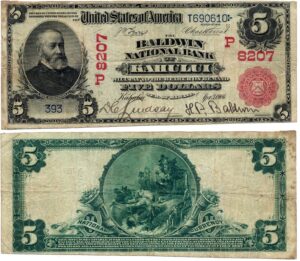
The vast majority of notes produced by Oklahoma’s statehood-era banks were Series 1902 National Bank Notes, and the series breaks into three distinct plate varieties that collectors track carefully. The Series 1902 Red Seal, issued from 1902 until approximately mid-1908, features a red Treasury seal and was produced in relatively small quantities before the date-back plates replaced them. Oklahoma banks that received charters in late 1907 and early 1908 had a narrow window to issue Red Seals, making any Oklahoma 1902 Red Seal a genuine rarity regardless of the issuing city. The First National Bank of Tulsa (Charter 5171, originally chartered 1898) did manage to issue some Red Seals before the plate transition, and these are among the more recognized Oklahoma red seal pieces in the collector market.
Series 1902 Red Seals from Oklahoma banks chartered in 1907 or 1908 are exceptionally rare because the Bureau of Engraving and Printing was transitioning to the Date Back plates at precisely that moment. If you encounter a Red Seal from an Oklahoma bank with a charter number above roughly 8,500, treat it as a potential major discovery and consult the Hickman and Oakes census data before purchasing or selling.
The Series 1902 Date Backs, identifiable by the dates “1902-1908” printed on the back of the note, represent the most commonly seen Oklahoma statehood-era issue but are still scarce on an absolute basis. These were produced from mid-1908 through approximately 1916, covering the heart of the Oklahoma chartering boom. Denominations ranged from $5 through $100, with $5 and $10 notes surviving in greater numbers simply because lower denominations circulated harder and were replaced more frequently. A $5 Series 1902 Date Back from a surviving Oklahoma small town bank in Very Fine condition might trade today in the $300 to $600 range, while a $50 or $100 from the same bank and series could easily reach $1,500 to $3,000 in comparable grade, assuming it is even known to exist.
The Series 1902 Plain Backs, which replaced the Date Backs after 1916 by removing the printed dates from the reverse, overlap with the final years of our focus period and extend into the 1920s. They are generally more available than Date Backs but still carry Oklahoma state premium in the collector market.
Denominations, Signature Combinations, and Key Details
Beyond series and geography, advanced collectors track Treasury signature combinations as a further refinement. Series 1902 notes carry the signatures of the Register of the Treasury and the Treasurer of the United States, and these combinations changed with administrations. For the statehood charter wave period, the most common signature combinations on Oklahoma Date Back notes are Vernon-Treat (1906-1909), Vernon-McClung (1909-1911), Napier-McClung (1909-1912), Napier-Thompson (1912), and Napier-Burke (1912-1914). Notes with the rarer Teehee-Burke combination (1915-1919) appear on later Plain Backs. Certain signature pairings are inherently scarcer than others, and when combined with a small-issuing Oklahoma bank, the multiplication of rarities can make a single note quite valuable despite unassuming condition.
The $5 “Bison” note (catalog designation Friedberg 598 through 612 for the 1902 series across varieties) is the iconic denomination of this era and features the famous portrait of Onepapa the bison on the reverse. For Oklahoma collectors, finding a $5 Date Back from a town with a single known surviving note, what the hobby calls a “one of a kind” or “unique” piece, is the ultimate trophy. The Paper Money of the United States reference by Friedberg, now in its 22nd edition, remains essential alongside Hickman and Oakes for attributing these pieces.
The Society of Paper Money Collectors (SPMC) maintains census data on Oklahoma national bank notes, and the National Bank Note Census online database (nbncensus.com) is an invaluable free resource. Before bidding on any scarce Oklahoma national, check the census to understand how many examples are reported and in what grades. A note listed as “unique” or with only two or three census appearances justifies a price many times that of a more available piece in similar condition.
Ghost Towns on Paper: Small Community Issues
One of the most captivating aspects of collecting Oklahoma statehood-era nationals is the sheer variety of issuing towns, many of which shrank dramatically or disappeared entirely after the agricultural hardships of the 1910s and 1920s. Communities like Stidham in McIntosh County, Indiahoma in Comanche County, or Braggs in Muskogee County chartered national banks during the optimistic post-statehood boom, issued modest quantities of notes, and then closed within a decade. A note from the First National Bank of Stidham (Charter 8913, chartered 1907) represents not just a currency artifact but a tangible piece of a community’s entire economic history. The print runs for these small institutions were often fewer than a few hundred notes per denomination, and survival rates are extremely low given the heavy circulation demands placed on rural currency.
Determining total issue figures for specific Oklahoma banks requires working through the Comptroller of the Currency annual reports and the data compiled by Hickman and Oakes. As a general benchmark, a bank capitalized at $25,000 (the minimum for national bank organization during this period) could issue notes up to 90 percent of its paid-in capital against bonded securities, meaning a minimum-capital bank might issue only $22,500 worth of notes across all denominations and years of operation. Distributed across multiple denominations and accounting for redemptions and reissues, the actual number of survivors from such a bank could be measured in single digits or less.
Series 1882 Notes from the Statehood Window
Although the Series 1902 notes dominate the statehood-era Oklahoma market, collectors should not overlook that Series 1882 notes were still technically issuable through 1922 for banks holding the appropriate bond series. The 1882 series breaks into three back types: the Brown Back (Friedberg 487-518), the Date Back (Friedberg 519-535), and the Value Back (Friedberg 536-548). An Oklahoma bank chartered just before or just after statehood that had secured the right bond type could have issued 1882 Value Backs as late as 1916. These are extraordinarily rare from Oklahoma issuers and would represent a significant find for any specialist collector.
| Series / Type | Issuing Context | Approx. Surviving Notes | Rarity |
|---|---|---|---|
| 1882 Brown Back | Oklahoma Territory charters (pre-1907) | Fewer than 50 known statewide | Key Date |
| 1902 Red Seal | Any Oklahoma bank, 1907-1908 window | Fewer than 30 known statewide | Key Date |
| 1902 Date Back, $5-$10 | Major city banks (OKC, Tulsa, Muskogee) | Several hundred known total | Scarce |
| 1902 Date Back, $5-$10 | Small town banks, single known issuers | 1 to 5 per bank | Key Date |
| 1902 Date Back, $50-$100 | Any Oklahoma bank | Fewer than 10 known per bank typically | Rare |
| 1902 Plain Back, $5-$10 | Major city banks | Moderate survivors | Common |
| 1902 Plain Back, $5-$10 | Rural/ghost town banks | Under 20 known per bank | Scarce |
| 1882 Value Back | Any Oklahoma bank (extremely rare issuers) | Fewer than 5 known | Key Date |
| 1929 Type 1 and Type 2 | Oklahoma banks surviving into small-size era | Relatively available for major towns | Common |
Building an Oklahoma Nationals Collection: Practical Strategies
For the collector just entering this specialty, the most practical starting point is the Series 1902 Plain Back from one of Oklahoma’s larger cities. The First National Bank of Oklahoma City (Charter 4862), the Exchange National Bank of Tulsa (Charter 5580), and the Muskogee National Bank (Charter 5568) all produced enough notes that reasonably priced examples in circulated grades appear at major currency shows and through established dealers several times per year. These anchor pieces give a collector foundation notes from which to branch into scarcer small-town issues.
Mid-level collectors with established Oklahoma interest typically focus on assembling Date Back notes from as many different towns as possible, a pursuit sometimes called “county collecting” because enthusiasts attempt to acquire at least one note from each of Oklahoma’s 77 counties. This is an achievable but lengthy goal: some counties had only one or two national banks, and for a handful of rural counties, no census-reported survivors are known from the statehood decade at all.
Advanced specialists pursue the pre-statehood territorial issues, the Red Seals, and the large-denomination Date Backs, acquiring pieces through major auction houses such as Heritage Auctions, Stack’s Bowers, and Lyn Knight Currency Auctions, where Oklahoma nationals appear regularly in catalog sales. Joining the SPMC and connecting with the specific network of Oklahoma currency specialists is strongly advised at this level, as privately negotiated trades between specialists move many of the finest known pieces before they ever reach public auction.
Conclusion: Why Oklahoma Nationals Reward Patient Collectors
The burst of national bank chartering that followed Oklahoma statehood in November 1907 compressed what older states spread across decades of banking history into a single dramatic decade of growth, optimism, and in many cases, ultimate failure. The notes produced during those years carry extraordinary historical resonance: they funded the homesteads, grain elevators, general stores, and oil field supply companies of a young state finding its identity. Today they survive as tactile links to communities both thriving and vanished, each one bearing the name of a real place and a real institution. Whether you pursue a single fine example from Oklahoma City to represent the era or commit to the long hunt for one note from every county, the statehood decade of Oklahoma national currency offers a lifetime of rewarding collecting that blends history, geography, and genuine numismatic challenge in equal measure.