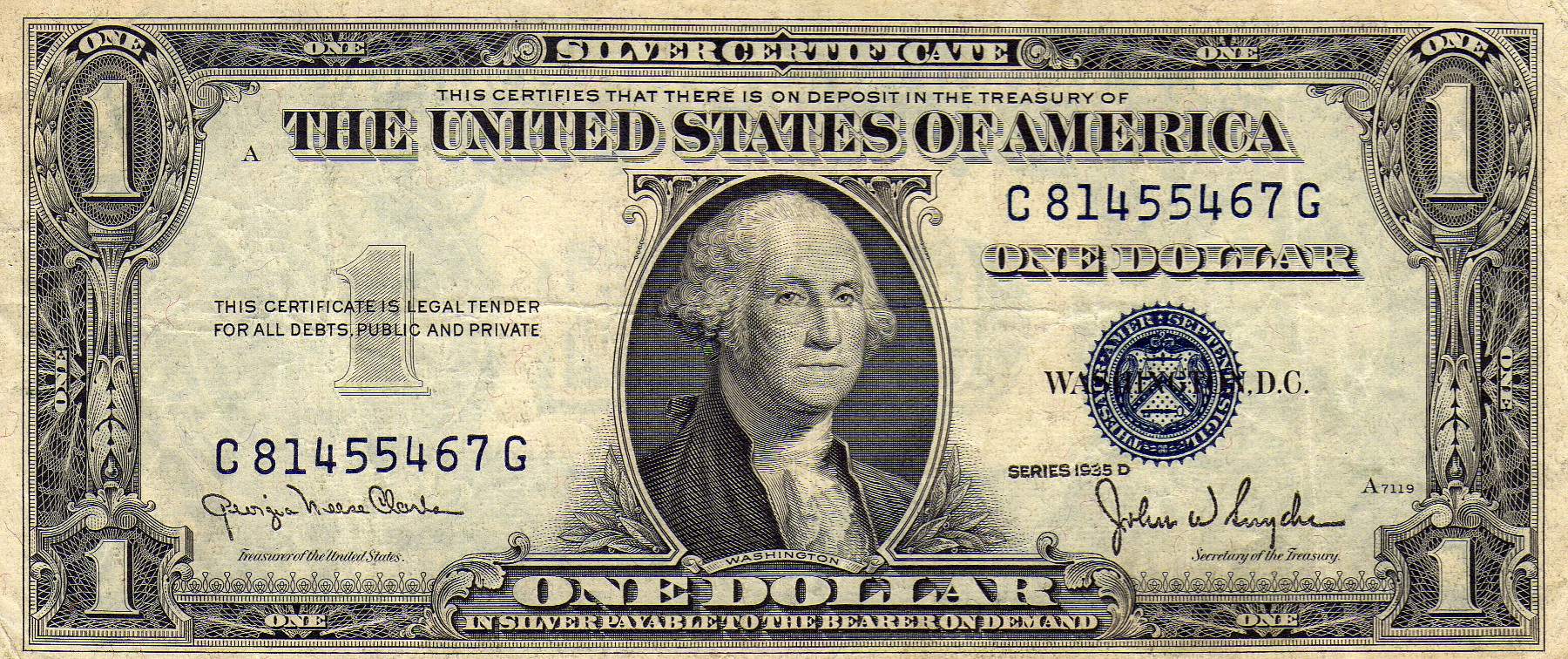
📷 Image source: Wikimedia Commons. Images are selected by AI to represent the article topic and may not depict the exact note(s) described.
Pull a Series 1935C Silver Certificate from an old collection album and you might assume you are holding a straightforward, common small-size note. Look closer, and you could be sitting on a legitimately scarce variety that specialists will pay a meaningful premium to acquire. The Series 1935C $1 Silver Certificate, issued under the signature combination of Treasurer William A. Julian and Secretary John W. Snyder, spans a deceptively wide range of varieties, the most consequential being the Wide and Narrow back design differences. Misattribution of these varieties is rampant in dealer inventories, auction catalogs, and online marketplaces, making accurate identification a genuine skill worth developing.
A Brief History of the 1935 Series Silver Certificates
The $1 Silver Certificate series that began in 1935 replaced the earlier 1928 series notes and introduced the familiar design that would endure, with minor modifications, until Silver Certificates were discontinued in 1963. The portrait of George Washington, engraved by Louis Delnoce after the Gilbert Stuart Athenaeum portrait, anchors the face of the note, while the reverse carries the familiar “ONE” back design executed by the Bureau of Engraving and Printing.
What many collectors do not appreciate is that the reverse plate design was not static throughout the run. Starting with the Series 1935 itself and continuing into the 1935A through 1935G issues, the BEP made incremental modifications to back plate geometry. The most notable of these occurred during the 1935C run, when printers shifted from an older back plate design with wider spacing in the border lettering and ornamentation to a tighter, more compact arrangement. These became known colloquially, and now formally in the Friedberg reference, as the Wide back (F-1607) and Narrow back (F-1608).
Understanding the Wide vs. Narrow Back Distinction
The difference between the Wide and Narrow backs is a matter of millimeters, but it is measurable and consistent once you know where to look. On the Wide back design, the distance between the outer edge of the green “ONE” medallion on the left reverse side and the adjacent border scrollwork measures approximately 2.2 to 2.5 mm. The lettering in “THE UNITED STATES OF AMERICA” on the reverse is also slightly more spread, and the overall geometry of the note’s back plate gives a marginally less compressed appearance to the design elements.
On the Narrow back design, those same gaps compress noticeably, with the corresponding measurement falling closer to 1.5 to 1.8 mm. The border scrollwork pulls tighter against the central vignette elements, and the reverse lettering sits in a closer relationship to the surrounding ornamentation. When the two designs are placed side by side, the difference becomes obvious. In isolation, particularly with an uncirculated example still in a currency holder, a collector who does not know specifically what to look for can easily misread one for the other.
Always examine a 1935C Silver Certificate under good raking light before attributing the back variety. Use a quality loupe at 5x to 7x magnification and measure the gap between the left “ONE” medallion and the nearest border scroll element. A printed reference sheet with side-by-side scans of confirmed Wide and Narrow examples is invaluable at shows and auctions.
Why Misattribution Is So Common
The frequency of misattribution in the marketplace is partly a function of the note’s apparent ordinariness. Because the Series 1935C is one of the most plentiful Silver Certificate issues overall, with hundreds of millions of notes printed across both varieties, dealers and even some grading services have historically given these notes a cursory examination. A note presented as a Wide back may be verified by a seller only to the extent that it is genuinely a 1935C Silver Certificate, with the specific variety assumption carried over from a previous description or lot tag.
Auction misattribution is particularly common in bulk or estate lots. A group of circulated Silver Certificates described as “assorted 1935 series” will frequently intermingle Wide and Narrow backs with no acknowledgment of the distinction, because the consignor, and sometimes the auction house cataloger, did not check. For the alert buyer, these lots represent real opportunity. Locating a confirmed Wide back note, which commands a premium over the Narrow back in equivalent grade, within a lot priced as generic Silver Certificates is a legitimate form of numismatic arbitrage.
When reviewing auction lots of mixed Silver Certificates, request high-resolution scan images of the reverse of every 1935C note included. Reputable auction houses will provide these upon request before the close of bidding. Do not rely solely on catalog descriptions for variety attribution.
Serial Number Ranges and Transitional Notes
Precisely pinpointing where the Wide back plates gave way to Narrow back plates during the 1935C print run is a subject that still generates discussion among specialists. Based on documented examples and census data compiled by collectors such as those active in the Society of Paper Money Collectors, the transition appears to have occurred approximately in the serial number range bracketing the E-A and F-A blocks, though transitional examples with atypical plate combinations are occasionally reported.
It is important to understand that the face plates and back plates were printed in separate press runs and then married during finishing. This means that early face plates could technically be paired with later back plates and vice versa, creating what specialists call transitional printings. These are distinct from miscut or error notes, but they add a layer of complexity that makes strict serial number attribution unreliable as the sole method of variety identification. The back plate number, visible on confirmed examples in the lower right corner area of the reverse, is the most authoritative attribution tool alongside direct measurement.
Grading Considerations for the 1935C Varieties
Both the Wide and Narrow back 1935C notes grade on the standard scale used for all small-size currency. However, the premium for the Wide back variety becomes meaningful primarily in the VF-25 and above range. In heavily circulated grades such as G-4 through F-12, the collector base for variety-specific examples is smaller, and the price differential narrows considerably. In Gem Uncirculated 65 or above, a certified Wide back 1935C can trade at three to five times the value of an equivalent Narrow back, though exact ratios vary with the market.
Paper quality on circulated 1935C notes can complicate grading. Many of these notes spent decades in circulation, and evidence of chemical cleaning, pressing, or artificial brightening is not uncommon. Notes with original paper surfaces, even in moderate circulation grades, are preferable to pressed or cleaned examples at any technical grade level. PMG and PCGS Currency both note cleaning and pressing in their holder comments, and a cleaned note will carry a “details” qualifier that significantly reduces market value regardless of variety.
For the Wide back 1935C specifically, certification by PMG or PCGS Currency is strongly recommended before purchasing at a significant premium. The variety attribution is confirmed during the grading process, and a certified holder eliminates dispute about which variety you are actually acquiring. Uncertified Wide back examples should be priced accordingly to reflect attribution risk.
Star Notes Within the 1935C Series
Star notes from the 1935C run, replacement notes printed with a star suffix to the serial number, exist for both the Wide and Narrow back varieties. The star note population for the Wide back 1935C is substantially smaller, and documented Wide back star notes are considered genuinely scarce in the paper money community. Auction appearances of Wide back star notes in VF or better are infrequent enough that confirmed sales are tracked and referenced by specialists.
Narrow back star notes from the 1935C series are more available, though still considerably scarcer than non-star Narrow back examples. Both varieties of star notes trade at meaningful premiums in all grades above Good, and high-grade gems are legitimately rare. If a 1935C star note is presented without specific variety attribution, assume the seller has not verified the back type and examine it yourself before finalizing any transaction.
| Series / Variety | Type | Approx. Print Run | Rarity |
|---|---|---|---|
| 1935C Wide Back (F-1607) | Regular Issue | Est. 670,000,000+ | Common |
| 1935C Narrow Back (F-1608) | Regular Issue | Est. 1,000,000,000+ | Common |
| 1935C Wide Back Star | Star / Replacement | Est. 2,000,000 or fewer | Scarce |
| 1935C Narrow Back Star | Star / Replacement | Est. 3,200,000 | Scarce |
| 1935C Wide Back (Gem CU-65+) | Condition Rarity | N/A | Rare |
| 1935C Wide Back Star (VF or better) | Star / Condition Rarity | N/A | Rare |
| 1935C Transitional Back Pairing | Variety / Error | Unknown, very limited | Key Date |
| 1935C Wide Back Star (Gem CU-65+) | Star / Condition Rarity | Fewer than 10 confirmed | Key Date |
Practical Identification Steps for Collectors
Developing a reliable process for attributing 1935C Silver Certificates saves time and prevents costly errors. Begin by confirming you have a genuine 1935C: check the series date printed to the right of Washington’s portrait on the face, and verify the Julian-Snyder signature combination, with Julian’s signature on the left as Treasurer and Snyder’s on the right as Secretary of the Treasury. Both signatures appear in black ink printed over the face design.
Next, flip the note to the reverse under good lighting. Using a loupe, examine the gap between the medallion containing the large ornate “ONE” on the left side of the reverse and the nearest decorative scroll border element. Measure or visually compare this gap against a reference image of a confirmed Wide or Narrow example. Then examine the back plate number in the lower right corner of the reverse. Published plate number records, available through SPMC resources and specialized Silver Certificate guides such as those produced by the Whitman Publishing series, list which plate numbers correspond to which back design variant.
Finally, if the note is a star note or is being purchased at a significant premium for variety attribution, third-party certification is the prudent final step. Both PMG and PCGS Currency have extensive reference sets and will attribute the variety in their encapsulation data.
Build a personal reference file with high-resolution photographs of confirmed Wide and Narrow back 1935C examples, sourced from certified auction appearances or dealer inventories where the attribution is guaranteed. Having this reference on your phone during shows and estate sales is one of the most practical tools a Silver Certificate specialist can carry.
Conclusion: Small Differences, Real Consequences
The Series 1935C $1 Silver Certificate illustrates a fundamental truth about collecting small-size currency: design differences that seem trivial to the casual observer carry real numismatic and financial weight for the specialist. The Wide versus Narrow back distinction is not a matter of condition or eye appeal. It is a measurable, documented, catalog-recognized variety difference that affects value in certified grades and represents genuine historical information about how the Bureau of Engraving and Printing evolved its production processes across one of the most prolific print runs in American currency history.
The prevalence of misattribution in this series is, in a sense, good news for the careful collector. It means that correctly identified Wide back examples, and especially Wide back star notes, can still be found at incorrect prices by those willing to look carefully and verify what they are actually holding. That combination of accessible price points and genuine scarcity for confirmed high-grade examples is exactly the kind of dynamic that sustains long-term collector interest. The 1935C Silver Certificate rewards patience, precision, and a willingness to do the work that others skip.