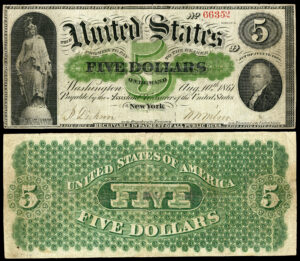
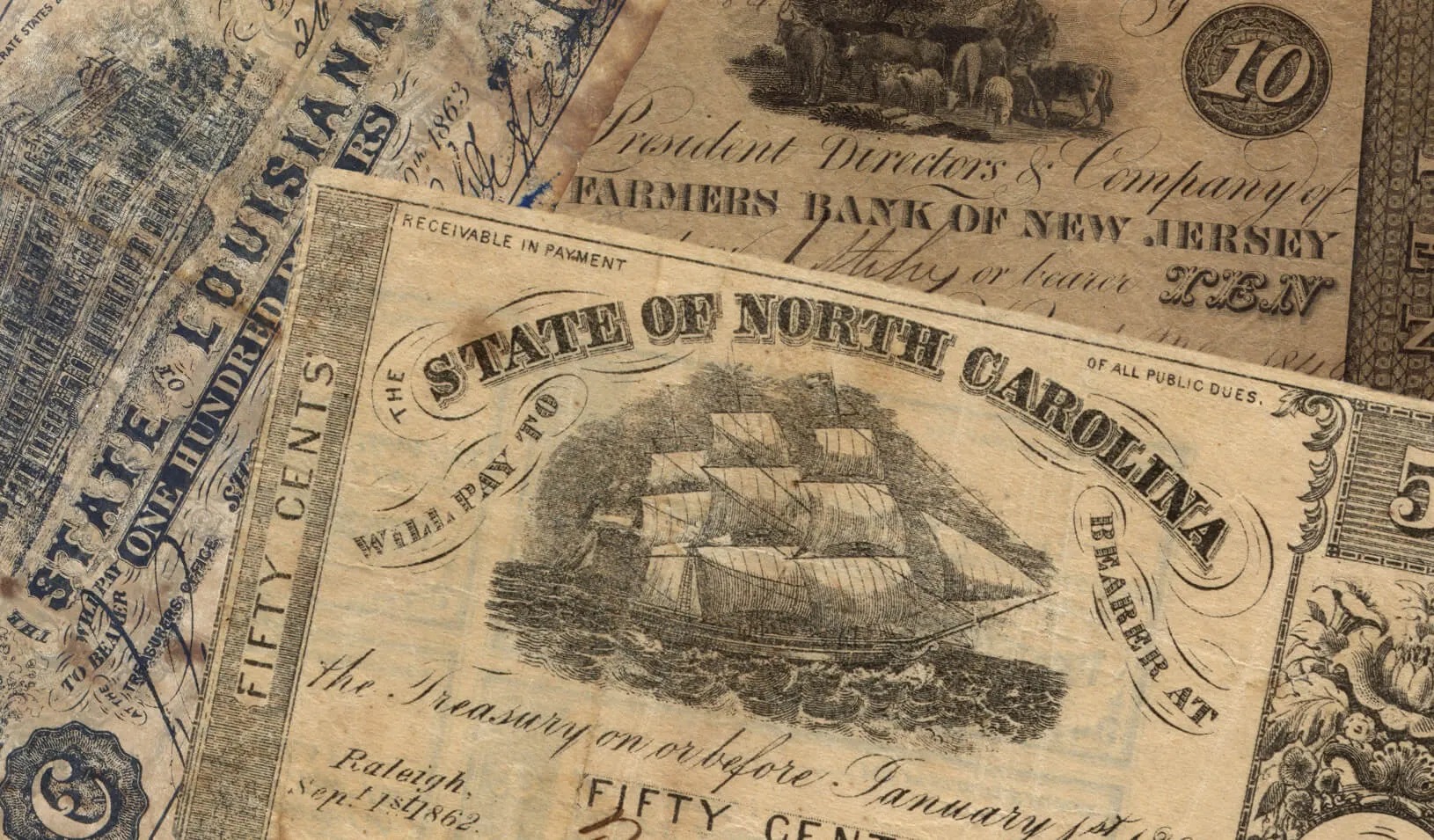
📷 Image source: Wikimedia Commons. Images are selected by AI to represent the article topic and may not depict the exact note(s) described.
Walk into any major obsolete currency auction today and you will find, scattered among the grand Southern plantation notes and ornate Eastern seaboard issues, a quieter but equally compelling category: the state-chartered banknotes of the Upper Midwest. Minnesota Territory did not achieve statehood until 1858, and yet banks were already issuing paper currency there years before. Wisconsin, admitted to the Union in 1848, passed its own Free Banking Act in 1852, unleashing a torrent of colorful, sometimes dubious, and historically priceless paper money onto a rapidly developing frontier economy. For collectors, these notes represent one of the last great undervalued frontiers in American numismatics.
The Free Banking Era: A Brief Framework
The Free Banking Era is generally dated from Michigan’s Free Banking Act of 1837 through the passage of the National Banking Acts of 1863 and 1864, which created a federally supervised system of national banks empowered to issue notes backed by U.S. government bonds. Before those acts, banking was regulated, loosely or strictly, at the state level. Some states required specific legislative charters for each bank, a process susceptible to political favoritism. Free banking laws, by contrast, allowed any individual or group meeting minimum capital and bond-deposit requirements to open a bank and issue notes.
The theory was sound: deposits of state or federal bonds with a state banking authority would back the notes, giving holders a claim on real assets if the bank failed. The practice was messier. Bond markets fluctuated, deposit requirements were sometimes satisfied with depreciated securities, and enforcement was uneven. The result was a currency landscape of staggering complexity, with notes trading at varying discounts from face value depending on the issuing bank’s perceived solvency and geographic distance from the note holder.
Wisconsin: Ambition, Reform, and the Milwaukee Failures
Wisconsin’s original constitution of 1848 actually prohibited banking corporations, a reflection of the Jacksonian anti-bank sentiment then dominant in frontier politics. The legislature worked around this for several years through individual charters before voters approved a constitutional amendment permitting a general banking law. The Wisconsin Free Banking Act of 1852 required banks to deposit Wisconsin state bonds or bonds of other approved states with the state bank comptroller as backing for their note issues.
The problem emerged almost immediately. Many Wisconsin banks backed their notes with bonds of Southern states, particularly Missouri and Virginia, which were available at discount. When those bond values fell, Wisconsin notes followed, and the Panic of 1857 delivered a near-fatal blow to the system. The Milwaukee-area banking community was especially hard hit. Banks like the Bank of Kenosha, the Bank of Racine, and the Farmers and Millers Bank of Milwaukee all issued notes that circulated widely before ultimately failing, leaving note holders with cents on the dollar.
Wisconsin obsolete notes printed by Rawdon Wright Hatch and Edson before 1858 tend to carry sharper, more detailed vignettes than later issues. Look for the printer’s imprint at the bottom of the note, typically reading “RWH&E” or spelled out in full. These early impressions, especially on $1 and $2 denominations from Milwaukee-area banks, are genuinely scarce in grades above Fine-12.
For collectors, this era produced some of the most visually arresting paper money ever made in America. Territorial vignettes of Native Americans, fur traders, and Great Lakes steamships appeared alongside classical allegorical figures. The $3 note of the Bank of La Crosse, for instance, features a detailed paddlewheel steamer on the Mississippi River that is as much a historical document as a piece of currency. The $5 denomination from the Bank of Mineral Point often carries a miner with pick and wheelbarrow, a direct reference to Wisconsin’s lead-mining economy in the southwestern counties.
Minnesota: Currency on the Frontier
Minnesota’s experience was compressed into an even shorter and more turbulent window. The Territory of Minnesota was organized in 1849, and while early commerce relied on notes shipped in from Wisconsin, Illinois, and the East, local banking ambitions arrived quickly. The Minnesota territorial legislature authorized banking in 1853, and by the time Minnesota achieved statehood in May 1858, several banks were already operating and issuing notes.
The Minnesota State Bank, chartered in 1858 under the new state’s first banking law, issued notes in denominations from $1 through $20. These notes are today among the most coveted of all Upper Midwest obsoletes. The state banking law required deposit of Minnesota state bonds, which were themselves thinly traded and sometimes difficult to value. When the Panic of 1857 struck, many Minnesota institutions had not yet fully established themselves, and several closed before issuing notes beyond proof or specimen stage, making even cancelled remainders significant finds.
The Bank of Minnesota, headquartered in St. Paul, and the Exchange Bank of St. Anthony (present-day Minneapolis) both left behind note varieties that appear with some regularity in Midwest estate sales and auction catalogs. More elusive are the notes of the Farmers Bank of Minnesota, which operated briefly in 1858 and 1859 near the town of Red Wing. Fewer than a dozen notes from this institution are believed to have survived in any condition.
When examining Minnesota territorial and early statehood obsolete notes, pay close attention to the engraved date on the note versus any handwritten date added at issuance. Notes dated before May 11, 1858 (statehood) should read “Territory of Minnesota” or carry territorial charter language. A note with post-statehood printing on a territorial charter is a significant red flag for alteration or fantasy reproduction.
Wildcat Banking: Separating Myth from Reality
The term “wildcat bank” has been applied so broadly to Free Banking Era institutions that it has lost much of its precision. Historians and numismatists use it somewhat differently. To the historian, a wildcat bank is one deliberately established in a remote location to make it difficult for note holders to present notes for redemption in specie, exploiting the time-value of distance. To the currency collector, the term is often used loosely to describe any failed or poorly backed institution.
In Wisconsin and Minnesota, true wildcat operations were less common than in Michigan or Indiana, partly because both states had active banking comptrollers by the late 1850s and partly because population density in the Upper Midwest made truly remote bank placement impractical. The more common failure mode was not deliberate fraud but genuine miscalculation: banks backed with Illinois or Missouri bonds that fell sharply in value during the 1857 Panic, leaving note obligations unfunded through bad luck rather than bad faith.
This distinction matters for collectors because it affects survivorship. Deliberately fraudulent banks often issued notes with minimal distribution, printing them primarily to sell to note brokers rather than for everyday commerce. These notes sometimes survive in large remainder quantities. Banks that failed through genuine economic stress often have notes that circulated widely and were subsequently lost or destroyed, making worn survivors more historically authentic and sometimes, paradoxically, scarcer in high grade than rarities from sham institutions.
Vignettes, Printers, and Visual Identification
The visual language of Upper Midwest obsolete notes is regional in a way that makes identification both challenging and rewarding. Three major security printing firms dominated the production of Wisconsin and Minnesota banknotes. The American Bank Note Company (ABNC), formed in 1858 from a merger of several predecessors, produced the majority of notes issued in the final years before National Banking Act consolidation. Rawdon Wright Hatch and Edson, one of the ABNC predecessor firms, handled much of the earlier Wisconsin output. The New England Bank Note Company printed notes for several Minnesota territorial institutions.
Vignettes were sourced from shared stock plates and customized with regional imagery. Common ABNC stock vignettes appearing on Upper Midwest notes include: a “Lumberman Felling Tree” (used on notes from sawmill-economy towns like Eau Claire and Oshkosh), a “Fur Trader with Canoe” (especially popular with St. Paul and Lake Superior area banks), and a generic “Pioneer Family” grouping that appears on dozens of different bank notes across multiple states. Identifying these shared vignettes and their regional customizations is a specialized sub-hobby within obsolete currency collecting.
Genuine Free Banking Era notes from Wisconsin and Minnesota will show letterpress or intaglio printing with ink that has a slightly raised feel even on well-circulated examples. Modern reproductions, which do exist for several popular varieties, tend to show flat offset printing with no tactile relief. Use raking light and a 5x loupe to check fine line engraving in portrait vignettes: genuine examples show crisp, individually distinct lines, while photographic reproductions show a dot pattern under magnification.
Grading Considerations for Obsolete Currency
Obsolete currency is graded on the same Sheldon-derived 70-point scale used for federal issues, but with meaningful practical differences. Paper Conservation Society guidelines and major grading services (PCGS Currency, PMG) both acknowledge that frontier-issued notes frequently exhibit characteristics that would devastate the grade of a federal note but are contextually normal for obsolete issues: vertical fold lines from being carried in a wallet or ledger book, minor edge fraying from handling by merchants and farmers, and pen or pencil notations from bank clerks or note brokers.
A Wisconsin or Minnesota obsolete note grading Fine-12 to Very Fine-20 is, for most issues, a perfectly respectable collectible. Choice Uncirculated (63 and above) examples are genuinely rare for notes that actually circulated, and many “Uncirculated” survivors represent remainders, never-issued sheets, or cancelled proof impressions. Cancelled notes, those with a cut, hole punch, or manuscript “Cancelled” notation, trade at a meaningful discount to uncancelled examples but are perfectly legitimate collectibles with their own documentary interest.
Market Values and Auction Performance
The market for Upper Midwest obsoletes has strengthened considerably since the early 2000s, driven partly by regional collector interest and partly by the broader growth of the obsolete currency category as a whole. Heritage Auctions, Lyn Knight Currency Auctions, and Stack’s Bowers all handle Upper Midwest material regularly. A circulated $1 note from a common Wisconsin bank like the Bank of Wisconsin (Milwaukee) might realize $75 to $200 in grades of Good to Very Fine. The same denomination from a scarce Minnesota issuer in Fine condition can bring $400 to $800 or more, while genuinely rare single-known or two-known varieties have crossed $2,000 at major sales.
The 2019 Heritage Currency Signature Sale included a very fine example of a $5 note from the Farmers Bank of Minnesota, Red Wing, that realized $1,560 against a pre-sale estimate of $600 to $900, a strong indicator of collector demand outpacing conventional wisdom about this category. Wisconsin notes from the 1850s depicting Lake Michigan commercial shipping have similarly outperformed estimates at several recent Chicago-area regional sales.
| Institution / Series | Denomination or Variety | Estimated Survivors | Rarity |
|---|---|---|---|
| Bank of Wisconsin, Milwaukee (1853) | $1, $2, $3, $5 | 50 to 100+ per denomination | Common |
| Bank of Kenosha, Wisconsin (1854 to 1857) | $1 and $3 | 15 to 30 known each | Scarce |
| Bank of Mineral Point, Wisconsin (1856) | $5 Miner Vignette | 20 to 40 known | Scarce |
| Bank of La Crosse, Wisconsin (1857) | $3 Steamship Note | 10 to 20 known | Rare |
| Farmers and Millers Bank, Milwaukee (1853 to 1857) | $10 and $20 | 8 to 15 known each | Rare |
| Minnesota State Bank, St. Paul (1858) | $1 through $5 | 25 to 50 known per denom. | Scarce |
| Exchange Bank of St. Anthony (1858 to 1860) | $1 and $2 | 12 to 25 known each | Scarce |
| Farmers Bank of Minnesota, Red Wing (1858 to 1859) | All denominations | Fewer than 12 total known | Key Date |
| Bank of Minnesota, St. Paul (1858), Proof Impressions | $10 and $20 Proofs | 3 to 5 known | Key Date |
| Bank of Eau Claire, Wisconsin (1861) | $1 Lumberman Vignette | 30 to 60 known | Scarce |
Building a Collection: Practical Starting Points
For collectors new to this category, a logical entry point is a denomination-focused collection of Wisconsin $1 notes from banks that operated in communities still in existence today: Madison, Milwaukee, Green Bay, Racine, Kenosha, and Oshkosh all had Free Banking Era institutions. Assembling a set of $1 notes from these cities provides both historical grounding and a manageable scope, with most examples available in circulated grades for under $200 each from reputable dealers.
A more ambitious approach is a territorial focus on Minnesota, attempting to document every known issuing institution from the 1853 to 1865 period. The Standard Catalog of United States Obsolete Bank Notes by James Haxby (four volumes, published by Krause Publications) remains the essential reference, listing plate letters, serial number ranges where known, and rarity ratings for virtually every documented issue. Haxby numbers (e.g., MN-30 G2 for a specific Bank of Minnesota note) are the standard citation format used in major auction catalogs and dealer inventories.
Joining the Society of Paper Money Collectors (SPMC) provides access to the organization’s research library and its peer-reviewed journal, Paper Money, which has published multiple authoritative studies on Wisconsin and Minnesota obsolete issues. The SPMC’s online member forums are also an excellent place to cross-reference Haxby catalog numbers with auction records and to connect with specialists who have documented previously unknown varieties from estate sources.
Conclusion: Notes Worth Rediscovering
The state-chartered banknotes of Wisconsin and Minnesota represent far more than numismatic curiosities. They are primary source documents for one of the most dynamic periods in American economic and territorial history, a time when the financial architecture of an entire region was being improvised on the fly by frontier entrepreneurs, territorial legislators, and note-issuing bank cashiers who sometimes held their institutions together through sheer force of confidence. That confidence eventually ran out for many of these banks, but the paper they left behind has endured.
For collectors willing to do the research, to learn the Haxby numbers, to read the histories of towns like Mineral Point and Red Wing and La Crosse, and to hold these beautifully engraved notes up to the light and see the crisp intaglio lines that a printer set by hand in the 1850s, the Free Banking Era notes of the Upper Midwest offer a depth of historical engagement that very few other areas of American numismatics can match. The market has been noticing, and the window for acquiring choice material at reasonable prices may not remain open indefinitely.